What Is PRINCE2 AI Project Management?
PRINCE2 AI project management means using PRINCE2 to govern an artificial intelligence project through its Business Case, responsibilities, management stages, risks, quality requirements, tolerances, progress, and expected benefits. AI specialists can use iterative technical methods to develop and test the solution, while PRINCE2 helps decision-makers determine whether the project should continue, change direction, or stop.
The distinction matters because managing an AI project isn’t the same as developing an AI model.
PRINCE2 provides the project management method. It doesn’t prescribe which model to select, how to train it, how prompts should be engineered, or how an AI system should be deployed technically.
Instead, it helps answer questions such as:
- Why is this project worth doing?
- What products must it deliver?
- Who is accountable for decisions?
- What uncertainty needs to be managed?
- How will quality and success be demonstrated?
- When should more investment be authorised?
- What happens when the evidence no longer supports the original plan?
These questions become particularly valuable when the project involves technical experimentation and uncertain outcomes.
Can PRINCE2 Be Used to Manage an AI Project?
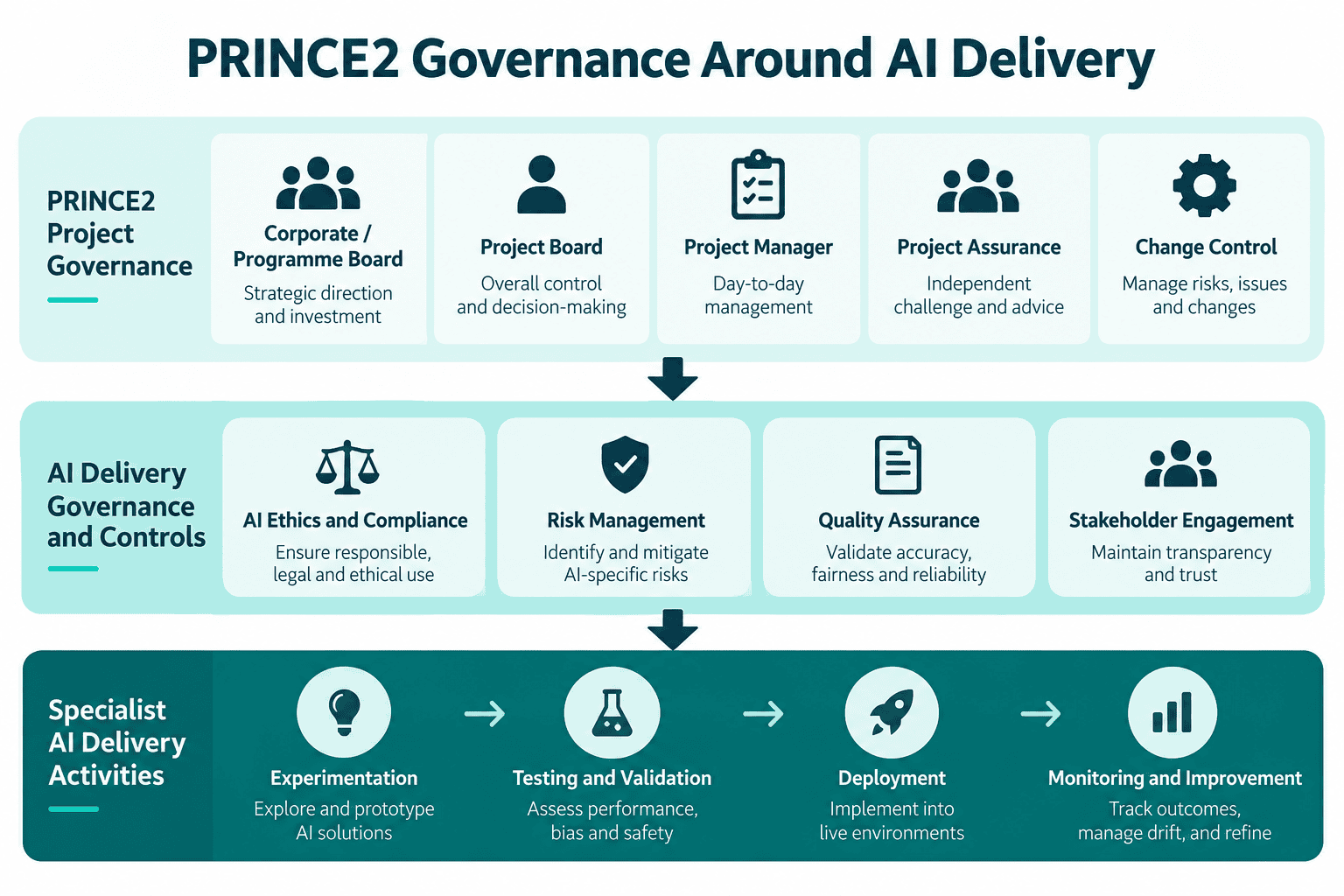
Yes. PRINCE2 can be used to manage an AI project because it separates project governance from specialist product development and can be tailored to different delivery methods.
The current PRINCE2 method recognises linear-sequential, iterative-incremental, and hybrid delivery methods.
That means a project developing an AI customer-service assistant could use PRINCE2 to control investment and decision-making while its technical team tests different models and improves the solution through repeated development cycles.
The Project Manager doesn’t need to approve every experiment. Equally, the technical team shouldn’t have unlimited authority to change project objectives, increase spending, or introduce new risks.
PRINCE2 helps establish the boundaries between those responsibilities.
For more context, read our guide to PRINCE2 Project Management.
What Makes AI Projects Different From Traditional Technology Projects?
Some AI projects involve greater uncertainty about how the final solution will perform than projects using well-understood technology.
For example, a conventional application might need to retrieve a specific customer record and display it according to defined rules.
An AI assistant might need to interpret a customer’s question and generate a useful response. Its performance may vary with the wording of the question, the information available, and the model being used.
Other differences can include:
- Technical feasibility: Experiments may be needed before the team knows whether the proposed solution is achievable.
- Data dependence: The quality, availability, and suitability of data or knowledge sources can affect the result.
- Variable outputs: Some AI systems produce probabilistic or generative responses that require different evaluation approaches from deterministic software.
- Changing performance: Model behaviour and real-world performance may change as inputs, users, or operational conditions change.
- Human impact: Employees or customers may need to change how they work with, interpret, or challenge AI outputs.
- External dependencies: Hosted models and AI services may introduce supplier, pricing, security, or availability risks.
Not every AI project faces all these challenges. A limited classification tool and an AI system supporting high-impact decisions can have very different requirements.
The National Cyber Security Centre (NCSC) recommends addressing AI security across system design, development, deployment, and ongoing operation.
PRINCE2 doesn’t eliminate these uncertainties. It provides a way to expose them, decide what evidence is needed, and manage investment accordingly.
How Does PRINCE2 Project Context Apply to AI Projects?
PRINCE2 should be tailored to the environment in which the AI project operates.
The current manual identifies five common project-context considerations:
- Organisational context: The business structure, policies, capabilities, and relationships.
- Commercial context: Supplier arrangements, contracts, and procurement.
- Delivery method: Linear-sequential, iterative-incremental, or hybrid delivery.
- Sustainability context: Relevant organisational commitments and sustainability performance requirements.
- Scale: The project’s relative complexity, importance, and risk.
For an AI project, the team should also investigate practical factors such as data availability, technical capability, supplier dependencies, applicable regulatory requirements, and the potential effect on users.
These are AI-project considerations within the broader project context, not additional official PRINCE2 context categories.
A small internal AI pilot may need straightforward reporting and a limited number of management stages. A complex AI implementation involving sensitive information, multiple suppliers, or significant organisational change may need more extensive assurance and controls.
The aim is to apply enough governance to support good decisions without introducing unnecessary administration.
Learn more about how to tailor PRINCE2.
How Do You Build a Business Case for an AI Project?
An AI project Business Case should explain the business problem, why the proposed solution is worthwhile, what it will cost, which benefits are expected, and what risks or dis-benefits could affect the investment.
“We want to use AI” is not a sufficient business objective.
Consider a customer-service team that spends too much time finding approved information.
The business problem is the time employees spend searching. AI is one possible solution.
The team might compare three options:
- Do nothing differently and retain the current process.
- Improve the existing knowledge base and search tools.
- Introduce an AI assistant that retrieves and presents approved information.
A credible Business Case should assess those options rather than assuming AI is automatically the best choice.
What Should an AI Business Case Include?
The PRINCE2 Business Case Practice provides the project-level structure. The AI-specific questions help establish the evidence needed to complete it.
| Area | Questions to answer |
|---|---|
| Business problem | What needs to improve, and why? |
| Options | Could a simpler or less expensive solution work? |
| Expected benefits | What measurable improvement should result? |
| Costs | What are the development, integration, supplier, and ongoing operating costs? |
| Feasibility | What technical assumptions still need testing? |
| Data | Is suitable data or source information available? |
| Risks | What could prevent successful delivery or reduce expected value? |
| Dis-benefits | Could the change create new workloads, costs, or negative effects? |
| Sustainability | What relevant performance requirements or impacts should be assessed? |
| Investment decision | Does the evidence justify proceeding? |
For instance, a prototype may demonstrate that an AI assistant can retrieve useful answers. That doesn’t prove it will save money.
The team must still consider licence costs, human verification, system maintenance, user training, and the time needed to correct unsuitable answers.
The Business Case should be updated as evidence becomes available.
A technically successful prototype could still be commercially unattractive. Conversely, a modest prototype might reveal a practical solution with enough value to justify further investment.
For a fuller explanation, see What Is a PRINCE2 Business Case?.
When Should an AI Project Be Stopped or Reconsidered?
An AI project should be reconsidered when new evidence materially weakens its Business Case or indicates that the agreed approach is no longer achievable or acceptable.
This reflects the PRINCE2 principle of ensuring continued business justification.
There are several possible warning signs:
- Required data cannot be obtained or used appropriately.
- The proposed technology cannot satisfy essential requirements.
- Costs increase enough to undermine expected value.
- Significant risks cannot be managed within acceptable limits.
- Operational testing shows that users cannot use the solution effectively.
- A simpler alternative becomes more attractive.
- The expected business benefits are no longer credible.
However, an unsuccessful experiment doesn’t necessarily mean the entire project should stop.
Suppose a prototype fails its first evaluation. The technical team identifies a realistic improvement that can be tested within the authorised budget, timescale, and other tolerances.
Continuing that work might be reasonable.
Now suppose the same evaluation reveals that the required source data doesn’t exist, and obtaining it would cost more than the expected benefit.
That is a different management problem.
The Project Manager should assess the consequences, update the relevant forecasts and Business Case, and escalate when required by the project’s authority arrangements.
Depending on the circumstances, the appropriate decision may be to continue, revise the approach, seek additional authorisation, or close the project prematurely.
PRINCE2 encourages decisions based on continued justification rather than the amount already spent.
How Should an AI Project Be Divided Into Management Stages?
PRINCE2 management stages divide the project into periods of authorised management and investment.
The Project Board reviews the evidence and authorises the next stage when continued investment is justified.
For an AI project, management stages can be aligned with important decisions about feasibility, technical evidence, operational readiness, and further investment.
The following is an illustrative AI project structure, not an official PRINCE2 AI lifecycle.
| Illustrative stage | Main objective | Evidence for the next decision |
|---|---|---|
| Discovery and feasibility | Establish whether the problem and proposed approach are viable | Approved use case, initial options, data assessment, early risks |
| Prototype | Test essential technical assumptions | Prototype, evaluation results, updated cost and risk forecasts |
| Controlled pilot | Assess the solution in a realistic operating environment | User feedback, quality evidence, operational findings, revised Business Case |
| Rollout and transition | Deliver the accepted solution and establish operational ownership | Accepted products, support arrangements, training, monitoring, handover |
The project would also need to be properly initiated in accordance with PRINCE2. The table shows an illustrative sequence of delivery-focused stages, not a replacement for PRINCE2’s initiation requirements.
The project might use fewer or more stages depending on its scale, risks, and investment decisions.
What Should Be Decided at Each AI Project Stage Boundary?
A stage boundary is an opportunity to review what has happened, reassess the remaining work, and decide whether further investment is justified.
For an AI implementation, useful questions include:
After discovery: Is AI appropriate for the problem, and are the main assumptions sufficiently credible?
After prototyping: Has the team obtained enough evidence to justify controlled testing with users?
After the pilot: Does the solution satisfy the required quality expectations, and do the expected benefits remain credible?
Before broader rollout: Are data, integration, security, support, user readiness, and monitoring arrangements appropriate?
The Project Manager prepares the relevant information through the Managing a Stage Boundary process. The Project Board then decides whether to authorise the next stage, subject to its delegated authority.
Importantly, stage approval isn’t simply confirmation that the team completed its planned activities.
It is a decision about whether the project remains justified and whether the proposed next stage is appropriate.
How Does PRINCE2 Handle AI Experimentation?
PRINCE2 can accommodate AI experimentation by allowing specialist teams to investigate technical options within agreed project controls.
For example, an AI team might test several approaches to retrieving customer-support information.
The team could compare different models, revise prompts, improve the knowledge source, or change the technical architecture where those decisions fall within its authorised responsibilities.
The Project Board shouldn’t need to approve every technical test.
However, experimentation must still support the agreed products and project objectives.
It should operate within appropriate boundaries for:
- Time and cost.
- Product scope.
- Quality expectations.
- Risk exposure.
- Dependencies and reporting.
- Relevant sustainability and benefit requirements.
The distinction is between technical flexibility and uncontrolled project change.
PRINCE2’s Manage by Exception principle helps establish when the team can act independently and when a decision must move to a higher management level.
How Can Work Packages Support AI Development?
A Work Package provides an agreed basis for authorising, managing, and reporting the delivery of specified products.
Consider this illustrative Work Package:
Develop and Validate a Customer-Query Classification Prototype
The authorised work could involve:
- Delivering a prototype for a defined classification use case.
- Using an approved evaluation approach.
- Providing documented test results.
- Working within agreed constraints and tolerances.
- Reporting progress and emerging risks.
- Identifying dependencies that could affect completion.
The AI team remains responsible for the specialist technical work.
The Project Manager uses the agreed delivery information to understand whether the required products can be completed and whether the work remains within its authorised boundaries.
A Work Package should not be confused with a technical sprint specification. The project may use both, or suitably tailored equivalent arrangements, depending on its delivery method.
How Does Product-Based Planning Help an AI Project?
Product-Based Planning helps an AI project identify what must be delivered before deciding the work required to deliver it.
This is especially useful when the technical team needs to experiment.
Instead of creating an activity plan that simply says “develop the AI”, the project identifies the products needed to achieve its objectives.
For example, an AI assistant project might need:
- An approved use-case definition.
- A suitable knowledge source or dataset.
- A validated prototype.
- An evaluation report.
- An integrated production solution.
- User guidance.
- Agreed monitoring and support arrangements.
These are illustrative products, not a mandatory PRINCE2 list for AI projects.
The PRINCE2 Plans Practice uses product-focused planning to clarify required outputs, requirements, dependencies, and the work needed to deliver them.
This reduces the likelihood that a technically impressive component is produced without the supporting products needed for business use.
See our guide to Product-Based Planning in PRINCE2.
What Might an AI Product Breakdown Structure Include?
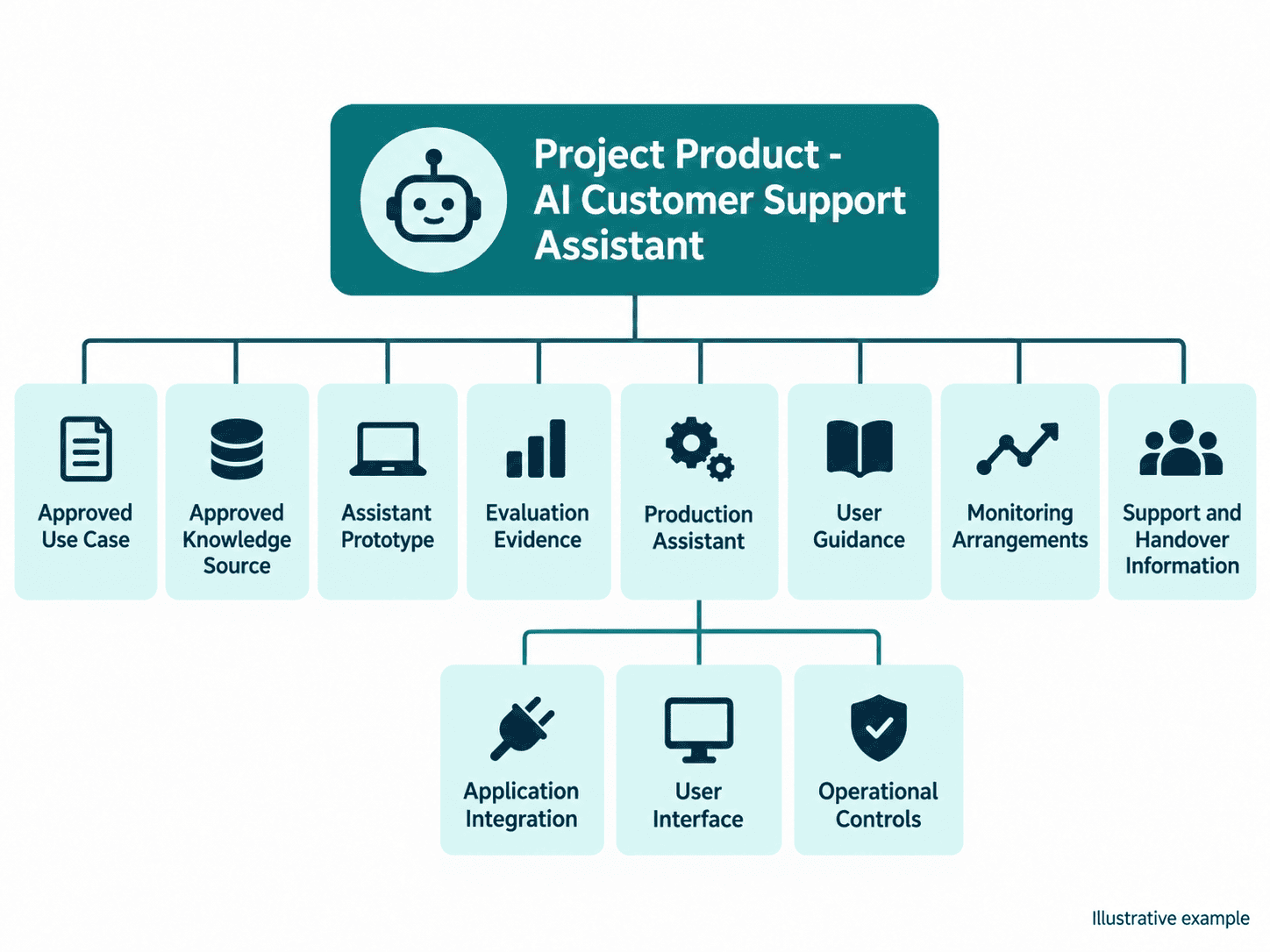
A Product Breakdown Structure shows the hierarchy of products required by the project.
For an AI customer-support assistant, an illustrative structure might include:
Project Product: AI Customer Support Assistant
- Approved use case.
- Approved knowledge source.
- Assistant prototype.
- Evaluation evidence.
- Production assistant.
- Application integration.
- User interface.
- Operational controls.
- User guidance.
- Monitoring arrangements.
- Support and handover information.
The exact structure would depend on the project’s requirements.
A Product Breakdown Structure doesn’t show the order in which work takes place. A Product Flow Diagram can help identify product dependencies and sequencing.
For example, the team may need access to an approved knowledge source before certain evaluation activities can be completed.
How Do You Define Quality for an AI Product?
AI product quality should be defined by what the product needs to achieve in its intended operating environment, not by one technical performance score.
PRINCE2’s Quality Practice helps the project establish product specifications, quality criteria, quality-control methods, and responsibilities.
Specialist AI guidance helps determine the technical evaluation methods and safeguards appropriate to the particular system.
For example, a customer-support assistant might be assessed against:
- The relevance and correctness of retrieved information.
- Its ability to handle questions outside the approved use case.
- Response times under defined conditions.
- The effectiveness of human escalation.
- Security and privacy requirements.
- Accessibility and usability.
- Integration with the support team’s workflow.
- Reliability under realistic operating conditions.
Not every AI system needs every quality dimension.
A predictive maintenance model, a document summarisation tool, and a generative customer assistant may require quite different evaluation approaches.
The aim is to define the criteria that matter for the actual product and its intended use.
Read more about Quality Management in PRINCE2.
What Should AI Acceptance Criteria Look Like?
Good AI acceptance criteria describe how the completed product will be judged acceptable.
In PRINCE2, individual products have quality criteria, while the overall project product has acceptance criteria. For an AI project, a prototype might satisfy its technical quality requirements without the complete solution meeting the agreed acceptance requirements for integration, usability, security, or operational readiness.
Compare these statements:
Too vague: “The AI should be accurate.”
Stronger: “Under the agreed evaluation method, the assistant meets the approved performance threshold for answering questions drawn from the defined support knowledge base.”
The stronger version still requires the project to establish the actual threshold, test method, and acceptance responsibilities.
Another example might be:
“Under the agreed pilot conditions, at least X% of participating users complete the defined information-retrieval task successfully.”
Here, X is a placeholder for a target that must be justified by the project. It isn’t a recommended industry percentage.
A well-designed acceptance approach may also need to consider unacceptable errors, user experience, security, and operational readiness.
An AI product shouldn’t automatically be accepted simply because one model-performance measure has been achieved.
Is This a Good AI Acceptance Criterion?
Test your understanding of AI product acceptance criteria. Decide whether each statement is sufficiently clear and measurable, then see the explanation.
Original ITonlinelearning learning resource. These examples are illustrative, not universal AI acceptance standards.
Are AI Model Metrics the Same as Project Quality Criteria?
No. AI model metrics provide technical evidence about model behaviour. Project quality criteria describe the characteristics a product must satisfy to meet its specified requirements.
For example, a classification model may achieve its agreed technical performance target.
However, the full product might still be unsuitable because it cannot integrate with the existing application, responds too slowly, or fails an essential security requirement.
Similarly, a generative AI assistant might perform well in a technical evaluation while occasionally producing unsuitable responses in realistic user workflows.
Project-level acceptance requires consideration of the agreed requirements for the complete product.
| Model metric | Broader project quality question |
|---|---|
| Classification accuracy | Does the system reliably support the intended workflow? |
| Response relevance | Are answers suitable for the approved business use case? |
| Latency | Is the complete application responsive enough for users? |
| Evaluation success rate | Does the delivered product meet its agreed acceptance requirements? |
| Error rate | Are the remaining errors acceptable within the use case and risk controls? |
These are examples, not a universal AI-quality framework.
The relevant criteria should be agreed before acceptance decisions are made.
How Does PRINCE2 Risk Management Apply to AI Projects?
PRINCE2’s Risk Practice helps identify, assess, plan, implement, and communicate responses to uncertainty that could affect project objectives.
AI projects may involve uncertainty beyond model performance, including the data environment, operational processes, suppliers, security, and expected benefits.
The specific risks depend on the AI system and its intended use.
| Risk | Potential effect | Possible response | Who needs visibility |
|---|---|---|---|
| Required data may be incomplete | Reduced solution usefulness | Assess data readiness before further investment | Project Manager, data owner |
| Model performance may be insufficient | Product fails quality requirements | Conduct bounded feasibility and validation work | Technical lead, Project Manager |
| AI outputs may be unsuitable | Incorrect information reaches users | Test outputs and establish suitable human controls | Senior User, quality specialists |
| Supplier pricing may increase | Business Case becomes less attractive | Assess contractual exposure and alternative options | Project Manager, commercial lead |
| Sensitive information may be exposed | Security or privacy consequences | Conduct specialist assessments and apply appropriate controls | Security/privacy specialists, relevant decision-makers |
| Users may not adopt the solution | Expected benefits are not realised | Involve users in testing and change planning | Senior User, operational owner |
| Performance may degrade after deployment | Reduced operational reliability | Define monitoring and incident arrangements | Operational owner, technical specialists |
PRINCE2 provides the project risk-management structure. It doesn’t supply the specialist cybersecurity or AI-risk responses.
For those, the project should use relevant expertise and authoritative guidance, including the NCSC and NIST.
For the project-level method, read our PRINCE2 Risk Management guide.
What Is the Difference Between an AI Risk and an AI Issue?
A risk concerns uncertainty that could affect project objectives. An issue is a current matter requiring management consideration.
For example:
Risk: The AI model may perform poorly when handling questions from a newly introduced customer segment.
Issue: Validation has demonstrated that performance for that segment is below the agreed requirement.
Another example:
Risk: The external AI provider may increase its prices.
Issue: The provider has announced a price increase that affects the project’s cost forecast.
A risk may become an issue, but not every issue starts as a previously identified risk.
The distinction helps determine whether the team is responding to possible future events or managing an existing problem, change request, or off-specification.
How Should Data Dependencies Be Managed in an AI Project?
Critical data and knowledge-source dependencies should be identified early, assessed for suitability, and incorporated into project planning, quality, and risk management.
An AI project may depend on information that the technical team doesn’t own or control.
For example, a customer-service assistant might require access to an approved knowledge base maintained by another department.
Before relying on it, the project should establish:
- Whether the information exists and is accessible.
- Who is responsible for maintaining it.
- Whether its quality and completeness are adequate.
- Whether the intended use is permitted.
- What privacy and security requirements apply.
- How changes to the information will be managed.
- What happens if the dependency cannot be satisfied.
Where appropriate, data-related deliverables can be identified as project products, while externally supplied information can be managed as a dependency.
The ICO provides guidance on applying data protection requirements to AI systems processing personal data. Its guidance distinguishes legal obligations from recommended good practice.
Not every AI project uses personal data. Where it does, the appropriate data protection and specialist assessments should be determined for the actual processing activity.
How Do You Control AI Project Issues and Scope?
PRINCE2’s Issues Practice provides an approach for assessing and responding to current problems, off-specifications, and requests for change.
An AI project might begin with an approved use case: summarising customer calls for agents.
As the prototype develops, stakeholders may request additional capabilities:
- Automatically replying to customers.
- Predicting whether customers will leave.
- Recommending sales offers.
- Making pricing decisions without human approval.
These proposals shouldn’t automatically be treated as minor enhancements.
They could change the required data, product scope, quality expectations, costs, risks, and Business Case.
The Project Manager should assess their consequences through the agreed issue-management and change-control arrangements.
Not every prompt adjustment or technical bug requires a formal project-level decision. The approach should be proportionate to the significance of the matter and the team’s authority.
Why Should an AI Use Case Be Defined Clearly?
A clearly defined AI use case helps the team establish the boundaries of the product being delivered.
Practical questions include:
- Who will use the system?
- What task will it support?
- What information may it receive?
- What outputs may it produce?
- Which decisions remain with people?
- What uses are explicitly excluded?
- When must the system refer a matter to a human?
- What evidence will demonstrate acceptable performance?
These are practical AI-governance questions, not an official PRINCE2 Product Description template.
They help prevent a narrow, manageable pilot from gradually turning into a more consequential system without appropriate reassessment.
For more information, read our guide to managing PRINCE2 scope creep.
How Do You Manage Third-Party AI Suppliers With PRINCE2?
Third-party AI suppliers should be managed as part of the project’s commercial context, delivery dependencies, and risk arrangements.
A project may rely on a hosted language model, an AI software platform, a data provider, or an external development team.
That creates practical questions about what is being delivered and which responsibilities remain with the organisation implementing the solution.
For example:
- What products or services must the supplier provide?
- Which service and performance commitments apply?
- What information will be shared with the supplier?
- Can the supplier modify the model or service during the project?
- What happens if the API, pricing, or availability changes?
- How will security and operational incidents be handled?
- What options exist if the organisation needs to change provider?
The NCSC recommends assessing and managing AI supply-chain security throughout the system lifecycle.
A supplier may provide the technology, but that doesn’t automatically remove the commissioning organisation’s responsibilities for the project or the resulting system.
Who Is Responsible for an AI Project in PRINCE2?
PRINCE2 establishes project governance roles based on business, user, and supplier interests. AI specialists contribute the technical expertise needed to deliver the products.
The roles should be clearly assigned and tailored to the project.
| PRINCE2 role | Practical AI project responsibility |
|---|---|
| Project Board | Directs the project, makes decisions within its authority, and authorises stages |
| Executive | Accountable for the Business Case and the project’s business success |
| Senior User | Represents user interests and is accountable for benefits realisation |
| Senior Supplier | Represents the supplier interests and capability needed to deliver the products |
| Project Manager | Manages day-to-day delivery within authorised stage tolerances |
| Team Manager | Manages delivery of the products assigned through agreed Work Packages |
| Project Assurance | Provides independent assurance on behalf of the Project Board |
| Project Support | Provides project administration and support where established |
An AI project may also involve data scientists, machine-learning engineers, data engineers, product specialists, information-security professionals, and operational subject-matter experts.
These are specialist delivery or advisory roles, not replacements for PRINCE2 governance roles.
The Senior Supplier doesn’t necessarily represent an external AI vendor. The supplier interest may be represented by internal technical leadership.
Likewise, the Project Manager doesn’t need to be the lead data scientist.
However, they do need enough understanding of the technical evidence to recognise its implications for project quality, cost, risk, progress, and the Business Case.
For more detail, see PRINCE2 Roles and Responsibilities.
Where Does Human Oversight Fit Into an AI Project?
Human oversight is an AI governance and operational-control consideration. It isn’t a separate PRINCE2 role.
Depending on the AI system, suitable oversight may involve reviewing outputs, approving decisions, handling exceptions, monitoring errors, or providing an escalation route when the system cannot respond appropriately.
For a support assistant that helps staff find approved information, human oversight could mean requiring agents to check answers before using them with customers.
For a system affecting people’s rights or making consequential decisions, the required controls may be more extensive.
Human review should also be meaningful. Simply placing a person at the end of an automated process doesn’t necessarily provide effective oversight.
The ICO’s human-review guidance highlights the importance of reviewers having the appropriate understanding, authority, and ability to challenge AI-assisted decisions.
PRINCE2 can help the project establish who is responsible for delivering the agreed oversight arrangements, how their quality will be assessed, and how they will be transferred into operations.
The detailed oversight requirements must be established through the relevant AI, operational, and legal assessments.
How Should AI Project Stakeholders Be Involved and Informed?
AI projects should involve the people who will use, maintain, govern, or be affected by the resulting system.
The technical development team is only one stakeholder group.
Depending on the use case, relevant stakeholders could include:
- Employees and operational users.
- Customers or other affected individuals.
- Business owners.
- Data owners.
- IT and integration specialists.
- Security and privacy specialists.
- Suppliers.
- Operational support teams.
- Governance and risk specialists.
PRINCE2’s People element emphasises leading change, building relationships, and maintaining effective communication.
For example, if employees are concerned that an AI assistant will replace their judgement, describing its intended purpose and limits may help establish realistic expectations.
The project should also obtain feedback rather than simply broadcasting progress updates.
Useful communication topics include the approved use case, system limitations, pilot findings, changes, human escalation arrangements, and operational responsibilities.
Read more about the People element in PRINCE2.
How Do You Measure the Benefits of an AI Project?
AI project benefits should be measured through improvements in business outcomes, not merely through the delivery of AI technology.
PRINCE2 distinguishes between products, the changes they enable, and the benefits expected from those changes.
Consider an AI customer-support assistant.
| Element | Illustrative example |
|---|---|
| Product | AI assistant that retrieves approved support information |
| Capability | Support agents can obtain relevant information through the assistant |
| Outcome | Agents spend less time searching during customer enquiries |
| Benefit | Average information-search time decreases |
| Measurement | Compare baseline and post-implementation search time under agreed conditions |
The model’s technical performance may help determine whether the product is suitable.
However, that performance isn’t itself proof that the organisation has received the expected business benefit.
Suppose an assistant meets all its technical evaluation requirements, but employees rarely use it.
The project may have delivered an acceptable technical product without enabling the anticipated business improvement.
The Benefits Management Approach should establish how benefits will be measured, when reviews will take place, and who is responsible.
The Senior User is accountable for benefits realisation, including arrangements for benefits that become measurable after project closure.
Read more about how benefits management works in PRINCE2.
How Do You Measure Progress and Use Tolerances on an AI Project?
PRINCE2 Progress focuses on whether the approved plans remain achievable and whether the project should continue.
For AI projects, meaningful progress evidence might include:
- An approved and feasible use case.
- Resolution of a critical data dependency.
- A prototype meeting agreed quality criteria.
- Completion of necessary security assessments.
- Successful operational pilot results.
- Accepted integration products.
- Evidence that expected benefits remain achievable.
By contrast, reporting that a team has tested fifteen models doesn’t necessarily demonstrate that the project is closer to delivering an acceptable product.
Why Are Actual and Forecast Performance Important?
Actual performance describes what has happened. Forecast performance estimates what is likely to happen.
For example, an AI team may have completed most of its planned validation activities.
However, the results may indicate that the required product-quality criteria are unlikely to be achieved within the remaining authorised work.
The Project Manager should use that forecast when assessing the stage’s continued achievability.
Waiting until the planned completion date to recognise the problem would weaken project control.
How Can Tolerances Be Applied to AI Projects?
PRINCE2 7 recognises seven performance targets: benefits, cost, time, quality, scope, sustainability, and risk.
Tolerances establish the permitted deviation from a plan’s targets without escalation.
For an AI prototype, the team may be authorised to experiment within agreed time, cost, quality, scope, and risk boundaries, alongside any other relevant performance constraints.
If the forecasts indicate that tolerances will be exceeded, the matter must be escalated through the applicable management level.
The team shouldn’t wait for a tolerance limit to be breached in reality.
This is the practical value of Management by Exception in PRINCE2.
Can AI Development Be Agile Within a PRINCE2 Project?
Yes. AI specialists can use iterative-incremental or Agile delivery methods within a PRINCE2 project when these methods suit the work.
For example, the team might progressively develop and evaluate an AI assistant while the Project Manager maintains stage-level control and the Project Board authorises further investment.
The technical team may work through short experiments, demonstrations, and feedback cycles.
Other activities may follow a more sequential approach, such as obtaining data access, completing required approvals, integrating infrastructure, or preparing operational handover.
This can make a hybrid delivery approach appropriate for some AI projects.
However, hybrid delivery isn’t mandatory, and not every AI project needs Agile development.
The important distinction is that PRINCE2 provides the project management environment while specialist delivery methods determine how the products are developed.
Learn more about how to use PRINCE2 in hybrid projects.
Is the AI Project Finished When the Model Goes Live?
Not necessarily. Model deployment doesn’t automatically mean that the PRINCE2 project has completed its agreed products or that its benefits have been realised.
The project may still need to finish user training, operational handover, support arrangements, monitoring preparations, and acceptance activities.
Once the agreed project work is complete and closure has been authorised, ongoing operation is normally the responsibility of the receiving organisation.
For an AI solution, post-project responsibilities might include:
- Monitoring system performance.
- Responding to incidents and unsuitable outputs.
- Managing supplier or model changes.
- Maintaining security controls.
- Reviewing the suitability of data.
- Updating documentation and user guidance.
- Measuring benefits after handover.
The NCSC’s secure AI guidance specifically addresses operational monitoring, updates, and maintenance after deployment.
How Should an AI Project Be Closed in PRINCE2?
The Closing a Project process should confirm that the project’s conclusion is properly managed.
For an AI project, relevant checks may include:
- Have the agreed products been accepted?
- Are outstanding issues and risks understood?
- Have support and operational responsibilities been assigned?
- Are required monitoring arrangements established?
- Have relevant lessons been recorded?
- Is there a clear approach to remaining benefits reviews?
- Are any post-project actions assigned?
Ongoing monitoring should not be confused with the PRINCE2 Progress Practice.
The former concerns operation of the AI system after handover. The latter concerns the management and control of the temporary project.
PRINCE2 AI Project Example
Consider a fictional organisation introducing an AI customer-support assistant.
The objective is to help support agents find approved information more quickly.
The assistant will not make autonomous high-impact customer decisions. Agents remain responsible for reviewing information before using it.
The following stages and activities are illustrative, not an official PRINCE2 AI lifecycle.
Step 1 – Define the Business Problem
The customer-service team spends too much time searching for approved information.
The Business Case compares possible solutions, including improving the existing knowledge base and introducing an AI assistant.
Expected value is defined through reduced information-search time, rather than simply deploying AI.
Step 2 – Test Feasibility
The team reviews whether approved information is available, suitable, and accessible.
It identifies technical uncertainties, initial costs, relevant risks, and the evidence needed to justify prototype development.
The Project Board uses the project information to decide whether further investment is justified.
Step 3 – Build and Evaluate the Prototype
The technical team develops a prototype within agreed project controls.
The team evaluates its ability to retrieve appropriate information under defined test conditions.
The Project Manager considers the results alongside remaining costs, risks, dependencies, and quality expectations.
Step 4 – Run a Controlled Pilot
A group of support agents tests the assistant in a controlled environment.
The pilot assesses both technical suitability and operational usefulness.
The team investigates unsuitable answers, evaluates human escalation arrangements, and reviews whether the expected benefits remain credible.
Step 5 – Decide Whether to Scale
Suppose the pilot shows that the assistant helps agents find answers faster, but integration costs are higher than expected.
The Project Manager updates the forecasts and Business Case.
The Project Board then considers whether to authorise the next stage based on the evidence, rather than automatically proceeding because the pilot worked.
Step 6 – Transition to Operational Ownership
Once the solution satisfies its agreed acceptance requirements, the project prepares the operational handover.
The receiving team takes responsibility for monitoring, user support, incidents, and future changes.
Benefits reviews continue according to the agreed Benefits Management Approach.
The example demonstrates how PRINCE2 can keep the project focused on value while allowing technical specialists to work experimentally.
Common Mistakes When Managing AI Projects
Several avoidable mistakes can weaken an AI implementation project.
Effective PRINCE2 application means using controls to make decisions, not generating documents simply to demonstrate that the method has been followed.
PRINCE2 AI Project Management Checklist
Use the following questions when initiating or reviewing an AI project.
Business Case
- Is the business problem clearly defined?
- Have simpler alternatives been considered?
- Are expected benefits measurable?
- Does the current evidence still justify investment?
Products and scope
- Is the intended AI use case agreed?
- Are the required products identified?
- Are exclusions and operational boundaries clear?
Data
- Are critical data dependencies understood?
- Are the necessary data and permissions available?
- Are relevant quality, privacy, and security concerns addressed?
Quality
- Have measurable product requirements been established?
- Are appropriate evaluation methods agreed?
- Are technical and operational acceptance considerations covered?
Risk and governance
- Are material uncertainties recorded and managed?
- Are decision-making responsibilities clear?
- Are performance targets and tolerances established?
- Are escalation routes understood?
People
- Have users and affected stakeholders been involved?
- Are appropriate human oversight arrangements defined?
- Is training or organisational change support needed?
Progress and benefits
- Does reporting provide useful evidence about completed products?
- Are forecasts updated when new information emerges?
- Do expected benefits remain credible?
Operations
- Who will own the AI solution after handover?
- How will performance and incidents be managed?
- Who is responsible for future benefits measurement?
Frequently Asked Questions About PRINCE2 AI Project Management
Can PRINCE2 Be Used for AI Projects?
Yes. PRINCE2 can govern AI projects through defined responsibilities, a maintained Business Case, management stages, project controls, and benefits management. The method is not specific to one technology or delivery approach. AI specialists can use appropriate technical methods for development and evaluation while the wider project is managed using PRINCE2.
How Should an AI Project Be Staged?
An AI project should be divided into management stages around meaningful investment and control decisions. An illustrative approach might include discovery, prototyping, pilot validation, and rollout. These aren’t official PRINCE2 AI stages. The Project Board should authorise further work based on current justification, evidence, risk, and the proposed next Stage Plan.
How Do You Manage AI Project Risk?
Use the PRINCE2 Risk Practice to identify and manage uncertainty affecting project objectives. Consider relevant technical, data, supplier, security, people, operational, and benefits risks. Specialist AI guidance should inform the assessment and response. Risks should be revisited as testing and project evidence develop.
How Do You Define AI Project Quality?
Define what the complete AI product must achieve in its intended use, including relevant performance, reliability, usability, security, and operational requirements. Establish appropriate quality criteria and checking methods. Technical model metrics provide supporting evidence but should not automatically replace broader product-quality or acceptance requirements.
How Do You Set AI Acceptance Criteria?
Start with the intended business use and establish criteria that can be evaluated under defined conditions. For example, specify the task, evaluation method, required performance level, and acceptance responsibility. Avoid vague requirements such as “the AI must be accurate”. No universal performance percentage is appropriate for every AI system.
Who Is Responsible for an AI Project?
The PRINCE2 Project Board provides direction, the Executive is accountable for the Business Case, the Senior User represents user interests and benefits, and the Senior Supplier represents delivery capability. The Project Manager controls day-to-day project management within authorised tolerances. Specialist AI teams undertake technical work within their agreed responsibilities.
How Does Human Oversight Fit Into PRINCE2?
Human oversight is a specialist AI governance consideration rather than a standalone PRINCE2 role. Depending on the use case, it may involve output review, escalation, monitoring, or human decision-making. PRINCE2 can help establish how the required oversight arrangements are delivered, assured, accepted, and handed over.
How Do You Manage an AI Supplier?
Identify what the supplier must deliver, relevant performance and service commitments, data and security responsibilities, dependencies, and the consequences of supplier changes. Manage these through the project’s commercial arrangements, plans, risks, and issues. Supplier arrangements should be proportionate to the system and organisational context.
How Do You Measure AI Project Progress?
Assess whether agreed products are being delivered, whether quality requirements can be achieved, and whether the current plans remain viable. Prototype results, resolved dependencies, accepted products, and pilot evidence can be meaningful progress indicators. Counting technical experiments alone does not establish that the project is advancing successfully.
Can AI Development Use Agile Within PRINCE2?
Yes. PRINCE2 can provide project governance while specialist teams use iterative-incremental development. The appropriate delivery method depends on the project’s products, dependencies, risk, and context. Some AI projects may benefit from a hybrid approach that combines iterative experimentation with more sequential approval, integration, and rollout activities.
When Should an AI Project Be Stopped?
An AI project should be reconsidered when technical evidence, costs, risks, or expected benefits undermine its continued business justification. A failed experiment may simply require corrective work within existing authority. However, an unviable Business Case may require the project to be redirected or prematurely closed through the appropriate PRINCE2 decision-making process.
Is an AI Project Finished When the Model Goes Live?
Not automatically. The project may still need to complete acceptance, training, handover, support preparation, and other agreed products. After formal closure, the receiving organisation may continue monitoring the AI system, managing incidents, maintaining the solution, and measuring benefits through business-as-usual arrangements.
What Should You Explore Next?
PRINCE2 won’t eliminate the uncertainty involved in AI development. Its value is helping organisations make better project decisions while that uncertainty is investigated.
By establishing clear objectives, realistic stages, product requirements, delegated authority, and continued justification, teams can experiment without losing sight of the business outcome.
If you’re developing your project-management knowledge, understanding how PRINCE2 applies to newer technologies can help you see how its principles, practices, and processes work beyond traditional project examples.
Want to understand how PRINCE2 can help you manage high-uncertainty projects such as AI implementation?