What Is PRINCE2 Benefits Management?
PRINCE2 benefits management involves defining the improvements a project is expected to achieve, establishing how those improvements will be measured, and arranging responsibility for their realisation. Benefits support the Business Case and help determine whether continued investment is justified. The Benefits Management Approach explains how benefits will be monitored and reviewed, including after project closure.
A project isn’t successful simply because it finishes on time, stays within budget, and delivers everything promised. Those achievements matter, but they don’t necessarily prove the investment was worthwhile.
Imagine a company invests in a new employee self-service portal. The project delivers the system as planned, but employees continue contacting HR for routine tasks.
The product exists. The expected improvement hasn’t happened.
This is the distinction at the heart of PRINCE2 benefits management: delivering a product and realising its intended value are not the same thing.
The Business Case explains why the investment is worthwhile, while the Benefits Management Approach establishes how and when benefits will be measured and reviewed. The Senior User is accountable for realising the benefits, and the Project Executive oversees the Business Case during the project.
What Is a Benefit in PRINCE2?
In PRINCE2, a benefit is a measurable improvement resulting from an outcome that the investing organisation considers advantageous and that contributes to its business objectives.
Put simply, a benefit is a positive improvement the organisation expects to achieve because of the change introduced by a project.
Benefits don’t have to involve money.
For example, a project might aim to:
- Reduce the time employees spend completing administrative tasks.
- Improve the speed of customer enquiries being resolved.
- Reduce errors in an important business process.
- Improve compliance with operational requirements.
- Reduce resource consumption.
These are illustrative examples. To establish them as project benefits, the organisation must define what improvement is expected and how it will be measured.
Saying a project will “improve efficiency” is too vague on its own.
A more useful benefit statement might be:
“Reduce the average time required to process an employee expense claim from five working days to two.”
This describes a measurable improvement that can be compared against the organisation’s existing performance.
Product vs Outcome vs Benefit: What’s the Difference?
The difference between a product, an outcome, and a benefit is one of the most important concepts in PRINCE2.
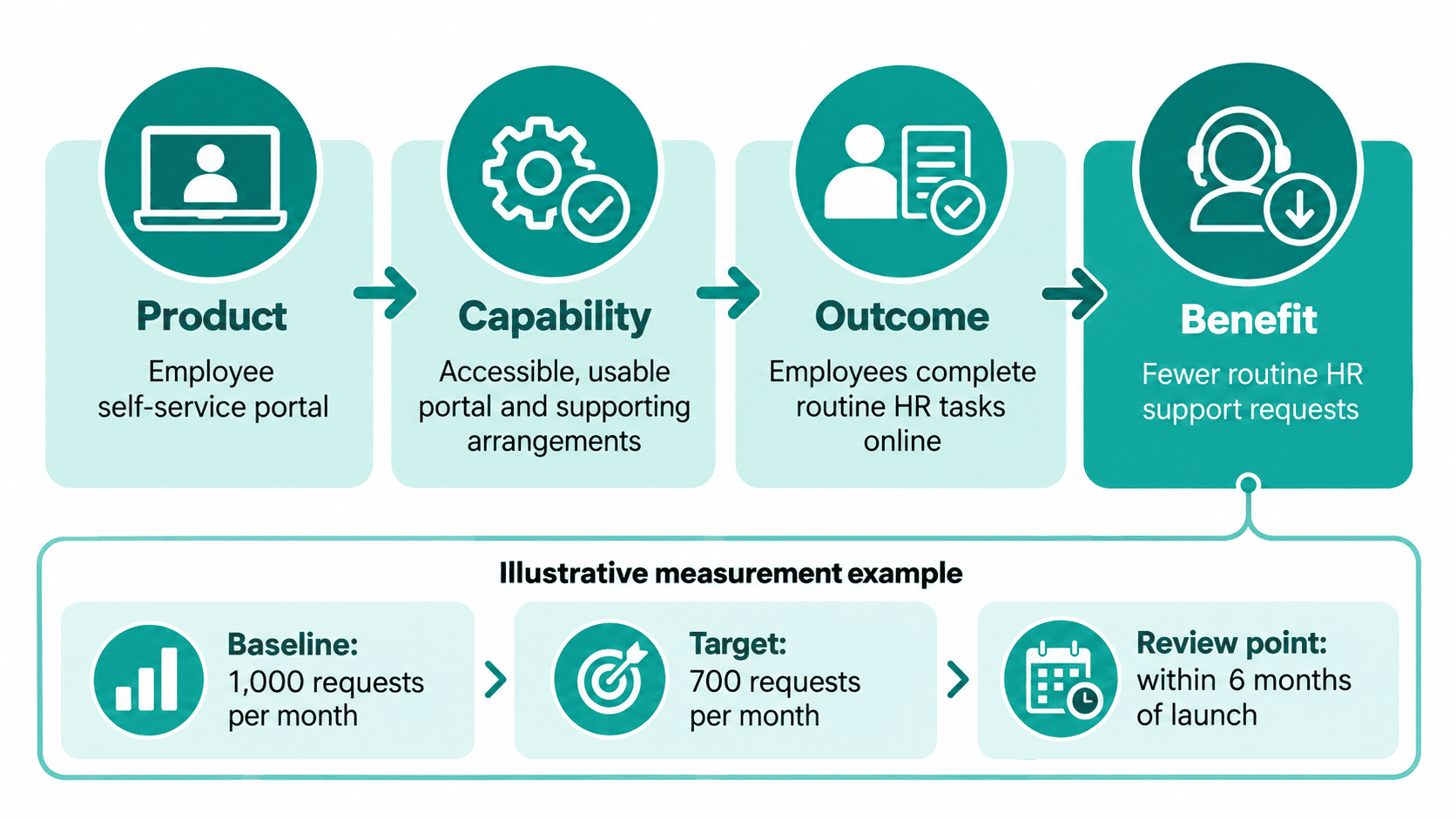
A product is something the project delivers. An outcome is the result of a change, normally affecting behaviour or circumstances. A benefit is the measurable improvement resulting from that outcome.
PRINCE2 also recognises the concept of capability: the completed set of project outputs needed to produce an outcome.
For example, a new HR portal may be delivered, but employees also need appropriate access, supporting processes, and the ability to use it effectively before the intended change can take place.
| Concept | What It Means | Employee Portal Example |
|---|---|---|
| Product | The specialist output delivered by the project | Employee self-service portal |
| Capability | The completed set of outputs needed to enable an outcome | An accessible, usable portal and supporting capability |
| Outcome | The change that results from using the capability | Employees complete routine HR tasks online |
| Benefit | A measurable improvement resulting from the outcome | Fewer routine HR support requests |
The relationship can be understood as:
Product → Capability → Outcome → Benefit
However, this isn’t an automatic sequence.
Employees may need training. Internal processes may need changing. Managers may need to encourage adoption.
If those changes don’t happen, the expected benefit may never materialise.
This is why Product-Based Planning in PRINCE2 and benefits management complement each other.
Product-Based Planning helps define what must be delivered. Benefits management keeps attention on why those products are needed.
What Are Dis-Benefits in PRINCE2?
A dis-benefit is a measurable decline resulting from an outcome that the investing organisation regards as negative and that detracts from its business objectives.
A project can create improvements in one area while producing negative consequences in another.
Consider the employee portal project.
Expected benefit: The organisation handles fewer routine HR support requests.
Possible dis-benefit: Managers spend more time supporting employees with HR administration after responsibilities are transferred to them.
For this to be treated as a measurable dis-benefit, the additional workload would need to be assessed rather than simply assumed.
The important distinction is between a dis-benefit and a risk.
A dis-benefit concerns a negative consequence expected from the change. A risk concerns uncertainty.
For example:
- Dis-benefit: Additional manager administration time expected under the proposed operating model.
- Risk: Employees might not adopt the portal, preventing the expected reduction in HR enquiries.
Both matter because the project’s Business Case needs to reflect the likely positive and negative consequences of the investment.
How Are Benefits Linked to the PRINCE2 Business Case?
Benefits are central to the PRINCE2 Business Case because they help explain why the organisation should invest in the project.
The Business Case considers the expected value of an investment alongside its costs, risks, timescales, and other consequences.
This helps decision-makers determine whether the proposed project is desirable, viable, and achievable.
For example, the employee portal may offer significant administrative improvements. However, if implementation costs increase substantially while expected savings decline, the organisation needs to reconsider the investment.
The project doesn’t remain worthwhile simply because the original benefits sounded attractive.
PRINCE2 addresses this through the principle of Ensure Continued Business Justification.
The Business Case must remain valid throughout the project, not just when the investment is first approved.
Benefits therefore influence decisions about starting, continuing, changing, or stopping a project.
For a detailed explanation, read What Is a PRINCE2 Business Case?.
How Are Benefits Identified and Measured?
PRINCE2 connects expected benefits to the outcomes that a project should achieve and the business objectives those outcomes support.
The Business Case records the expected benefits and dis-benefits in measurable terms, while the Benefits Management Approach explains the arrangements for measuring and reviewing them.
A practical way to develop a benefit is to ask:
- What improvement does the organisation want?
- What outcome must occur for that improvement to become possible?
- Which project products will enable that outcome?
- How is performance measured today?
- What improvement is expected?
- When should it become measurable?
- Who is accountable for achieving and confirming the benefit?
These questions are a practical planning aid, not a separate official PRINCE2 process.
Consider a fictional employee portal project.
The organisation currently receives 1,000 routine HR support requests per month.
Its target is to reduce this number to 700 per month within six months of launching the portal.
The expected improvement can be measured using the organisation’s HR support-ticket records.
The baseline is 1,000 requests. The target is 700. The measurement approach is to compare monthly query volumes against the agreed baseline.
This makes the benefit easier to monitor and provides evidence for future reviews.
However, measurements must be interpreted carefully. A fall in requests might also result from seasonal staffing changes or a reduction in employee numbers.
The organisation should therefore consider whether the improvement genuinely reflects the intended outcome.
Do PRINCE2 Benefits Have to Be Financial?
No. PRINCE2 benefits can be financial or non-financial, provided they are measurable improvements that contribute to business objectives.
A financial benefit might involve reduced operating costs or increased revenue.
A non-financial benefit could involve faster processing, fewer errors, improved service, or better operational capability.
For instance, a public-sector organisation may invest in a new digital service to improve accessibility rather than generate revenue.
The benefit would still need to be measurable, perhaps through improved service completion rates or reduced waiting times.
The important question isn’t simply whether the benefit saves money. It’s whether the improvement contributes to the investing organisation’s objectives and helps justify the investment.
Who Is Responsible for Benefits in PRINCE2?
PRINCE2 assigns different benefits-related responsibilities to the Senior User, Project Executive, Project Manager, and business layer.
These responsibilities should not be treated as interchangeable.
| Role | Key Responsibility |
|---|---|
| Senior User | Specifies desired outcomes and benefits and is accountable for their realisation |
| Project Executive | Is accountable for the Business Case and benefits-review arrangements during the project |
| Project Manager | Develops and maintains the Business Case and Benefits Management Approach under delegated responsibility |
| Business layer | Holds the Senior User accountable for post-project benefits and oversees post-project benefits-management arrangements |
| Project Board | Makes project direction and authorisation decisions using the Business Case and relevant benefit forecasts |
What Is the Senior User’s Role in Benefits?
The Senior User is accountable for defining the desired outcomes and benefits that support the Business Case and for ensuring those benefits are realised.
This is particularly important because benefits often depend on how people use the project’s products.
For the employee portal, the Senior User must be satisfied that the intended operational changes will produce the expected improvements.
The Senior User also confirms benefit achievements, provides evidence during benefits reviews, and supports the continued realisation of benefits after project closure.
The responsibility therefore extends beyond simply approving the system’s features.
What Is the Project Executive’s Role in Benefits?
The Project Executive is accountable for the Business Case throughout the project.
This includes ensuring the project remains a worthwhile investment and that expected benefits align with business objectives.
The Executive also oversees the arrangements for benefits reviews during the project.
The Executive doesn’t personally have to deliver every benefit. Instead, the role focuses on maintaining the justification for the investment and ensuring the appropriate arrangements are in place.
What Is the Project Manager’s Role in Benefits?
The Project Manager develops and maintains the Business Case and Benefits Management Approach under responsibilities delegated by the Executive.
The Project Manager also assesses how progress, issues, and risks affect the continuing viability of the project.
For example, if employee adoption is lower than expected, the Project Manager should consider how this affects the benefits forecast and whether the Business Case needs updating.
However, the Project Manager is not automatically accountable for realising benefits after project closure.
That distinction matters because the temporary project organisation will eventually disband, while the organisation may continue using the product for years.
The business layer remains accountable for post-project benefits-management arrangements and holds the Senior User accountable for realisation.
For more detail, read our guide to PRINCE2 Roles and Responsibilities.
What Is the PRINCE2 Benefits Management Approach?
The Benefits Management Approach is an official PRINCE2 7 management product that defines how the project’s outcomes and benefits will be managed, measured, and reviewed.
It forms part of the Project Initiation Documentation and may remain relevant beyond the life of the project.
Its purpose is to establish the management actions and benefits reviews needed to confirm whether the expected outcomes and benefits have been achieved.
It covers areas such as:
- Which benefits will be managed and measured.
- The arrangements needed to support benefit realisation.
- How and when benefits will be measured.
- The baseline measures used for comparison.
- Guidance relating to benefits tolerances.
- How the project product will be reviewed in operational use.
- Responsibilities, resources, tools, and applicable standards.
- Arrangements for benefits management after closure.
The Project Manager first develops the approach during project initiation, and it is submitted for approval when project authorisation is sought.
The level of detail should suit the project. A relatively simple internal project may need a concise approach, while a complex transformation could require more extensive arrangements.
Benefits Management Approach vs Business Case: What’s the Difference?
The Business Case and Benefits Management Approach work together, but they answer different questions.
Business Case: Why is this investment justified, and does it remain worthwhile?
Benefits Management Approach: What will be done to support benefit realisation, and how, when, and by whom will benefits be measured and reviewed?
The Business Case includes the expected benefits, dis-benefits, and tolerances.
The Benefits Management Approach explains the arrangements for managing and confirming those benefits.
Neither should be treated as a document that is completed once and ignored.
When Are Benefits Reviewed in PRINCE2?
Benefits should be considered throughout the project lifecycle, with formal reviews taking place when appropriate.
At stage boundaries, PRINCE2 reviews whether benefits expected during the project remain on track and updates forecasts for benefits not yet realised. Any benefits already achieved should be confirmed by the Senior User and reported through the appropriate project reports. The Benefits Management Approach defines the relevant benefits-review arrangements, including those that continue after project closure.
A simplified view of the lifecycle is:
- Starting Up a Project: Initial justification and expected improvements are considered.
- Initiating a Project: The Business Case and Benefits Management Approach are developed.
- During delivery: Progress, risks, issues, and benefit forecasts are monitored.
- Stage boundaries: Continued justification and relevant benefits information are reviewed.
- Closing a Project: Achieved and outstanding benefits are considered, together with arrangements for future reviews.
- After closure: The business undertakes the agreed post-project benefits reviews.
Can Benefits Be Realised Before Project Closure?
Yes. Some benefits can be realised during the project, while others only emerge after the project has finished.
For example, an organisation delivering a system in phases might introduce self-service leave requests before the full employee portal is complete.
If that release reduces HR queries, the organisation may begin measuring the benefit while further project work continues.
PRINCE2 expects benefits that can be measured during the project to be confirmed by the Senior User and formally reported.
What Happens to Benefits After Project Closure?
Project closure doesn’t necessarily mean all expected benefits have been achieved.
Some improvements depend on longer-term adoption, operational changes, or performance over several months.
The Benefits Management Approach should therefore establish suitable post-project arrangements.
After closure, responsibility for benefits-review arrangements transfers to the business, with the Senior User accountable for demonstrating benefit realisation.
The business may review actual results against forecasts, consider the performance of the project product in operational use, and identify corrective actions where expected benefits have not been fully realised.
For the HR portal, that could mean checking monthly support-ticket volumes six months after launch.
The temporary project team may no longer exist, but the organisation still needs evidence of whether the investment delivered the expected improvement.
What Happens If Expected Benefits Start to Fall?
If expected benefits decrease significantly, PRINCE2 requires the continuing business justification to be considered.
A project should not carry on simply because money has already been spent or most of its products are complete.
Suppose the employee portal was originally expected to reduce monthly HR queries by 30%, but updated forecasts suggest only a 5% reduction is likely.
That change could materially affect the value of the investment.
The Project Manager should assess the implications and update the relevant information. Depending on the circumstances and delegated authority, the matter may require escalation.
The Project Board may consider corrective action, changes to the project, or whether the investment remains justified.
A reduction in expected benefits does not automatically mean the project must stop.
The decision depends on the revised Business Case and applicable tolerances.
What Is Benefits Tolerance in PRINCE2?
Benefits tolerance is the permitted variation in benefit performance targets before a deviation must be escalated to the next management level.
It is documented in the Business Case, with additional guidance provided through the Benefits Management Approach.
For example, a fictional project might target a 30% reduction in routine HR requests, with an agreed minimum acceptable improvement of 25%.
If the forecast falls below the permitted level, the relevant exception and escalation arrangements apply.
(This numerical example is illustrative. PRINCE2 does not prescribe a universal percentage for benefits tolerance.)
For further explanation, see What Are Tolerances in PRINCE2?.
How Do Benefits Connect to Management by Exception?
PRINCE2 uses tolerances to define the authority delegated between management levels.
As long as forecasts remain within the agreed tolerances, the appropriate manager can continue operating within their authority.
When a relevant tolerance is forecast to be exceeded, the deviation must be escalated to the next management level for a decision.
This includes benefits.
The purpose is to ensure that significant threats to expected value receive attention without requiring senior management to approve every minor adjustment.
Read more in PRINCE2 Management by Exception.
How Do Risks, Issues, Scope, and Quality Affect Benefits?
Benefits are affected by more than financial calculations.
Changes to the project or its environment may alter whether expected outcomes are still achievable.
Risk: Employees may not adopt the portal, threatening the expected reduction in HR enquiries.
Issue: A confirmed system integration problem delays the rollout and could postpone benefit realisation.
Scope change: A proposal to remove important self-service functionality could reduce development costs but also weaken the anticipated benefits.
Quality: A portal that is unreliable or difficult to use may fail to support the intended operational change.
These situations should be considered through the appropriate PRINCE2 practices, with their implications reflected in the Business Case and relevant forecasts.
This is also why a change request should not be judged solely by how much additional work it creates.
A seemingly small change could materially affect the value delivered by the project.
For further reading, explore our articles on PRINCE2 Risk Management, Issue Management, Scope Creep, and Quality Management.
Why Doesn’t Delivering a Product Guarantee Its Benefits?
A completed product creates the possibility of improvement, but the organisation still needs the required outcomes to occur.
For example, an employee portal may be technically complete and meet its acceptance criteria.
However, the expected reduction in HR queries may depend on employees knowing how to use it, understanding which tasks are available, and being willing to change their existing routines.
If those conditions aren’t achieved, the benefit may be delayed or lost.
This connects to the people element of PRINCE2.
People affected by the project need to understand the intended change and have appropriate support to adopt new ways of working.
The project’s Change Management Approach helps define how the organisation will move from its current state towards the desired future state.
Stakeholder engagement and communication also support adoption.
The lesson is straightforward: product acceptance and benefit realisation are different measures of success.
PRINCE2 Benefits Management Example
Consider a fictional organisation introducing an employee self-service portal to reduce the workload associated with routine HR enquiries.
The following example uses invented figures for educational purposes.
| Element | Illustrative Detail |
|---|---|
| Product | Employee self-service HR portal |
| Outcome | Employees complete routine HR tasks online |
| Expected benefit | Reduced routine HR support requests |
| Baseline | 1,000 requests per month |
| Target | 700 requests per month |
| Expected timing | Within six months of launch |
| Measurement | Monthly HR support-ticket reporting |
| Possible dis-benefit | Increased manager administration time |
| Main risk | Low employee adoption |
| Benefit accountability | Senior User |
| Post-project review | Business arrangements defined through the Benefits Management Approach |
Define the Expected Benefit
The organisation wants to reduce the number of routine HR support requests.
This must be linked to the outcome of employees using the new portal to complete tasks independently.
Establish the Baseline and Target
Current reporting shows 1,000 routine requests per month.
The expected target is 700 requests per month within six months of launch.
That represents an intended reduction of 300 requests per month.
Decide How and When to Measure It
The organisation will compare monthly support-ticket data against the baseline.
The Benefits Management Approach should establish the measurement arrangements, timing, and responsibilities.
Assign Responsibility
The Senior User is accountable for realising the expected benefit.
Relevant operational people may need to undertake measurement and adoption activities, with their responsibilities clearly established.
The Project Manager maintains the relevant information during the project under delegated responsibility.
Monitor Assumptions and Forecasts
The expected improvement depends on employees using the portal and the system performing reliably.
If adoption is lower than expected, this could threaten the benefit.
The Project Manager should assess the effect on the forecast and Business Case, with escalation where required.
Review Actual Benefit Realisation
Suppose the organisation records 820 requests per month six months after launch.
This represents an improvement of 180 requests, but it falls short of the target of 700.
The organisation achieved an 18% reduction in routine HR requests against its original target of 30%. Although this represents a measurable improvement, the benefit remains below expectations and may require further investigation and corrective action.
It does mean the actual improvement should be assessed against the expectations used to justify the investment.
Common PRINCE2 Benefits Management Mistakes
Several common mistakes can weaken the connection between delivering a project and achieving its intended value.
- Confusing products with benefits. Launching a new portal is an output, not proof of an improvement.
- Assuming benefits happen automatically. Operational adoption and organisational change may still be required.
- Using vague benefit statements. “Improve efficiency” needs a measurable meaning.
- Failing to establish a baseline. Without a starting measure, improvements become harder to demonstrate.
- Ignoring dis-benefits. Expected negative consequences also affect the investment’s overall value.
- Leaving responsibility unclear. Benefit accountability and post-project arrangements must be established.
- Assuming the Project Manager owns all benefits. The Senior User has explicit accountability for benefit realisation.
- Ignoring changing forecasts. Risks, issues, and changes can affect expected value before benefits are realised.
- Treating closure as the end of measurement. Important benefits may emerge after the project has finished.
- Continuing without reassessing justification. A project must remain worthwhile throughout its lifecycle.
PRINCE2 Benefits Management Checklist
Before finalising benefit arrangements, consider the following questions:
- Is the expected benefit clearly defined?
- Does it contribute to a business objective?
- Is the required outcome understood?
- Are the products enabling that outcome identified?
- Is there a measurable baseline?
- Is the expected improvement clearly stated?
- Are the measurement method and timing agreed?
- Are relevant dis-benefits considered?
- Is the Senior User’s accountability clear?
- Are necessary adoption and change activities identified?
- Are benefits tolerances and escalation arrangements understood?
- Are risks and issues affecting benefits being monitored?
- Are benefits reviews planned?
- Are post-project responsibilities and resources agreed?
- Does the Business Case remain justified?
Frequently Asked Questions
What Is Benefits Management in PRINCE2?
Benefits management in PRINCE2 establishes how expected improvements will be managed, measured, and reviewed. It connects project outcomes to measurable business objectives and supports continued business justification. The Benefits Management Approach defines the activities and responsibilities required to confirm whether benefits are realised during and after the project.
What Is a Benefit in PRINCE2?
A benefit is a measurable improvement resulting from an outcome that the investing organisation considers advantageous and that contributes to business objectives. For example, reducing average invoice-processing time from five working days to two could represent a benefit. Delivering the invoice-processing software itself would be a product, not the benefit.
What Is the Difference Between a Product and a Benefit?
A product is something the project creates or delivers, while a benefit is a measurable improvement resulting from the outcome enabled by the project’s outputs. For example, a new booking system is a product. A measurable reduction in booking-related telephone enquiries could be a benefit if customers adopt the system.
What Is an Outcome in PRINCE2?
An outcome is the result of change, normally affecting real-world behaviour or circumstances. For example, when employees begin completing HR tasks through a new self-service system, that change in how work is performed represents an outcome. The benefit is the measurable improvement that follows.
What Is a Dis-Benefit?
A dis-benefit is a measurable decline resulting from an outcome that the investing organisation perceives as negative and that detracts from its objectives. It should not be confused with a risk. A dis-benefit describes a negative consequence of the change, while a risk concerns uncertainty about what may happen.
Who Is Responsible for Benefits in PRINCE2?
The Senior User is accountable for specifying desired outcomes and benefits and for their realisation. The Project Executive is accountable for the Business Case during the project, while the Project Manager develops and maintains relevant information under delegated responsibility. The business layer oversees the post-project arrangements and holds the Senior User accountable.
What Is the PRINCE2 Benefits Management Approach?
The Benefits Management Approach is a current PRINCE2 management product forming part of the Project Initiation Documentation. It defines the activities, measurement arrangements, reviews, responsibilities, and resources required to ensure project outcomes are achieved and benefits are confirmed, including arrangements for benefits management after project closure.
When Are Benefits Measured?
Benefits are measured according to the arrangements established in the Benefits Management Approach. Some can be measured during project delivery, including at relevant stage reviews. Others may only become measurable after products have entered operational use. The timing should reflect when the intended outcomes and improvements can reasonably be expected.
Can Benefits Be Measured After Project Closure?
Yes. PRINCE2 explicitly allows for post-project benefits reviews because many improvements may not be realised until after delivery has finished. Responsibility for these arrangements transfers to the business, with the Senior User accountable for benefit realisation. Reviews should assess actual achievements against the expected benefits.
What Happens If Expected Benefits Decrease?
If expected benefits fall, the organisation must consider the effect on continued business justification. The Business Case and relevant forecasts may need updating. Where benefit tolerances are forecast to be exceeded, escalation is required. Decision-makers can consider corrective action, changes to the project, or controlled closure if the investment is no longer justified.
Do PRINCE2 Benefits Have to Be Financial?
No. Benefits can include measurable operational, service, or other improvements that contribute to business objectives. Examples include shorter processing times, fewer errors, or improved service accessibility. The important requirement is that the improvement can be measured and supports the investing organisation’s objectives.
What Should You Explore Next?
Understanding benefits management makes it easier to see how PRINCE2 connects project delivery to real business value.
The Business Case explains why an investment is justified. The Benefits Management Approach establishes how expected improvements will be measured and reviewed. The Senior User remains accountable for ensuring those benefits are realised.
To build your understanding of the wider method, explore our guides to PRINCE2 Business Case, Project Progress, Tolerances, and Roles and Responsibilities.
Want to develop your knowledge of PRINCE2 in a more structured way?
Want to understand how PRINCE2 connects project delivery to measurable business value?