How Can PRINCE2 Support Digital Transformation?
PRINCE2 digital transformation project management provides structured governance around business justification, project responsibilities, delivery stages, risks, issues, quality, progress, and benefits. It helps organisations maintain control while technology, processes, and working practices change. PRINCE2 should be tailored to the project and used alongside suitable technical delivery and organisational change approaches.
The important distinction is that PRINCE2 helps govern the transformation project, but delivering the technology isn’t the same as achieving the transformation.
A new platform might be delivered on time and within budget. However, if employees don’t use it, processes remain unchanged, and the expected improvements never happen, the organisation may not realise the benefits that justified its investment.
This is why effective digital transformation project management needs to connect project delivery with business outcomes.

What Is a Digital Transformation Project?
A digital transformation project introduces digital capabilities to change how an organisation operates, delivers services, serves customers, or carries out its work.
The change might involve replacing manual processes, introducing integrated digital services, improving access to information, or redesigning how employees and customers interact with the organisation.
However, not every technology upgrade amounts to digital transformation.
Replacing old laptops with newer models is generally a technology upgrade. Introducing a digital self-service platform that also changes responsibilities, processes, and customer interactions is more likely to be transformation.
The difference lies in what changes for the organisation, not simply which technology is installed.
UK government service-design guidance reinforces the importance of considering the whole service and the needs of its users rather than concentrating only on an individual technical product.
Why Is Digital Transformation More Than a Technology Project?
Digital transformation usually brings several connected areas of work together.
A new customer platform, for example, may require:
- Technology teams to configure and integrate the platform.
- Data specialists to prepare and migrate information.
- Operational teams to redesign existing processes.
- Managers to clarify responsibilities.
- Employees to learn new working practices.
- Suppliers to deliver specialist products or services.
These activities may follow different delivery approaches, but they need to contribute towards a shared business objective.
PRINCE2 helps by providing a common project-management structure around what must be delivered, who is responsible, how progress will be controlled, and how important decisions will be made.
It doesn’t replace the specialist knowledge required to design systems, manage data, or implement wider organisational change.
Why Is the Business Case Critical in Digital Transformation?
Digital transformation projects can become focused on technology rather than the business problem that originally justified the investment.
An organisation might begin by wanting to improve customer service but gradually shift its attention towards purchasing software, adding features, and integrating new systems.
The PRINCE2 Business Case Practice helps keep the underlying justification visible.
Instead of asking only, “What technology should we implement?”, the project needs to ask:
“What business problem are we solving, and what measurable improvement will justify the investment?”
A transformation Business Case should consider the reasons for undertaking the project, available options, expected benefits and dis-benefits, costs, timescales, investment appraisal, sustainability targets, and major risks.
For example, an organisation considering a new employee-service platform might establish the following illustrative objectives.
| Business problem | Desired improvement | Possible measure |
|---|---|---|
| HR receives too many routine enquiries | Employees complete routine tasks independently | Monthly support requests |
| Employees wait for basic information | Faster access to HR services | Average time to complete a request |
| Manual processes create duplicated work | Less administrative effort | Staff hours spent on routine tasks |
| Information is spread across systems | More consistent access to information | Data completeness or error rates |
These measures need baselines, targets, and credible assumptions. A proposed improvement is not automatically a confirmed benefit.
The Business Case also needs to consider possible disadvantages, such as temporary disruption during implementation or increased ongoing licensing costs.
For a more detailed explanation, see What Is a PRINCE2 Business Case?.
How Does PRINCE2 Keep Digital Transformation Focused on Business Value?
PRINCE2 uses the principle of ensuring continued business justification.
This means that the reasons for investing in a project must remain valid throughout its lifecycle.
Digital transformation projects often begin with assumptions about technology, user demand, operating costs, and expected improvements. As delivery progresses, some assumptions may prove incorrect.
For example:
- Integration costs may be higher than anticipated.
- A proposed solution may not meet important user needs.
- Expected operational savings may fall.
- New risks may make an option less attractive.
- A better delivery approach may become available.
These developments should inform reviews of the Business Case and decisions about the project’s future.
PRINCE2 does not suggest continuing simply because money has already been spent.
If a project can no longer be justified, the appropriate response may be to reconsider its approach or bring it to a controlled close.
This is particularly valuable in transformation projects, where continuing to deliver an increasingly unsuitable solution could consume substantial resources without producing the intended value.
Why Does Project Context Matter in Digital Transformation?
The Project Context element helps ensure PRINCE2 is applied appropriately rather than identically to every project.
The seventh-edition manual identifies several important contexts:
- Organisational context.
- Commercial context.
- Delivery method.
- Sustainability context.
- Project scale.
For digital transformation, the project team may also need to consider practical conditions such as legacy systems, existing data quality, supplier dependencies, staff capabilities, regulatory obligations, and organisational readiness.
These are practical transformation considerations, not additional official PRINCE2 context categories.
A digital transformation involving one department will not necessarily need the same governance arrangements as a project affecting several organisations, multiple suppliers, and critical operational services.
The method should reflect the complexity and risks involved.
How Should PRINCE2 Be Tailored for Digital Transformation?
PRINCE2 should be tailored to the project’s environment, importance, delivery method, complexity, team capability, and level of risk.
Tailoring doesn’t mean removing governance. It means establishing the most appropriate way to apply it.
For a digital transformation project, tailoring might involve:
- Management stages: Choosing stage boundaries around important investment or delivery decisions.
- Reporting: Combining concise project-level reporting with suitable specialist delivery information.
- Product descriptions: Using sufficient detail to define required outputs and acceptance expectations.
- Work packages: Agreeing how specialist teams receive, deliver, and report on authorised work.
- Stakeholder engagement: Adapting communication and involvement to the people affected.
- Delivery methods: Accommodating iterative, linear-sequential, or hybrid approaches.
- Project controls: Establishing responsibilities and tolerances appropriate to the risk involved.
For example, a software team may use an Agile backlog and regular demonstrations, while the Project Manager uses that evidence to maintain forecasts and provide governance information.
The Project Manager is responsible for recommending tailoring arrangements, while the Project Board is accountable for approving them.
Tailoring decisions should be documented in the project initiation documentation and remain consistent with the seven PRINCE2 principles.
For practical guidance, read How to Tailor PRINCE2 to Your Project.
How Should a Digital Transformation Project Be Divided Into Management Stages?
PRINCE2 uses management stages to establish defined periods of planning, monitoring, control, and authorisation.
The Project Board authorises one stage at a time. This allows it to reconsider the project’s justification, risks, and plans before committing further resources.
For digital transformation, stage boundaries are particularly useful when the organisation needs to make important decisions about technical feasibility, investment, adoption, or operational readiness.
| Management stage | Main focus | Key decision |
|---|---|---|
| Initiation | Establish the Business Case, controls, and project arrangements | Is there sufficient justification to proceed? |
| Design and validation | Confirm requirements, options, and feasibility | Is the proposed solution viable? |
| Build and integration | Develop products, integrate systems, and prepare data | Are the products ready for pilot testing? |
| Pilot | Test products and working practices with users | Does the evidence support wider rollout? |
| Rollout and transition | Deploy the solution and prepare normal operations | Are the products accepted and handover arrangements satisfactory? |
This is an illustrative structure for a digital transformation project, not an official PRINCE2 lifecycle. Actual management stages should reflect the project’s particular decisions, risks, and circumstances.
What Should Be Reviewed at a Transformation Stage Boundary?
At a stage boundary, the Project Manager provides information that helps the Project Board determine whether and how the project should continue.
Relevant considerations may include the updated Business Case, performance against the current Stage Plan, risks and issues, expected benefits, lessons, and the proposed next Stage Plan.
In a digital transformation project, this review might also consider user feedback, integration results, supplier readiness, and evidence about how well the proposed changes will work in practice.
A pilot that reveals serious adoption difficulties shouldn’t automatically be followed by a full rollout simply because that was the original plan.
The evidence should inform the next investment decision.
Can PRINCE2 Work With Agile or Hybrid Digital Transformation?
Yes. PRINCE2 can govern projects that use iterative-incremental, linear-sequential, or hybrid delivery approaches.
Digital transformation projects often contain workstreams with different characteristics.
For example, software development may benefit from iterative delivery and frequent feedback. Infrastructure replacement or certain migration activities may follow more sequential arrangements.
The PRINCE2 management structure can coordinate these approaches without requiring every team to follow the same delivery technique.
| Workstream | Possible delivery approach |
|---|---|
| Employee portal | Iterative configuration and testing |
| Data migration | Controlled migration stages |
| Infrastructure | Linear-sequential implementation |
| Process redesign | Collaborative, iterative development |
| Employee training | Incremental rollout |
| Supplier integration | Contractual milestones and agreed deliverables |
These are examples rather than prescribed approaches.
A useful distinction is that an Agile sprint is a delivery cycle, while a PRINCE2 management stage is a period of management control.
Several sprints can occur within a single management stage.
The Project Manager still needs sufficient information about products, risks, issues, costs, and forecasts to manage the project within the agreed tolerances.
Related reading: How PRINCE2 Works With Agile Project Management and How to Use PRINCE2 in Hybrid Projects.
How Does Product-Based Planning Help Digital Transformation?
Digital transformation objectives can be broad.
An instruction such as “modernise our HR services” does not explain what the project needs to deliver or how those products will be accepted.
PRINCE2’s product-focused planning approach helps make the required outputs more specific.
An employee-services transformation project might need:
- A configured employee self-service portal.
- Migrated and validated HR data.
- Integrations with existing systems.
- Redesigned HR procedures.
- User guidance and training materials.
- An agreed operational support model.
- Reporting and monitoring capabilities.
These are illustrative project products, not a mandatory PRINCE2 list.
Product-Based Planning helps the team identify and describe the required products, understand dependencies, and develop realistic estimates and plans.
For example, training materials might depend on approved processes and sufficiently stable user interfaces. Data migration testing may depend on an available integration environment.
Identifying these relationships early makes the project easier to plan and control.
Learn more in Product-Based Planning in PRINCE2 Explained.
Why Is Delivering Technology Not the Same as Delivering Transformation?
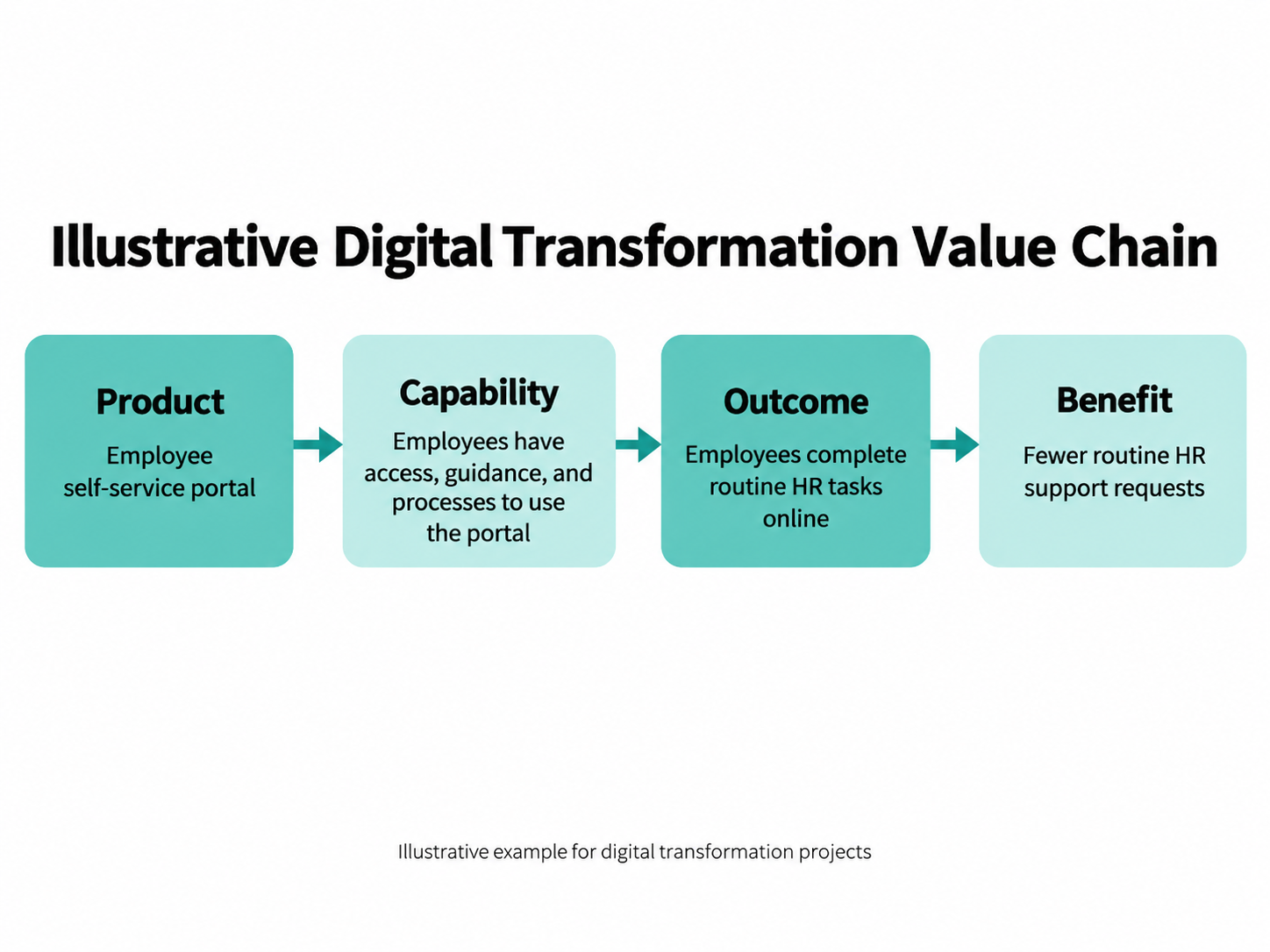
A product is something delivered by the project. An outcome is the change that results from using it. A benefit is a measurable improvement arising from that change.
Consider an employee self-service portal.
| Element | Example |
|---|---|
| Product | An employee self-service portal |
| Capability | Employees have access, guidance, and processes enabling them to use the portal |
| Outcome | Employees complete routine HR tasks online |
| Benefit | Routine HR support requests decrease |
Capability is used here to help explain the transition between delivery and use; it is not being presented as an additional mandatory PRINCE2 product category.
Suppose the organisation currently receives 1,000 routine HR requests per month. Its target might be to reduce this to 700 within six months of adoption.
The project may deliver the portal successfully, but the benefit won’t necessarily follow.
Employees may continue emailing HR because the new system is difficult to use, information is missing, or they don’t understand the changed process.
This is why the Business Case must consider the route from project outputs to actual improvements.
Why Is the PRINCE2 People Element Important in Digital Transformation?
Digital transformation changes how people work.
Employees may need to learn unfamiliar tools, follow redesigned processes, collaborate with different teams, or take on new responsibilities.
Even when the technical solution is suitable, poor engagement and insufficient preparation can undermine the intended change.
PRINCE2 7 addresses people directly as one of its five integrated elements.
The People element covers people working on the project, relationships between them, and people affected by the project.
It also addresses leading successful change, leading successful teams, and communication.
For digital transformation, this means the project needs to consider more than the delivery team.
Operational managers, employees, customers, suppliers, and other affected groups may all influence whether the products are adopted successfully.
For a detailed explanation, see People in PRINCE2.
Does PRINCE2 Manage Organisational Change?
PRINCE2 supports organisational change through project governance, its People element, stakeholder engagement, and appropriate change-management arrangements.
However, PRINCE2 is not intended to replace every specialist organisational change-management approach.
A transformation project may need additional expertise in workforce preparation, learning, communication, organisational design, or adoption.
For example, PRINCE2 can help ensure that the project identifies and manages the need for employee training. Specialist HR or learning professionals may still be responsible for designing and delivering that training.
Another important distinction is between organisational change and the PRINCE2 Issues Practice.
Organisational change concerns how people and operations move towards a different way of working. The Issues Practice addresses current project events, problems, and proposed changes that need management consideration.
They are connected, but they aren’t the same activity.
How Should Stakeholders Be Managed During Digital Transformation?
Stakeholder management should begin by understanding who will be affected and what involvement they need.
In a digital transformation project, stakeholders might include end users, executives, IT specialists, HR, operational managers, data protection teams, cybersecurity specialists, suppliers, customers, and finance teams.
Different stakeholders have different concerns.
A senior leader may want evidence that the transformation remains worthwhile. An employee may want to understand how the new system affects daily work. A technical specialist may need to confirm that proposed integrations are feasible.
Effective engagement should therefore go beyond announcing project decisions.
The project may need to involve stakeholders in defining requirements, reviewing proposed products, testing processes, identifying unintended consequences, and preparing for adoption.
How Does Communication Support Digital Transformation?
PRINCE2’s communication management approach helps establish what information needs to be shared, with whom, how frequently, through which channels, and with what opportunities for feedback.
For example:
| Stakeholder | Communication need | Possible approach |
|---|---|---|
| Project Board | Business justification, exceptions, decisions | Governance reports and reviews |
| Employees | Process changes and practical implications | Demonstrations, guidance, and feedback |
| IT specialists | Dependencies and technical decisions | Workstream meetings |
| Operational managers | Readiness and handover | Transition reviews |
| Suppliers | Deliverables, issues, and responsibilities | Contractual and delivery coordination |
This is an illustrative communication arrangement, not a prescribed PRINCE2 schedule.
Communication should help people understand the proposed change and provide opportunities to influence it appropriately.
Read more in PRINCE2 Stakeholder Management.
How Do You Control Scope in a Digital Transformation Project?
Digital transformation projects can attract additional ideas as stakeholders begin to see what the technology might make possible.
A project may initially aim to replace a customer-service portal.
During delivery, stakeholders might propose adding a new CRM, automated reporting, AI functionality, a mobile application, or a wider customer-data platform.
Some ideas may offer genuine value. Others may introduce costs, risks, dependencies, and delays that undermine the original Business Case.
PRINCE2’s focus on products helps establish what the project has agreed to deliver.
New opportunities should be assessed against the agreed scope and business justification rather than automatically included.
This doesn’t prevent adaptation. It distinguishes authorised refinement from uncontrolled expansion.
How Does PRINCE2 Handle Changing Requirements During Transformation?
PRINCE2’s Issues Practice provides a controlled way to consider current events and proposed changes affecting a project.
However, not every adjustment within an Agile delivery team needs to become a formal project-level escalation.
For example, a team may reprioritise detailed features within its authorised scope and tolerances.
By contrast, a request for an additional system integration could introduce new products, costs, risks, and dependencies.
That request may need formal assessment and authorisation according to the project’s agreed issue and change-control arrangements.
The key question is whether the proposed change remains within delegated authority and the agreed project baseline.
If a forecast indicates that a relevant tolerance will be exceeded, the issue must be escalated appropriately.
The purpose is to support controlled adaptation, not prevent useful changes.
Related reading: How Issue Management Works in PRINCE2.
What Risks Should a Digital Transformation Project Consider?
Digital transformation can introduce uncertainty across technical, organisational, commercial, and operational workstreams.
The PRINCE2 Risk Practice provides a structured approach to identifying, assessing, planning responses to, implementing responses to, and communicating risks.
Potential digital transformation risks include:
- Existing systems may not integrate successfully.
- Migrated information may contain errors.
- A supplier may fail to deliver a critical product.
- Employees may not adopt the new working practices.
- Cybersecurity or privacy weaknesses may be discovered.
- Operational teams may be unprepared for handover.
- Costs may increase beyond the investment assumptions.
- Expected business benefits may not materialise.
A useful risk description identifies the uncertain event, its possible cause, and its effect on project objectives.
For example:
“Because the existing HR system has incomplete employee records, data migration may produce inaccurate portal information, resulting in rework, reduced user confidence, and delayed rollout.”
The project team can then identify suitable responses, responsibilities, and monitoring arrangements.
The Business Case may need updating if the combined risk exposure materially affects the project’s justification.
How Does PRINCE2 Quality Management Apply to Digital Transformation?
Quality management involves establishing and checking whether project products meet their requirements and are fit for purpose.
For a digital service, quality shouldn’t be reduced to whether the software runs without an obvious error.
Relevant project-specific acceptance requirements might cover:
- Functionality and usability.
- Accessibility.
- Data accuracy.
- System integration.
- Performance.
- Security requirements.
- Compatibility with operational processes.
Product Descriptions help make requirements and quality expectations clear.
A new employee portal, for example, might require successful testing of specific HR tasks, accurate migrated records, and agreed access controls before acceptance.
These requirements should be defined appropriately for the particular project and confirmed through suitable quality activities.
The PRINCE2 Quality Practice provides governance around these requirements, while specialist teams carry out the relevant technical testing.
How Should Progress Be Measured in Digital Transformation?
A digital transformation project should measure more than the percentage of software development completed.
Technical development might be progressing well while data migration, training, and operational preparation are significantly behind.
PRINCE2’s Progress Practice supports monitoring actual performance and forecasting future performance against the project’s agreed plans and tolerances.
Useful evidence may include:
- Delivery and acceptance of required products.
- Data migration and integration readiness.
- Results from user testing.
- Completion of relevant training.
- Operational handover preparation.
- Current risks and issues.
- Updated cost and time forecasts.
- Changes to expected benefits.
These measures should be selected according to the project’s objectives and context.
A meaningful progress report should help the Project Manager and Project Board understand where the project stands, where it is heading, and whether intervention is necessary.
Read more in How PRINCE2 Measures Project Progress.
How Do Tolerances and Management by Exception Help Control Transformation?
PRINCE2 uses tolerances to establish how much deviation is permitted from an agreed plan before escalation is required.
The seventh-edition method includes seven performance targets:
- Benefits.
- Cost.
- Time.
- Quality.
- Scope.
- Sustainability.
- Risk.
Management by Exception gives the Project Manager and delivery teams delegated authority within agreed limits.
For example, a software team might be permitted to vary lower-priority functionality while keeping mandatory requirements and agreed delivery constraints intact.
Senior leaders don’t need to approve every detailed technical decision.
However, where a forecast indicates that a relevant tolerance will be exceeded, the matter must be escalated to the next management level for a decision.
Consider a digital transformation stage planned to take eight weeks, with an upper time tolerance of nine weeks.
If a supplier problem in week five causes the revised forecast to increase to ten weeks, the Project Manager should escalate the forecast exception when it becomes apparent.
They shouldn’t wait until the ninth week has passed.
This allows the appropriate decision-makers to consider recovery options, revised plans, or other actions before the situation deteriorates.
For more detail, explore Management by Exception in PRINCE2.
How Should Digital Transformation Benefits Be Managed?
The value of digital transformation often becomes visible only after the organisation begins using the new capability.
For example, an online customer-service system may be delivered successfully, but the reduction in manual transactions might emerge gradually as customers move to the new channel.
The Business Case and benefits management approach help connect project delivery with expected improvements.
A useful benefits measure should identify:
- What improvement is expected.
- The current baseline.
- The target.
- How the improvement will be measured.
- When measurement will take place.
- Who is responsible.
Consider the employee-services example.
| Measure | Illustrative value |
|---|---|
| Baseline | 1,000 routine HR requests per month |
| Target | 700 requests per month |
| Expected change | 30% reduction |
| Measurement point | Six months after rollout |
| Responsible interest | Senior User and designated operational benefit owner |
The Senior User is accountable for benefits realisation, while appropriate arrangements are needed to measure benefits after project closure.
For a more detailed explanation of how expected improvements are defined, measured, and reviewed, explore our PRINCE2 Benefits Management guide.
What Happens If Transformation Benefits Become Unachievable?
If evidence suggests that the expected benefits are no longer realistic, the Business Case should be reconsidered.
Depending on the circumstances and decision-making authority, options may include improving adoption activity, adjusting the delivery approach, revising scope, reconsidering the investment, or bringing the project to a controlled end.
There is no automatic requirement to continue simply because the technology has been purchased or partially implemented.
How Should Data and Cybersecurity Be Managed in Digital Transformation?
Data and cybersecurity may be critical to a digital transformation project’s success.
A new digital platform may depend on accurate information, appropriate access arrangements, integration with existing systems, and suitable protection against security threats.
PRINCE2 helps the project manage these considerations through product requirements, risk management, quality controls, planning, issues, and appropriate responsibilities.
It does not prescribe specialist data architecture or cybersecurity implementation techniques.
For example, the Project Manager may need to ensure that security requirements are defined and that the appropriate specialists participate in relevant quality and acceptance activities.
UK government secure-by-design guidance recommends considering security early and throughout digital delivery rather than treating it as an afterthought.
The project should therefore establish the necessary specialist responsibilities and evidence of readiness before relevant products are accepted.
How Does PRINCE2 Help Manage Digital Transformation Suppliers?
Digital transformation can involve several internal and external suppliers.
These might include software developers, cloud-service providers, infrastructure specialists, consultants, or systems-integration partners.
PRINCE2’s commercial context recognises that projects may involve multiple contractual relationships and different parties with their own responsibilities.
The project needs clarity about the products each supplier will provide, their dependencies, relevant quality expectations, and how delivery will be coordinated.
Work Packages provide a means of agreeing and managing authorised work with delivery teams.
For example, an external implementation partner may be responsible for configuring the portal, while the organisation’s internal IT team provides the integration environment.
Both activities must be coordinated, even if the teams use different working methods.
PRINCE2 helps establish the project-management interfaces and responsibilities; it does not replace specialist procurement, supplier management, or contractual expertise.
Who Is Responsible for a Digital Transformation Project in PRINCE2?
PRINCE2 establishes defined project responsibilities that represent the business, user, and supplier interests.
The Project Board is particularly important because it brings these interests together when directing the project.
Executive
The Executive represents the business interest, is ultimately accountable for the project’s success, and is responsible for ensuring that the project remains justified.
In digital transformation, this includes maintaining a clear connection between project investment and the organisation’s business objectives.
Senior User
The Senior User represents those who will use the project’s products and has accountability for the expected benefits.
This role is especially important when the transformation requires new working practices, user involvement, and continued adoption.
Senior Supplier
The Senior Supplier represents those providing the expertise and resources needed to deliver the products.
Depending on the project, this may include internal technology teams, external implementation partners, or other specialist suppliers.
Project Manager
The Project Manager is responsible for day-to-day project management within the authority delegated by the Project Board.
This involves coordinating plans, products, dependencies, risks, issues, progress, reporting, and stakeholder-related activity.
The Project Manager doesn’t need to personally perform every technical activity.
Instead, they need to establish effective management arrangements and work with people who have the necessary specialist knowledge.
Project Assurance
Project Assurance provides independent assessment on behalf of the relevant Project Board interests.
In a digital transformation project, assurance arrangements may need suitable business, user, and supplier expertise to assess whether delivery remains appropriate and controlled.
A Chief Digital Officer, Transformation Director, or Change Manager may also be involved in the wider organisation, but these are not additional mandatory PRINCE2 roles.
What Happens When the Digital Solution Goes Live?
Go-live is an important milestone, but it doesn’t automatically mean the organisation has completed its transformation or realised its expected benefits.
After deployment, employees may still be learning the new processes, operational teams may be resolving early problems, and benefits may only be beginning to emerge.
This makes the transition into business as usual important.
The project may need to confirm that relevant products have been accepted, operational ownership is established, and appropriate arrangements exist for support, outstanding actions, and subsequent benefit reviews.
These arrangements should reflect the project’s agreed acceptance and closure requirements.
PRINCE2’s Closing a Project process provides a controlled means of confirming acceptance and closure rather than allowing the temporary project organisation to disappear without suitable arrangements.
The organisation taking ownership of the products remains responsible for operating them and supporting the changes that follow.
Where Does AI Fit Into Digital Transformation Projects?
Artificial intelligence may be one of the technologies used within a digital transformation project, but AI and digital transformation aren’t synonymous.
For example, an organisation might introduce AI-assisted customer-service tools as one element of a wider redesign of its service processes.
If AI is material to the project, its data requirements, risks, quality expectations, acceptance criteria, and business justification will need appropriate consideration.
PRINCE2 can provide project governance around these matters, while specialist AI expertise addresses technical implementation and evaluation.
For further reading, see How to Manage an AI Project Using PRINCE2.
PRINCE2 Digital Transformation Example: Employee Digital Services Transformation
Consider a fictional organisation that currently manages most routine employee HR requests through email, spreadsheets, and manual processing.
Employees regularly contact HR to update information, request documents, and complete administrative tasks.
The organisation wants to replace these fragmented arrangements with an integrated digital employee-service model.
The objective is not simply to install a portal. It is to make routine HR services easier to access while reducing unnecessary administrative effort.
Step 1 – Define the Business Outcome
The Business Case establishes the intended improvements and explains why the investment may be worthwhile.
The organisation identifies the following illustrative targets:
- Reduce routine HR support requests from 1,000 to 700 per month.
- Improve the time employees need to complete common HR tasks.
- Reduce duplicate manual data entry.
- Improve the consistency of information available to employees.
These targets are provisional until the organisation confirms the baseline, costs, options, risks, and expected value.
The Project Board will need evidence that the proposed investment is justified.
Step 2 – Identify the Required Products
The project identifies products that may include:
- Employee self-service portal.
- Migrated HR records.
- Interfaces with existing systems.
- Updated HR processes.
- User guidance.
- Training materials.
- Operational support arrangements.
- Reporting capability.
Product Descriptions establish the relevant requirements and quality expectations.
For example, the portal might need to allow employees to complete specific tasks successfully, while the migrated records must satisfy agreed accuracy requirements.
Step 3 – Select Suitable Delivery Approaches
The Project Manager coordinates several workstreams under the project’s agreed governance arrangements.
The technology team uses iterative configuration and demonstrations.
The data team plans and tests migration activities.
HR specialists redesign processes and consult operational employees.
Training is introduced incrementally as suitable versions of the portal become available.
An external supplier delivers agreed integration products according to the commercial arrangements.
These workstreams don’t all need the same delivery method.
Step 4 – Establish Management Stages
The Project Manager proposes an illustrative sequence of stages.
| Stage | Work | Decision |
|---|---|---|
| Initiation | Confirm justification, governance, and approach | Is the investment justified? |
| Design and validation | Establish requirements, products, and feasibility | Is the approach viable? |
| Build and integration | Create and test products | Is a pilot appropriate? |
| Pilot | Evaluate technical performance and user experience | Is rollout justified? |
| Rollout and transition | Deploy and hand over products | Are acceptance and closure conditions met? |
Step 5 – Manage People and Stakeholders
HR employees help define the new service processes.
A sample of employees tests the portal and reports difficulties.
Operational managers assess how the proposed changes will affect their teams.
The Senior User ensures that user needs and the intended benefits are represented appropriately.
Training and communication arrangements are developed alongside the technical work rather than left until the end.
Step 6 – Monitor Risks, Issues, and Progress
During integration testing, the team discovers that some HR records cannot be transferred accurately.
The confirmed data problem requires management attention as an issue.
The Project Manager assesses its effect on product quality, the Stage Plan, costs, and the wider Business Case.
If the consequences remain within delegated authority, the team can manage the response appropriately.
If the revised forecast indicates that a relevant tolerance will be exceeded, the Project Manager escalates the exception for a decision.
The team also continues monitoring risks such as supplier delays and low user adoption.
Step 7 – Evaluate the Pilot Before Wider Rollout
The pilot confirms that the portal can perform its intended functions.
However, employees report that one important HR process is difficult to complete without assistance.
This is valuable evidence.
Rather than treating technical completion as sufficient justification for rollout, the team considers improvements to usability, guidance, and the supporting process.
Any proposed changes are handled through the project’s agreed controls.
The Project Board considers the updated justification and plans when deciding whether to authorise further work.
Step 8 – Transition Into Operations and Measure Benefits
Following acceptance and appropriate handover, the operational organisation takes responsibility for the new service.
Employees begin using the platform as part of their normal working practices.
After six months, the organisation measures routine HR requests against the original baseline.
If the number has fallen from 1,000 to 700 per month, it has evidence that the intended 30% reduction has been achieved.
It should still consider whether the reduction is attributable to the transformation and whether the wider expected benefits and dis-benefits have materialised.
The project may have closed before this review takes place, so responsibility for measurement must already have been established.
This example demonstrates the central value of PRINCE2 in transformation: keeping investment, products, decisions, and intended benefits connected while several different kinds of work are being delivered.
Common Mistakes When Using PRINCE2 for Digital Transformation
Several mistakes can undermine digital transformation projects even when a recognised project-management method is being used.
Mistake 1: Treating the technology as the objective. A system is a means of delivering change. The intended outcomes and benefits still need to be understood.
Mistake 2: Assuming Agile delivery removes the need for governance. Iterative delivery can coexist with defined responsibilities, management stages, business justification, and tolerances.
Mistake 3: Treating stakeholder communication as a launch announcement. People affected by the change may need involvement throughout the project.
Mistake 4: Allowing every new opportunity to expand scope. Attractive additional functionality still requires assessment against the project’s authority, costs, risks, and justification.
Mistake 5: Reporting only technical progress. The organisation also needs visibility of other important products, dependencies, risks, and readiness activities.
Mistake 6: Assuming go-live means benefits have been realised. Products must be used effectively, and the expected improvements need to be measured.
PRINCE2 Digital Transformation Checklist
Before and during a digital transformation project, consider the following questions:
- Is the business problem clearly defined?
- Are the expected outcomes, benefits, and dis-benefits understood?
- Does the Business Case remain justified?
- Are the business, user, and supplier interests represented?
- Is the method appropriately tailored to the project context?
- Are the required products and acceptance expectations clear?
- Have workstreams and delivery approaches been coordinated?
- Are management stages linked to meaningful decisions?
- Are affected stakeholders involved appropriately?
- Are important risks and issues being managed?
- Are project performance targets and tolerances established?
- Is progress reporting based on actual performance and credible forecasts?
- Are operational acceptance and handover arrangements clear?
- Is responsibility for measuring benefits established after closure?
Want to Build Broader Digital Transformation Skills?
PRINCE2 provides a structured approach to managing projects, but digital transformation also draws on business analysis, Agile delivery, organisational change, and data skills.
If you’re interested in developing these broader capabilities, ITonlinelearning’s Digital Transformation Career Programme brings together learning in business analysis, Agile project delivery, change management, and data-related topics.
It’s a separate learning route for people interested in transformation work beyond PRINCE2 project governance.
Frequently Asked Questions About PRINCE2 and Digital Transformation
Can PRINCE2 Be Used for Digital Transformation?
Yes. PRINCE2 can be used to manage digital transformation projects by providing structured governance around the Business Case, roles, management stages, delivery products, risks, issues, progress, and expected benefits. The method is adaptable to different project contexts and delivery approaches. However, specialist technical and organisational change activities still need appropriate expertise and management alongside PRINCE2.
Is Digital Transformation Just an IT Project?
No. A digital transformation project typically involves more than implementing technology. It may also change processes, responsibilities, services, customer experiences, and ways of working. Technology implementation can form part of transformation, but the wider objective is organisational improvement. Successful deployment alone doesn’t establish that the intended business outcomes or benefits have been achieved.
Can PRINCE2 Work With Agile Digital Transformation?
Yes. PRINCE2 supports iterative-incremental, linear-sequential, and hybrid delivery approaches. Agile teams can develop and refine products through iterations while PRINCE2 provides project-level management arrangements. Delivery cycles such as sprints should not be confused with PRINCE2 management stages, which provide defined periods of management authority and control.
How Should a Digital Transformation Project Be Staged?
A digital transformation project should be divided into management stages that create appropriate control and decision points. Depending on the project, these may align with design validation, technical development, pilot testing, or rollout. The structure should reflect uncertainty, risk, and investment decisions. PRINCE2 does not prescribe a universal set of digital transformation stages.
Does PRINCE2 Include Organisational Change Management?
PRINCE2 recognises the importance of organisational change through its People element and change-management considerations. It supports appropriate governance, communication, stakeholder involvement, and preparation for the intended change. However, it does not replace every specialist organisational change-management approach that may be needed to help employees and operations adopt new ways of working.
How Do You Prevent Scope Creep in Digital Transformation?
Scope creep can be controlled by clearly defining project products, establishing appropriate baselines, and assessing proposed changes through the agreed project controls. New ideas should be evaluated for their impact on costs, time, quality, risks, benefits, and other project targets. Changes within delegated authority can be managed appropriately, while forecast tolerance breaches require escalation.
How Are Digital Transformation Benefits Measured?
Benefits should be measured against agreed baselines, targets, and review arrangements. For example, a transformation might aim to reduce manual administration, shorten service times, or improve the completeness of information. The benefits management approach should establish how results will be measured and who is responsible. Some benefits may only become measurable after the project closes.
What Happens If Employees Don’t Adopt the New Technology?
Poor adoption can prevent a transformation from achieving its intended outcomes and benefits. The organisation should investigate why people are not using the solution, whether the products meet their needs, and whether further training, process changes, or other action is required. Material implications for expected benefits or project justification should be considered through appropriate governance arrangements.
What Are the Biggest Risks in Digital Transformation?
The most important risks depend on the project. Examples include integration difficulties, inaccurate migrated data, cybersecurity weaknesses, supplier dependencies, low user adoption, operational disruption, and benefits falling below expectations. PRINCE2’s Risk Practice provides a structured approach to managing uncertainty, but the identification and assessment of specialist risks may require appropriate technical and operational expertise.
Who Is Responsible for Digital Transformation in PRINCE2?
The PRINCE2 Project Board directs the project and represents business, user, and supplier interests. The Executive is ultimately accountable for project success, while the Senior User is accountable for expected benefits. The Project Manager manages day-to-day project delivery within delegated authority. Wider organisational transformation may also involve people and responsibilities outside the formal PRINCE2 project structure.
What Happens After a Digital Transformation System Goes Live?
After go-live, the organisation may still need to support users, monitor performance, refine operational processes, and measure benefits. PRINCE2’s Closing a Project process supports controlled acceptance, handover, and closure arrangements. The business remains responsible for operating the delivered products and completing appropriate post-project benefits reviews.
What Should You Explore Next?
PRINCE2 can help organisations manage digital transformation without losing sight of the reason the project exists.
Its value lies in connecting business justification, clear responsibilities, product delivery, stages, risks, changes, progress, and expected benefits.
But successful transformation also depends on people adopting new ways of working and the organisation using the delivered products to achieve meaningful improvement.
If you want to develop your understanding of the method, explore ITonlinelearning’s PRINCE2 Foundation and Practitioner training.
Want to build the project-management skills needed to lead complex digital change? Speak to a Course & Career Advisor about your options.