PRINCE2 in Hybrid Projects
PRINCE2 hybrid project management combines different delivery approaches within one controlled project. For example, a software team might develop a product iteratively while an infrastructure team follows a linear-sequential approach. PRINCE2 brings their work together through agreed products, management stages, plans, responsibilities, tolerances, progress reporting, and project-level decisions.
What Is PRINCE2 Hybrid Project Management?
PRINCE2 hybrid project management is the application of the PRINCE2 method to projects that combine linear-sequential and iterative-incremental delivery approaches.
The current PRINCE2 manual explicitly recognises hybrid delivery. It also explains that a project may use more than one delivery method to create its required products.
Think about a project to introduce a new employee self-service platform.
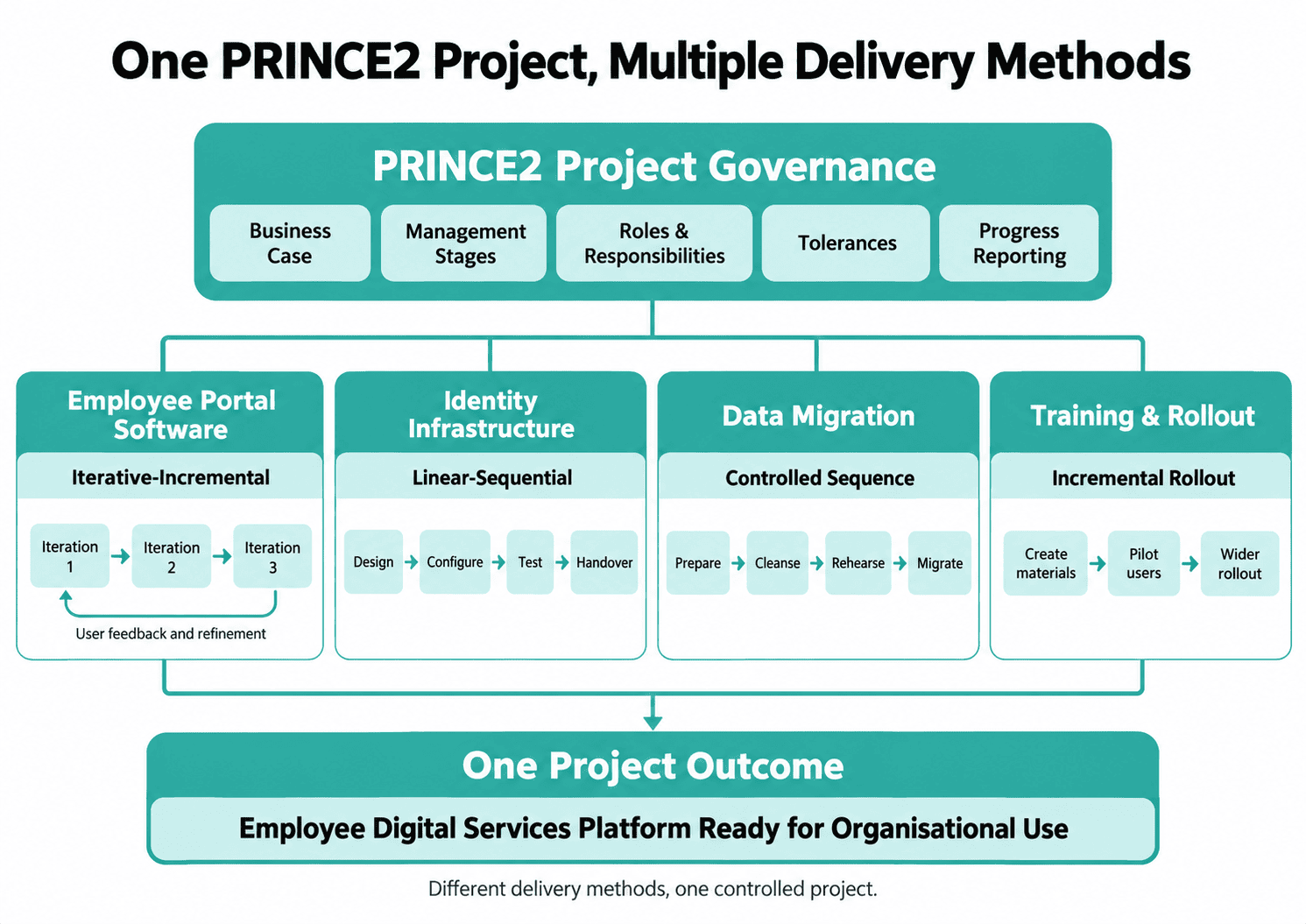
The software team might build and improve the portal through several iterations. Meanwhile, an infrastructure team could complete defined technical activities in sequence, and a supplier might deliver a payroll integration according to contractual milestones.
These teams don’t necessarily need identical ways of working. However, their outputs must come together to deliver the overall project product.
That’s where PRINCE2 becomes useful.
It provides a common management structure without prescribing every specialist activity used to create the products.
Is Hybrid Delivery Just Agile Plus Waterfall?
Not exactly. Although Agile and Waterfall are familiar terms, PRINCE2 7 describes the delivery approaches as linear-sequential, iterative-incremental, and hybrid.
Hybrid delivery isn’t necessarily a 50/50 mixture of two methodologies.
Some projects may use sequential work for most of their lifecycle and iterative development for one specialist product. Others may operate several delivery approaches at the same time.
The defining characteristic is the combination of linear-sequential and iterative-incremental approaches within the project.
For a closer comparison, read our guide to whether PRINCE2 is Waterfall.
Why Would a Project Use Hybrid Delivery?
A project may use hybrid delivery because different products need different approaches to their development.
For instance, software requirements might become clearer as users test early versions. An infrastructure installation, on the other hand, may involve an established sequence of design, installation, configuration, and inspection.
Trying to deliver both in exactly the same way may create unnecessary constraints.
Hybrid delivery allows the project to consider the needs of each part of the work.
Potential reasons include:
- Changing requirements: Some products benefit from repeated user feedback.
- Technical dependencies: Certain activities need to happen in a defined order.
- External suppliers: Contractual arrangements may influence how products are delivered.
- Regulatory obligations: Some products require specific inspections, approvals, or evidence.
- Different delivery rhythms: Teams may produce outputs at different intervals.
- Product uncertainty: Some requirements may be understood early, while others become clearer through development.
These are considerations rather than universal rules.
Hybrid isn’t automatically better than a fully linear-sequential or iterative-incremental approach. The delivery method should fit the project and the products it needs to create.
How Does Project Context Influence Hybrid Delivery?
Project Context is one of the five integrated elements of PRINCE2. It helps determine how the method should be applied and tailored.
The current manual identifies five relevant contextual considerations:
- Organisational context: The structures, standards, capabilities, and relationships surrounding the project.
- Commercial context: The arrangements between the business, customers, suppliers, and other organisations.
- Delivery method: How the required products will be developed and delivered.
- Sustainability context: The sustainability requirements and objectives relevant to the project.
- Project scale: The project’s complexity, importance, risk, and required level of management control.
These factors influence how a hybrid project should be organised.
For example, an internal software team may already have established iterative development practices. An external infrastructure supplier may operate through contractual milestones.
PRINCE2 doesn’t require the project to disregard either approach. Instead, the Project Manager needs to establish how the different arrangements fit within the overall management method.
This includes agreeing on products, responsibilities, reporting, dependencies, and authority.
The important distinction is that Project Context influences how PRINCE2 is applied. It doesn’t replace the principles, practices, or processes of the method.
What Delivery Methods Can Be Combined in a PRINCE2 Project?
PRINCE2 7 recognises three broad approaches to delivering project products.
Linear-Sequential Delivery
Linear-sequential delivery involves completing delivery steps in a sequence.
For example, infrastructure work may progress from detailed design to installation, configuration, inspection, and handover.
This can suit work where requirements and dependencies make a defined sequence appropriate.
Iterative-Incremental Delivery
Iterative-incremental delivery involves developing and refining products through repeated cycles, potentially making useful increments available as work progresses.
A software team might develop an initial portal, test it with users, incorporate feedback, and add further capabilities.
The project can maintain agreed objectives and controls while the team develops detailed functionality progressively.
If you’re unfamiliar with the distinction between refining a product through iterations and delivering functionality incrementally, our PRINCE2 Iterative and Incremental Delivery guide explains both approaches with practical examples.
Read more about how PRINCE2 works with Agile project management.
Hybrid Delivery
Hybrid delivery combines linear-sequential and iterative-incremental approaches within the same project.
Different products or parts of the project may use different approaches, but their outputs contribute to the same overall objectives.
| Workstream | Illustrative approach | How PRINCE2 supports control |
|---|---|---|
| Employee portal | Iterative-incremental | Agreed products, scope, quality expectations, and reporting |
| Identity infrastructure | Linear-sequential | Planned dependencies, milestones, and acceptance |
| Data migration | Controlled sequence of preparation and migration | Product readiness, risks, and quality checks |
| Training and rollout | Incremental deployment | Product acceptance, stakeholder engagement, and stage planning |
| External payroll integration | Delivery approach agreed with supplier | Commercial arrangements, dependencies, and authorised delivery work |
The table shows possible approaches, not mandatory delivery methods for these types of work.
How Does PRINCE2 Govern Multiple Delivery Methods?
PRINCE2 separates project management from the specialist activities used to create products.
This distinction allows the overall project to maintain a consistent management structure while delivery teams use suitable techniques.
For example, an iterative software team may use a backlog and regular demonstrations. An infrastructure team may rely on technical schedules and inspection records.
The Project Manager doesn’t need to replace those practices with identical delivery procedures.
However, the project still needs a shared understanding of:
- What products must be delivered.
- How those products contribute to the Business Case.
- Which management stages and plans control the project.
- Who is authorised to make decisions.
- What tolerances apply.
- Which dependencies affect other teams.
- How progress and forecasts are communicated.
- When risks, issues, and exceptions require attention.
One project can therefore have several delivery approaches without creating separate project-management structures for each team.
How Do Management Stages Work in Hybrid Projects?
A PRINCE2 management stage is a period of project management control.
It isn’t the same thing as an Agile Sprint, product release, technical development phase, or supplier milestone.
The Project Board authorises a management stage and delegates responsibility for managing it within agreed tolerances to the Project Manager.
Within that stage, different teams may undertake different types of delivery work.
For example, one eight-week management stage could include four software iterations, a sequence of infrastructure activities, migration preparation, and training development.
All these activities contribute to the products and objectives of the authorised stage.
Do PRINCE2 Stage Boundaries Have to Match Agile Sprints?
No. PRINCE2 management stages and Agile Sprints serve different purposes.
A management stage provides a period of project-level control and a basis for the Project Board’s decisions. A Sprint is a Scrum delivery event.
PRINCE2 allows several Sprints or timeboxes to operate within one management stage.
The appropriate number depends on the project, its risks, and the decisions that need to be made.
What Happens at a Stage Boundary?
At a stage boundary, the Project Manager supports a review of the current stage and prepares the information needed to decide what happens next.
For a hybrid project, this may involve assessing completed products, unresolved dependencies, supplier readiness, forecasts, risks, and the Business Case.
The Project Board then decides whether to authorise the next management stage.
A Sprint finishing doesn’t automatically mean that a PRINCE2 stage boundary has been reached.
Read more about PRINCE2 management stages and the project lifecycle.
How Should PRINCE2 Be Tailored for Hybrid Delivery?
PRINCE2 should be tailored so that its management arrangements suit the project’s context and delivery approach.
Tailoring doesn’t mean removing important controls or ignoring the seven principles. It means deciding how those controls will work effectively.
For a hybrid project, potential tailoring decisions include:
- How different team roles relate to the PRINCE2 project-management structure.
- Whether existing delivery tools can provide the information required for project reporting.
- How management stages relate to delivery iterations and supplier milestones.
- How products and requirements are described.
- Whether conventional Work Package descriptions, Agile delivery artefacts, or other agreed arrangements are appropriate.
- How progress, risks, issues, and decisions are communicated.
- How frequently reports and reviews are needed.
- Which management techniques are appropriate for the different teams.
The Project Manager develops the tailoring recommendations, while the Project Board is accountable for approving them.
The agreed arrangements are recorded in the Project Initiation Documentation.
Can Agile Artefacts Replace PRINCE2 Documents?
In appropriate circumstances, PRINCE2 can be tailored to use equivalent delivery techniques and information.
For instance, the current manual explicitly discusses using Sprints and user stories instead of conventional Work Packages and Product Descriptions, where the chosen arrangements preserve the method’s principles.
That doesn’t mean all PRINCE2 management information can simply be abandoned.
The project still needs sufficient information to establish responsibilities, make decisions, monitor performance, and manage exceptions.
The aim is to avoid duplicating information when an existing approach can meet the necessary management purpose.
The important point is that the alternative arrangements must still provide the information and controls needed to authorise work, establish responsibilities, monitor delivery, and manage exceptions. Using Agile artefacts doesn’t remove those management requirements.
Explore how to tailor PRINCE2 for more examples.
How Do Planning and Product-Based Planning Connect Workstreams?
Planning connects the different parts of a hybrid project by establishing what must be delivered, when products are needed, and how the work contributes to the overall objectives.
PRINCE2 uses different planning levels.
Project Plan
The Project Plan provides the overall picture of how the project’s objectives will be achieved.
In a hybrid project, this can bring together major software, infrastructure, migration, supplier, and rollout products.
Stage Plan
The Stage Plan provides the more detailed basis for managing the authorised stage.
It helps the Project Manager understand the products, activities, resources, dependencies, and controls relevant to that stage.
Team Plans
Team Plans are optional in PRINCE2.
Where used, they support a Team Manager in organising and controlling the work required to execute a Work Package.
An iterative development team may instead use suitable delivery-planning arrangements, provided the information and controls required by the tailored project management method are maintained.
Why Is Product-Based Planning Especially Useful?
Product-Based Planning begins with the products the project needs to deliver, rather than starting with a list of activities.
This provides a useful common reference for teams that organise their work differently.
For example, an employee-services project might require:
- A functioning employee portal.
- Configured identity infrastructure.
- Migrated HR data.
- A working payroll integration.
- Approved training materials.
- A platform ready for organisational use.
Each product can be described in terms of its purpose, requirements, and relevant quality expectations.
The delivery teams can then determine how the products will be created within the agreed arrangements.
How Do Product Breakdown Structures and Product Flow Diagrams Help?
A Product Breakdown Structure identifies the products required and shows their hierarchy.
A Product Flow Diagram shows the sequence and dependencies between products.
These provide different views of the same project.
For example, the Product Breakdown Structure shows that the employee-services platform includes both infrastructure and software products.
The Product Flow Diagram can then show that the infrastructure environment must be ready before certain software integration tests can be completed.
This is particularly helpful when different teams use different delivery schedules.
Learn more in our guide to PRINCE2 Product-Based Planning.
How Do You Manage Dependencies Between Hybrid Workstreams?
Cross-workstream dependencies need to be visible within the project’s planning and control arrangements.
A team might be performing well against its own delivery measures while another team is waiting for a product it needs.
Consider these dependencies:
- Infrastructure configuration must reach an agreed state before software integration testing can begin.
- Data mappings must be approved before a migration rehearsal can proceed.
- Training materials may depend on the portal’s user interface being sufficiently stable.
- The pilot launch may depend on successful testing, migrated data, and trained support staff.
These relationships can affect the whole project, even when the underlying work is managed by different teams.
PRINCE2’s Product Flow Diagram helps describe product dependencies and sequencing. Relevant dependencies also need to be reflected in planning and authorised delivery arrangements.
What Should the Project Manager Do When a Dependency Changes?
The Project Manager should establish what the change means for the affected products, plans, forecasts, and tolerances.
For example, imagine the infrastructure supplier reports that the test environment will be available one week later than planned.
The important question isn’t simply whether the infrastructure team has missed a milestone.
It’s whether the delay affects software integration, migration testing, the planned pilot, or the authorised stage completion date.
If the project can accommodate the impact within agreed authority, the Project Manager may be able to arrange corrective action.
If the forecast indicates that a relevant tolerance will be exceeded, the matter must be escalated.
How Do Work Packages and Tolerances Support Hybrid Delivery?
Work Packages and tolerances help connect specialist delivery work with PRINCE2’s management controls.
A Work Package establishes an agreement for the products and work being assigned for delivery.
Depending on the agreed arrangements, it may define products, responsibilities, quality requirements, constraints, dependencies, reporting, and relevant tolerances.
For example, the Project Manager may agree delivery arrangements with an infrastructure Team Manager and a software delivery team.
The teams can carry out their work through different specialist approaches while remaining accountable for their agreed outputs.
However, a Work Package shouldn’t automatically be treated as the same thing as a Sprint Backlog.
PRINCE2 permits tailoring, and the relationship between delivery artefacts and project management information should be established explicitly.
How Do Tolerances Work Across Different Teams?
Tolerances define how far performance may deviate from an agreed target before a decision must be escalated.
PRINCE2 recognises seven performance targets:
- Benefits
- Cost
- Time
- Quality
- Scope
- Sustainability
- Risk
Different delivery arrangements may justify different tolerance choices.
An iterative software team might work within fixed time and cost limits while having permitted flexibility over specified scope.
An infrastructure Work Package may have tight time constraints because other products depend on its completion.
The Project Manager still needs to consider how each team’s forecast affects the authorised stage.
Why Does Management by Exception Matter?
Management by Exception allows decisions to be made at the appropriate level without unnecessary intervention.
Teams can operate within their delegated authority. The Project Manager manages within the Stage Plan tolerances, and the Project Board maintains direction and oversight.
The important rule is that escalation is based on forecast tolerance exceedance, not on waiting until a target has already been missed.
For instance, if a Team Manager forecasts that an authorised Work Package will exceed tolerance, they must raise the matter with the Project Manager.
The Project Manager assesses the implications and determines whether it can be managed within stage authority or requires escalation to the Project Board.
Read our guides to PRINCE2 tolerances and Management by Exception.
How Do You Measure and Report Progress When Teams Use Different Metrics?
Hybrid projects don’t require every delivery team to measure its work in exactly the same way.
An iterative software team might track completed increments, remaining work, and expected release dates.
An infrastructure team might report completed installations, inspection results, and milestone forecasts.
A supplier may report delivery dates and contractual deliverables.
These measures can all provide useful information, but they don’t automatically tell the Project Manager whether the overall project remains on track.
How Do Different Metrics Become One Project Forecast?
The Project Manager needs to interpret team information in relation to the authorised products, Stage Plan, and agreed tolerances.
For example:
| Team information | Project-level question |
|---|---|
| Software features completed | Will the required portal capability be ready for integration? |
| Infrastructure milestone forecast | Will the environment be available when another team needs it? |
| Migration rehearsal result | Is the migrated data product likely to meet acceptance expectations? |
| Supplier delivery forecast | Does the integration remain achievable within the Stage Plan? |
| Training readiness | Can the pilot proceed with the necessary user support? |
The objective isn’t to convert every metric into a single artificial score.
It’s to understand actual progress, expected future performance, and the effect on the project.
A team’s Sprint velocity, for example, shouldn’t be presented as a measure of the entire project’s completion.
How Should Reporting Work?
PRINCE2 uses reporting to provide relevant information to the appropriate management level.
Checkpoint Reports communicate delivery progress to the Project Manager. Highlight Reports provide the Project Board with progress information.
The precise reporting arrangements can be tailored.
For example, information already maintained in a delivery team’s dashboard may be used to support the project’s reporting needs, provided it supplies reliable information in the agreed format.
The aim should be sufficient control, not a second set of reports containing the same information.
How Do You Manage Scope, Risk, Issues, and Quality Across Workstreams?
Different delivery methods do not remove the need for integrated project controls.
The project’s management approaches should establish how relevant information is identified, assessed, communicated, and acted upon.
Scope
An iterative development team may have authority to reorder or refine features within agreed product and scope boundaries.
However, a request for an additional product may affect other workstreams, the project budget, or the Business Case.
Flexibility within approved authority is different from uncontrolled scope change.
Risk
A risk in one workstream may affect several others.
For example, uncertainty about an external supplier’s integration capability could threaten software testing and the pilot launch.
The Risk Practice helps manage such uncertainty in relation to the project and its objectives.
A team may use its own techniques to identify risks, but project-relevant exposure still needs appropriate management.
Issues
Not every development task or local impediment requires a separate project-level issue.
The important consideration is whether the matter needs handling through the project’s agreed issue-management arrangements.
For example, changing the order of two backlog items within authorised scope may be a local delivery decision.
A supplier interface change affecting agreed products and the Stage Plan may require project-level issue assessment.
The distinction depends on the agreed authority and the actual impact.
Quality
Different products can use different quality-control techniques.
A software team may use automated tests and user reviews. An infrastructure team may undertake inspections. Training materials may be reviewed through a pilot.
These are specialist techniques, not separate PRINCE2 quality methods.
PRINCE2’s Quality Practice helps ensure that product quality expectations, specifications, controls, and acceptance arrangements are established and maintained.
Different testing techniques can therefore contribute to a shared understanding of what an acceptable overall project product looks like.
How Do the Business Case and Benefits Keep Hybrid Teams Aligned?
The Business Case provides the justification for undertaking and continuing the project.
This matters when teams are concentrating on different products, milestones, and local priorities.
For example, an iterative software team may identify a feature that users would appreciate.
However, adding it could delay integration with the payroll supplier, increase migration costs, or postpone organisational rollout.
The decision shouldn’t be made solely on the software team’s preference.
The wider impact on project cost, risk, benefits, and continued justification needs to be considered through the agreed decision-making arrangements.
How Do Hybrid Projects Stay Focused on Benefits?
All the workstreams ultimately contribute to the project’s intended outcomes and benefits.
For example:
Product: Employee self-service platform.
Capability: Employees can complete selected HR requests online.
Outcome: Employees begin using the platform instead of contacting HR for every routine request.
Benefit: Fewer routine requests need direct HR team handling, provided adoption and performance meet expectations.
The infrastructure, software, migration, and training products all contribute to achieving that wider result.
They shouldn’t be judged only by whether their individual tasks have been completed.
Who Coordinates a Hybrid PRINCE2 Project?
The PRINCE2 project-management structure establishes accountability and responsibility across the different delivery teams.
The main roles remain relevant regardless of which specialist methods are being used.
| PRINCE2 role | Main contribution to a hybrid project |
|---|---|
| Project Board | Directs the project and authorises management stages within its authority |
| Project Manager | Integrates planning, controls, responsibilities, progress, and stage management |
| Team Manager | Manages the delivery of agreed work within the authorised arrangements |
| Project Assurance | Provides assurance for the relevant business, user, and supplier interests |
The exact allocation of responsibilities can be tailored to the project.
Does the Project Manager Need to Be an Expert in Every Delivery Method?
No. PRINCE2 separates the management of the project from specialist product development.
The Project Manager needs to understand the delivery arrangements sufficiently to integrate products, plans, dependencies, risks, issues, and forecasts.
That doesn’t mean personally conducting software development, infrastructure installation, or supplier engineering.
Specialist teams remain responsible for their delivery expertise.
Do Scrum Roles Replace PRINCE2 Roles?
Not automatically.
Scrum identifies the Product Owner, Scrum Master, and Developers as its three accountabilities.
These operate within Scrum’s delivery framework. They don’t automatically replace the PRINCE2 Project Board, Project Manager, Senior User, or Team Manager.
The current PRINCE2 manual allows responsibilities to be tailored to the chosen delivery approach, including circumstances where a development team collectively fulfils the Team Manager role.
The actual arrangements need to be agreed and made clear.
How Do You Avoid Duplicate Governance in a Hybrid Project?
A hybrid project doesn’t need separate, competing project-management arrangements for every team.
The goal is to preserve the information, decisions, and controls needed to manage the whole project while allowing specialists to work effectively.
A practical approach is to:
- Agree on one project-management structure and clearly defined decision rights.
- Use existing team information when it meets the project’s reporting needs.
- Distinguish local delivery decisions from matters affecting other workstreams.
- Establish clear product and dependency information.
- Align stage boundaries with meaningful project-level decisions.
- Avoid requiring identical delivery procedures across every team.
- Make escalation arrangements understandable to everyone involved.
- Review whether the controls remain proportionate as the project develops.
For example, a software team might already have a reliable dashboard showing product readiness and release forecasts.
Rather than asking the team to reproduce every detail in a separate spreadsheet, the Project Manager can use the relevant information to support the agreed project controls.
The important test is whether the information supports effective decisions.
PRINCE2 Hybrid Project Example
Consider a fictional organisation implementing an Employee Digital Services Platform.
The overall project product is a digital employee-services platform ready for organisational use.
The project contains five delivery workstreams.
Step 1 – Select the Delivery Approach for Each Workstream
| Workstream | Illustrative delivery approach |
|---|---|
| Employee portal software | Iterative-incremental |
| Identity infrastructure | Linear-sequential |
| Historical HR data migration | Staged migration activities |
| Employee training and rollout | Incremental rollout |
| External payroll integration | Supplier-agreed approach with contractual milestones |
The approaches are chosen according to the nature of the work, rather than requiring every team to adopt the same method.
Step 2 – Define the Products and Dependencies
The Project Manager works with specialists and relevant stakeholders to establish the necessary products and their relationships.
For example:
Infrastructure environment ready → Portal integration testing → Migration rehearsal → Pilot readiness review → Pilot launch
This sequence is illustrative. The actual project would need to confirm the technical dependencies, including which activities could run in parallel.
The Product Breakdown Structure identifies the products. The Product Flow Diagram helps show sequencing and dependency relationships.
Step 3 – Establish Project-Level Governance
The Project Board provides direction and authorises the relevant management stages.
The Project Manager coordinates delivery through the agreed plans and management approaches.
Team responsibilities, decision rights, reporting requirements, and tolerances are established.
The project retains one Business Case and an integrated understanding of its products and objectives.
Step 4 – Authorise and Manage Delivery Work
The Project Manager agrees the relevant delivery arrangements with the teams.
The software team works iteratively, while the infrastructure supplier follows its agreed technical sequence.
The team-level arrangements must provide the management information and controls required by the tailored PRINCE2 approach.
This may involve Work Package descriptions or suitable alternative arrangements where the method has been tailored.
Step 5 – Integrate Progress and Forecasts
During the Build and Pilot management stage, the software team completes several iterations.
The infrastructure team reports the expected readiness date for the test environment.
The migration team reports rehearsal results, while training staff confirm whether pilot materials will be ready.
The Project Manager assesses these updates against the Stage Plan and agreed tolerances.
Step 6 – Respond to a Cross-Workstream Problem
Suppose the infrastructure team reports during week five that a security configuration issue will delay the environment required for software integration.
The original stage target is eight weeks, with an upper time tolerance of nine weeks.
The Project Manager assesses the knock-on effects on integration testing, migration preparation, and pilot readiness.
The combined forecast is now ten weeks.
Because the stage is forecast to exceed its nine-week upper tolerance, the Project Manager must escalate the exception to the Project Board.
The Project Manager doesn’t wait until week nine to report the problem.
The Project Board considers the available options and decides how the project should proceed within its own authority.
The Project Board may authorise corrective action, request an Exception Plan, or make another decision within its delegated authority. If the proposed response would exceed the Project Board’s own authority, the matter must be referred to the business layer.
Step 7 – Review the Stage and Prepare for the Next Decision
Following the appropriate decisions and any authorised replanning, the Project Manager reviews the stage’s performance and prepares the information needed for the next stage decision.
This includes product readiness, unresolved dependencies, risks, updated forecasts, and continued business justification.
The Project Board can then decide whether the next management stage should be authorised.
Common Mistakes When Using PRINCE2 in Hybrid Projects
Several mistakes can make hybrid delivery unnecessarily difficult.
1. Treating hybrid as exactly half Agile and half Waterfall. PRINCE2’s definition is based on the combination of delivery approaches, not a fixed percentage.
2. Confusing management stages with Sprints. These operate at different levels and serve different purposes.
3. Letting teams manage shared dependencies independently. A locally achievable milestone may still create a problem for another workstream.
4. Forcing identical metrics on every team. The Project Manager needs comparable management information, not necessarily identical specialist measures.
5. Duplicating delivery reports. Tailoring can allow useful existing information to support PRINCE2 controls.
6. Treating all local changes as project-level issues. Decisions should follow agreed authority and escalation arrangements.
7. Ignoring the effect of supplier arrangements. Contracts, responsibilities, and delivery dependencies need to be reflected in project management.
8. Losing sight of the Business Case. Completing every workstream isn’t sufficient if the overall project is no longer justified.
9. Treating tailoring as permission to remove essential controls. The seven PRINCE2 principles must continue to be applied.
PRINCE2 Hybrid Project Checklist
Use this checklist when establishing or reviewing a hybrid project’s management arrangements.
- Have we chosen suitable delivery approaches for the different products or workstreams?
- Are the reasons for those choices clear?
- Have we defined the overall project product?
- Are important product dependencies visible?
- Does the Project Plan provide an integrated picture?
- Are management stages linked to meaningful project decisions?
- Are delivery responsibilities and authority agreed?
- Do the Work Package or alternative delivery arrangements provide sufficient control?
- Are relevant tolerances established?
- Can team-level information support reliable project forecasts?
- Are cross-workstream risks and issues managed appropriately?
- Are scope boundaries and quality expectations understood?
- Are supplier arrangements reflected in project controls?
- Are reporting and decision-making arrangements proportionate?
- Does the Business Case still justify the project?
Frequently Asked Questions
Does PRINCE2 Support Hybrid Project Management?
Yes. PRINCE2 7 explicitly recognises hybrid delivery as an approach combining linear-sequential and iterative-incremental work. The method provides a controlled environment for specialist delivery activities without requiring one specific delivery method. The project must still apply the PRINCE2 principles and establish suitable plans, responsibilities, controls, and management arrangements.
Can PRINCE2 Combine Agile and Waterfall-Style Delivery?
Yes. A PRINCE2 project can combine iterative-incremental development with linear-sequential delivery. For example, an application may be developed through iterations while its supporting infrastructure follows an agreed technical sequence. PRINCE2 helps manage the project as a whole through integrated planning, product management, responsibilities, and progress control.
How Do Management Stages Work in Hybrid Projects?
Management stages are periods of project-management control authorised by the Project Board. Each stage may contain different specialist delivery activities, including multiple iterations, sequential work, and supplier milestones. The stage boundary provides a project-level review and decision point. It doesn’t need to coincide with every Sprint or product release.
How Do Work Packages Work in Hybrid Projects?
Work Packages establish agreed arrangements for delivering products and specialist work. They can define responsibilities, requirements, constraints, reporting, and tolerances. PRINCE2 can also be tailored to use appropriate Agile delivery arrangements where they fulfil the required management purpose. A Work Package is therefore not automatically equivalent to a Sprint Backlog.
How Do You Control Scope Across Different Delivery Methods?
Scope control begins with agreement on the required products and the authority for managing changes. An iterative team may adjust detailed requirements within approved boundaries, while other workstreams may have more fixed specifications. Changes affecting agreed products, project objectives, tolerances, or wider dependencies must be assessed and handled through the appropriate project arrangements.
Who Manages Dependencies in a Hybrid PRINCE2 Project?
The Project Manager is responsible for integrating relevant delivery information and managing the authorised stage. Team Managers and specialists provide information about their products, dependencies, and forecasts. Product-Based Planning supports this work by identifying required products and their relationships. Decisions are made or escalated according to agreed responsibilities and tolerances.
Do Agile Roles Replace PRINCE2 Roles?
No, not automatically. Scrum’s Product Owner, Scrum Master, and Developers have accountabilities within Scrum, whereas PRINCE2 defines a project-management structure. Roles may be tailored and responsibilities allocated appropriately, but the arrangements must preserve the necessary business, user, supplier, management, and assurance responsibilities.
How Do You Avoid Duplicate Governance?
Start by defining which information and decisions the overall project needs. Use existing delivery information where suitable, clarify reporting and escalation responsibilities, and tailor management products to the project’s context. The aim is to preserve effective PRINCE2 management without forcing every team to produce unnecessary parallel documentation.
What Should You Explore Next?
Hybrid delivery shows why PRINCE2 is designed to be flexible.
A Project Manager doesn’t have to choose between controlling the overall project and allowing specialist teams to use suitable delivery techniques.
The important skills are understanding how to establish governance, plan around products, manage dependencies, delegate authority, and recognise when a project-level decision is needed.
If you’re learning PRINCE2 or looking to apply it in a mixed delivery environment, PRINCE2 Foundation and Practitioner training can help you develop a structured understanding of the method.
Want to understand how PRINCE2 can help you manage projects that combine Agile, sequential, and supplier-led delivery?