The PRINCE2 practices are seven areas of Project Management that need continual attention throughout a PRINCE2 project. Together, they help the project team understand why the project should continue, who is responsible for what, what needs to be delivered, how uncertainty and change will be handled, and whether the project remains on track.
What Are the PRINCE2 Practices?
The PRINCE2 practices are seven essential aspects of Project Management that are applied consistently throughout the project lifecycle. The seven practices are Business Case, Organizing (or Organising), Plans, Quality, Risk, Issues, and Progress. They are not seven sequential steps. Instead, they work together throughout the project to support effective decisions, control, and delivery.
The seven PRINCE2 practices are:
- Business Case
- Organizing
- Plans
- Quality
- Risk
- Issues
- Progress
A useful way to understand them is to think about the project management question each practice helps the team answer.
The Seven PRINCE2 Practices at a Glance
| Practice | Main question | What it helps manage |
|---|---|---|
| Business Case | Why? | Whether the project remains worthwhile and justified |
| Organizing | Who? | Accountability, responsibility, decision-making, and relationships |
| Plans | How? How much? When? | Products, activities, resources, costs, and timescales |
| Quality | What? | What must be delivered and how acceptable quality will be achieved |
| Risk | What if? | Uncertainty that could affect project objectives |
| Issues | What now? | Problems, changes, opportunities, and other events requiring attention |
| Progress | Where are we now, where are we going, and should we carry on? | Performance, forecasting, tolerances, escalation, and continued control |
The questions provide an easy way to remember the purpose of each practice, but they shouldn’t be viewed as separate stages. Business justification, planning, quality, risk, issues, and progress may all need attention at the same point in a project.
Explore the 7 PRINCE2 Practices
Choose a project management question to discover which PRINCE2 practice helps address it.
Business Case
The Business Case practice focuses on why the project should be undertaken and whether it remains a worthwhile use of resources as the project develops.
Costs rise significantly during a software project, so decision-makers reassess whether the expected benefits still justify continuing.
The Seven PRINCE2 Practices Explained
1. Business Case
The Business Case practice focuses on why the project should be undertaken and whether it remains a worthwhile use of resources. It gives decision-makers a basis for assessing the project’s justification throughout its lifecycle rather than assuming that a project that made sense at the beginning will always continue to make sense.
A project’s circumstances can change:
Costs may rise.
Expected benefits may change.
New risks may emerge.
An alternative solution may become available.
For that reason, the Business Case isn’t just written at the beginning and filed away. It needs to remain relevant as the project develops.
Why does the Business Case practice matter?
Projects consume money, time, people, and other resources.
The Business Case helps decision-makers consider whether continuing the project is still justified in light of what the organisation wants to achieve and what is now known about the project.
For example, imagine a retailer investing in a new customer self-service portal.
At the start, the portal appears likely to reduce pressure on its customer support team. Halfway through the project, implementation costs increase significantly.
The project team shouldn’t just continue because work has already started.
The Business Case provides the framework for reconsidering whether the expected outcomes still justify the investment.
This is closely connected to the PRINCE2 principle of continued business justification.
2. Organizing
The Organizing practice establishes who is involved in managing the project, what they are accountable or responsible for, how authority is delegated, and how the people involved will work together. It helps create a temporary project structure that supports clear decisions throughout the project.
Projects often cross normal organisational boundaries.
A single project might involve:
- senior decision-makers
- operational users
- technical specialists
- external suppliers
- Project Managers
- delivery teams
- assurance or support functions
Without clear roles and decision-making authority, problems start to appear:
Who approves a major change?
Who represents the people who will eventually use the project’s products?
Who is accountable for the Business Case?
Who is managing work day to day?
Organizing is concerned with making those relationships clear.
For example, a company implementing a new finance platform may involve Finance, IT, an external software supplier, and senior management. The Organizing practice helps establish who represents each relevant interest and who has authority to make different types of decisions.
This practice is about more than drawing an organisation chart. It also considers relationships, responsibilities, authority, and how the project’s people work together.
3. Plans
The Plans practice defines how the project’s products and work will be delivered, by whom, when, and with what resources. PRINCE2 uses planning at different levels so that decision-makers can understand the overall direction while delivery teams have the detail needed to complete their work.
A useful plan needs to do more than show a list of tasks and dates.
It should provide enough information for people to understand:
- what needs to be delivered
- how the work will be organised
- when it should happen
- what resources are required
- how much it is expected to cost
- who is responsible for the work
- how progress will be assessed
PRINCE2 planning is very closely connected to products.
In simple terms, the team first needs clarity about what must be created before deciding exactly what work is required to create it.
For example, if a company is launching an employee onboarding portal, the team could identify products such as approved content, portal functionality, user guidance, testing outputs, and the completed live system.
Those products can then inform the work, resources, dependencies, costs, and schedule required.
Planning is also revisited as the project develops rather than being treated as a one-time exercise.
4. Quality
The Quality practice focuses on understanding what users require from the project’s products and establishing how those requirements will be achieved and checked. It helps the project team move from a broad idea of what should be produced to clear expectations about what an acceptable result looks like.
Finishing a product doesn’t automatically mean the product is good enough.
Imagine a project is creating a new online booking system.
Saying “build the booking system” isn’t enough.
The project may also need to establish expectations around:
- functionality
- reliability
- usability
- accessibility
- performance
- security
- approval
These expectations give the team something meaningful to design, build, review, and test against.
So, Quality needs to be considered during planning and delivery, rather than being left until the end.
For example, usability requirements for a customer portal should influence its design and testing from the beginning. Discovering at the point of launch that users cannot complete an important task efficiently would be much more difficult to correct.
5. Risk
The Risk practice helps the project identify, assess, and control uncertainty that could affect its objectives. PRINCE2 considers both threats, which could have a negative effect, and opportunities, which could have a positive effect if they occur.
Projects involve uncertainty because they are trying to create change.
Some uncertainty comes from within the project or organisation. Other uncertainty comes from suppliers, regulation, technology, economic conditions, or the wider environment.
The important distinction is that a risk relates to something uncertain.
It hasn’t necessarily happened.
For example, a specialist supplier may be unable to deliver an important component by the required date.
That’s a risk because the delay hasn’t actually happened, but there is an element of uncertainty that could affect the project.
The team can then consider its likelihood, potential impact, ownership, and suitable response.
Risk management is also ongoing.
New risks can emerge, existing risks can change, and some risks may disappear as the project progresses.
6. Issues
The Issues practice helps the project assess and respond to events or situations that now require attention. These can include problems, concerns, events outside the project, business opportunities, requests for change, or products that do not meet an agreed specification.
The easiest way to begin distinguishing an issue from a risk is to ask:
Has the uncertain event happened, or is there now something requiring a response?
Suppose the project previously identified this risk:
A supplier may miss the agreed delivery date.
Then the delivery date passes and the supplier hasn’t delivered.
The project is no longer dealing only with uncertainty. There is now an actual situation to assess and manage.
Issues don’t always mean something has gone badly wrong:
A new opportunity may appear.
Someone may request a change.
A product may fail to meet its agreed requirements.
An external event may affect the project.
The key thing is that something now needs consideration or action.
Depending on its significance, an issue may be handled informally or require more formal assessment and decision-making.
This is a useful starting distinction rather than a substitute for properly assessing the situation.
7. Progress
The Progress practice helps the project management team understand what has been achieved compared with what was planned, forecast what is likely to happen next, and decide whether deviations require action or escalation. It supports informed decisions about whether the project should continue.
A project team needs more than a plan.
It also needs to know:
- What have we actually achieved?
- How does that compare with what we expected?
- What is likely to happen next?
- Are we still operating within the authority we were given?
- Do we need to escalate something?
- Does continuing the project still make sense?
PRINCE2 uses agreed tolerances to help different levels of management understand how much deviation can be handled without unnecessary escalation.
For example, a Project Manager might be authorised to manage a stage within agreed limits.
If forecasts remain within those limits, they can continue managing the work.
If the project is forecast to move beyond them, the situation may need to be escalated to the appropriate decision-making level.
Progress therefore isn’t simply about reporting percentages completed. It connects performance information to forecasting, control, decisions, and continued project viability.
How Do the Seven PRINCE2 Practices Work Together?
The seven practices work at the same time, not one after another.
Consider an organisation launching a new customer self-service portal.
Business Case asks whether the portal is still worth investing in.
Organizing clarifies who makes decisions, who represents users, who manages the work, and who delivers it.
Plans establish what must be delivered, when, how, and with which resources.
Quality defines what an acceptable portal needs to do and how that will be checked.
Risk considers uncertainties, such as a potential integration delay.
Issues handles situations that require action, such as a confirmed supplier delay or requested feature change.
Progress compares what is happening with what was planned and helps determine what should happen next.
These activities all influence one another.
A new issue may increase cost.
That may require the plan to change.
The change may create a new risk.
The increased cost may affect the Business Case.
Progress information may then show that a tolerance is likely to be exceeded.
That interaction is one of the reasons it is misleading to think of the seven practices as seven project phases.
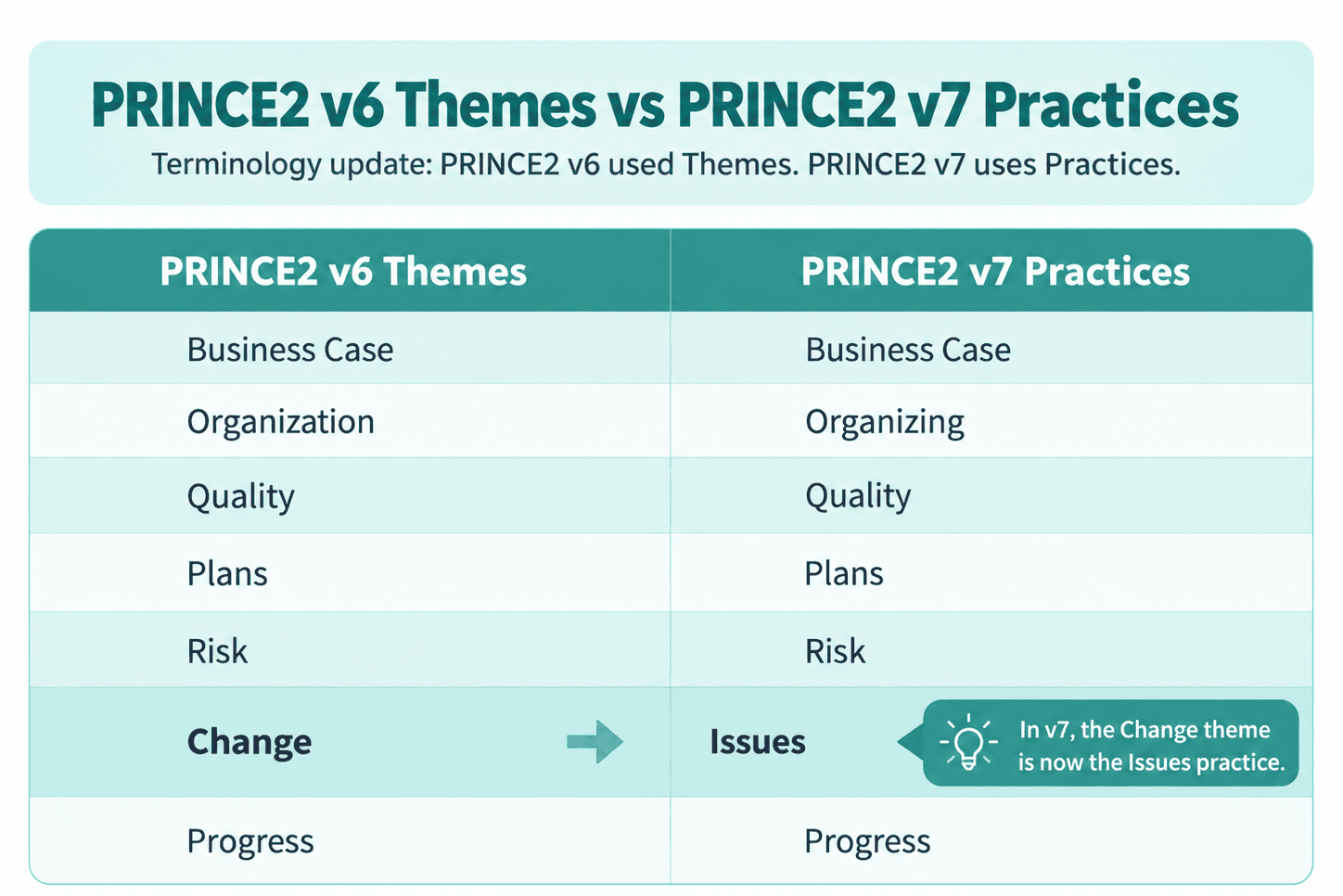
Are PRINCE2 Themes Now Called Practices?
PRINCE2 Version 7 Project Management uses the term “practices”, while older versions used the term “themes”. Someone searching for “PRINCE2 themes” is usually looking for the part of the method now discussed through the seven practices. However, the current practices should be learned from current PRINCE2 guidance rather than assuming every older theme maps perfectly onto the updated method.
Terminology isn’t the only thing that has changed; the current PRINCE2 v7 has developed how different aspects of Project Management are treated and integrated.
What Is the Difference Between PRINCE2 Principles, Practices, and Processes?
PRINCE2 principles guide how the method should be applied, practices cover areas of Project Management that require continual attention, and processes describe the management journey through the project lifecycle. They work together but perform different functions within the PRINCE2 methodology.
PRINCE2 Principles vs Practices vs Processes
| Element | What it does | Simple way to remember it |
|---|---|---|
| Principles | Guide whether and how PRINCE2 is being applied | The rules guiding the method |
| Practices | Address important Project Management areas throughout the project | What continually needs managing |
| Processes | Describe the management journey across the project lifecycle | What happens through the lifecycle |
For example, manage by stages is a PRINCE2 principle.
Plans is a practice.
Managing a Stage Boundary is a process.
Those elements interact, but they shouldn’t be used interchangeably.
People is also integrated into the PRINCE2 method because projects are delivered through people and relationships, while all elements need to be applied to the specific project context.
Do All Seven PRINCE2 Practices Have to Be Used?
Yes. All seven PRINCE2 practices are applied on a PRINCE2 project, but the way they are applied can vary according to the project. A small, low-risk project will not necessarily need the same level of documentation, control, or formality as a large, complex, high-risk project.
Tailoring doesn’t mean removing whichever parts of PRINCE2 appear inconvenient – it means adapting how the method is applied so that the level of control is appropriate to the project’s context.
Can the PRINCE2 Practices Be Tailored?
Yes. PRINCE2 practices are designed to be tailored to the project’s context. Factors such as scale, complexity, risk, urgency, delivery method, organisational environment, and the people involved can influence how formally each practice is applied and how much documentation or control is appropriate.
For example, the Quality practice for a short internal project might use relatively simple acceptance criteria and testing arrangements.
A highly regulated project could require much more extensive quality planning, evidence, approval, and assurance.
Both still apply the Quality practice.
They simply apply it proportionately.
How Are the Practices Used Throughout the Project Lifecycle?
The practices are continually revisited as the project moves through the PRINCE2 processes.
They aren’t “completed” once.
Business justification may be reassessed when circumstances change.
Plans are developed and updated.
Quality expectations guide product development and acceptance.
Risks are identified and reviewed.
Issues arise and are handled.
Progress is monitored and forecast.
Organisational responsibilities continue to shape who makes and implements decisions.
This creates a useful distinction:
Processes move the project through its management lifecycle.
Practices help the team manage important aspects of the project throughout that lifecycle.
Can the PRINCE2 Practices Work with Agile or Hybrid Delivery?
Yes. PRINCE2 can be tailored to projects using agile, iterative, incremental, linear, or hybrid delivery approaches. The practices still address the same fundamental Project Management needs, while the way planning, reporting, control, product delivery, communication, and documentation work can be adapted to the project’s delivery approach.
For example, an agile delivery team might use iterative delivery cycles, visual workflow tools, frequent reviews, and evolving detail within its plans.
PRINCE2 can provide the wider project governance and decision-making structure around that delivery approach.
The important point is that tailoring changes how the practices are applied, not whether the project still needs to consider business justification, responsibilities, planning, quality, uncertainty, issues, and progress.
How Do the Practices Fit into PRINCE2 Training?
Understanding the seven practices is an important part of understanding the wider PRINCE2 Project Management method.
PeopleCert’s current Foundation syllabus includes the seven PRINCE2 Project Management practices as recurring areas that should be addressed throughout a project, alongside the principles, processes, roles, people, and tailoring.
PRINCE2® Project Management Foundation (Version 7) is designed to build understanding of the method and its terminology.
PRINCE2® Project Management Practitioner (Version 7) moves further towards applying and tailoring the method within project situations.
If you’re deciding which route fits what you want to achieve, comparing the qualification levels can help you choose an appropriate next step.
Frequently Asked Questions About the PRINCE2 Practices
What are the 7 PRINCE2 practices?
The seven PRINCE2 practices are Business Case, Organizing, Plans, Quality, Risk, Issues, and Progress. They address important aspects of Project Management that need continual attention throughout a project. They aren’t sequential steps: several or all of the practices may be relevant at the same time as the project moves through its lifecycle.
How many PRINCE2 practices are there?
There are seven PRINCE2 practices in current PRINCE2 Project Management: Business Case, Organizing, Plans, Quality, Risk, Issues, and Progress. Each addresses a different Project Management question, from why the project should continue and who is responsible through to uncertainty, changes, and whether performance remains acceptable.
Are PRINCE2 themes now called practices?
Current PRINCE2 Project Management uses practices, while earlier versions used the term themes. People searching for PRINCE2 themes may therefore be looking for the current equivalent area of the method. However, current practices should be learned using current guidance because PRINCE2 has evolved rather than simply changing one label.
Are all seven PRINCE2 practices mandatory?
All seven practices should be applied when using PRINCE2, but their application can be tailored. The amount of documentation, formality, monitoring, and control used for each practice should reflect factors such as the project’s scale, complexity, risk, people, organisation, and delivery environment.
What is the Business Case practice in PRINCE2?
The Business Case practice helps decision-makers understand why the project should be undertaken and whether it remains justified. It supports continuing assessment of whether the project remains worthwhile as information about costs, benefits, risks, progress, and changing circumstances becomes clearer.
What is the difference between Risk and Issues in PRINCE2?
The Risk practice deals with uncertainty that could affect project objectives, while the Issues practice deals with situations that now require assessment or action. A possible supplier delay can therefore be a risk. If the supplier actually misses the deadline, the project is dealing with an issue that needs to be assessed and managed.
What does the Progress practice do?
The Progress practice compares actual performance with what was planned, forecasts what is likely to happen next, and helps determine whether deviations need corrective action or escalation. It gives decision-makers information they need to judge whether work, stages, and ultimately the project should continue.
What is the difference between PRINCE2 principles, practices, and processes?
PRINCE2 principles guide how the method should be applied. Practices deal with important Project Management areas that require continual attention. Processes describe the management journey through the project lifecycle. They are separate but integrated parts of the same PRINCE2 method.
Can PRINCE2 practices be tailored?
Yes. The way each PRINCE2 practice is applied should be appropriate to the project context. A smaller project may use lighter documentation and controls, while a complex or high-risk project may need greater formality. Tailoring changes the application of the practices rather than removing the need to address them.
Do PRINCE2 practices work with Agile projects?
Yes. PRINCE2 can be tailored around different delivery methods, including agile and hybrid approaches. Agile techniques can influence how teams plan, deliver, communicate, review progress, and manage products, while the PRINCE2 practices continue to address the broader Project Management needs surrounding that delivery work.
What Should You Explore Next?
The seven practices are only one part of the wider PRINCE2 method.
If you want to understand how they connect to the rest of PRINCE2, explore:
- What Is PRINCE2 Project Management? A Complete Guide to the PRINCE2 Methodology
- The 7 PRINCE2 Principles Explained
- The 7 PRINCE2 Processes Explained
Sources
PeopleCert (2026) PRINCE2® Project Management (Version 7). PeopleCert.