What Are the PRINCE2 Principles?
PRINCE2 principles are the seven guiding obligations that underpin how a PRINCE2 project is managed. Together, they help teams decide whether a project remains worthwhile, who is responsible for what, how control should work, what should be delivered, and how the method should be adapted. All seven principles must be applied for a project to be managed using PRINCE2.
The seven PRINCE2 principles are:
- Ensure continued business justification
- Learn from experience
- Define roles, responsibilities, and relationships
- Manage by exception
- Manage by stages
- Focus on products
- Tailor to suit the project
These aren’t seven optional Project Management tips; they are part of what makes PRINCE2, PRINCE2.
Explore the 7 PRINCE2 Principles
Select a principle to see what it means and how it could apply to a project.
Ensure Continued Business Justification
A PRINCE2 project needs a valid reason to begin and a sufficiently strong reason to continue. The business justification should be reviewed as circumstances change throughout the project.
PRINCE2 is deliberately flexible – different projects can use different delivery methods, organisational structures, levels of documentation, controls, and terminology. So, the principles provide a consistent foundation underneath that flexibility. PRINCE2 can support linear, iterative-incremental, and hybrid delivery approaches.
If you’re new to the wider method, start with our guide to what PRINCE2 Project Management is and how the PRINCE2 methodology works before returning to the seven principles in more detail: What Is PRINCE2 Project Management? A Complete Guide to the PRINCE2 Methodology
The Seven PRINCE2 Principles at a Glance
| Principle | What it means | Why it matters |
|---|---|---|
| Ensure continued business justification | Keep checking that there is a worthwhile reason to continue the project. | Stops projects continuing simply because they have already started. |
| Learn from experience | Find, use, record, and share useful lessons throughout the project. | Helps teams improve rather than repeat avoidable mistakes. |
| Define roles, responsibilities, and relationships | Make it clear who is responsible, who makes decisions, and how people work together. | Reduces ambiguity and improves accountability. |
| Manage by exception | Delegate authority within agreed tolerances and escalate when those tolerances are forecast to be exceeded. | Allows decisions to be made at the appropriate level without constant senior intervention. |
| Manage by stages | Plan, authorise, monitor, and control the project one management stage at a time. | Creates regular control and decision points. |
| Focus on products | Define what the project needs to deliver, including expectations and quality requirements, before concentrating on activities. | Keeps work aligned with the outputs the project actually needs. |
| Tailor to suit the project | Adapt the application of PRINCE2 to the project’s context while retaining the method’s integrity. | Avoids both excessive bureaucracy and insufficient control. |
The PRINCE2 principles in one sentence
A PRINCE2 project should remain justified, learn from experience, give people clear responsibilities, delegate authority within tolerances, be controlled in stages, focus on defined products, and apply the method in a way that suits its context.
Why Does PRINCE2 Have Principles?
The PRINCE2 principles provide the common foundation that allows the method to be flexible without becoming arbitrary.
PRINCE2 Project Management is made up of five integrated elements:
- principles;
- people;
- practices;
- processes; and
- project context.
The principles guide the project. People apply the method. The practices address recurring areas of Project Management, such as the business case, plans, quality, risk, issues, and progress. The processes provide a route through the project lifecycle. All of these are applied in a way that suits the project’s context.
That is why principles, practices, and processes aren’t interchangeable terms.
A useful way to think about them is:
- Principles help define what must remain true about how the project is managed.
- Practices help the project team manage important Project Management areas throughout the project.
- Processes organise Project Management activity across the project’s lifecycle.
- People recognises that projects depend on the people working on, affected by, and influencing them.
- Project context affects how the entire method should be applied.
The 7 PRINCE2 Principles Explained
1. Ensure Continued Business Justification
Ensure continued business justification means a PRINCE2 project needs a valid reason to begin and a sufficiently strong reason to continue. So, the justification should be reviewed as circumstances change rather than treated as a one-off approval at the beginning of the project.
The key word here is continued.
A project can make perfect sense when it starts and become a poor investment later:
Costs might increase.
A competitor could change the market.
New regulation could affect the proposed solution.
A technical assumption might prove incorrect.
Another project could make the planned output unnecessary.
PRINCE2 does not assume that just because money, time, or effort has already been invested, the project should automatically continue.
The business case practice supports this principle by helping the project assess whether the investment remains desirable, viable, and achievable. If the justification can no longer be supported, the appropriate response may be to change the project or close it rather than continuing regardless.
What does this look like in practice?
Imagine a retailer starts a project to build a new click-and-collect application.
Halfway through the project, an existing platform the company already licences introduces almost all the required functionality at a much lower implementation cost.
The team shouldn’t just say:
“We’ve already spent six months building ours, so we need to finish.”
The business justification should be reviewed.
The sensible choice may still be to continue with the custom application. Or the business may decide to change direction. The principle requires the decision to be based on the project’s current justification, not momentum.
Common misunderstanding: continued business justification doesn’t mean a project must generate an immediate financial profit. Value, costs, benefits, risks, and other business objectives can all contribute to whether the project remains worthwhile.
2. Learn From Experience
Learn from experience means a PRINCE2 project team actively looks for useful lessons, applies them during the project, and shares what it learns for future work. Learning isn’t something reserved for a meeting after the project has finished.
PRINCE2 projects contain an element of uniqueness, but that doesn’t mean every challenge is completely new.
Previous projects may have encountered similar suppliers, technologies, stakeholders, risks, timescales, or delivery problems.
PRINCE2 expects learning to take place:
- when the project starts;
- while the project is progressing; and
- when the project closes.
And identifying a lesson is not enough – a lesson only becomes useful when the team actually does something with it.
What does this look like in practice?
Let’s say a university is replacing its student booking system.
A previous software rollout experienced severe delays because users weren’t involved in testing early enough.
The new project team finds that lesson during initiation and changes its approach, involving representative users earlier in each delivery cycle.
Later, one department discovers that its booking rules differ significantly from those assumed during planning. That new lesson is then used when the team prepares the next rollout.
Learning becomes part of delivery, rather than a document that nobody reads after closure.
Common misunderstanding: learning from experience isn’t another name for documenting mistakes. Teams should learn from successes as well as problems.
3. Define Roles, Responsibilities, and Relationships
This PRINCE2 principle requires the project to establish clear and agreed roles and responsibilities, while also paying attention to the relationships between the people and stakeholders involved.
Projects often bring together people from different departments, organisations, disciplines, and reporting structures.
Without clarity, familiar questions appear quickly:
- Who approves this?
- Who owns the decision?
- Who represents the user?
- Who is responsible for delivering it?
- Who needs to be consulted?
- Who has authority when there is disagreement?
PRINCE2 seeks to make that accountability a bit more explicit.
The current method also goes further than just drawing boxes on an organisation chart. Relationships matter because a “technically correct” structure won’t help much if communication, trust, influence, and stakeholder engagement are ignored.
PRINCE2 identifies business, user, and supplier interests that need appropriate representation within the project organisation.
What does this look like in practice?
Imagine a hospital introducing a new appointment-management system.
The software supplier may understand how the system can be built.
Hospital staff understand what users need from it.
The organisation funding the project needs confidence that the investment remains worthwhile.
If responsibilities and decision-making authority aren’t clear, the supplier could build something technically impressive that doesn’t work for clinicians, or users could continually request changes without understanding the budget impact.
Defining who represents each interest, who makes which decisions, and how those people will work together reduces that ambiguity.
4. Manage by Exception
Manage by exception means authority is delegated within agreed limits, known as tolerances. People can make decisions within the authority they have been given, while forecast deviations beyond those limits are escalated to the appropriate management level.
This is one of the most recognisable PRINCE2 principles, but also one of the easiest to misunderstand.
It does not mean:
“Leave everything alone until something goes badly wrong.”
It means agreeing in advance how much variation is acceptable.
PRINCE2 uses tolerances to support control across project performance areas such as:
- benefits;
- time;
- cost;
- quality;
- scope;
- sustainability; and
- risk.
If the work is forecast to remain within the authority delegated to a manager or team, they can continue managing it.
If a tolerance is forecast to be exceeded, the issue moves to the level with the authority to decide what happens next.
That allows senior decision-makers to retain control without having to approve every routine decision.
What does management by exception look like?
Imagine a Project Manager is responsible for a stage with an approved budget of £100,000 and a cost tolerance of ±10%.
That means the Project Manager can manage the stage as long as the forecast cost stays between £90,000 and £110,000.
A supplier then increases its price, pushing the forecast stage cost to £106,000.
The forecast is higher than planned, yes – but it’s still within the agreed tolerance. So, the Project Manager can deal with the issue using the authority already delegated to them.
Later, another unexpected cost appears, and the forecast rises to £114,000.
The stage is now forecast to exceed the £110,000 upper tolerance limit.
At that point, the Project Manager can’t simply continue as normal. The forecast exception needs to be escalated to the appropriate management level for a decision.
This is management by exception in practice:
- Planned stage budget: £100,000
- Agreed cost tolerance: ±10%
- Authority range: £90,000 to £110,000
- Forecast of £106,000: within tolerance, so the Project Manager continues to manage it
- Forecast of £114,000: outside tolerance, so it must be escalated
The important point is that the £110,000 limit is not a spending target; it’s actually a boundary of the Project Manager’s delegated authority.
5. Manage by Stages
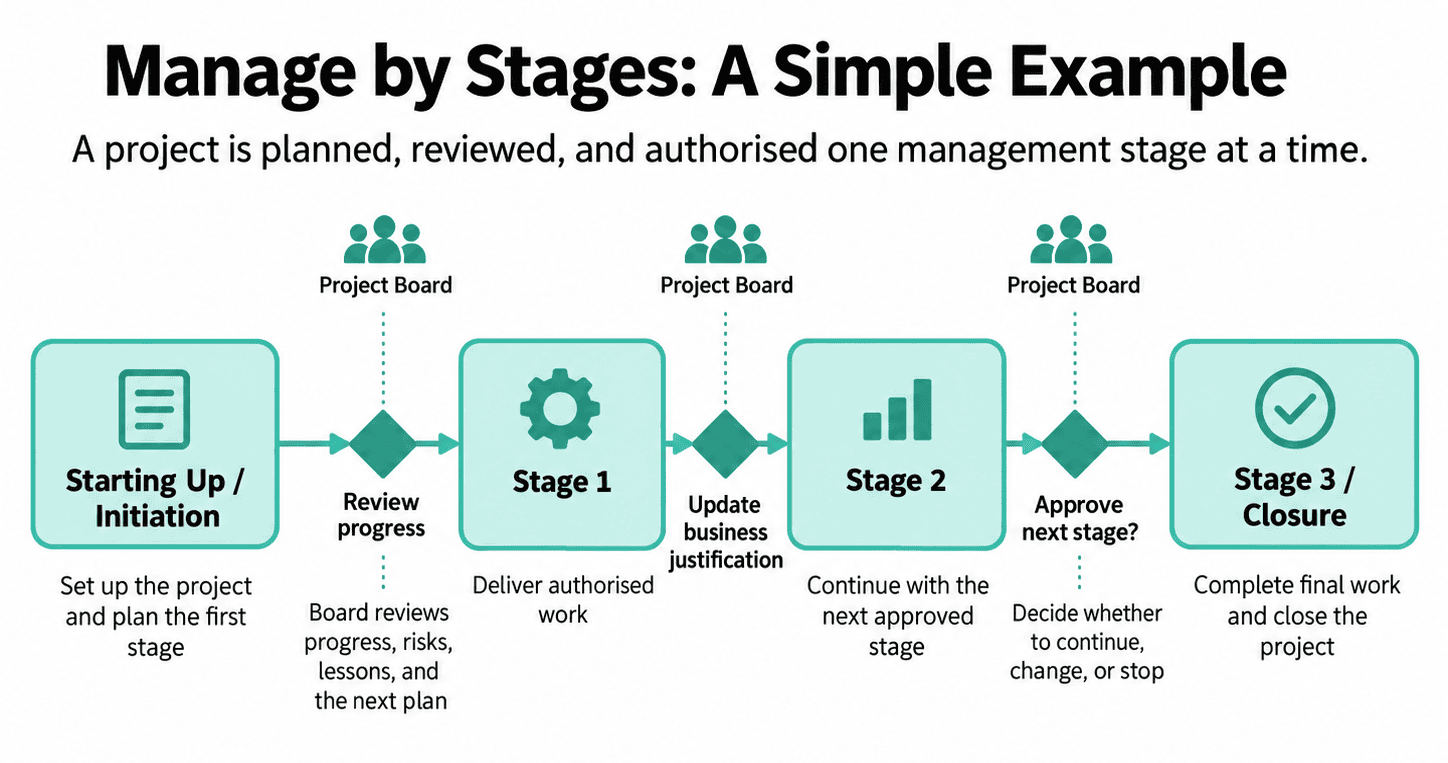
Manage by stages means a PRINCE2 project is planned, monitored, authorised, and controlled one management stage at a time. Instead of committing to detailed control of the entire project from the beginning, the Project Board can review progress and justification at meaningful decision points.
Every PRINCE2 project needs an initiation stage and at least one further management stage (even though the appropriate number of stages depends on the project).
Stages give the Project Board opportunities to ask questions like:
- Is the project still justified?
- What has been delivered?
- What have we learned?
- What does the next stage require?
- Have risks or assumptions changed?
- Should the next stage be authorised?
The Board authorises a stage and delegates its day-to-day management within agreed tolerances. At the next stage boundary, the project can be reassessed before further commitment is made.
What does managing by stages look like?
Consider an organisation introducing a new self-service HR platform.
The project might have:
Stage 1: initiation and detailed planning
Stage 2: configure and pilot the platform
Stage 3: wider implementation and transition
During Stage 2, the Project Manager manages the authorised work.
Before moving into the wider implementation, the Project Board can review the pilot results, current business justification, risks, plans, and lessons before committing to Stage 3.
This creates control points without requiring senior management to direct every day’s work.
Common misunderstanding: management stages aren’t necessarily the same thing as technical development phases, sprints, or delivery steps.
A management stage is more about how the project is authorised and controlled.
6. Focus on Products
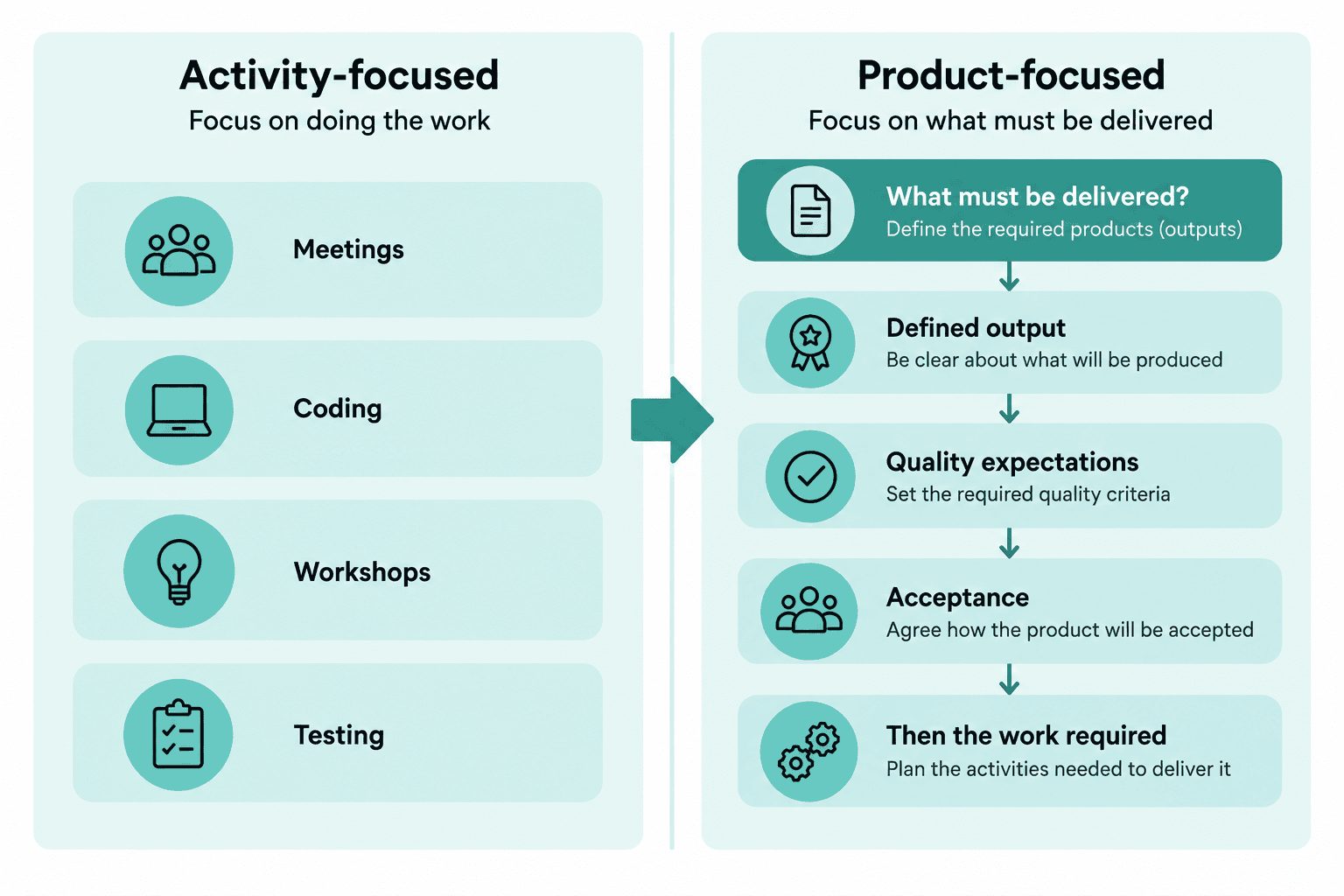
Focus on products means defining what the project needs to produce, including the required characteristics and quality expectations, before allowing activity itself to become the main focus.
In everyday work, teams can easily become activity-driven.
“We’ve completed 40 tasks.”
“We’ve held six workshops.”
“We’ve spent three months developing.”
Those statements describe effort; they don’t necessarily tell you whether the project is producing what users actually need.
PRINCE2 uses the word “product” more broadly than a physical product for sale. A product may be tangible or intangible, provided it can be described, created, and tested or assessed in some meaningful way.
The question then becomes:
What needs to exist when this work is finished, and how will we know it’s acceptable?
That product focus improves planning because the team can work backwards from agreed outputs instead of starting with a long activity list.
What does focus on products look like?
Imagine a company wants “a new employee onboarding process”.
That phrase could mean very different things to different people:
One person imagines a new digital portal.
Another expects revised HR procedures.
A manager assumes training is included.
New employees expect access, equipment, and guidance on day one.
A product-focused approach forces the project to clarify what must actually be delivered and what “acceptable” means before everybody starts performing work based on different assumptions.
Common misunderstanding: focusing on products doesn’t mean PRINCE2 only works for organisations that manufacture physical goods.
Products can include systems, services, documents, capabilities, processes, or other defined outputs.
7. Tailor to Suit the Project
Tailor to suit the project means adapting how PRINCE2 is applied so that the level of governance, control, documentation, terminology, and management effort fits the project’s actual context. Tailoring changes how the method is applied; it doesn’t make the seven principles optional.
A three-month internal improvement project shouldn’t necessarily require the same level of formality as a multi-year, multi-supplier infrastructure programme.
Equally, “keeping things simple” isn’t a reason to abandon Project Management controls altogether.
PRINCE2 therefore expects the method to be adapted according to factors including the project’s:
- organisational environment;
- scale;
- complexity;
- importance;
- delivery method;
- team capability; and
- level of risk.
Possible tailoring decisions could affect:
- the amount and formality of project information;
- how frequently reports are produced;
- terminology;
- roles and how they are assigned;
- the number of stages;
- supporting techniques;
- management approaches; and
- how existing organisational methods are integrated.
The important boundary is that tailoring should remain consistent with the seven principles.
What does tailoring look like?
Consider two projects.
Project A is a small internal website update involving one co-located team and limited organisational risk.
Project B is a national system replacement involving several suppliers, regulatory obligations, thousands of users, and significant operational risk.
Applying PRINCE2 identically to both would make little sense.
Project A may use lighter documentation, combined roles where appropriate, shorter reports, and relatively simple governance arrangements.
Project B may require more detailed management information, more formal controls, clearer separation of responsibilities, and additional assurance.
Both can still apply the same seven principles.
Common misunderstanding: tailoring does NOT mean “choose whichever PRINCE2 principles you like”.
The method itself is flexible, but the obligation to apply all seven principles remains.
PRINCE2 Myths vs Reality
Click or tap each card to reveal the reality behind the myth.
How Do the Seven PRINCE2 Principles Work Together?
The seven PRINCE2 principles work together rather than operating as seven separate rules.
Imagine a fictional financial-services company is launching a new online customer portal.
No single principle does all the work.
Together, they create a pattern of justification, learning, accountability, delegated control, staged decision-making, output clarity, and contextual adaptation.
Are All Seven PRINCE2 Principles Mandatory?
Yes. All seven PRINCE2 principles must be applied for a project to be considered a PRINCE2 project.
That doesn’t mean every project needs to look identical.
PRINCE2 deliberately separates the principles that must be respected from the way the method is applied and tailored in a particular context. It describes the principles as the obligations that determine whether a project is genuinely being managed using PRINCE2.
A small project and a complex programme-related project may therefore have very different:
- reporting arrangements;
- numbers of people;
- management information;
- stage structures;
- delivery methods; and
- levels of formality.
But the same seven principles still underpin both.
This is the difference between tailoring PRINCE2 and simply removing its foundations.
How Do PRINCE2 Principles Work With Agile and Hybrid Projects?
The PRINCE2 principles can be applied to linear, iterative-incremental, and hybrid projects because PRINCE2 governs the management of the project rather than requiring one particular specialist delivery method.
For example, an Agile development team can still:
- maintain business justification;
- review lessons through retrospectives and feedback;
- establish clear decision-making responsibilities;
- work within delegated tolerances;
- operate sprints or iterations within PRINCE2 management stages;
- define expected products and acceptance requirements; and
- tailor the Project Management approach to the delivery environment.
PRINCE2 guidance actually explicitly recognises linear-sequential, iterative-incremental, and hybrid delivery methods – and even gives examples of iterative work operating within management stages.
So “PRINCE2 or Agile?” can sometimes be the wrong question.
The more useful question is:
How should PRINCE2 Project Management controls work around the chosen way of delivering the project’s products?
PRINCE2 Principles vs Practices vs Processes
PRINCE2 principles, practices, and processes perform different roles within the method. Principles guide how a PRINCE2 project must be managed, practices address important Project Management areas throughout the project, and processes organise Project Management activity across the project lifecycle.
| Element | Main question | What it does |
|---|---|---|
| Principles | What must guide the way this PRINCE2 project is managed? | Establishes seven guiding obligations. |
| Practices | What aspects of Project Management need continual attention? | Addresses recurring management areas throughout the project. |
| Processes | What Project Management activity happens through the lifecycle? | Provides a structured journey from before initiation through delivery and closure. |
People and project context are also integrated elements of the method, so reducing PRINCE2 to “seven principles, seven practices, and seven processes” misses an important part of the picture.
PRINCE2 Method Explorer
Click each integrated element to explore how it contributes to the PRINCE2 method.
Principles
The principles are the guiding obligations that help ensure a project is genuinely being managed using PRINCE2.
- They provide the core foundation of the method.
- They support business justification, product focus, learning, and clear responsibilities.
- They should all be applied, while the way they are applied can be tailored to the project.
PRINCE2 has seven principles that help keep projects justified, structured, and adaptable.
People
People is a central integrated element of PRINCE2 because projects depend on the people doing the work, making decisions, leading change, and being affected by the outcomes.
- It brings attention to leadership, relationships, communication, and collaboration.
- It recognises that projects operate within organisational and project ecosystems.
- It connects human factors with the rest of the PRINCE2 method.
People helps ensure that successful projects are not treated as a process-only exercise.
Practices
Practices are the recurring aspects of project management that need ongoing attention throughout the project lifecycle.
- The seven practices are business case, organising, plans, quality, risk, issues, and progress.
- They support the ongoing management of a project rather than a one-time activity.
- They work together, so a change in one area can affect several others.
Practices help project teams manage the main ongoing concerns of a project in a structured way.
Processes
Processes describe the management activity used across the project lifecycle, from deciding whether a project is worth initiating through to formal closure.
- They provide a structured flow for directing, managing, and controlling work.
- They connect the project lifecycle with decision points and responsibilities.
- They help turn PRINCE2 from a concept into a practical management method.
PRINCE2 has seven processes that help organise how the project is started, managed, and closed.
Project Context
Project context shapes how PRINCE2 is applied. The method should be tailored to suit the project’s scale, complexity, organisation, environment, and delivery approach.
- It helps keep PRINCE2 proportionate rather than overly rigid.
- It allows the method to support different types of projects and organisations.
- It accommodates linear-sequential, iterative-incremental, and hybrid delivery.
Project context is what makes PRINCE2 flexible and suitable for different real-world environments.
How Do the PRINCE2 Principles Fit Into PRINCE2 Training?
Understanding the seven principles is one part of understanding how the whole PRINCE2 method works.
PeopleCert’s current PRINCE2® Project Management Foundation (Version 7) includes the principles alongside the practices, processes, roles and responsibilities, people, project performance, digital and data management, communication, and tailoring.
That makes the principles useful as a starting point, but not the whole method.
If you’re deciding whether formal training is relevant to you, the next question is usually whether you want to:
- build an understanding of the PRINCE2 method;
- develop your ability to apply and tailor PRINCE2;
- or understand how PRINCE2 fits alongside your wider Project Management knowledge.
ITonlinelearning offers training routes including:
- PRINCE2® Project Management Foundation
- PRINCE2® Project Management Practitioner
- PRINCE2® Project Management Foundation and Practitioner
Frequently Asked Questions About PRINCE2 Principles
What are the 7 PRINCE2 principles?
The seven PRINCE2 principles are: ensure continued business justification; learn from experience; define roles, responsibilities, and relationships; manage by exception; manage by stages; focus on products; and tailor to suit the project. All seven must be applied for the project to be genuinely managed using PRINCE2.
How many principles are there in PRINCE2?
PRINCE2 has seven principles. They form one of the five integrated elements of the current PRINCE2 method alongside people, practices, processes, and project context. The number seven is easy to remember because the current method also contains seven practices and seven processes (although these elements perform different functions).
Are all seven PRINCE2 principles mandatory?
Yes. All seven PRINCE2 principles need to be applied for a project to be considered a PRINCE2 project. What can be tailored is the way PRINCE2 is applied to the project’s context, such as the formality of controls, reporting, roles, terminology, management information, and supporting techniques. Tailoring does not mean discarding whichever principles are inconvenient.
What is the most important PRINCE2 principle?
PRINCE2 does not establish one principle as the single principle that replaces or outranks the other six. The principles are designed to work together, and all seven are required. Continued business justification, for example, helps determine whether a project should continue, while manage by stages and manage by exception help provide the control needed to make and implement those decisions.
What is management by exception in PRINCE2?
Management by exception means delegating authority within agreed tolerances and escalating a forecast deviation when it falls outside the authority already given. This allows people to manage routine work without unnecessary intervention while preserving senior management control over decisions that exceed agreed limits. PRINCE2 can apply tolerances across benefits, time, cost, quality, scope, sustainability, and risk.
What does manage by stages mean in PRINCE2?
Manage by stages means planning, monitoring, and controlling a PRINCE2 project one management stage at a time. The Project Board authorises the work of a stage and can then review progress, business justification, risk, learning, and the next plan before committing to a further stage. Management stages create planned decision points rather than allowing the entire project to continue automatically.
What does focus on products mean in PRINCE2?
Focus on products means concentrating first on the outputs the project must deliver and the expectations or requirements those outputs need to meet. The principle helps teams avoid confusing activity with progress. A PRINCE2 “product” does not have to be a physical item; it can be a tangible or intangible output that can be described and assessed.
What does tailoring mean in PRINCE2?
Tailoring means adapting how PRINCE2 is applied to the actual project. Factors such as scale, complexity, risk, delivery method, organisational environment, importance, and team capability can affect the amount of documentation, reporting, governance, control, and formality required. Tailoring makes PRINCE2 proportionate, but it must remain consistent with all seven principles.
Have the PRINCE2 principles changed in PRINCE2 7?
The current PRINCE2 version still contains seven principles, but PRINCE2 v7 updated how parts of the method are expressed and places greater emphasis on areas such as people, relationships, sustainability, data, and modern delivery environments. For current study and application, use the Version 7 principle names listed in this guide rather than relying on older PRINCE2 v6 terminology.
Do the PRINCE2 principles work with Agile projects?
Yes. The PRINCE2 principles can be applied when specialist teams use iterative-incremental or Agile ways of working. For example, Agile teams can learn through retrospectives, deliver defined products incrementally, operate within tolerances, and run iterations within PRINCE2 management stages. PRINCE2 does not require one particular specialist delivery method.
What is the difference between PRINCE2 principles, practices, and processes?
PRINCE2 principles are the obligations guiding how the project is managed. Practices address recurring Project Management areas that need attention throughout the project. Processes organise Project Management activities across the project lifecycle. They are separate but integrated parts of the method, alongside People and the project context.
What Should You Explore Next?
Once you understand the PRINCE2 seven principles, the most useful next step is to see where they sit within the rest of the method.
Sources
PeopleCert (2026) PRINCE2® Project Management (Version 7). PeopleCert.