PRINCE2 vs Agile: What’s the Difference?
The key difference between PRINCE2 and Agile is that PRINCE2 provides a structured method for managing and governing projects, while Agile describes a broader family of adaptive approaches that emphasise collaboration, feedback, and iterative delivery. They’re not necessarily alternatives. PRINCE2 can be used to manage projects in which teams work using Agile approaches, combining project-level control with flexible delivery.
If you’re comparing Agile vs PRINCE2, the most useful question isn’t which one is better. It’s what each approach helps you achieve, where their responsibilities overlap, and how they might work together.
PRINCE2 vs Agile at a Glance
| Area | PRINCE2 | Agile |
|---|---|---|
| What it is | A structured Project Management method | A broad family of adaptive approaches, frameworks, and practices |
| Primary focus | Directing, managing, governing, and controlling projects | Delivering value through collaboration, feedback, and adaptation |
| Governance | Explicit project governance, responsibilities, decision rights, and controls | Governance varies by framework and organisational context |
| Planning | Plans at appropriate management levels, tailored to the project | Planning is often iterative, with details evolving as work progresses |
| Delivery | Supports different specialist delivery methods | Commonly uses iterative and incremental approaches |
| Change | Uses defined practices and controls to assess and manage changes | Emphasises responding to emerging needs and feedback |
| Roles | Defines project-level management and governance responsibilities | Roles depend on the specific Agile framework |
| Documentation | Uses tailorable management products | Favours useful, appropriately detailed documentation |
| Flexibility | Tailors the method to project context | Adapts delivery as teams learn more |
| Can they work together? | Yes, PRINCE2 can manage projects using Agile delivery | Yes, Agile practices can operate within PRINCE2-managed projects |
Essentially, PRINCE2 helps establish how a project should be justified, directed, managed, and controlled. Agile approaches often provide ways to develop and deliver valuable outcomes incrementally, incorporating feedback as work progresses.
Neither is limited exclusively to these areas.
What Does PRINCE2 Focus On?
PRINCE2, now formally branded as PRINCE2 Project Management, is a structured method for managing projects from initiation through to closure.
It provides guidance on how to organise project responsibilities, justify investment, manage risk, plan work, monitor progress, and make decisions.
The current method consists of five integrated elements:
- Principles: Seven guiding obligations that underpin the method.
- People: The individuals, teams, relationships, and stakeholders involved in or affected by the project.
- Practices: Seven aspects of project management that need to be addressed throughout the project.
- Processes: Seven processes covering the management of a project from preparation to closure.
- Project Context: The environment and circumstances to which the method must be tailored.
One of PRINCE2’s defining characteristics is its emphasis on continued business justification. A project should remain worthwhile, and the people responsible for it should have the information needed to make informed decisions.
PRINCE2 also establishes clear management responsibilities, including the Project Board, Project Manager, and Team Manager roles.
Importantly, it doesn’t prescribe exactly how specialist work must be performed. A software development team, for example, may use Agile techniques while the wider project is managed using PRINCE2.
For a detailed explanation, see our guide to PRINCE2 Project Management.
What Does Agile Mean in Project Management?
Agile describes a broad approach to working that emphasises adaptability, collaboration, frequent feedback, and the delivery of value.
Its origins are closely associated with the Manifesto for Agile Software Development.
The Manifesto for Agile Software Development, published in 2001, established four values that prioritise individuals and interactions, working software, customer collaboration, and responding to change. Although originally focused on software development, Agile thinking has since been applied across a wider range of industries and working environments.
These values do not reject processes, documentation, contracts, or plans. Instead, they emphasise the importance of people, useful outcomes, and adapting when circumstances change.
In practice, Agile approaches may involve:
- Delivering products or improvements in manageable increments.
- Gathering feedback throughout development.
- Reviewing and adapting priorities.
- Encouraging collaboration between delivery teams and stakeholders.
- Allowing requirements and solutions to evolve as understanding improves.
- Regularly reflecting on how work can be improved.
However, Agile is not one single Project Management methodology.
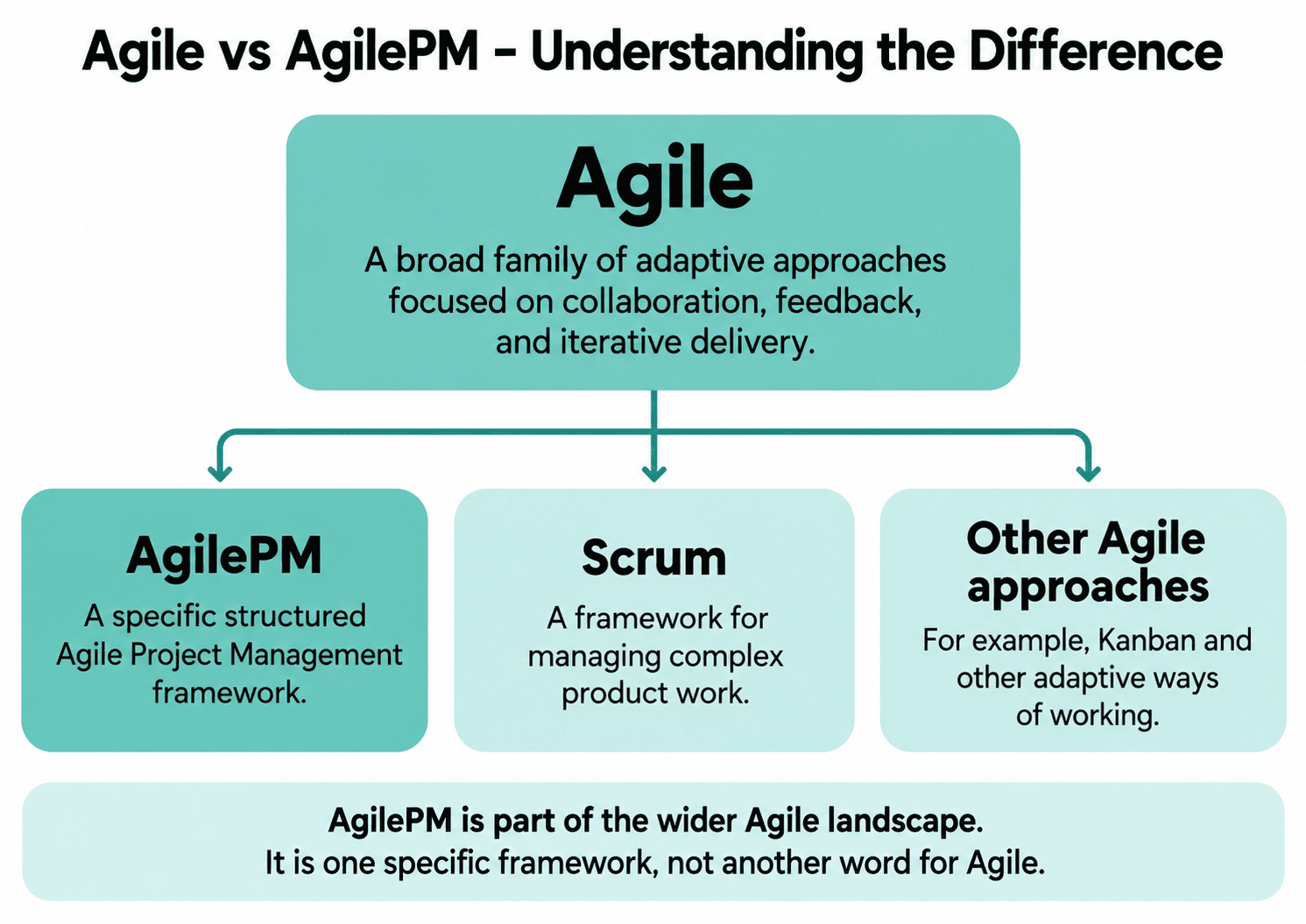
Different frameworks apply Agile thinking in different ways. Scrum, for example, is a framework for developing and sustaining products in complex environments. AgilePM, meanwhile, provides a specific framework for managing Agile projects.
This distinction matters because comparing PRINCE2 with Agile broadly is not quite the same as comparing PRINCE2 with a particular Agile Project Management framework.
Is AgilePM the Same as Agile?
No. AgilePM is a specific Agile Project Management framework, whereas Agile is the broader family of values, principles, approaches, and practices.
AgilePM was developed from the project management aspects of the Dynamic Systems Development Method (DSDM).
It provides structured guidance on managing Agile projects, including defined roles, project lifecycle phases, planning, governance, prioritisation, and delivery controls.
The current AgilePM v3 framework also integrates with Scrum and recognises other delivery mechanisms.
This means AgilePM is not simply another word for Agile, nor is it limited to facilitating short development cycles.
For someone researching training, this is especially important.
You can develop an understanding of Agile principles without studying AgilePM specifically. However, an AgilePM qualification focuses on a defined Project Management framework and how its guidance can be applied.
Is PRINCE2 Agile?
PRINCE2 is not itself an Agile delivery framework, but it can be used to manage projects that follow Agile approaches.
The current PRINCE2 method separates project management from the specialist work needed to create the project’s products.
This allows teams to select delivery approaches that suit their circumstances without abandoning the wider management method.
For example, PRINCE2 might establish:
- Who is responsible for project-level decisions.
- Why the project is being undertaken.
- What outcomes and benefits are expected.
- How progress will be monitored.
- What level of deviation is acceptable before escalation.
Meanwhile, a team developing the project’s products could work iteratively, reviewing feedback and adapting detailed delivery plans.
Therefore, describing PRINCE2 as an Agile methodology would be misleading, but describing it as incompatible with Agile would be equally inaccurate.
Is PRINCE2 a Waterfall Method?
No. PRINCE2 does not require Waterfall or linear-sequential delivery. It can be applied to projects using linear-sequential, iterative-incremental, or hybrid delivery approaches.
Linear-Sequential Delivery
Work generally progresses through a defined sequence of activities.
For example, one phase of product development might need to be substantially completed before the next begins.
This may be appropriate where the nature of the work requires a sequential approach.
Iterative-Incremental Delivery
Products are developed and refined through repeated cycles, with useful components or improvements delivered incrementally.
Teams may revisit requirements, design, development, and testing as they learn more.
This type of delivery is often associated with Agile approaches.
Hybrid Delivery
Different elements of a project use different delivery approaches.
For example, an infrastructure component may be delivered sequentially while an associated digital service is developed iteratively.
PRINCE2 allows these approaches because it is concerned with establishing an appropriate project management environment rather than imposing one specialist delivery method.
The misconception comes from confusing a project’s management method with its delivery method.
PRINCE2 projects can certainly use sequential delivery, but that doesn’t make sequential delivery a requirement of PRINCE2.
The method also explicitly requires tailoring to the project’s circumstances. This includes considering the delivery method, project scale, complexity, organisational environment, and other relevant factors.
For a practical explanation, see how to tailor PRINCE2 to different project environments.
How Do PRINCE2 and Agile Approach Governance?
PRINCE2 provides an explicit project governance structure, while Agile approaches incorporate governance in ways that depend on the framework and organisational environment.
Governance concerns how decisions are made, who is accountable, how progress is monitored, and how the project remains aligned with its objectives.
In PRINCE2, governance is particularly visible through the relationship between the business, Project Board, Project Manager, and delivery teams.
Responsibilities and decision-making authority are defined, and tolerances establish how much freedom a management level has before an issue must be escalated.
This is closely related to the PRINCE2 principle of manage by exception.
Rather than requiring senior decision-makers to approve every activity, the method allows work to proceed within agreed boundaries.
Agile approaches also require appropriate accountability and control.
For example, Agile teams often rely on transparency, regular reviews, visible progress, and empowered decision-making.
More specifically, AgilePM includes project governance, defined responsibilities, compliance considerations, and financial oversight.
Therefore, it would be incorrect to suggest that PRINCE2 has governance while Agile does not.
The practical difference lies in how governance is structured and applied.
PRINCE2 provides an explicit, tailorable project-level management structure. Agile frameworks may establish governance through different mechanisms, sometimes combining organisational oversight with greater autonomy at delivery-team level.
For more information about PRINCE2’s approach to delegation and control, read our guide to managing by exception.
How Do PRINCE2 and Agile Approach Planning?
Both PRINCE2 and Agile approaches use planning, but they may organise and update plans differently.
The idea that PRINCE2 requires every detail to be planned upfront while Agile avoids planning altogether is inaccurate.
Planning in PRINCE2
PRINCE2 uses planning to establish what needs to be delivered, when, by whom, and within which constraints.
Depending on the project, this may include:
- A Project Plan covering the overall project.
- Stage Plans covering individual management stages.
- Team Plans where appropriate.
- Product descriptions that clarify what needs to be created and how quality will be assessed.
PRINCE2 planning is product-focused and can be tailored to the project’s delivery approach.
Detailed planning can therefore develop progressively, particularly where requirements are expected to evolve.
Planning in Agile
Agile approaches commonly use adaptive planning.
Teams may establish an overall direction and then refine shorter-term plans as new information becomes available.
For example, a software team might agree on a product goal, identify priority work, and plan the next short delivery period.
Feedback from that period can then inform future decisions.
This is still planning. The difference is that detailed plans are deliberately revisited as the team learns.
In AgilePM specifically, planning takes place throughout the project lifecycle, incorporating project-level planning, prioritisation, timeboxes, and delivery-team activities.
The important distinction is not planning versus no planning. It is how planning supports decision-making and adaptation.
Which Handles Change Better: PRINCE2 or Agile?
Agile approaches explicitly emphasise responding to change and learning from feedback, while PRINCE2 provides structured mechanisms for assessing and managing changes to a project.
Neither automatically handles every type of change better.
Agile delivery can be particularly useful when detailed requirements are uncertain or likely to evolve.
For example, users might test an early version of a digital service and reveal that a planned feature is less useful than originally expected.
The team can consider that feedback when deciding what to develop next.
PRINCE2, meanwhile, addresses how changes affect the wider project.
A proposed change might influence:
- Cost and available resources.
- Delivery dates.
- Quality requirements.
- Project scope.
- Expected benefits.
- Risk.
- Sustainability objectives.
The PRINCE2 Issues practice provides guidance for identifying, assessing, and responding to issues, including requests for change.
This doesn’t mean every adjustment requires extensive approval. Authority can be delegated, and controls should be appropriate to the project’s circumstances.
A useful way to understand the difference is that an Agile team may adjust its detailed delivery priorities while PRINCE2 helps determine when those adjustments affect agreed project-level commitments.
Both forms of change management may be needed on the same project.
How Do PRINCE2 and Agile Handle Scope and Requirements?
PRINCE2 focuses on agreeing what products the project must deliver and managing changes to those commitments. Agile approaches often allow requirements and solution details to become clearer through iterative work.
The approaches can therefore operate at different levels of detail.
In PRINCE2, product-based planning helps teams define required products, quality expectations, and relationships between deliverables.
This provides a basis for planning, monitoring, and controlling the project.
Our PRINCE2 Product-Based Planning guide explains how defining products and their quality requirements can support planning without dictating the specialist delivery approach.
In Agile delivery, requirements may begin at a higher level and become more detailed as the team explores the solution.
For example, an initial requirement might state that customers need a simpler way to update their account details.
The team could develop an early version, gather feedback, and refine the functionality over subsequent iterations.
How Does AgilePM Prioritise Requirements?
AgilePM includes MoSCoW prioritisation.
This categorises requirements as:
- Must Have: Essential requirements for achieving an acceptable outcome.
- Should Have: Important requirements that are not essential to the immediate outcome but should be included where possible.
- Could Have: Desirable requirements that may be delivered if sufficient time and resources are available.
- Won’t Have This Time: Requirements that have been explicitly excluded from the agreed timeframe.
MoSCoW provides a structured way of discussing priorities and managing expectations.
However, it is a technique used within AgilePM and other contexts, not a universal requirement for every Agile approach.
In a project using PRINCE2 and Agile delivery together, the team could refine and prioritise detailed requirements while the wider project continues to manage scope, business justification, and agreed tolerances.
How Do Roles Differ in PRINCE2 and Agile?
PRINCE2 defines project management and governance roles. Agile roles vary according to the specific framework being used.
This makes a direct role-by-role comparison difficult.
PRINCE2 Roles
PRINCE2 establishes responsibilities across the business, directing, managing, and delivering levels.
Examples include:
- Project Board: Directs the project and makes key project-level decisions.
- Executive: Has overall accountability for the project’s business justification.
- Senior User: Represents the interests of those who will use the project’s products.
- Senior Supplier: Represents the expertise and resources needed to deliver the project’s products.
- Project Manager: Manages the project within delegated authority.
- Team Manager: Coordinates the delivery of work packages where this role is used.
These roles establish accountability and help ensure that relevant business, user, and supplier interests are represented.
Agile Roles
Agile does not prescribe one universal set of roles.
Scrum, for example, defines Product Owner, Scrum Master, and Developers as accountabilities within a Scrum Team.
Other Agile frameworks organise responsibilities differently.
AgilePM v3 has a broader project organisation that includes Business Sponsor, Business Visionary, Project Manager, Solution Architect, and defined delivery-team roles.
Although some AgilePM roles may appear similar to PRINCE2 roles, they should not automatically be treated as direct equivalents.
The responsibilities, decision rights, and relationships must be understood in the context of the particular framework.
To explore the PRINCE2 structure in more detail, see PRINCE2 roles and responsibilities.
How Is Work Delivered in PRINCE2 vs Agile?
PRINCE2 provides guidance for managing the project within which delivery takes place. Agile approaches often provide more specific guidance on developing, reviewing, and improving products incrementally.
For example, PRINCE2 helps establish:
- What needs to be delivered.
- Who has authority to approve work.
- How work packages are agreed.
- How progress will be reported.
- What should happen when agreed tolerances are forecast to be exceeded.
However, PRINCE2 does not prescribe a particular specialist development technique.
An Agile delivery team might use short development cycles, regular reviews, and frequent stakeholder feedback.
That delivery approach can operate within the management environment established by PRINCE2.
This distinction is especially useful when comparing the PRINCE2 processes with delivery frameworks such as Scrum.
PRINCE2’s processes manage the project’s progression, decisions, and controls. Scrum provides a framework for managing complex product work through its accountabilities, events, and artefacts.
They aren’t simply alternative versions of the same lifecycle.
Does PRINCE2 Require More Documentation Than Agile?
Not necessarily. PRINCE2 requires appropriate management information, but its management products can be tailored to the project’s needs. Agile also uses documentation and other forms of recorded information where they support effective work.
The idea that PRINCE2 always involves extensive paperwork comes from treating every management product as a large formal document.
That isn’t how the current method needs to be applied.
PRINCE2 management products may include information such as:
- The Business Case.
- Plans.
- Product descriptions.
- Risk and issue information.
- Progress reports.
- Lessons.
The format, level of detail, and formality should reflect the project’s context.
Some information may be maintained using digital tools, registers, dashboards, or collaborative systems rather than lengthy standalone documents.
Agile approaches also require useful information.
Product requirements, acceptance criteria, delivery priorities, decisions, and risks may all need to be recorded.
AgilePM v3, for example, explicitly defines Project Artifacts to support project delivery and management.
The useful question is therefore not which approach has fewer documents, but whether the information being maintained helps the people involved make decisions, coordinate work, and deliver the intended outcomes.
Explore our guide to PRINCE2 management products for a closer look at how they work.
Which Is More Flexible: PRINCE2 or Agile?
Both can be flexible, but they emphasise different dimensions of flexibility.
Agile approaches particularly emphasise adapting how work is delivered as new information becomes available.
PRINCE2 explicitly requires the management method to be tailored to the project’s context.
For example, an Agile delivery team might adjust its priorities after a user review.
A PRINCE2 Project Manager might adapt reporting arrangements, management controls, or work package boundaries to suit an iterative delivery environment.
These are different kinds of flexibility.
PRINCE2’s project context includes factors such as organisational arrangements, delivery methods, sustainability considerations, commercial relationships, and project scale.
Understanding these factors helps determine how much management structure is appropriate.
Can PRINCE2 and Agile Be Used Together?
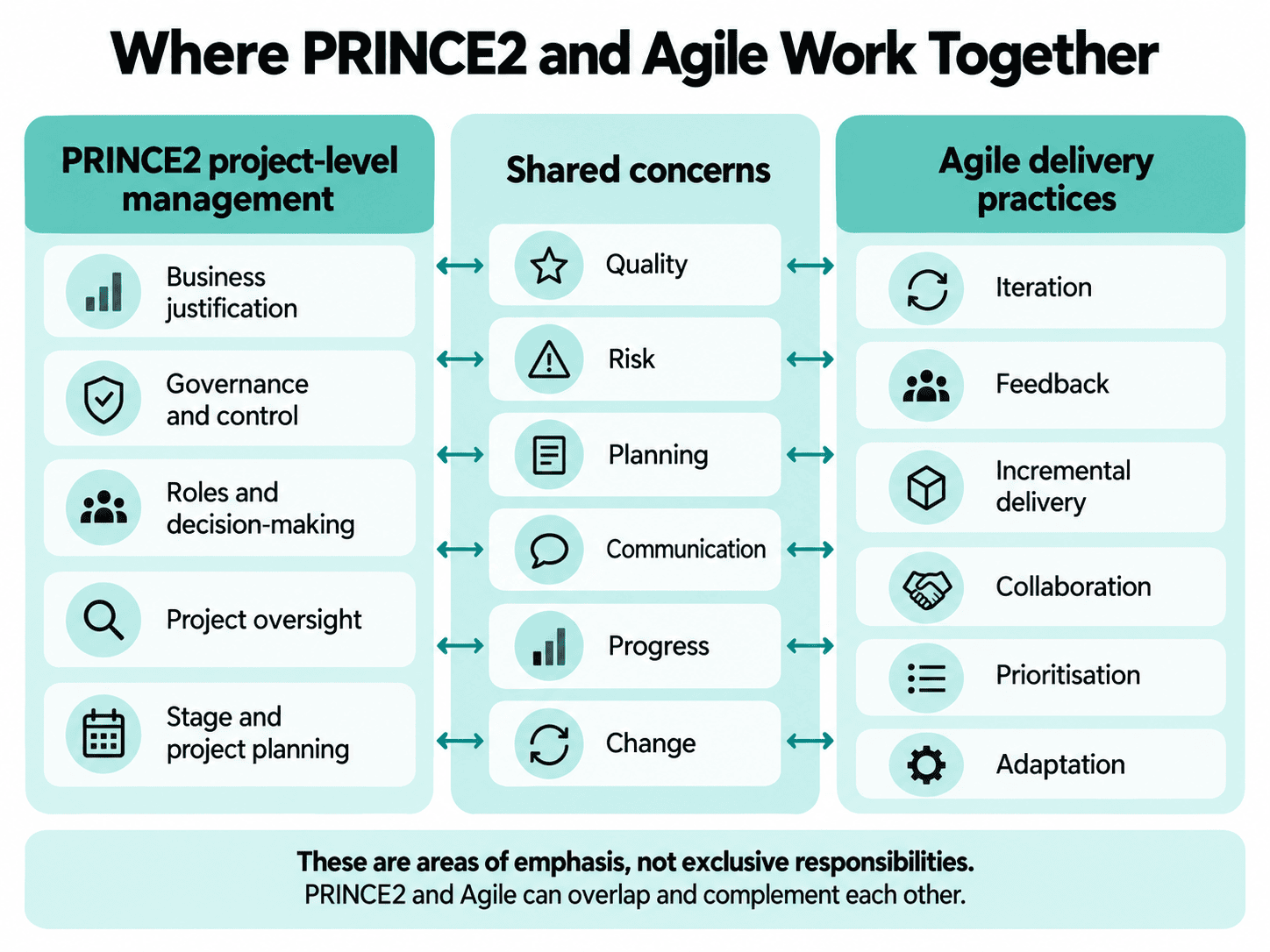
Yes. PRINCE2 can provide project-level direction, business justification, accountability, and control while teams use Agile approaches to develop products iteratively and respond to feedback.
This combination is sometimes described as hybrid Project Management, although the term can cover different arrangements.
There is no single mandatory way to combine the two.
An organisation may use PRINCE2 to manage the overall project while one or more delivery teams use Agile techniques.
Alternatively, a project may use sequential delivery for some components and iterative delivery for others.
The important consideration is whether the chosen approaches work together effectively.
For practical examples of combining different delivery approaches within one project, explore our PRINCE2 Hybrid Project Management guide.
For example, teams need clarity about which decisions they can make independently, when a change affects project-level commitments, and how progress will be communicated.
Example: Using PRINCE2 and Agile to Deliver a Customer Portal
Imagine a fictional organisation developing a new online customer portal.
The portal will allow customers to manage their personal information, track requests, and access support services.
The organisation needs to control its investment, protect customer information, and ensure that the portal delivers meaningful business benefits.
At the same time, it expects customer feedback to influence the design.
How PRINCE2 Could Be Used
PRINCE2 could help establish:
- A Business Case explaining the expected benefits and investment.
- A Project Board with appropriate business, user, and supplier representation.
- Defined responsibilities for managing and delivering the project.
- Management stages for reviewing progress and making investment decisions.
- Agreed tolerances for cost, time, scope, quality, benefits, sustainability, and risk.
- Progress reporting and escalation arrangements.
- Controls for assessing issues and changes that affect project-level commitments.
For example, the Project Board might authorise the next management stage after reviewing progress, the updated Business Case, and the proposed plan.
The Project Manager would then manage the authorised work within agreed tolerances.
How Agile Delivery Could Be Used
Meanwhile, the development team could use an Agile approach to create the portal incrementally.
Rather than attempting to finalise every design detail before development begins, the team might:
- Identify the highest-priority customer needs.
- Build an initial version of the portal.
- Demonstrate working functionality to users.
- Gather feedback about usability and functionality.
- Refine requirements and delivery priorities.
- Develop additional capabilities through subsequent iterations.
For example, customers might find the request-tracking feature confusing during an early review.
The team could use that feedback to improve the feature before expanding the service further.
How the Two Approaches Could Work Together
The development team could manage detailed delivery decisions within its agreed authority, while the Project Manager maintains oversight of the wider project.
If customer feedback leads to a change that remains within agreed project tolerances, the team and Project Manager may be able to address it without escalating the decision.
However, a proposed change that significantly affects the budget, expected benefits, or authorised scope may require a project-level decision.
This provides a practical illustration of how adaptive delivery and structured governance can coexist.
The team retains opportunities to learn and improve the product, while the organisation maintains appropriate oversight of the investment.
Importantly, this is only one possible arrangement. The exact responsibilities, controls, and delivery practices would need to be tailored to the project’s circumstances.
How Does PRINCE2 Compare with AgilePM?
PRINCE2 and AgilePM are more directly comparable than PRINCE2 and Agile broadly because both provide structured approaches to Project Management.
However, they aren’t identical frameworks, and their components should not be treated as direct equivalents.
PRINCE2 provides a structured, tailorable method for directing, managing, and controlling projects regardless of the chosen specialist delivery method.
AgilePM provides a structured approach to managing Agile projects, explicitly incorporating adaptive planning, iterative and incremental delivery, prioritisation, governance, and collaboration.
Both address business value, planning, responsibilities, risk, and project control.
The differences become clearer when looking at how each framework organises these responsibilities.
PRINCE2 vs AgilePM
| Area | PRINCE2 | AgilePM v3 |
|---|---|---|
| Primary emphasis | Managing and governing projects across delivery environments | Managing projects using Agile approaches |
| Principles | Seven PRINCE2 principles | Eight AgilePM principles |
| Lifecycle structure | Seven project management processes | Six lifecycle phases |
| Governance | Defined management levels, project controls, tolerances, and escalation | Defined project roles, governance, compliance, and financial oversight |
| Delivery | Accommodates linear-sequential, iterative-incremental, and hybrid methods | Explicitly emphasises iterative and incremental value delivery |
| Planning | Product-based planning and management-level plans | Adaptive planning through the lifecycle, including increments and timeboxes |
| Prioritisation | Scope and products are managed within agreed project controls | Includes MoSCoW prioritisation |
| Documentation | Tailorable management products | Project Artifacts with different levels of requirement and formality |
| Project context | Explicit tailoring to project context | Adapting the project approach to its circumstances and risks |
AgilePM can also work with Scrum, connecting project-level management with Agile delivery-team activities.
This makes AgilePM particularly relevant when an organisation wants a defined Agile Project Management framework rather than solely introducing Agile practices at team level.
PRINCE2 and AgilePM both provide more than a simple collection of techniques, so the training decision should consider the responsibilities and project environment involved.
Should You Learn PRINCE2 or Agile?
The most useful choice depends on the type of work you do, the responsibilities you want to develop, and how your organisation manages and delivers projects.
When Might PRINCE2 Be More Relevant?
PRINCE2 may be worth exploring if you want to develop knowledge of structured Project Management, particularly where your responsibilities involve:
- Project planning and coordination.
- Business justification.
- Project governance and reporting.
- Risk and issue management.
- Defined responsibilities and decision-making.
- Managing work across different delivery environments.
It may also be relevant if your current or prospective employer specifically uses PRINCE2.
When Might Agile Knowledge Be More Relevant?
Agile approaches may be particularly useful to understand if your work involves:
- Iterative product development.
- Frequent user or stakeholder feedback.
- Evolving requirements.
- Collaborative delivery teams.
- Adaptive planning and prioritisation.
- Continuous improvement.
This may include digital, software, product development, and other environments where learning and adaptation are important.
However, the specific Agile framework used by your organisation matters. Learning Agile principles alone isn’t necessarily the same as learning the framework required for a particular role.
When Might Learning Both Be Useful?
Developing knowledge of both may be worthwhile if your responsibilities span project-level management and Agile delivery.
For example, a Project Manager working with Agile development teams may need to understand both organisational governance requirements and the team’s delivery practices.
Similarly, someone supporting hybrid projects may benefit from understanding how management decisions and iterative delivery interact.
This doesn’t mean everyone needs both qualifications.
The better starting point is to identify which knowledge is most relevant to your current responsibilities or intended career direction.
Should You Take PRINCE2 or AgilePM Training?
If you’re comparing qualifications rather than general ways of working, the decision becomes more specific.
ITonlinelearning offers training in both PRINCE2 Project Management and AgilePM.
PRINCE2 training focuses on understanding and applying the PRINCE2 method, including its principles, practices, processes, roles, and tailoring.
AgilePM training focuses on applying a structured framework for managing Agile projects, including its approach to governance, collaboration, iterative delivery, planning, and prioritisation.
Before choosing, consider what your employer uses and which responsibilities you want to develop.
For example, someone entering a Project Coordinator or Project Management role might want to explore PRINCE2 if their focus is on structured project governance, management processes, and control.
Someone already working with Agile teams might find AgilePM more relevant if they need a defined framework for managing Agile projects beyond individual delivery-team practices.
Another learner may work in an organisation using both structured governance and adaptive delivery, making knowledge of both useful over time.
Neither route should be selected simply because it sounds more modern or more comprehensive.
The most relevant qualification is the one that aligns with the work you need to do.
Is PRINCE2 or Agile Better?
Neither PRINCE2 nor Agile is universally better. The most suitable approach depends on what the project needs, how work is delivered, and the balance required between governance, adaptability, and control.
For example, a project requiring clear investment decisions, management responsibilities, and organisational oversight may benefit from a structured method such as PRINCE2.
A delivery team working with evolving requirements may benefit from Agile practices that support iterative development and regular feedback.
A project involving both circumstances may benefit from combining appropriate elements of structured Project Management and Agile delivery.
The decision should therefore be based on the project’s context rather than assuming one approach is inherently more effective.
Ultimately, successful Project Management is less about selecting a fashionable methodology and more about applying the right guidance, responsibilities, controls, and delivery practices to achieve the intended outcomes.
Frequently Asked Questions About PRINCE2 vs Agile
What Is the Main Difference Between PRINCE2 and Agile?
PRINCE2 is a structured Project Management method covering project direction, governance, planning, control, and tailoring. Agile is a broad family of adaptive approaches that emphasise collaboration, iterative delivery, feedback, and responding to change. The two aren’t necessarily competing methods because PRINCE2 can manage projects whose teams use Agile delivery practices. Their areas of emphasis overlap, but they are not synonymous.
Is PRINCE2 an Agile Methodology?
PRINCE2 is not itself an Agile delivery methodology, although it can be used with Agile approaches. The current PRINCE2 method accommodates different delivery methods, including iterative-incremental and hybrid delivery. This means a PRINCE2-managed project can include teams using Agile practices without changing PRINCE2 into an Agile framework. The distinction lies between managing the overall project and selecting appropriate ways to deliver its products.
Is PRINCE2 a Waterfall Methodology?
No. PRINCE2 does not mandate Waterfall or linear-sequential delivery. Its current guidance recognises linear-sequential, iterative-incremental, and hybrid approaches. PRINCE2 separates project management from specialist delivery activities, allowing the method to be tailored to the project’s circumstances. A project may use sequential delivery where appropriate, but that is a delivery choice rather than a defining requirement of PRINCE2.
Can PRINCE2 Be Used with Agile?
Yes. PRINCE2 can provide the project-level management structure while delivery teams use Agile approaches to develop products incrementally. For example, PRINCE2 may support business justification, project direction, planning, and agreed controls, while teams use short development cycles and feedback to refine functionality. The combination must be tailored so that responsibilities, decision-making authority, and reporting arrangements remain clear.
Is AgilePM the Same Thing as Agile?
No. Agile is the broader collection of adaptive values, principles, frameworks, and ways of working. AgilePM is one specific framework for managing Agile projects. AgilePM provides defined project roles, lifecycle phases, governance, planning guidance, prioritisation, and delivery controls. Understanding Agile principles can be useful across different environments, while studying AgilePM focuses on applying a particular structured Project Management framework.
Does Agile Have Project Governance?
Yes. Agile approaches can incorporate governance, although the specific arrangements depend on the framework and organisation. Agile governance may include decision-making responsibilities, transparency, reviews, agreed boundaries of authority, and appropriate oversight. AgilePM specifically includes structured project governance, financial management considerations, and compliance guidance. It would therefore be inaccurate to suggest that Agile means working without accountability or control.
Which Is More Flexible: PRINCE2 or Agile?
Both can be flexible, but they emphasise different aspects of adaptability. Agile approaches often focus on adapting delivery as new information and feedback emerge. PRINCE2 requires the project management method to be tailored to the project’s circumstances, including its delivery approach, scale, and organisational environment. A PRINCE2-managed project can therefore accommodate Agile delivery practices where appropriate.
Which Is Better for Software Development: PRINCE2 or Agile?
Agile approaches can be particularly useful in software development where requirements evolve and teams benefit from iterative delivery and regular feedback. However, PRINCE2 can also manage software projects because it does not prescribe a single specialist delivery method. For example, an organisation might use PRINCE2 for project governance while a software team uses Scrum or another Agile approach for product development.
Is PRINCE2 Suitable for Large Projects?
PRINCE2 can be tailored to projects of different sizes and levels of complexity. Its defined management responsibilities, planning arrangements, governance, and controls may be useful where projects involve significant investment, multiple stakeholders, or organisational dependencies. However, project size alone should not determine the approach. Agile frameworks can also support complex or large-scale work, depending on their structures and how they are applied.
Does PRINCE2 Allow Requirements to Change?
Yes. PRINCE2 includes guidance for identifying, assessing, and responding to issues, including requests for change. It also supports different delivery methods and can be tailored to projects where detailed requirements evolve. The important consideration is how proposed changes affect agreed products, tolerances, costs, benefits, and other project objectives. Not every adjustment requires escalation, particularly when decision-making authority has been appropriately delegated.
Does PRINCE2 Require Lots of Documentation?
Not necessarily. PRINCE2 management products can be tailored according to the project’s needs. Information may be maintained using documents, registers, dashboards, or other appropriate formats. The aim is to provide sufficient information for effective management and decision-making rather than produce unnecessary paperwork. Agile approaches also use documentation where it supports communication, quality, accountability, and delivery.
Should I Learn PRINCE2 or AgilePM First?
The better starting point depends on your responsibilities, employer requirements, and intended career direction. PRINCE2 may be a useful choice if you want to develop structured Project Management knowledge across different delivery environments. AgilePM may be more relevant if you want to understand a defined framework for managing Agile projects. If your organisation uses a particular framework, that requirement should be considered before choosing training.
What Is Hybrid Project Management?
Hybrid Project Management involves combining different management or delivery approaches to suit the needs of a project. For example, a project may combine structured governance with Agile delivery practices, or use sequential delivery for certain components and iterative development for others. PRINCE2 can accommodate hybrid arrangements because it allows the management method to be tailored and does not prescribe a single delivery approach.
PRINCE2 vs Agile: What Should You Take Away?
The difference between PRINCE2 and Agile is more useful when viewed as a question of responsibilities and project context rather than a competition between two opposing approaches.
PRINCE2 provides a structured method for managing and governing projects. Agile describes a broader range of adaptive approaches that emphasise feedback, collaboration, and iterative delivery.
They overlap in important areas, including planning, quality, communication, and control. However, their approaches to organising these responsibilities can differ.
The current PRINCE2 method is not inherently Waterfall, and Agile does not mean working without structure or governance.
For organisations, the most effective approach may involve PRINCE2, a specific Agile framework, or a combination of complementary practices.
For learners, the decision is similar. Consider the responsibilities you want to develop, the type of projects you work on, and the methods your current or prospective employer uses.
Not sure whether PRINCE2, AgilePM, or a combination fits your role? Our Course & Career Advisors can help you explore the available training routes and decide which aligns with your goals.