PRINCE2® vs PMP®
PRINCE2 and PMP are both internationally recognised Project Management qualifications, but they serve different purposes. PRINCE2 teaches a structured method for managing projects, with Foundation providing an accessible starting point. PMP is a professional certification for experienced Project Managers who meet specific eligibility requirements. The right choice depends on your experience, career goals, and the qualifications employers value.
PRINCE2 vs PMP at a Glance
Before choosing between PRINCE2 and PMP, it helps to understand what each qualification actually represents.
| Feature | PRINCE2 | PMP |
|---|---|---|
| Full name | PRINCE2 Project Management | Project Management Professional |
| Awarding organisation | PeopleCert | Project Management Institute (PMI) |
| Type | Project Management method with associated qualifications | Professional Project Management certification |
| Origins | United Kingdom | United States |
| Main focus | Learning, applying, and tailoring a defined method | Demonstrating professional Project Management capability |
| Entry requirements | Foundation has no formal experience prerequisites; Practitioner has recognised certification prerequisites | Substantial professional experience, education, and training requirements |
| Suitable for beginners? | Yes, at Foundation level | Not generally, because professional experience is required |
| Methodology | A specific, structured Project Management method | Not tied to one specific methodology |
| Qualification progression | Foundation and Practitioner | PMP is a standalone professional certification within PMI’s wider certification portfolio |
| International recognition | Yes | Yes |
The biggest practical difference is eligibility. You can begin studying PRINCE2 Foundation without having previously managed projects professionally. PMP requires applicants to demonstrate qualifying Project Management experience before they can sit the examination.
That distinction can make the decision considerably easier if you’re starting or changing your career.
Who Can Actually Take the PMP Exam?
To take the PMP examination, you must meet PMI’s education, professional Project Management experience, and training requirements. Depending on your education, the current experience requirement ranges from two to five years.
PMP is designed for professionals who have already taken responsibility for managing projects. It is not an entry-level certification intended to introduce complete beginners to Project Management.
Current PMP Eligibility Requirements
PMI currently provides four main education and experience pathways.
| Education | Required Project Management experience |
|---|---|
| High school diploma, GED, or equivalent secondary qualification | 5 years |
| Associate’s degree or vocational trade school diploma | 4 years |
| Bachelor’s degree or higher | 3 years |
| Bachelor’s or postgraduate degree from a PMI Global Accreditation Center-accredited programme | 2 years |
Qualifying experience must have been gained within the preceding 10 years.
PMI explains that applicants should have managed projects in a professional setting, taking responsibility for planning, decisions, delivery, and outcomes.
Overlapping projects cannot be double-counted when calculating experience.
Applicants must also meet the current training requirement of 35 hours of qualifying Project Professional training. PMI recognises an active Certified Associate in Project Management (CAPM)® certification as an alternative route for satisfying that training requirement.
These requirements apply to the current PMP certification pathway. PMI is also introducing updated eligibility rules for certain live training courses from 1 December 2026.
You can review the latest requirements directly through PMI’s official PMP eligibility information.
Why Does PMP Require So Much Experience?
PMP is intended to recognise professional Project Management capability developed through experience.
Candidates are expected to have encountered the responsibilities, decisions, and challenges involved in managing projects before pursuing certification.
The eligibility requirements therefore reflect the certification’s purpose.
For example, someone who has spent several years leading projects may already have substantial experience managing stakeholders, coordinating teams, controlling risks, and making delivery decisions.
PMP offers a way to demonstrate knowledge and capability across those professional responsibilities.
Someone who has never worked on a project, however, may not yet have the experience needed to apply.
This does not mean PMP is better or worse than PRINCE2. It means the qualifications are designed for different starting points.
Who Can Take PRINCE2?
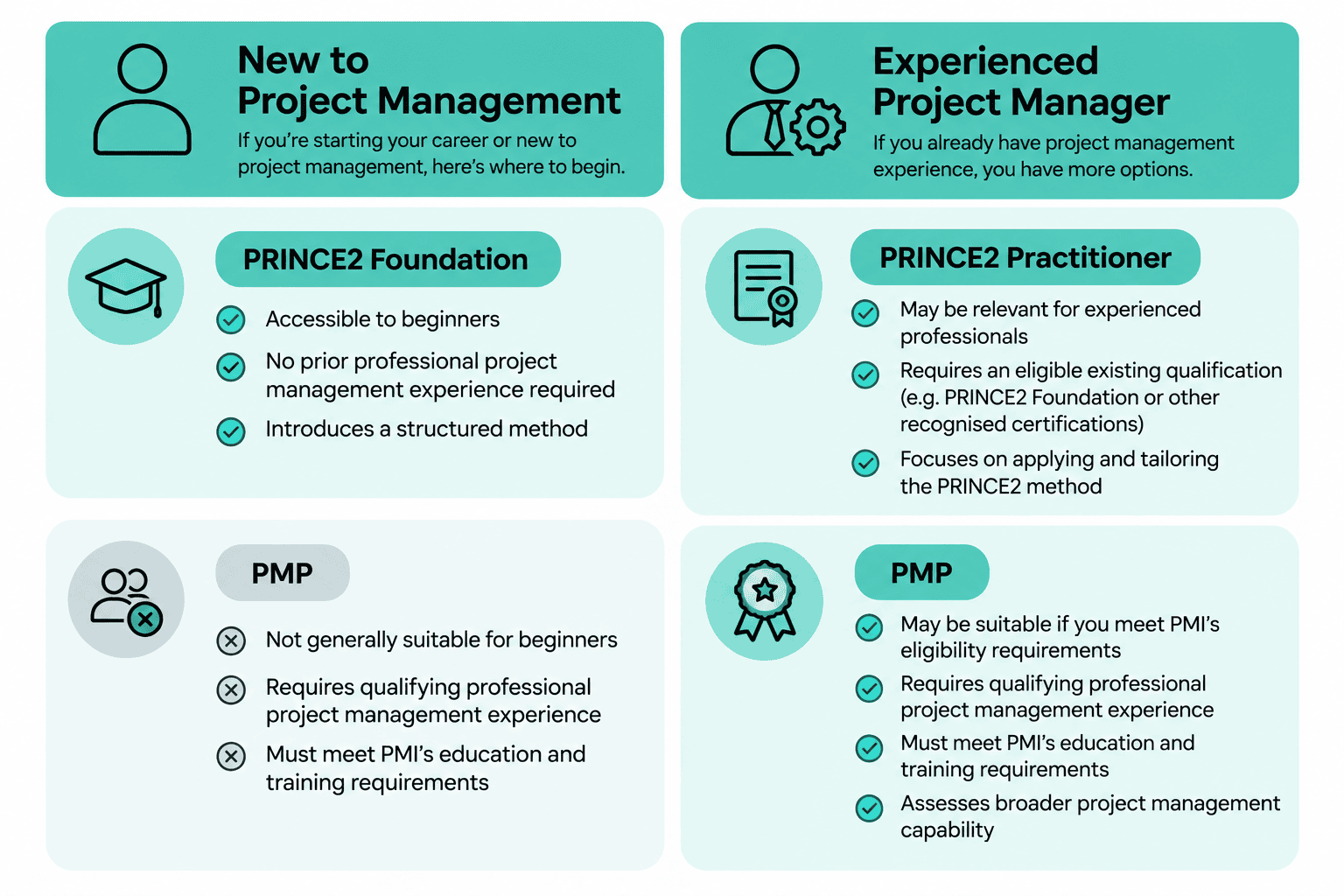
PRINCE2 Project Management Foundation is open to learners without previous professional Project Management experience. PRINCE2 Practitioner has additional prerequisites because it focuses on applying and tailoring the method.
PRINCE2 Foundation Requirements
PRINCE2® Project Management Foundation introduces the principles, practices, processes, and terminology of the PRINCE2 method.
There are no formal requirements to have previously worked as a Project Manager or accumulated several years of professional experience.
This makes Foundation accessible to:
- Career changers exploring Project Management.
- Project Coordinators and Project Support Officers.
- Professionals who contribute to projects but have not formally managed them.
- Graduates interested in Project Management careers.
- Experienced professionals who are new to PRINCE2.
Foundation does not automatically qualify someone to manage complex projects independently. Instead, it establishes knowledge of a recognised Project Management method.
For a closer look, read our guide to PRINCE2 Foundation.
PRINCE2 Practitioner Requirements
PRINCE2® Project Management Practitioner focuses on applying and tailoring PRINCE2 to different project situations.
Unlike Foundation, Practitioner requires an eligible existing qualification.
Recognised prerequisites include PRINCE2 Foundation and certain other Project Management certifications, including PMP, CAPM, APM qualifications, and specified IPMA certifications.
This means Foundation is a common progression route, but it is not the only recognised way to become eligible for Practitioner.
You can explore the distinction in our guide to PRINCE2 Foundation vs Practitioner.
What Does PRINCE2 Teach You?
PRINCE2 teaches a structured method for organising, directing, managing, and controlling projects. It explains how Project Management responsibilities, governance, planning, decision-making, and delivery controls work together.
The current PRINCE2 method integrates five elements:
- Principles: Seven guiding obligations that underpin effective application of the method.
- People: The human aspects of Project Management, including leadership, collaboration, communication, and stakeholder engagement.
- Practices: Seven recurring aspects of managing projects, including Business Case, Organising, Plans, Quality, Risk, Issues, and Progress.
- Processes: Seven processes that describe the management activities involved throughout the project lifecycle.
- Project Context: The environment and circumstances that influence how PRINCE2 should be tailored.
PRINCE2 also establishes responsibilities and governance arrangements that help clarify who makes decisions, who manages delivery, and when matters should be escalated.
For example, a Project Manager using PRINCE2 can establish agreed tolerances for cost, time, and scope, manage progress through stages, and escalate forecasts that exceed delegated authority.
The method provides a common structure while allowing teams to adapt its application to their projects.
This is an important distinction: PRINCE2 is not simply a collection of Project Management concepts. It is a defined method that brings those concepts together.
To explore the method in more detail, read What Is PRINCE2 Project Management?.
What Does PMP Assess?
PMP assesses Project Management knowledge and capability across a broad range of professional responsibilities and delivery approaches. It is not limited to one prescribed method.
The current PMP examination is structured around three domains.
| Domain | Examination weighting | Main emphasis |
|---|---|---|
| People | 33% | Leadership, team effectiveness, stakeholder engagement, and people-related responsibilities |
| Process | 41% | Managing project delivery and associated Project Management activities |
| Business Environment | 26% | Business value, outcomes, organisational context, and strategic considerations |
These weightings reflect PMI’s July 2026 examination update.
The current examination also addresses predictive, adaptive/Agile, and hybrid Project Management approaches.
Approximately 40% of examination items represent predictive approaches, while the remaining 60% are divided between adaptive/Agile and hybrid approaches.
The revised examination places greater emphasis on areas including value delivery, sustainability, artificial intelligence, and stakeholder engagement.
Rather than examining a candidate’s understanding of one named method, PMP assesses professional knowledge and judgement across different Project Management situations.
This is why PMP can be relevant to professionals working in organisations with different delivery models.
Is PMP a Project Management Methodology?
No. PMP is a professional certification, not a Project Management methodology.
This is one of the most commonly misunderstood differences between PRINCE2 and PMP.
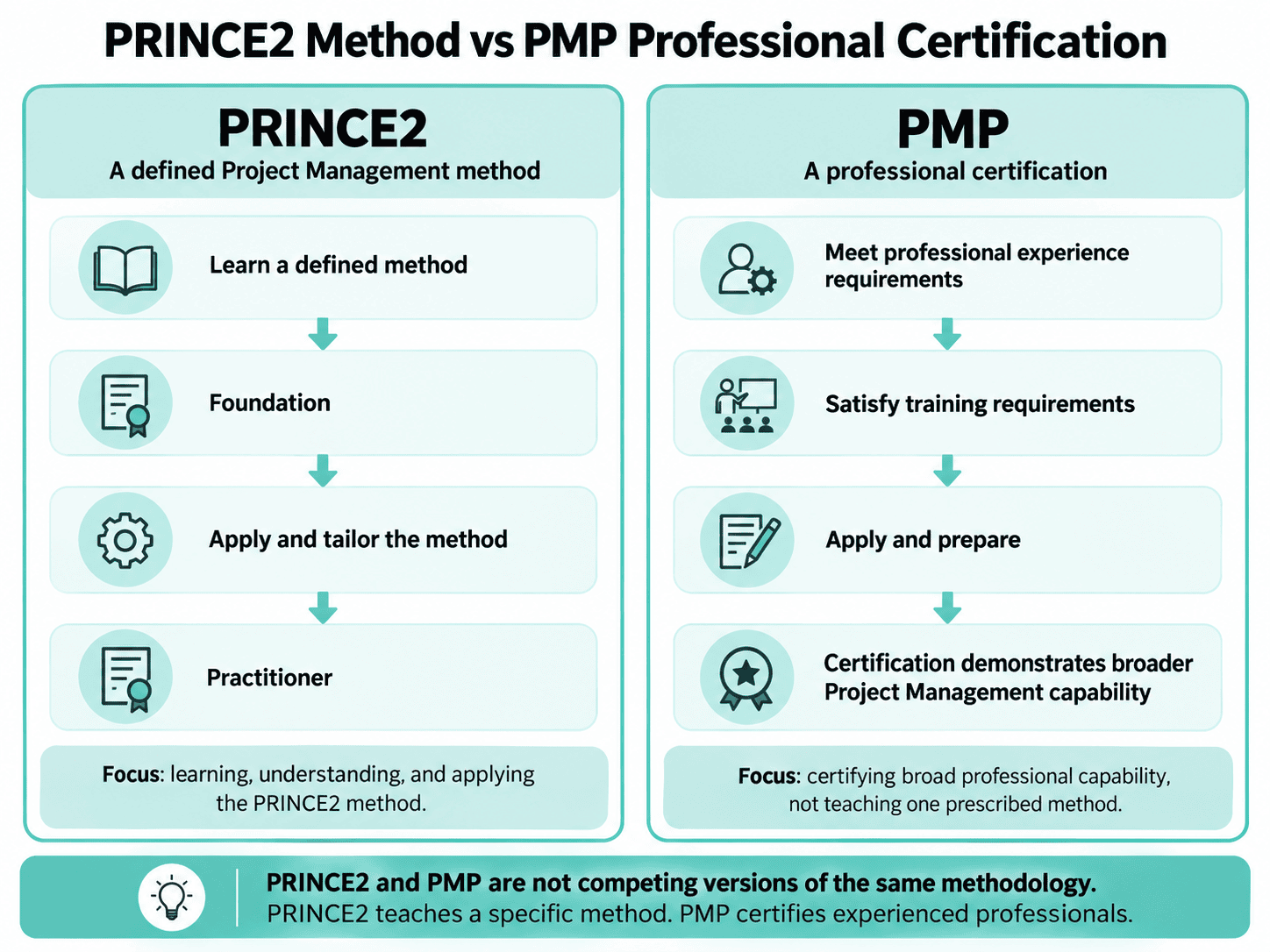
PRINCE2 provides a specific method for managing projects. PMP, by contrast, is a certification awarded by PMI to professionals who meet its requirements and pass the examination.
PMP certification does not require every certified professional to use one particular method.
A PMP-certified Project Manager might work in a predictive environment, an Agile environment, or an organisation that combines different approaches.
That flexibility is part of PMP’s purpose.
Is the PMBOK Guide a Project Management Method?
The PMBOK® Guide is not the same thing as a prescribed Project Management methodology.
Published by PMI, A Guide to the Project Management Body of Knowledge provides standards and guidance informed by professional Project Management practice.
The current Eighth Edition includes principles, performance domains, and practical guidance addressing different Project Management environments.
Although the PMBOK Guide is relevant to the professional body of knowledge associated with PMI, it should not be confused with PMP certification.
The PMP examination is defined by its current Exam Content Outline, rather than being simply a test of one edition of the PMBOK Guide.
Is PRINCE2 or PMP Better for Beginners?
PRINCE2 Foundation is generally the more accessible option for beginners because it does not require previous professional Project Management experience. PMP is intended for professionals who already meet substantial experience requirements.
If you’re starting from scratch, you can begin learning PRINCE2 without first spending several years managing projects.
Foundation introduces terminology, governance, planning, roles, processes, and practices that can help you understand how structured Project Management works.
PMP follows a different model.
You cannot generally begin a Project Management career by immediately applying for PMP certification because you must first meet PMI’s eligibility criteria.
That does not make PRINCE2 universally better.
It means PRINCE2 Foundation is available at an earlier stage of professional development.
For beginners, accessibility is often the deciding factor.
Should a Career Changer Choose PRINCE2 or PMP?
PRINCE2 Foundation may be a more realistic starting point for career changers who do not yet have qualifying Project Management experience. It provides an opportunity to develop formal knowledge while building practical experience.
Imagine someone moving from administration, operations, customer service, or another professional field into Project Management.
They may already have transferable skills involving communication, organisation, deadlines, stakeholders, and problem-solving.
However, those skills do not automatically establish eligibility for PMP.
PRINCE2 Foundation allows them to begin learning a defined Project Management method without having to prove several years of prior professional Project Management responsibility.
From there, they can consider Practitioner and seek opportunities to develop relevant workplace experience.
Someone changing careers who has already managed qualifying projects professionally may have a different starting point and could potentially explore PMP eligibility.
For a broader look at career routes, read How to Become a Project Manager.
Remember that earning a qualification can support career development, but it does not replace workplace experience or guarantee employment.
Should an Experienced Project Manager Choose PRINCE2 or PMP?
Both PRINCE2 Practitioner and PMP can be valuable to experienced Project Managers, but the most appropriate choice depends on the professional capability they want to develop or demonstrate.
PMP may be particularly relevant if you:
- Meet PMI’s education, experience, and training requirements.
- Want a professional certification covering broad Project Management capability.
- Work in, or are targeting, organisations that value PMP certification.
- Manage projects using different delivery approaches.
PRINCE2 Practitioner may be particularly relevant if you:
- Work in an organisation that uses PRINCE2.
- Want to strengthen your ability to apply and tailor the method.
- Need a clearer understanding of PRINCE2 governance, responsibilities, and controls.
- Meet the current Practitioner prerequisites.
An experienced Project Manager could also find value in holding both.
For example, someone may use PRINCE2 to manage governance and project controls while also holding PMP to demonstrate wider professional Project Management knowledge.
The two are not mutually exclusive.
Is PRINCE2 Practitioner Equivalent to PMP?
No. PRINCE2 Practitioner and PMP should not be treated as directly equivalent qualifications because they have different eligibility requirements and assessment purposes.
PRINCE2 Practitioner assesses a candidate’s ability to apply and tailor the PRINCE2 method in a project context.
PMP assesses broader professional Project Management capability and requires substantial qualifying experience before certification.
Both involve application and professional judgement, but their assessment models differ.
Practitioner also recognises certain alternative qualifications as prerequisites, including PMP.
This recognition does not make the certifications equivalent. It just means PeopleCert accepts particular existing qualifications as suitable entry routes to the Practitioner examination.
Neither qualification should automatically be described as academically higher or lower than the other without an appropriate recognised equivalence framework.
PRINCE2 vs PMP in the UK: Which Is More Relevant?
Both PRINCE2 and PMP can be relevant in the UK. The better choice depends on the role, employer, sector, and type of Project Management work you want to pursue.
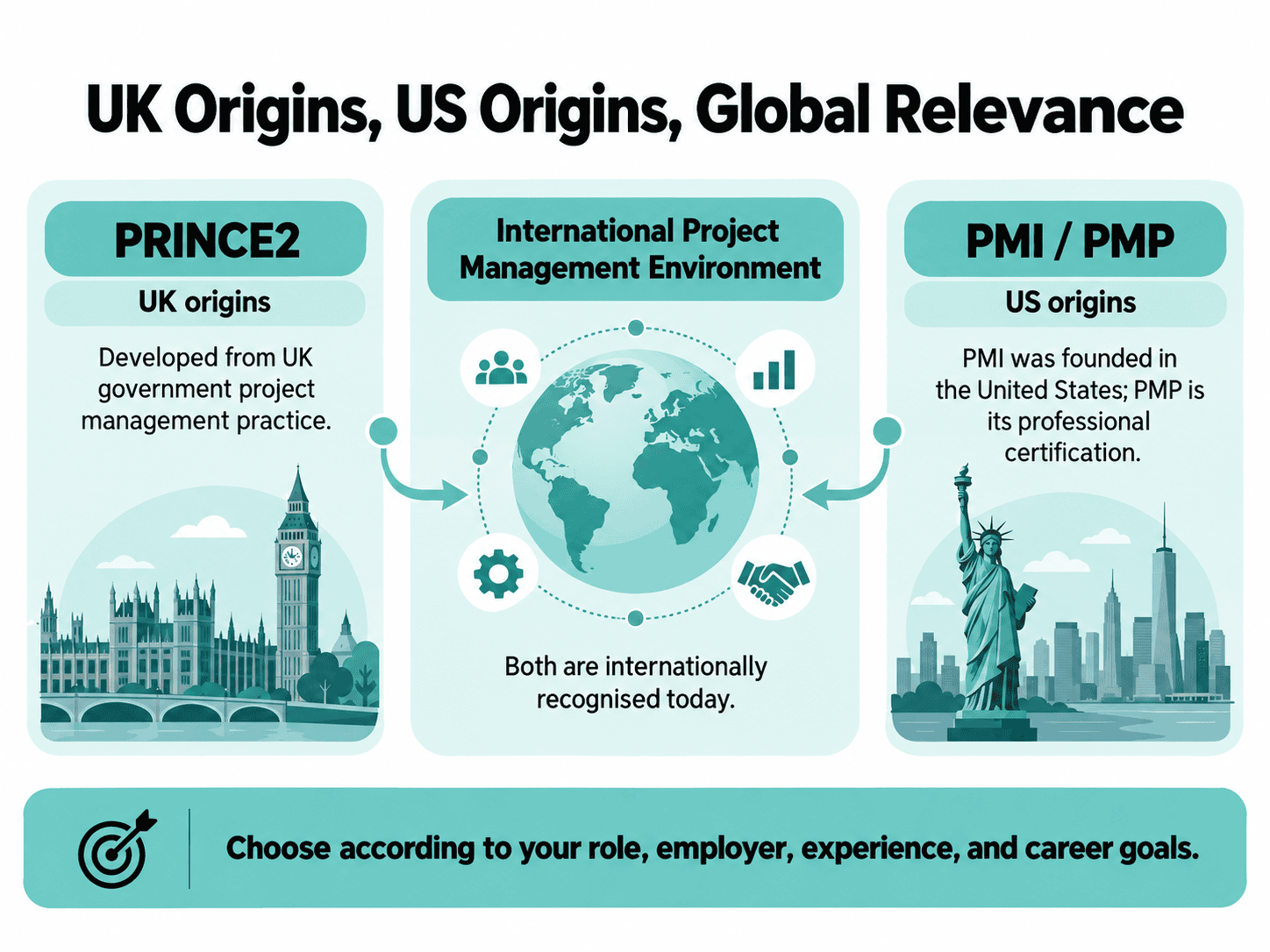
PRINCE2 has strong historical connections to UK Project Management practice.
Its origins can be traced to work undertaken within the UK government’s Central Computer and Telecommunications Agency, with PRINCE2 subsequently developed as a generic method suitable for different project environments.
That background makes PRINCE2 particularly relevant to understanding the development of structured Project Management practice in the UK.
However, historical origins alone do not establish that PRINCE2 is the preferred qualification for every UK employer.
PMP is also internationally recognised and may be relevant to UK organisations, particularly where employers seek experienced Project Managers with PMI certification.
When comparing qualifications for a specific UK role, examine the job description.
Does the employer explicitly request PRINCE2? Does it prefer PMP? Does it accept either? Or is practical Project Management experience the main requirement?
The answers will often be more useful than broad claims about which certification is more popular.
For a more focused discussion of how UK employers assess PRINCE2 certification alongside experience and other requirements, read our guide to whether employers value PRINCE2 qualifications.
You can also explore how PRINCE2 compares with another established Project Management qualification in our APM vs PRINCE2 guide.
PRINCE2 vs PMP in the US
PMP has strong historical connections to the United States because PMI was founded there.
However, PMP is internationally recognised rather than being an American-only certification.
Likewise, PRINCE2’s UK origins do not restrict it to UK projects.
For someone targeting a US employer, the most useful approach is to investigate the qualifications requested for the particular role.
If PMP is explicitly required, check your eligibility directly with PMI.
If an organisation uses PRINCE2, knowledge of that method may also be relevant.
The country where a qualification originated should inform your understanding, not determine your decision on its own.
Are PRINCE2 and PMP Internationally Recognised?
Yes. Both PRINCE2 and PMP have international recognition and are relevant beyond their countries of origin.
PRINCE2 is a method that can be applied in different organisational and geographical environments.
PMP is positioned by PMI as a professional certification that is not tied to one industry, methodology, or geography.
For someone considering an international Project Management career, either may have value.
However, international recognition is not the same as universal employer preference.
Check which qualifications appear in the roles, organisations, and locations that interest you.
Does PRINCE2 or PMP Teach You How to Manage a Project?
PRINCE2 provides an explicit method for managing projects, while PMP assesses professional capability across different Project Management approaches.
This is a distinction in purpose, not a claim that one is practical and the other theoretical.
PRINCE2 explains how to establish governance, assign responsibilities, manage by stages, maintain business justification, control progress, and tailor the method to a project’s circumstances.
PMP preparation also involves studying practical Project Management knowledge and applying judgement to project scenarios.
However, PMP certification is not designed around teaching candidates one mandatory method to follow.
If you want to learn a defined Project Management method, PRINCE2 aligns directly with that objective.
If you already manage projects and want to demonstrate wider professional capability, PMP may align more closely with yours.
How Do the PRINCE2 and PMP Exams Differ?
The examinations differ in format, duration, and what they assess.
| Feature | PRINCE2 Foundation | PRINCE2 Practitioner | PMP |
|---|---|---|---|
| Questions | 60 | 56 questions and sub-questions, worth 70 marks | 180 |
| Duration | 60 minutes | 150 minutes | 240 minutes |
| Format | Multiple choice | Objective testing using project scenarios | Multiple question formats, including scenario-based assessment |
| Open-book? | No | Yes, subject to PeopleCert’s permitted-material rules | No |
| Pass requirement | 60% | 60% | PMI uses its own scoring process rather than a universal published percentage |
| Main assessment focus | Understanding the PRINCE2 method | Applying and tailoring PRINCE2 | Broader professional Project Management capability |
The Practitioner examination uses 70 available marks, which should not be confused with 70 individual questions.
PMP’s current examination format reflects the July 2026 update.
For more detail about the PRINCE2 examinations, see our Foundation exam guide and Practitioner exam guide.
Do PRINCE2 and PMP Certifications Need to Be Renewed?
Yes. Both PRINCE2 and PMP have ongoing certification maintenance requirements, although their renewal systems differ.
PRINCE2 certifications are subject to PeopleCert’s three-year renewal cycle. Current renewal options include qualifying further certification activity and continuous professional development through the applicable PeopleCert membership arrangements.
PMP certification is maintained through PMI’s Continuing Certification Requirements programme.
PMP holders must earn 60 Professional Development Units (PDUs) within a three-year cycle, meet the applicable activity requirements, and complete the renewal process.
Because maintenance rules and membership arrangements can change, check the current requirements before planning your long-term certification costs.
Which Has More Career Value: PRINCE2 or PMP?
Neither qualification has universally greater career value. Their usefulness depends on your experience, employer requirements, sector, and professional objectives.
PMP can be particularly valuable to experienced Project Managers who meet PMI’s requirements and work in environments where the certification is recognised.
PRINCE2 can support professionals at different career stages, from those developing their understanding of formal Project Management to experienced practitioners applying the method within their organisations.
The qualifications also demonstrate different things.
PRINCE2 certification demonstrates knowledge or application of a specific method, depending on the level achieved.
PMP certification demonstrates that an experienced professional has met PMI’s eligibility requirements and passed its broader professional assessment.
Neither guarantees a particular salary, promotion, or employment outcome.
For a more detailed discussion of the qualification’s potential value, read Is PRINCE2 Worth It?.
Should You Choose PRINCE2 or PMP?
Choose according to your career stage, the qualifications you’re eligible for, and what you want to achieve. There is no universal winner.
| Your situation | Qualification to explore | Why |
|---|---|---|
| You’re new to Project Management | PRINCE2 Foundation | No prior professional Project Management experience required |
| You’re changing careers without qualifying PM experience | PRINCE2 Foundation | Accessible route into learning a structured method |
| You already hold PRINCE2 Foundation | PRINCE2 Practitioner | Develops application and tailoring capability |
| You have several years of qualifying Project Management experience | PMP | May be relevant for demonstrating broader professional capability |
| Your organisation uses PRINCE2 | PRINCE2 Foundation or Practitioner | Helps you understand and apply the method |
| Your employer specifically requests PMP | PMP, subject to eligibility | Directly aligns with the stated requirement |
| You’re experienced and both qualifications are relevant to your work | Consider both | They can provide complementary professional value |
If you’re considering PMP, review PMI’s current certification requirements before selecting any examination preparation programme.
Frequently Asked Questions About PRINCE2 vs PMP
What Is the Main Difference Between PRINCE2 and PMP?
PRINCE2 is a structured Project Management method, with qualifications that assess understanding and application of that method. PMP is a professional certification awarded by PMI that assesses broader Project Management capability. PRINCE2 Foundation can be studied without previous professional Project Management experience, whereas PMP requires substantial qualifying experience. The qualifications therefore serve different purposes and career stages.
Can You Take PMP Without Project Management Experience?
No, not without meeting PMI’s qualifying professional Project Management experience requirements. The amount required depends on your education and currently ranges from two to five years. PMI assesses professional project-management responsibilities, not simply whether you have held the formal job title of Project Manager. Check its official eligibility requirements for the latest rules.
Do You Need Experience for PRINCE2 Foundation?
No. PRINCE2 Foundation does not require previous professional Project Management experience. It is designed to establish an understanding of the PRINCE2 method, including its principles, practices, processes, and terminology. This makes it accessible to beginners, career changers, and professionals who contribute to projects without having formally managed them.
Is PMP Harder Than PRINCE2?
There is no straightforward comparison because the qualifications assess different things. PMP requires substantial professional experience before entry and assesses broad Project Management capability. PRINCE2 Foundation focuses on understanding a defined method, while Practitioner tests its application and tailoring. The difficulty of each examination depends on the candidate’s existing knowledge, experience, and preparation.
Is PRINCE2 Practitioner Equivalent to PMP?
No. PRINCE2 Practitioner and PMP are not direct equivalents. Practitioner assesses the application and tailoring of the PRINCE2 method, while PMP assesses broader professional Project Management capability and has substantial experience prerequisites. PeopleCert recognises PMP as one possible Practitioner prerequisite, but that does not establish equivalence between the certifications.
Is PMP Only Useful in the United States?
No. PMP is an internationally recognised certification, despite PMI’s origins in the United States. Its relevance depends on the employers, sectors, and geographical markets you are targeting. PRINCE2 is also internationally recognised despite its UK origins. Neither qualification should be selected solely according to its country of origin.
Can You Hold Both PRINCE2 and PMP?
Yes. Professionals can hold both PRINCE2 and PMP, provided they satisfy the relevant qualification requirements. The certifications can complement one another because PRINCE2 focuses on a defined Project Management method, while PMP assesses wider professional capability. Holding both may be useful in some organisations or career paths, but it is not necessary for every Project Manager.
Should You Take PRINCE2 Before PMP?
Not necessarily. PRINCE2 is not a mandatory prerequisite for PMP, and the two qualifications do not form a single formal progression pathway. For someone new to Project Management, Foundation may be a useful starting point while they build experience. An experienced Project Manager who already meets PMI’s requirements may reasonably pursue PMP directly.
So, PRINCE2 or PMP?
PRINCE2 and PMP are both established Project Management qualifications, but choosing between them should begin with understanding what they are designed to achieve.
If you’re starting a Project Management career, PRINCE2 Foundation offers an accessible way to learn a structured method without needing several years of professional experience.
If you’re already an experienced Project Manager, PMP may be particularly relevant if you meet PMI’s requirements and want to demonstrate broader professional capability.
PRINCE2 Practitioner provides another option for professionals who want to develop their ability to apply and tailor the PRINCE2 method.
Ultimately, the most useful qualification is the one that aligns with your experience, professional goals, and the requirements of the roles you want to pursue.
Not sure which Project Management qualification fits your experience and goals?
Our Course & Career Advisors can help you explore the PRINCE2 training routes available through ITonlinelearning and consider your wider career objectives.