What does AI upskilling in the UK actually mean?
AI upskilling in the UK is becoming a much bigger conversation as artificial intelligence moves from something people experiment with occasionally to something increasingly embedded in everyday work.
But there is a problem with the phrase “AI skills”: it can mean almost anything.
For one person, AI skills might mean programming, machine learning, Retrieval-Augmented Generation (RAG), or building AI applications.
For another, it might mean using an AI assistant to organise information, analyse a document, improve a project plan, or help debug code.
For a manager, AI capability may have much less to do with programming and much more to do with governance, ethics, risk, organisational change, and leading people.
Research published through the UK Government’s Skills for AI programme in 2026 makes that distinction especially important.
Its central finding is that AI use is growing faster than workforce capability. So, the challenge isn’t simply giving more people access to AI. It’s helping them understand how to use it effectively, safely, and appropriately.
AI is already becoming part of everyday work
The Skills for AI research drew on 23 workshops involving around 150 organisations, ten case studies, and a UK employer survey with 536 responses.
More than 44% of surveyed organisations reported using AI tools daily.
Yet capability isn’t necessarily developing at the same speed.
The research found that learning inside organisations is often informal. People may experiment with tools, ask colleagues for advice, watch videos, or simply learn through trial and error.
Experimentation isn’t necessarily a bad thing.
It’s often how people discover useful applications.
The problem comes when an organisation has widespread AI use without shared standards for accuracy, privacy, security, quality, ethics, or appropriate use.
Knowing how to ask AI for something is only the beginning.
AI literacy doesn’t mean becoming an AI engineer
One of the biggest misconceptions about AI upskilling is that everybody now needs highly technical AI expertise.
They don’t.
Skills England’s 2026 Annual Skills Report makes the broader challenge clear: the UK needs specialist AI capability, but the wider workforce also needs to adapt as AI becomes embedded in work.
That creates different levels of capability.
| Type of capability | What it might involve | Who could benefit |
|---|---|---|
| AI literacy | Using AI tools, writing effective instructions, checking outputs, understanding limitations | Employees across many professions |
| Profession-specific AI | Applying AI to project work, data analysis, coding, business analysis, or another specialism | Existing and aspiring professionals |
| Technical AI | Programming, data, machine learning, RAG, AI application development | Aspiring AI and technical professionals |
| AI security | Securing AI-enabled environments and understanding AI-related cyber threats | Cyber security professionals |
| AI leadership | Strategy, ethics, governance, risk, implementation, and organisational change | Managers and senior leaders |
There isn’t one correct level.
The right level depends on your role and what you’re trying to achieve.
Practical AI skills matter more than simply knowing a tool
AI products will continue to change.
That makes training based entirely around the location of particular buttons or features fragile.
The Skills for AI research instead emphasises practical, contextualised learning that connects AI with real workplace activities and decisions.
For example, someone in project management might practise using AI to help:
- structure project information;
- generate initial task breakdowns;
- explore stakeholder needs;
- organise meeting information;
- identify possible project risks;
- improve communications;
- summarise reporting information; and
- capture lessons learned.
A business analyst might apply AI to requirements and process analysis.
A data analyst might use it while framing questions, preparing data, checking answers, generating visual ideas, or communicating findings.
A developer could use AI-assisted development tools for prompting, code explanation, debugging, or refactoring.
The important word here is apply.
Knowing that an AI tool exists isn’t the same as knowing how to use it well within a professional context.
Verification and judgement are AI skills, too
Anyone who has spent time using generative AI knows something important:
It can sound convincing when it’s wrong.
That changes the nature of digital literacy.
Getting an output is easy, but evaluating that output can be much harder.
Workers therefore need to understand questions such as:
- Where did this information come from?
- Can I verify it?
- Has the AI misunderstood the context?
- Is anything missing?
- Is the output biased or misleading?
- Is the information safe to share with this tool?
- Is a human decision required here?
- What happens if this answer is wrong?
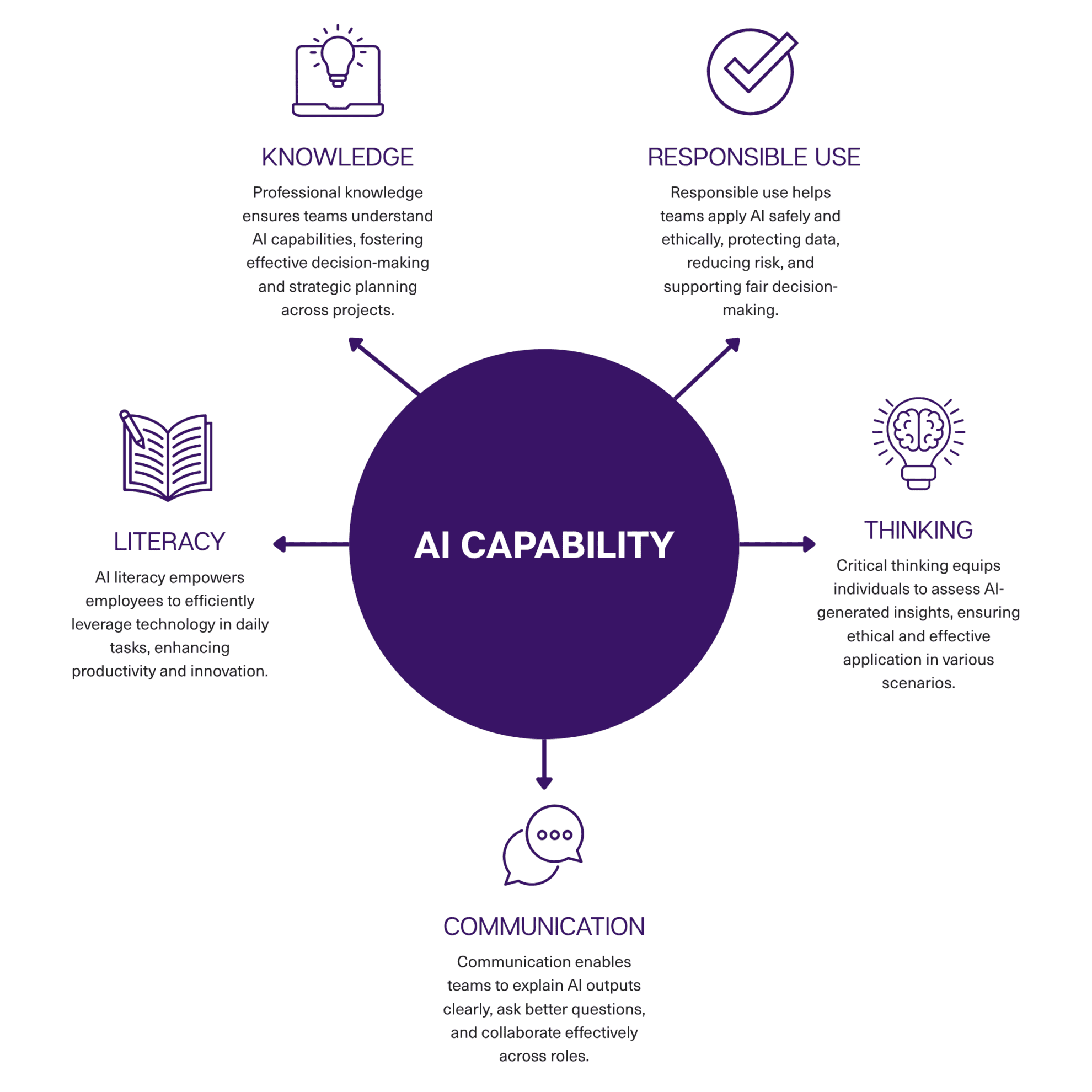
Skills England’s AI foundation skills for work include interacting effectively with AI tools, using them to support routine processes and tasks, understanding risks and consequences, and analysing information.
Critical thinking therefore isn’t separate from AI capability.
It’s part of it.
Responsible AI skills are becoming increasingly important
The more AI becomes embedded in work, the more organisations have to think about how it is used.
An employee pasting confidential information into an inappropriate AI service isn’t simply making a prompting mistake.
It may create a privacy, security, governance, or compliance problem.
An employee accepting an AI-generated analysis without checking it may create a quality problem.
A manager introducing AI into a team without considering the impact on responsibilities, controls, or staff may create an organisational problem.
Thus, the Skills for AI research recommends developing technical, non-technical, and responsible AI skills together.
This means responsible AI shouldn’t be treated as a short disclaimer at the end of a course.
It should influence how people use the technology from the beginning.
Human skills aren’t becoming obsolete
There is a strange contradiction in the AI conversation.
The more capable technology becomes, the easier it is to assume that technical capability is all that matters.
Yet many of the skills needed to use AI well are deeply human.
Communication, critical thinking, analytical ability, judgement, problem-solving, collaboration, and responsible decision-making all influence how effectively someone can use AI.
Imagine two employees using exactly the same AI tool.
One asks for an answer, copies the response, and moves on.
The other defines the problem carefully, provides appropriate context, challenges the first answer, checks the evidence, identifies gaps, applies professional judgement, and then communicates the conclusion clearly.
They technically used the same technology.
Their capability is very different.
That’s why learning to work with AI should include more than learning prompts.
Some people will need deeper technical AI skills
There is still an important specialist side to the market.
People who want to design, build, integrate, or improve AI-powered solutions need deeper technical foundations.
Depending on the role, that could include:
- Python;
- data fundamentals;
- cloud concepts;
- prompt engineering;
- machine learning;
- Retrieval-Augmented Generation (RAG);
- AI application development; and
- practical project work.
This is a different learning goal from simply becoming more productive with an AI assistant.
So, someone considering AI training should ask an important question before choosing a course:
Do I want to use AI, or do I want to build with AI?
Cyber security will form part of the AI skills picture
More AI also means a changing security landscape.
Organisations still need people who can protect systems, investigate threats, understand vulnerabilities, manage incidents, assess risk, and operate securely.
AI adds another dimension.
Security professionals increasingly need to understand how AI can affect both attackers and defenders, how AI-enabled systems introduce new risks, and how security practices need to adapt.
For someone interested in technology but less attracted to building AI applications directly, cyber security offers another route into the changing digital economy.
Organisations also need people who can lead AI adoption
Not every AI problem can be solved by a developer.
Consider what happens when an organisation decides to introduce AI across multiple departments.
Somebody has to decide where AI creates genuine value.
Somebody has to consider risk.
Somebody needs to define governance.
Somebody has to communicate the change.
Somebody must consider employees, customers, ethics, accountability, and organisational culture.
And somebody needs to determine whether the technology is actually delivering the intended outcome.
Those responsibilities sit increasingly within leadership and management.
Managers don’t necessarily need to become AI engineers.
They do need enough understanding to ask informed questions and lead responsible decisions.
What does good AI training look like?
The 2026 Skills for AI programme developed a framework called PRIMES from its research into effective AI workforce development.
It says AI training should be:
- Practical – grounded in real tasks and decisions.
- Reachable – accessible and inclusive.
- Integrated – aligned with working practices, organisational systems, standards, and governance.
- Modular – flexible enough to accommodate different starting points and learning needs.
- Expandable – capable of growing across different roles, teams, and organisations.
- Sustainable – designed to adapt as technology and working practices change.
The underlying research involved 23 workshops, ten case studies, and 536 survey responses.
Importantly, the framework focuses on the principles behind effective learning rather than promoting a particular AI product.
That reflects an important reality about AI learning.
You probably won’t finish one course and be “done with AI” forever.
The tools will change.
Your profession will change.
Your responsibilities may change.
The goal is to build a foundation that allows you to keep learning.
Upskilling is ultimately about adaptability
AI skills matter, yes, but the wider story is about adaptability.
Skills England’s annual report describes the need to enable people to upskill and reskill as technologies and roles evolve.
For one person, that might mean becoming an AI engineer.
For another, it could mean understanding how AI supports their current role.
Someone else may develop stronger cyber security, coding, or data skills.
A manager may need to understand governance and organisational change.
There isn’t one AI career path because AI isn’t one career. It’s a technology that sits across many careers.
The useful question is less:
“Do I need AI skills?”
and more:
“What level of AI capability makes sense for the work I want to do?”
That gives you a much more useful starting point for choosing what to learn next.
Frequently Asked Questions About AI Upskilling in the UK
AI skills can range from basic AI literacy and responsible use through to profession-specific applications, AI security, leadership, programming, machine learning, and AI engineering. The appropriate level depends on the individual’s role, goals, and responsibilities. Someone who needs to use AI effectively at work doesn’t necessarily require the same technical knowledge as someone developing AI-powered applications.
Not necessarily.
Many employees can use AI within areas such as project management, business analysis, data analysis, management, and other professions without building AI systems themselves. Coding becomes considerably more important if you want to develop, customise, or integrate technical AI solutions.
AI is increasingly being incorporated into workplace tools and processes, while current UK research indicates that workforce capability isn’t always developing at the same pace as adoption. Effective upskilling can help people move beyond experimentation towards using AI more confidently, critically, safely, and productively.
Responsible AI involves understanding the risks and consequences associated with AI and using the technology with appropriate attention to areas such as privacy, security, accuracy, bias, accountability, and human oversight. It also means understanding when AI is appropriate for a task – and when it isn’t.
AI development is likely to be an ongoing process rather than something most people complete once. The technologies will continue to evolve, which means workers may need to update their knowledge as tools, organisational practices, professional expectations, and their own responsibilities change. The aim should therefore be to develop useful foundations alongside the ability to continue learning.
Sources
Department for Work and Pensions and Skills England (2026) Skills England annual skills report 2026. Published 1 June 2026; updated 6 July 2026.
Department for Work and Pensions and Skills England (2026) Skills for AI: What works for AI upskilling in the UK. Published 10 June 2026; updated 27 July 2026.
Department for Work and Pensions and Skills England (2026) Employer guide: What works for AI upskilling in the UK. Updated 27 July 2026.
Department for Work and Pensions and Skills England (2026) Research evidence, analysis and methodology: What works for AI upskilling in the UK. Updated 27 July 2026.