How to Become a Chartered Manager
How to become a Chartered Manager depends on the management qualifications and professional experience you already have. Experienced managers can apply through CMI’s Full Assessment route, eligible CMI learners may qualify for the Fast Track route, and people completing certain management apprenticeships can achieve Chartered status through their End Point Assessment.
You don’t necessarily need a degree or an existing CMI qualification. However, you’ll usually need several years of relevant management experience and evidence that you’ve applied your leadership skills effectively in the workplace.
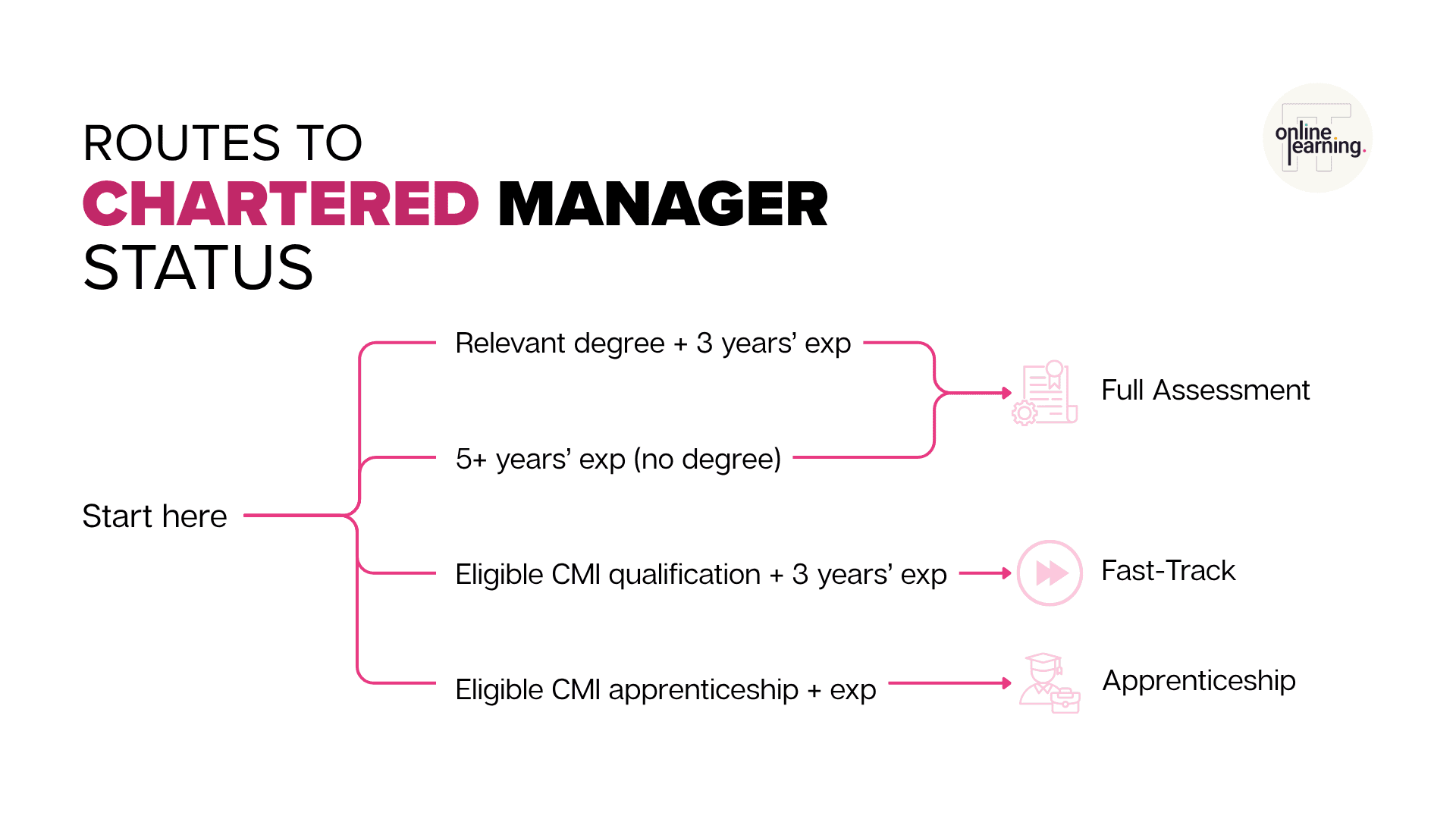
In simple terms, the main routes are:
| Your current position | Potential route | What you will generally need |
| You have a management, business, or leadership degree | Full Assessment | The relevant degree and at least three years of management experience |
| You don’t have a relevant management qualification | Full Assessment | At least five years of management experience at an appropriate operational or senior level |
| You recently completed an eligible CMI qualification | CMI Fast Track | An eligible Level 5–8 CMI qualification and at least three years of management experience |
| You completed an eligible management apprenticeship | Apprenticeship route | A relevant End Point Assessment and the management experience required for the appropriate status |
| You’re still developing your management experience | Foundation Chartered Manager | Completion of an eligible qualification, apprenticeship, or development programme |
CMI currently identifies three principal routes to full Chartered Manager status: Full Assessment, CMI Fast Track, and the Apprenticeship route. The right one depends on your qualifications, experience, and recent professional development.
This blog explains what Chartered Manager status means, who can apply, which qualifications may support your journey, and what to do next.
What Is a Chartered Manager?
A Chartered Manager is a management professional whose skills, workplace impact, and commitment to continuing professional development have been formally assessed against CMI’s Professional Standard.
Chartered Manager status is awarded by the Chartered Management Institute, the UK’s Chartered professional body for management and leadership. The protected professional title uses the post-nominal letters CMgr.
It’s not just the name of a job or an academic qualification; it’s a professional status demonstrating that you can apply management and leadership knowledge in real organisational situations.
CMI describes Chartered Manager as its highest accolade in management and leadership and as a sign of professional credibility, integrity, and management excellence.
What Does CMgr Mean?
CMgr means Chartered Manager.
These letters may be used after the name of someone who has successfully completed the Chartered Manager assessment and continues to meet the relevant membership and professional requirements.
For example:
Alex Smith CMgr MCMI
In this example:
- CMgr shows that Alex has achieved Chartered Manager status.
- MCMI shows that Alex is a Member of the Chartered Management Institute.
The CMgr title is protected, so it should only be used by someone who has been formally awarded (and continues to maintain) Chartered status.
What Does MCMI Mean?
MCMI means Member of the Chartered Management Institute.
MCMI is a professional membership grade rather than another name for Chartered Manager. Someone may therefore be an MCMI without yet being a Chartered Manager.
A person who has both achieved Chartered Manager status and holds the Member grade may use CMgr MCMI. Senior professionals who meet CMI’s Fellow-level requirements may instead use CMgr FCMI.
CMI currently describes Chartered Member as being available to professionals who meet its Member criteria and successfully complete the Chartered Manager assessment. Chartered Fellow has additional senior experience requirements, including substantial experience at strategic leadership level.
What Are the Requirements for Becoming a Chartered Manager?
The requirements vary according to the route you take.
Route 1: Full Assessment
The Full Assessment route is designed for experienced managers whose qualifications or experience demonstrate management capability at the required level.
You may be eligible through either of the following paths:
- A degree-level qualification focused on management, business, or leadership, plus at least three years of experience in a management role.
- At least five years of management experience at an equivalent Level 5, operational, or senior management level if you don’t hold a management-specific qualification.
The assessment includes a written application explaining your management and leadership journey and key workplace achievements. This is followed by an online professional discussion with an independent Chartered Manager assessor.
Route 2: CMI Fast Track
The CMI Fast Track route recognises recent learning completed through an eligible CMI qualification.
You may be eligible when you have at least three years of management experience and have completed one of the following within the previous five years:
- An eligible CMI Diploma or Extended Diploma at Level 5 or Level 6.
- An eligible CMI Certificate, Diploma, or Extended Diploma at Level 7 or Level 8.
The exact qualification must fall within one of CMI’s eligible subject areas. These currently include routes within Management and Leadership, Strategic Management and Leadership, Coaching and Mentoring, and Sustainability Leadership.
Because CMI has already assessed part of your management knowledge through the qualification, the Fast Track assessment takes this prior learning into account.
Route 3: Management Apprenticeship
Some learners can achieve Foundation or full Chartered Manager status after completing the End Point Assessment for an eligible management apprenticeship.
CMI currently lists apprenticeship standards including:
- Level 3 Team Leader or Supervisor
- Level 3 Business Administrator
- Level 4 Associate Project Manager
- Level 5 Operations or Departmental Manager
- Level 6 Improvement Leader
- Level 6 Chartered Manager Degree Apprenticeship
- Level 7 Senior Leader Apprenticeship
The status awarded depends partly on the learner’s management experience. CMI membership must also be maintained to retain Chartered status.
Do You Need a Degree to Become a Chartered Manager?
No, you don’t need a degree to become a Chartered Manager.
A relevant management, business, or leadership degree can support an application through the Full Assessment route when combined with at least three years of management experience.
However, CMI also accepts experienced managers without a management-specific degree. Under its current criteria, someone with at least five years of appropriate management experience may be eligible for Full Assessment without holding a relevant academic qualification.
This makes Chartered Manager status accessible to professionals who have developed their capability through practical leadership, internal progression, vocational learning, or workplace responsibility rather than university study.
Do You Need a CMI Qualification to Become a Chartered Manager?
No. A CMI qualification is not compulsory for every Chartered Manager route.
You may be able to apply through Full Assessment using a relevant degree and management experience or through management experience alone. Certain apprenticeships can also provide a route to Chartership.
However, completing an eligible CMI qualification can provide a more structured journey. It can help you:
- Develop formal management and leadership knowledge.
- Demonstrate learning aligned with CMI standards.
- Prepare evidence from your current workplace.
- Work towards Foundation Chartered Manager status.
- Potentially qualify for CMI’s Fast Track assessment later.
A CMI Diploma or Extended Diploma at Level 5 or Level 6 can support the Fast Track route when combined with at least three years of management experience and completed within CMI’s specified timeframe. Eligible Level 7 and Level 8 qualifications can also provide a Fast Track route.
What Is a Chartered Manager Qualification?
There isn’t one universal course called the “Chartered Manager qualification” that every applicant must complete.
People using this search term are usually looking for one of two things:
- A CMI management and leadership qualification that develops their skills and may support a future Chartered Manager application.
- The Chartered Manager assessment that formally evaluates their professional experience, workplace impact, and continuing development.
A CMI qualification provides structured learning at an appropriate career level. Chartered Manager status then recognises how effectively an experienced manager applies their capability in practice.
This distinction matters because simply completing a management course does not automatically make every learner a full Chartered Manager. Eligibility depends on the specific qualification, the route available, management experience, membership requirements, and any further assessment.
Which Chartered Manager Course or CMI Qualification Should You Take?
The right CMI qualification should reflect the work you currently do, or the level of responsibility you are preparing to take on.
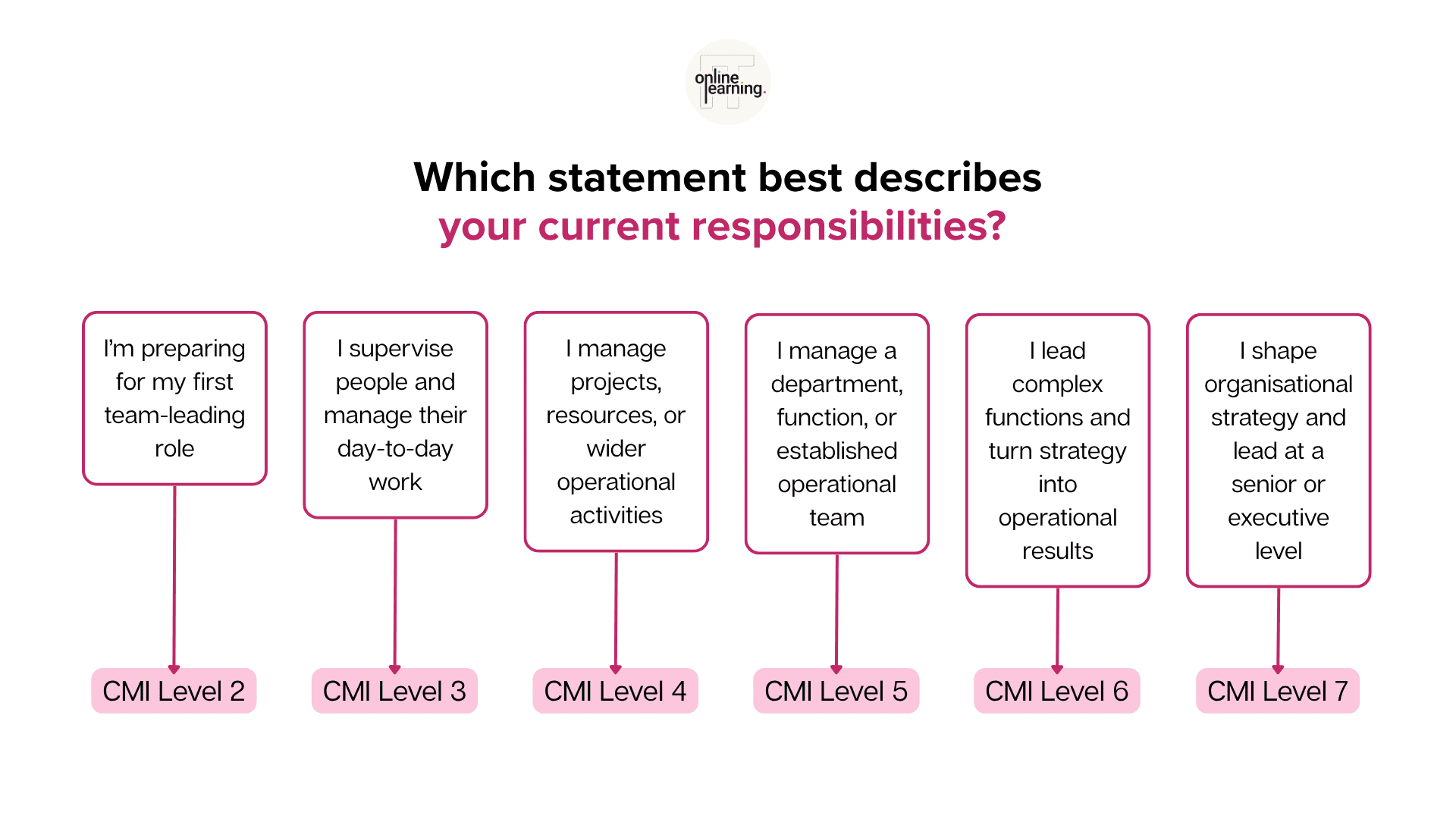
ITonlinelearning offers CMI qualifications from Level 2 through to Level 7. Broadly, Levels 2 and 3 suit aspiring, supervisory, and first-line managers; Levels 4 and 5 suit middle or operational managers; and Levels 6 and 7 are intended for senior managers responsible for turning organisational strategy into performance.
| CMI Level | Typically suitable for | Examples of responsibilities |
| Level 2 | Aspiring team leaders and people beginning to supervise others | Supporting colleagues, organising tasks, and developing basic team leadership skills |
| Level 3 | Aspiring or practising first-line managers | Supervising a team, setting goals, allocating work, and monitoring day-to-day performance |
| Level 4 | Junior managers moving beyond first-line supervision | Managing projects, resources, information, and broader operational responsibilities |
| Level 5 | Middle, operational, and departmental managers | Managing teams or departments, delivering operational plans, and improving performance |
| Level 6 | Professional and senior managers | Leading complex activity, implementing strategy, and managing organisational performance |
| Level 7 | Senior leaders, directors, and strategic managers | Setting direction, leading change, and making organisation-wide strategic decisions |
Choose CMI Level 2 if:
You’re beginning to take responsibility for other people or want to prepare for a future team-leading role.
Choose CMI Level 3 if:
You’re an aspiring or practising first-line manager, team leader, supervisor, project officer, or shift manager. CMI’s current Level 3 qualifications focus on supervising teams, setting and monitoring objectives, providing direction, and managing day-to-day operational or project activity.
Choose CMI Level 4 if:
You’ve moved beyond basic supervision and need to strengthen your knowledge of junior management, operational delivery, projects, and resources.
Choose CMI Level 5 if:
You already manage a function, department, operational area, or substantial team. This is often the most relevant level for managers who want to formalise middle-management capability and may eventually pursue the Fast Track route through an eligible Diploma.
Choose CMI Level 6 if:
You’re a professional or senior manager who translates organisational priorities into operational performance and leads activity across complex teams or functions.
Choose CMI Level 7 if:
You work at a senior, strategic, director, or executive level, or you’re preparing for responsibilities involving organisational strategy, transformation, governance, and long-term leadership.
Award, Certificate, Diploma, or Extended Diploma: What’s the Difference?
The qualification level tells you the seniority and complexity of the learning. The size of the qualification tells you how much content you’ll complete.
CMI Award
An Award is the shortest and most focused option. It is useful when you need development in a particular management topic or want to begin with a smaller qualification.
ITonlinelearning provides two months of online access for its CMI Award courses.
CMI Certificate
A Certificate covers more content than an Award and gives you the opportunity to develop knowledge across a broader selection of management areas.
ITonlinelearning provides eight months of online access for its CMI Certificate courses.
CMI Diploma
A Diploma is a more comprehensive qualification and is suitable for learners looking for substantial development across their management level.
ITonlinelearning provides 12 months of online access for its CMI Diploma courses.
CMI Extended Diploma
An Extended Diploma provides the broadest learning commitment within the relevant qualification suite. It may be appropriate for learners who want a particularly comprehensive programme.
ITonlinelearning provides 12 months of access for its Extended Diploma courses.
ITonlinelearning’s CMI courses are delivered online and assessed through assignments rather than exams. Learners receive official CMI course material, CMI membership, one-to-one support from a certified CMI Trainer, a Personal Study Coach, assignment pre-checking, work-based assessment support, and access to the Live Chat Support Team.
What Is Foundation Chartered Manager?
Foundation Chartered Manager, commonly written as fCMgr, is a professional status for people who have established foundational management skills and are continuing their journey towards full Chartered Manager status.
It can help an aspiring or developing manager demonstrate:
- Foundational management capability.
- Commitment to professional development.
- Connection with CMI’s professional community.
- A structured intention to progress towards full Chartered status.
Foundation Chartered Manager isn’t the same as full Chartered Manager status. It is an earlier professional milestone for learners who are still building the experience needed for CMgr.
CMI currently associates fCMgr with the completion of selected qualifications, apprenticeships, and recognised development programmes. Its stated eligibility includes certain Level 3 and Level 4 qualifications, some Level 5 Awards or Certificates, and selected qualifications at Levels 6 and 7.
Foundation Chartered Manager vs Chartered Manager
The simplest way to remember the difference between Foundation Chartered Manager status and Chartered Manager status is:
Foundation Chartered Manager recognises that you are building professionally credible management capability. Chartered Manager validates that you have applied advanced management capability and produced meaningful workplace results.
| Area | Foundation Chartered Manager | Chartered Manager |
| Post-nominal letters | fCMgr | CMgr |
| Typical career stage | Aspiring, early-career, or developing manager | Experienced practising manager or senior leader |
| Main purpose | Recognises foundational capability and commitment to development | Validates applied management capability, workplace impact, and professional development |
| Experience required | May be awarded before the full experience threshold is reached | Usually requires at least three or five years of relevant experience, depending on the route |
| Assessment route | Usually connected to an eligible programme, qualification, or apprenticeship | Full Assessment, CMI Fast Track, or eligible apprenticeship route |
| Progression | Provides a pathway towards full Chartered status | Represents CMI’s full Chartered Manager accolade |
What Does the Chartered Manager Assessment Involve?
The Chartered Manager assessment is designed to evaluate what you have achieved as a manager, not simply what you can remember from a textbook.
The exact process depends on your route.
Full Assessment
You will normally:
- Complete a written application.
- Describe your management and leadership journey.
- Provide examples of important workplace achievements.
- Reflect on how you apply management capability.
- Discuss your evidence with an independent assessor during an online professional discussion.
- Explain your continuing professional development plans.
CMI assesses applications against its Professional Standard framework.
Fast Track Assessment
The Fast Track assessment recognises learning already demonstrated through an eligible CMI qualification. You’ll still need to complete the required application and show how you apply your capability, but the route takes your previous CMI learning into account.
What Evidence Should You Prepare?
Useful evidence may include examples of how you have:
- Improved team or organisational performance.
- Managed change.
- Led people through a difficult situation.
- Set and delivered objectives.
- Used resources responsibly.
- Developed colleagues.
- Resolved performance or communication problems.
- Applied ethical judgement.
- Reflected on feedback and changed your approach.
- Continued developing your professional knowledge.
Your examples should be specific. Explain the challenge, what you personally did, why you chose that approach, and what changed as a result.
How Long Does It Take to Become a Chartered Manager?
The overall timescale depends on your starting point.
An experienced manager who is already eligible and has suitable evidence may be able to complete the application and assessment process relatively quickly. CMI states that its process can allow applicants to become Chartered in as little as two weeks, although this should be treated as a fastest-case indication rather than a guaranteed timescale.
You may need longer when you must first:
- Complete a relevant qualification.
- Build the required management experience.
- Collect stronger examples of workplace impact.
- Prepare your written submission.
- Complete an eligible apprenticeship.
- Develop towards the level expected by the Professional Standard.
Your ITonlinelearning course access will depend on the qualification size: two months for Awards, eight months for Certificates, and 12 months for Diplomas and Extended Diplomas.
How Much Does It Cost to Become a Chartered Manager?
The total cost can include:
- Any management qualification or course you choose to complete.
- The Chartered Manager assessment fee.
- CMI membership.
- Ongoing annual membership fees required to maintain the status.
- Optional support or course-package features.
At the time of research, CMI lists its Full Assessment at £750 plus VAT and its Fast Track assessment at £162 plus VAT, with membership fees potentially applying in addition. CMI also states that ongoing membership is required to maintain Chartered status. These external fees may change and should be checked before publication or purchase.
ITonlinelearning CMI course prices depend on the qualification level, size, and course package selected.
What Are the Benefits of Becoming a Chartered Manager?
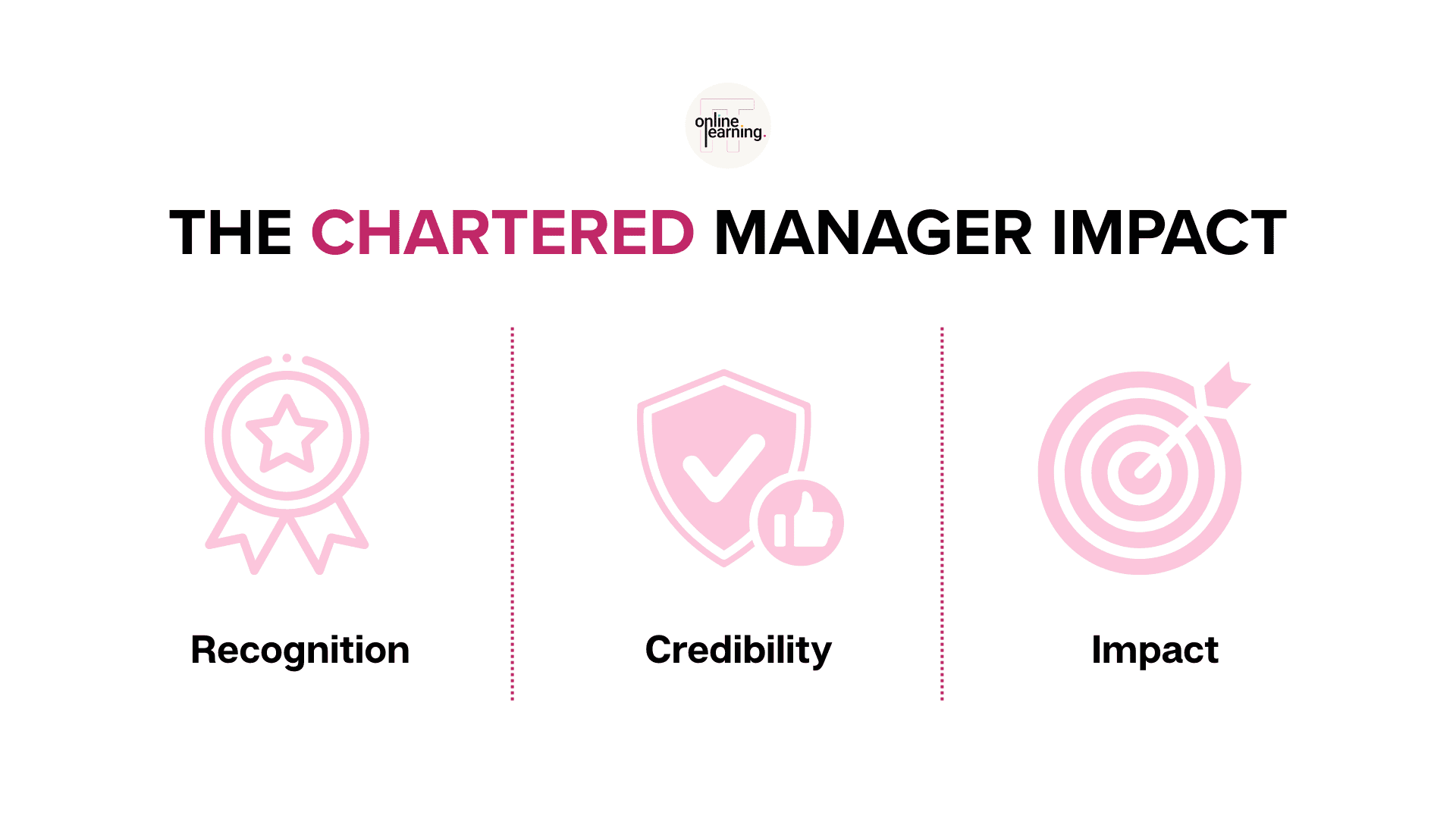
Chartered Manager status can provide independent professional recognition of your management skills and workplace contribution.
Potential benefits include:
Professional credibility
The assessment provides external confirmation that you meet a recognised professional management standard. CMI’s 2024 research shows that the average pay rise of a manager as a result of becoming Chartered is £13k.
Post-nominal letters
You can use the appropriate CMgr designation after your name while maintaining the necessary professional status and membership.
Greater confidence
Preparing your application requires you to examine what you’ve achieved, how you lead, and where you still want to develop.
Career differentiation
Chartered status can help distinguish your professional profile from candidates who have similar job titles but have not completed an equivalent external assessment. 92% of managers agree that the Chartered Manager award is the benchmark of excellence in management and leadership, according to CMI’s 2024 research.
Commitment to continuing development
Chartered Manager status isn’t intended to mark the end of learning. Maintaining it includes an ongoing commitment to professional development and CMI membership.
Organisational impact
The process encourages managers to connect their behaviour and decisions with measurable improvements in people, performance, and organisational outcomes. In CMI’s 2024 research, the 17,000 economically active Chartered Managers in the UK contributed £66 million to the annual GSP as a result of gaining Chartered Status.
Is Chartered Manager Status Worth It?
Chartered Manager status may be worth pursuing when you want formal professional recognition of management experience that you’ve already developed in the workplace.
It is likely to be particularly valuable when:
- Management is a long-term career rather than a temporary responsibility.
- You want an external benchmark for your leadership capability.
- You’re applying for more senior or competitive management roles.
- You want to strengthen your credibility with employers or stakeholders.
- You value membership, professional resources, and continuing development.
- Your organisation values professional status or funded development.
- You can clearly demonstrate workplace impact.
It may be less urgent when you have only just started managing people and don’t yet meet the experience requirements. In that situation, an appropriate CMI qualification and Foundation Chartered Manager status may provide a more realistic first step.
The decision should therefore be based on your career stage, existing evidence, future goals, and the amount of professional value you expect to gain from the designation.
What Jobs Can You Get with Chartered Manager Status?
Chartered Manager isn’t a licence for one specific occupation. Managers work across technology, healthcare, finance, education, construction, retail, public services, professional services, and many other sectors.
Depending on your existing industry knowledge and experience, the status may support progression towards roles such as:
- Team Manager
- Operations Manager
- Department Manager
- Programme Manager
- Project Manager
- Regional Manager
- Service Delivery Manager
- Business Manager
- Head of Department
- Head of Operations
- Senior Manager
- Director
The title alone does not guarantee access to these positions. Employers will still consider your sector knowledge, management history, technical capability, leadership results, and the requirements of the vacancy.
Chartered Manager status is best viewed as professional evidence supporting the experience you already have, rather than a substitute for that experience.
How to Get Chartered Manager Status: Your Next Steps
Step 1: Review your management experience
Write down how long you have held genuine responsibility for people, projects, resources, budgets, performance, or operational outcomes.
Step 2: Review your existing qualifications
Check whether you hold:
- A management, business, or leadership degree.
- A recent CMI qualification.
- An eligible management apprenticeship.
- Another relevant qualification demonstrating your professional level.
Step 3: Identify your likely route
Use your background to distinguish between Full Assessment, Fast Track, an apprenticeship route, or a qualification-led journey towards Foundation Chartered Manager.
Step 4: Choose the right CMI level where further study is needed
Don’t automatically choose the highest available level. Select the qualification that accurately reflects your responsibilities and development goals.
Step 5: Build a workplace evidence bank
Keep records of projects, improvements, feedback, objectives, difficult decisions, team development, and measurable results. This can support both assignment work and a future Chartered Manager application.
Step 6: Complete your qualification or assessment
Follow the requirements of your chosen route and ask for guidance when your eligibility is unclear.
Step 7: Maintain your professional development
Continue recording learning, feedback, achievements, and development activity after achieving your status.
Why Study a CMI Qualification with ITonlinelearning?
ITonlinelearning offers online CMI qualifications from Level 2 through to Level 7, allowing learners to choose a course suited to their current role, responsibilities, and progression goals.
You’ll receive:
- Official CMI course material.
- One-to-one tutoring with a certified CMI Tutor.
- A Personal Study Coach.
- Assignment pre-checking.
- Work-based assessment support.
- CMI membership.
- Live Chat support.
- Flexible online learning.
- Assignment-based assessment without exams.
Course access ranges from two months for Awards to 12 months for Diplomas and Extended Diplomas.
ITonlinelearning also supported a learner who became one of four finalists for the 2025 CMI Student of the Year Award.
The best course won’t necessarily be the longest or most senior qualification. It will be the one that matches the work you perform now and the capability you need to develop next.
Frequently Asked Questions About How to Become a Chartered Manager
Chartered Manager status means that your applied management capability, professional impact, and commitment to continuing development have been assessed against CMI’s Professional Standard. It provides professional recognition rather than simply confirming that you attended a course.
A Chartered Manager may use CMgr after their name. Depending on their CMI membership grade, this may appear as CMgr MCMI for Chartered Member or CMgr FCMI for Chartered Fellow. Foundation Chartered Managers use fCMgr.
CMgr means that the individual has achieved Chartered Manager status through the Chartered Management Institute and may use the protected professional title while meeting its ongoing requirements.
Yes. CMI’s Full Assessment route currently accepts applicants without a relevant degree when they have at least five years of management experience at the appropriate level.
Yes. You may qualify through Full Assessment using a relevant degree and experience or sufficient management experience alone. Eligible apprenticeships can provide another route. Earning a CMI qualification with relevant experience can, however, expedite this process.
You’ll generally need at least three years of management experience when applying with an eligible qualification. Applicants without a relevant management qualification may need at least five years of management experience. The exact requirement depends on the route.
No. Foundation Chartered Manager recognises foundational management capability and commitment to development. Full Chartered Manager status is intended for experienced professionals whose applied management impact has been assessed at the Chartered level.
Not automatically. An eligible Level 5 Diploma or Extended Diploma completed within the required period may support the Fast Track route when combined with at least three years of management experience. An Award or Certificate may instead support Foundation Chartered Manager status, depending on the precise qualification.
No. CMI’s Full Assessment is based on a written application and an online professional discussion rather than a conventional multiple-choice or written examination.
CMI says its process can be completed in as little as two weeks in some circumstances. Your actual timescale will depend on eligibility, route, evidence preparation, assessor availability, and whether you need to complete a qualification or build further experience first.
CMI states that ongoing membership is required to maintain Chartered Manager status. Membership fees and continuing professional development obligations may therefore apply after the initial assessment.
There is no single best qualification for everyone. Level 3 typically suits aspiring and first-line managers, Levels 4 and 5 suit junior, middle, and operational managers, and Levels 6 and 7 suit senior and strategic leaders. The best option is the qualification that matches your current responsibility and intended Chartered Manager route.
Start Your Journey Towards Chartered Manager Status
The first step towards becoming a Chartered Manager is understanding what you already have.
Experienced managers may be ready for direct assessment. Others may benefit from completing a CMI qualification, gaining Foundation Chartered Manager status, and building the experience required for full Chartership.
Your route should reflect your actual management level rather than the most impressive-looking course title. By choosing the right qualification and recording evidence of your workplace impact as you develop, you’ll be in a stronger position to pursue professional recognition when the time is right.