How to Become a Data Analyst
If you’re wondering how to become a data analyst in the UK, the first thing you’ll need to do is develop a combination of analytical, statistical, technical and communication skills, learn how to use common data analysis tools, and demonstrate that you can turn raw information into useful business insights.
You don’t necessarily need a data-related degree or previous experience in an analyst role. Many people enter data analysis by completing relevant training, building practical projects, and applying for junior positions in which they can continue developing their skills.
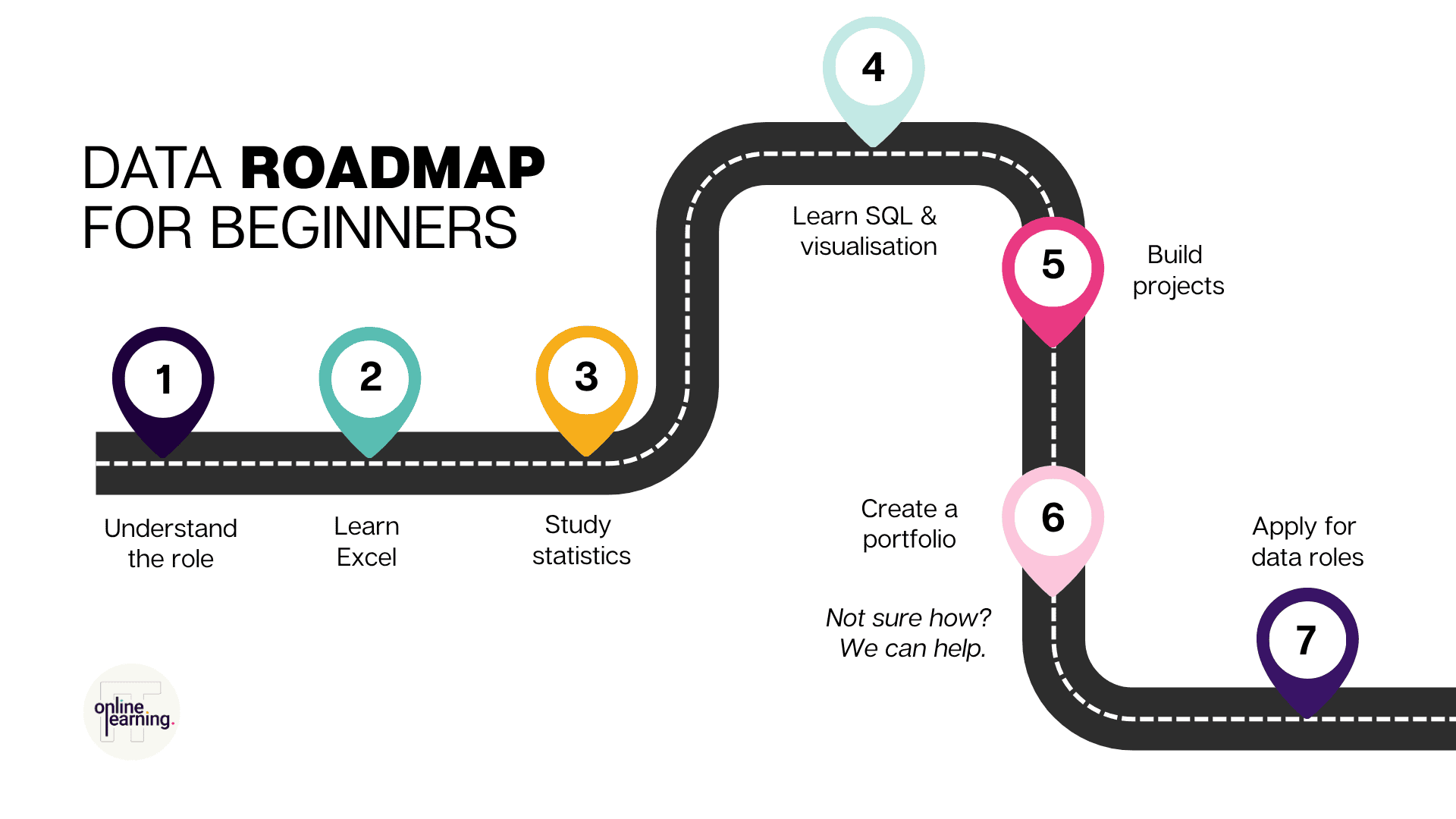
A typical beginner route is to:
- Understand what data analysts do.
- Learn spreadsheet and data visualisation tools.
- Build foundational statistical knowledge.
- Learn SQL and, where appropriate, Python.
- Complete practical projects using realistic datasets.
- Create a data analysis portfolio.
- Apply for entry-level, junior, or adjacent analytical roles.
The right route will depend on what you already know. Someone who regularly works with Excel and reports may need a different starting point from someone entering data analysis from a completely unrelated career.
What Do You Need to Become a Data Analyst?
There is no single universal set of requirements to become a data analyst. Employers may prioritise different tools, qualifications, and experience depending on the role.
In general, you’ll need to demonstrate:
- Confidence working with numbers and structured information.
- Analytical and logical thinking.
- Attention to detail.
- Basic statistical understanding.
- Spreadsheet skills.
- The ability to clean and organise data.
- Experience with visualisation or reporting tools.
- The ability to explain findings clearly.
- Evidence that you can apply your skills to a realistic problem.
More technical positions may also ask for SQL, Python, database knowledge or experience with a particular business intelligence platform.
Some common data analyst requirements include:
| Requirement | Why it matters | How a beginner can demonstrate it |
| Analytical thinking | Helps you break down questions and identify useful patterns | Complete case studies and explain your reasoning |
| Excel skills | Frequently used for cleaning, calculating and reporting | Build a spreadsheet-based analysis project |
| Statistics | Helps you interpret findings accurately | Complete a statistics course and apply the concepts |
| SQL | Allows you to retrieve information from databases | Write and save sample SQL queries |
| Data visualisation | Helps stakeholders understand results | Create dashboards using Power BI or Tableau |
| Communication | Analysts must explain what the data means | Add written summaries and recommendations to projects |
| Attention to detail | Small mistakes can affect an entire analysis | Document your data-cleaning and checking process |
| Portfolio evidence | Shows employers that you can apply your knowledge | Publish two to four relevant projects |
Essential Skills of a Data Analyst
The essential skills of a data analyst combine analytical thinking, technical data manipulation (using Excel, SQL, and Power BI), and clear communication. A successful analyst must gather and clean raw data, identify key patterns, and translate complex metrics into actionable business recommendations.
1. Analytical Thinking
Analytical thinking is the ability to examine a problem, identify the right questions, and use evidence to reach a logical conclusion.
A strong analyst does not immediately start creating charts. They first establish:
- What decision needs to be made?
- What question is the organisation trying to answer?
- Which data is relevant?
- Is the available data accurate and complete?
- What assumptions could influence the analysis?
- What does the result actually show?
2. Technical Data Skills
Data analysts need to be able to organise, clean, query, and visualise information. The exact tools vary, but Excel, SQL, and business intelligence platforms are commonly useful starting points.
Python can also help analysts automate repetitive tasks, work with larger datasets, and perform more advanced analysis. However, beginners do not always need to master every tool before applying for their first role.
3. Communication and Data Storytelling
An analysis is only useful when other people can understand and act on it.
Data storytelling involves choosing the most relevant information, presenting it clearly, and explaining why it matters. This may include building a dashboard, writing a short report, presenting findings, or recommending a practical next step.
Do You Need a Degree to Become a Data Analyst?
No, you do not need a degree to become a data analyst. While a quantitative degree can be helpful, many employers prioritise practical tool skills (such as SQL, Excel, and Power BI) alongside hands-on portfolio projects and relevant certifications over formal university degrees.
Some employers request a degree in subjects like mathematics, statistics, economics, computer science, or another numerate field, especially for graduate schemes or more statistically focused roles.
But having a degree is one of many possible routes.
When an employer doesn’t specify a degree as essential, relevant training, practical skills, industry knowledge, and a strong portfolio may help you demonstrate that you can perform the work.
How to Become a Data Analyst Without a Degree
To become a data analyst without a degree, focus on building clear evidence of your ability.
A practical non-degree route could include:
- Completing structured data analysis training.
- Learning Excel and a visualisation platform.
- Developing basic statistics and probability knowledge.
- Learning SQL.
- Completing realistic analysis projects.
- Building a portfolio.
- Applying for junior analyst, reporting, or data-support roles.
- Preparing to explain your analytical process during interviews.
The goal is not to collect as many course certificates as possible; it’s to show that you can take a question, prepare the relevant data, perform an accurate analysis, and communicate a useful answer.
Data Analyst Qualifications
There is no single mandatory qualification required to become a data analyst. Entry-level professionals typically build competency through accredited data analysis diplomas, vendor-neutral certifications (like CompTIA Data+), tool-specific courses, or structured career transition programmes.
Data analyst qualifications can help you build structured knowledge, validate your skills, and give employers a clearer understanding of what you have studied.
But no single qualification is required for every data analyst role.
The most appropriate option depends on whether you need:
- A broad beginner pathway.
- Training in a specific tool.
- A recognised certification.
- Practical project experience.
- A combination of technical and business skills.
Data Analysis Career Programme
A structured Career Programme may suit you if you want a guided route from learning the core skills through to preparing for job applications.
This route is most relevant to career changers and beginners who want to develop their technical knowledge while also receiving support with the practical process of entering the job market.
Data Analyst Diploma
A Data Analyst Diploma may suit learners who want to build a broader collection of data analysis skills rather than studying only one piece of software.
It can provide a more structured pathway through subjects such as spreadsheets, databases, visualisation, statistics, and programming.
Tool-Specific Data Analysis Courses
Individual courses may be appropriate when you already understand some parts of data analysis and want to close a specific skills gap.
Which data analysis course should you choose?
| Course | What it can help you learn | Most relevant when |
| Excel for Data Analysis | Spreadsheet analysis, formulas, cleaning and reporting | You are a beginner or regularly work with spreadsheets |
| Microsoft Power BI | Data modelling, dashboards, and business intelligence reporting | You want to create interactive reports and visualisations |
| Tableau | Visual analytics and dashboard creation | You want to strengthen your data visualisation skills |
| SQL for Data Analysis | Retrieving and organising information stored in databases | You are applying for roles that mention SQL |
| Python for Data Analysis | Programming-based cleaning, analysis, and automation | You want to work with larger datasets or automate processes |
| Essential Statistics for Data Analysis | Statistical concepts used to interpret information | You need more confidence choosing and interpreting analytical methods |
| Probability for Data Analysis | Uncertainty, likelihood, and probability concepts | You want a stronger foundation for statistical analysis |
| CompTIA Data+ | Vendor-neutral coverage of foundational data analysis concepts | You want an additional recognised certification |
| BCS Business Analysis Foundation | Understanding business needs, stakeholders and organisational change | You want to strengthen the business context around your analysis |
How to Get into Data Analysis with No Experience
You can get into data analysis without formal experience by building a portfolio of hands-on projects, reframing data-related tasks from previous roles, and mastering essential tools like Excel, SQL, and Power BI. Demonstrating practical problem-solving through real-world datasets is often more persuasive to employers than traditional job history.
To get into data analysis with no experience, you need to replace the perceived “missing” experience with other forms of evidence.
Employers are unlikely to expect a beginner to have led major analytics projects. They will, however, want to see that you understand the process and have made a serious effort to apply your skills.
Identify the Data Work You Already Do
Start by reviewing your current and previous responsibilities.
You may already have experience with:
- Creating reports.
- Tracking performance.
- Managing spreadsheets.
- Checking information for errors.
- Monitoring budgets.
- Comparing sales results.
- Identifying customer trends.
- Forecasting stock requirements.
- Preparing management information.
- Conducting surveys or research.
- Presenting findings.
- Making recommendations based on evidence.
These activities can be reframed as relevant analytical experience, provided you describe them accurately and do not exaggerate your responsibilities.
Build Practical Data Projects
Personal projects are one of the best ways to demonstrate your ability when you have not yet worked as a data analyst.
A strong beginner project should include:
- A clear business question.
- A relevant dataset.
- An explanation of how you cleaned the data.
- The analytical method you used.
- A chart, dashboard, or report.
- Your main findings.
- A practical recommendation.
- Any limitations or assumptions.
Look for Experience Beyond Formal Employment
Experience does not always need to come from a permanent analyst position.
You could build relevant evidence through:
- Volunteering for a charity or community organisation.
- Supporting a small business with reporting.
- Completing a work-based project in your current role.
- Taking part in an internship.
- Completing a structured simulated project.
- Contributing to a collaborative portfolio project.
- Analysing publicly available datasets.
What Is a Data Analyst?
A data analyst collects, organises, cleans, and examines data to help an organisation understand what is happening and make better decisions.
Instead of just producing spreadsheets or charts, a data analyst looks for patterns, trends, relationships, and anomalies. They then communicate what the data means to managers, clients, or other stakeholders.
Depending on the organisation and industry, a data analyst may:
- Gather data from spreadsheets, databases, and business systems.
- Check data for errors, missing information, and inconsistencies.
- Clean and prepare data before analysing it.
- Use statistical methods to identify trends and relationships.
- Write database queries using SQL.
- Create reports and dashboards in Excel, Tableau, or Microsoft Power BI.
- Present findings to technical and non-technical stakeholders.
- Recommend actions based on the available evidence.
- Store and use information in accordance with data protection and security requirements.
Is Data Analysis an IT Job?
Data analysis is often classed as a digital or technology-based career because analysts work with software, databases, and data systems. However, it’s not necessarily an IT support or software engineering role.
The work sits between technology, statistics, and business decision-making. Data analysts need enough technical confidence to work with datasets and analytical tools, but they also need to understand business problems and communicate clearly with people who may have little technical knowledge.
Data analysts can work in almost any sector, including:
- Finance and insurance,
- Healthcare,
- Retail and e-commerce,
- Marketing,
- Education,
- Government,
- Manufacturing,
- Logistics,
- Sport, and
- Environmental services.
This means that experience from another industry can be useful. For example, someone moving from retail into data analysis may already understand sales performance, customer behaviour, and stock management. Their next step would be learning how to analyse and present the relevant data.
How Long Does It Take to Become a Data Analyst?
It typically takes between 3 to 9 months to become a data analyst, depending on your prior experience, study hours, and chosen learning path. Candidates with prior quantitative or spreadsheet experience often transition faster through targeted, structured training.
The time it takes to become a data analyst depends on your starting knowledge, the complexity of the roles you are targeting, how consistently you study, and how quickly you build practical experience.
Someone with strong Excel, reporting, or quantitative experience may be able to prepare for junior applications more quickly than someone starting without spreadsheet, statistics, or technology experience.
What Does a Good Data Analyst Portfolio Include?
A good data analyst portfolio demonstrates your process, not just the finished dashboard.
Employers should be able to understand:
- What question you were trying to answer.
- Where the data came from.
- Whether you cleaned or changed it.
- Which tools you used.
- Why you selected a particular approach.
- What you discovered.
- What you would recommend.
- What limitations affected the result.
What Entry-Level Data Analyst Jobs Should You Search For?
Your first data-related role may not be advertised simply as “Data Analyst”.
Relevant entry-level or adjacent job titles can include:
- Junior Data Analyst.
- Trainee Data Analyst.
- Data Technician.
- Reporting Analyst.
- Business Intelligence Assistant.
- Insight Assistant.
- Operations Analyst.
- Marketing Analyst.
- Sales Analyst.
- Performance Analyst.
- Data Quality Assistant.
- Data Administrator.
- Junior Business Intelligence Analyst.
- Research Assistant.
Read the responsibilities rather than relying only on the title. A reporting or operations position may provide valuable experience with data cleaning, dashboards, and stakeholder requests.
Data Analyst Interview Questions to Prepare For in the UK
Data analyst interviews may test your technical understanding, problem-solving process, and ability to communicate findings.
How would you approach a new dataset?
Explain that you would first clarify the question, understand the source and structure of the data, check its quality, identify missing or unusual values, clean it where necessary, select an appropriate analytical method, and validate your results before presenting them.
How do you check that your analysis is accurate?
You might discuss checking formulas, reviewing data types, looking for duplicates, comparing totals with the source, testing queries, validating assumptions, and asking another person to review important work.
What would you do if the data were incomplete?
Explain that you would assess how much data is missing, investigate why, decide whether it can be corrected or excluded, and clearly communicate how the missing data affects the findings.
How would you explain a technical finding to a non-technical stakeholder?
Focus on the business question, remove unnecessary terminology, use a clear visual, and explain the practical implication rather than describing every technical step.
What is the difference between correlation and causation?
Correlation means that two variables change in a related way. Causation means that a change in one variable directly causes a change in another. A correlation alone is not enough to prove causation.
Tell us about a data project you completed.
Structure your answer around the problem, your role, the tools you used, the steps you followed, the findings, and the action you recommended.
Is a Data Analyst Career a High-Salary Career?
Data analysis can offer competitive earning potential, although salaries vary significantly by location, sector, technical specialism, and experience.
As of July 2026, ITJobsWatch gives an indicative UK salary range of approximately £32,500 for the average Junior Data Analyst role to £45,000 for a Data Analyst, with Senior Data Analysts earning an average of £60,000 annually.
How to Choose the Right Data Analysis Training Route
Before choosing a course, compare your current skills with the requirements of the roles you want.
Choose a Full Data Analyst Career Programme If:
- You are changing careers.
- You have little or no data experience.
- You want a structured learning sequence.
- You need help combining multiple tools.
- You want practical career preparation alongside training.
Choose an Accredited Data Analyst Diploma If:
- You want broad technical development.
- You prefer one structured learning pathway.
- You need to study several complementary tools and concepts.
- You want to build a foundation before deciding on a specialism.
Choose an Individual Data Analyst Course If:
- You already have some analytical experience.
- A specific skill is missing from your CV.
- The jobs you are targeting repeatedly mention the same tool.
- You need to improve one area, such as SQL, statistics or Power BI.
Review Real Job Descriptions Before Deciding
Search for ten to twenty entry-level data roles that genuinely interest you.
Record:
- The most frequently requested tools.
- The level of experience requested.
- Whether qualifications are essential or desirable.
- The typical responsibilities.
- The industries recruiting.
- Any recurring gaps in your current skills.
This gives you a more evidence-based way to choose your next course instead of trying to learn every data platform available.
How ITonlinelearning Can Help You Become a Data Analyst
ITonlinelearning offers several routes for learners who want to develop practical data analysis skills.
Beginners looking for a complete pathway can explore the Data Analysis Career Programme or Data Analyst Diploma. Learners who already have some experience can focus on specific areas through courses covering Excel, SQL, Tableau, Microsoft Power BI, Python, statistics, and probability.
The most suitable route depends on your current knowledge, career goals, and the job requirements you’re working towards.
Frequently Asked Questions About How to Become a Data Analyst
To become a data analyst in the UK, develop practical skills in Excel, statistics, SQL and data visualisation, then apply those skills through portfolio projects. You can enter through university study, college, apprenticeships, professional training or a career change from an adjacent role.
Begin by learning the core tools, completing practical projects and identifying analytical tasks from your existing work or education. Build a portfolio showing how you clean, analyse and present data, then apply for junior, trainee, reporting and data-support positions.
You need analytical thinking, attention to detail, numerical confidence, data-handling skills, and the ability to communicate your findings. Common technical skills include Excel, SQL, and a visualisation tool such as Power BI or Tableau.
Online courses can help you develop the required knowledge and technical skills, but course completion alone may not be enough. You should apply what you learn through realistic projects, build a portfolio, and practise explaining your analysis. Many employers may also require official certification to prove that you are able to confidently carry out the responsibilities of a data analyst.
There is no single mandatory data analyst qualification. Relevant options include data analysis diplomas, professional certification, apprenticeships, degrees, and individual courses covering Excel, SQL, Python, Power BI, Tableau and statistics. Choose qualifications that address the requirements of the roles you intend to apply for.
The top three skills are analytical thinking, technical data skills, and communication. Analysts need to solve problems logically, work accurately with information, and explain what their findings mean to other people.
Data analysis can be challenging because it can combine business understanding, numbers, software, and communication. It becomes more manageable when you learn in stages, beginning with spreadsheets and basic statistics before progressing to databases, visualisation, and programming. Many learners find it more useful to complete a structured training programme with tutor and mentor support when learning data analysis from scratch.
A data analyst usually focuses on examining existing data, identifying trends, producing reports, and supporting decisions. A data scientist may work more extensively with programming, advanced statistics, machine learning, and predictive models. Responsibilities can overlap between organisations.
Yes. There is no standard age for entering data analysis. Career changers can bring valuable sector knowledge, communication skills, and commercial understanding. The key is to develop the required technical abilities and demonstrate them through relevant projects.
Start Building Your Route into Data Analysis
The most practical way to become a data analyst is to build your skills in a logical order and apply each new concept through project work.
Start with the foundations, learn the tools that appear in the roles you want, and create evidence that you can solve a genuine problem using data. You do not need to know every platform or hold a specific degree before taking your first step.
For beginners who want a broader, guided pathway, the Data Analysis Career Programme and Data Analyst Diploma provide routes through multiple complementary areas of data analysis. Individual courses can also help experienced learners close more specific skills gaps.
About the Editor
Reviewed & edited by Roma Cheetanlal | BSc (Hons), Data Analyst & Technical Curriculum Developer
Roma is a Data Analyst and Business Intelligence professional holding a BSc (Hons) in Mathematics and Computer Science, along with dual degrees in Commerce and Business Analysis, and the CompTIA Data+ certification.
At ITonlinelearning, Roma leads technical curriculum development, including the Data Analyst Career Programme and specialised courses in Power BI, Excel, and Hypothesis Testing. She specialises in statistical modelling, database querying, and visual analytics using Power BI, SQL, Python, Tableau, and Excel.
With a track record of designing programmes that have helped learners transition into professional analytics roles, Roma ensures our learning content remains strictly aligned with current UK industry standards and real-world hiring requirements.