How Can PRINCE2® Help You Become a Project Manager?
Yes, PRINCE2 can help you become a Project Manager by giving you structured knowledge of project planning, governance, risk, roles, and control. It also provides a recognised qualification for your CV. However, PRINCE2 doesn’t replace practical experience. Your career prospects will depend on how well you combine your qualification with transferable skills, relevant project experience, and evidence of what you’ve achieved.

What PRINCE2 Gives You vs What You Still Need to Build
| PRINCE2 can help you build | Employers may also look for |
|---|---|
| Knowledge of project methods | Experience supporting or delivering work |
| Project terminology | Clear examples of your contribution |
| Governance understanding | Stakeholder and coordination experience |
| Risk and issue knowledge | Evidence of judgement and problem-solving |
| A formal qualification | Relevant sector knowledge |
| Confidence discussing projects | Convincing interview examples |
Can PRINCE2 Help You Become a Project Manager?
Yes. PRINCE2 can support your move into Project Management by helping you understand how projects are organised, managed, monitored, and controlled. It can be particularly useful if you’ve already worked on projects but haven’t had formal training. However, the qualification alone doesn’t establish your ability to manage a real project, so you’ll also need to demonstrate relevant skills and experience.
Think about someone working in operations who regularly coordinates process changes, organises people, and manages deadlines. They may already be doing work that’s relevant to Project Management, even if their job title doesn’t reflect it.
PRINCE2 can help that person understand how their experience fits into a recognised project management method.
The important part is what happens next: connecting what they’ve learnt with examples of work they’ve actually done.
How Does PRINCE2 Help You Build a Project Management Career?
PRINCE2 gives you a structured approach to managing projects. For someone considering a career change, that can help turn an unfamiliar profession into something more understandable.
It Gives You Structured Project Management Knowledge
PRINCE2 Project Management (Version 7) covers principles, people, practices, processes, and project context.
You’ll develop knowledge of how projects establish business justification, define responsibilities, create plans, manage quality, assess risks, handle issues, and monitor progress.
For example, instead of simply knowing that a project is running late, you’ll understand concepts such as forecasts, tolerances, and escalation. You’ll also learn why projects are managed in stages and how decisions are made at different management levels.
These concepts can help you understand what happens beyond your immediate tasks.
It Helps You Understand Governed Projects
Many people have worked on projects without seeing how decisions are made at the project level.
You might have coordinated a system rollout, for example, but had little involvement in approving budgets, reviewing the Business Case, or deciding whether a project should continue.
PRINCE2 introduces the governance structures behind those decisions.
That knowledge is useful when moving from supporting individual activities towards coordinating or managing broader project delivery.
It Gives You Recognised Evidence of Learning
A PRINCE2 qualification gives employers evidence that you’ve studied and passed an assessment in a recognised Project Management method.
This can be particularly helpful when your previous job titles don’t immediately suggest Project Management experience.
However, the qualification should support your application rather than carry it. Employers may still need evidence that you can organise work, communicate with people, handle problems, and deliver results.
It Helps You Explain Your Existing Experience
Imagine you’ve helped implement a new customer relationship management system.
You coordinated training sessions, communicated with colleagues, tracked outstanding actions, and helped resolve problems during the rollout.
Before studying PRINCE2, you might describe that experience simply as “helping with a new system”.
Afterwards, you may be better equipped to recognise the planning, stakeholder communication, issue management, and progress monitoring involved.
You’re not inventing new experience. You’re learning how to explain the experience you already have.
For a wider introduction to the method, read What Is PRINCE2 Project Management?.
Is PRINCE2 Enough to Become a Project Manager?
No. PRINCE2 alone isn’t enough to demonstrate that you can manage projects professionally. It provides formal knowledge of a Project Management method, but employers may also expect evidence of planning, coordination, communication, delivery, and decision-making. How much experience you need depends on the role. A Project Support Officer vacancy may have very different requirements from a Project Manager position.
This distinction matters because understanding how something should be done isn’t the same as having done it.
You might know how PRINCE2 approaches risk management, for example. That’s useful knowledge. But an employer may also ask you to describe a time you identified a real risk, assessed its impact, and helped decide what to do.
The strongest application connects those two things.
What Counts as Project Management Experience?
Project Management experience can include contributing to a temporary initiative that creates a defined output or change. You don’t necessarily need to have held the title “Project Manager”. Coordinating a system rollout, supporting an office move, organising a product launch, or helping implement a new process may all provide relevant experience, depending on your actual responsibilities.
Consider these examples:
- An administrator coordinates communications and training for a new internal system.
- A customer service team leader helps introduce a revised complaints process.
- A marketing executive coordinates a campaign launch involving several departments.
- An IT technician supports the deployment of new software across an organisation.
- An HR professional helps implement a new employee onboarding process.
Each could involve relevant project activities.
What matters is what the person actually did, the responsibility they held, and the outcome they contributed to.
Is Your Experience Really Project Work?
Not every busy or complicated task is a project.
Business-as-usual (BAU) work generally involves ongoing operations, while project work is temporary and intended to create a defined change, output, or result.
For example, answering customer queries every day is usually operational work. Helping design and implement a new customer support process may be project work.
The two can overlap. You might perform your normal responsibilities while also contributing to a temporary improvement initiative.
Which Transferable Skills Help You Move Into Project Management?
Transferable skills can help you move into Project Management because many project responsibilities involve abilities developed in other professions. Organisation, communication, planning, stakeholder coordination, problem-solving, and prioritisation are particularly relevant. The key is to demonstrate these skills through real examples rather than simply listing them on your CV.
The National Careers Service identifies planning, resource management, monitoring progress, dealing with problems, and working with different teams as important Project Manager activities.
| Transferable skill | How it could relate to projects |
|---|---|
| Organisation | Coordinating tasks, schedules, and information |
| Communication | Keeping stakeholders informed |
| Problem-solving | Identifying issues and supporting resolutions |
| Prioritisation | Managing competing deadlines |
| Leadership | Helping people work towards an outcome |
| Reporting | Tracking progress and highlighting concerns |
| Commercial awareness | Understanding costs, resources, and business objectives |
You don’t need to demonstrate every skill at the same level for every role.
Instead, look at the responsibilities in your target vacancies and identify where your existing experience matches.
Can PRINCE2 Help You Change Career Into Project Management?
Yes. PRINCE2 can be useful for career changers because it introduces a formal Project Management method that complements experience gained in other fields. The strongest transition often involves combining your existing industry knowledge and transferable skills with PRINCE2 learning, rather than abandoning your previous experience and starting again from zero.
From Customer Service or Administration
If you’ve worked in customer service or administration, you may already have experience coordinating people, maintaining records, managing deadlines, escalating problems, and communicating with stakeholders.
If you’ve also supported a defined change initiative, such as a new system or process, that experience could strengthen applications for project administration, support, or coordination roles.
From IT or Technical Support
Technical professionals may have experience with implementations, deployments, user requirements, suppliers, testing, and system changes.
PRINCE2 can complement that technical knowledge by introducing formal project governance and control.
Depending on your experience, you might explore IT Project Coordinator, implementation, or Project Manager opportunities.
For more context, see PRINCE2 for Software Project Management.
From Operations
Operations professionals may have worked on process improvements, resource planning, supplier coordination, or organisational changes.
If you’ve led defined initiatives with measurable outcomes, you may already have evidence relevant to Project Management.
From Marketing or HR
Marketing campaigns, product launches, HR system implementations, and training rollouts can all involve project-related activities.
Your experience coordinating deadlines, people, budgets, and deliverables may transfer, particularly when applying for project roles within a familiar industry.
The lesson is simple: your previous career may be part of your route into Project Management, not something you need to leave behind completely.
Can PRINCE2 Help Graduates Become Project Managers?
PRINCE2 can help graduates develop formal Project Management knowledge and demonstrate an interest in the profession. However, graduates without practical delivery experience may need to begin through project support, coordination, assistant roles, or graduate development schemes. Relevant internships, university projects, placements, and other genuine project contributions can also help demonstrate transferable skills.
A graduate who coordinated a university society event, for example, might be able to discuss planning, stakeholders, deadlines, and unexpected problems.
That doesn’t make them an experienced Project Manager, but it could provide useful interview evidence for an appropriate entry-level role.
Can You Become a Project Manager With PRINCE2 but No Experience?
You may be able to enter the Project Management profession with PRINCE2 and limited formal project experience, particularly through support or coordination roles. Moving directly into a full Project Manager position can be more difficult without evidence of delivery responsibility. However, having no previous Project Manager job title doesn’t necessarily mean you have no relevant experience.
Before assuming you’re starting from scratch, review your previous responsibilities.
Have you ever coordinated a defined initiative? Managed deadlines involving several people? Supported a system implementation? Helped deliver a change?
If so, you may already have relevant examples.
If not, your next step could be to seek appropriate opportunities to contribute to project work.
What Is the Best Entry Route Into Project Management After PRINCE2?
The best route depends on your existing experience. Someone with little project exposure may benefit from Project Administrator, Project Support, or Project Coordinator positions. Someone already coordinating workstreams may be able to target Assistant Project Manager roles. An experienced professional who has managed substantial projects informally may be able to apply directly for suitable Project Manager vacancies.
| Your starting point | Roles worth exploring |
|---|---|
| Little project exposure | Project Administrator, Project Support Officer |
| Some coordination experience | Project Coordinator, Project Officer |
| Strong project delivery evidence | Assistant Project Manager, Junior Project Manager |
| Established project responsibility | Project Manager roles matched to your experience |
| Extensive specialist experience | Project roles within your existing sector |
The National Careers Service recognises several pathways into Project Management, including progression through project support and direct entry based on substantial sector experience.
For a fuller breakdown of potential roles, read What Jobs Can You Get With a PRINCE2 Qualification?.
Foundation or Practitioner: Which Is Better for Your Project Management Career?
PRINCE2 Foundation may be a suitable starting point if you want to understand the method and demonstrate formal learning. Practitioner focuses more on applying and tailoring PRINCE2 to project situations. Neither level automatically qualifies you for a particular job title, and employers may value practical experience just as much as, or more than, the certification level.
Is PRINCE2 Foundation Enough to Start a Project Management Career?
PRINCE2 Project Management Foundation (Version 7) can provide a useful starting point for people entering or working around projects.
It establishes knowledge of the method’s principles, practices, processes, roles, and terminology.
PeopleCert positions Foundation as suitable for professionals at any career stage, so it shouldn’t be treated as a qualification only for beginners.
Read more in What Is PRINCE2 Foundation?.
Do You Need PRINCE2 Practitioner to Become a Project Manager?
Not universally. Some employers may request Practitioner, while others may accept Foundation, equivalent qualifications, or relevant experience.
Practitioner focuses on applying and tailoring PRINCE2, which can be useful when your role involves using the method in project situations.
However, passing Practitioner doesn’t automatically demonstrate that you’ve managed a project professionally.
Explore What Is PRINCE2 Practitioner?.
| Your situation | Foundation | Practitioner |
|---|---|---|
| New to formal Project Management | Useful starting point | Consider for deeper applied learning |
| Working in project support | Helps formalise method knowledge | May support progression |
| Already coordinating projects | Can strengthen existing knowledge | Useful where application is relevant |
| Already managing projects | May establish or refresh method knowledge | May align with roles using PRINCE2 directly |
For more detail, see PRINCE2 Foundation vs Practitioner.
Do Employers Want PRINCE2 Project Managers?
PRINCE2 can be relevant to UK Project Management recruitment, but it isn’t a universal employment requirement. Employers may specify PRINCE2 as essential, desirable, or one of several acceptable qualifications. Others may prioritise experience, sector expertise, or different methods. The best approach is to examine current vacancies in your target industry and identify what employers actually request.
When comparing advertisements, pay attention to the difference between:
- Essential: You normally need to meet the stated requirement.
- Desirable: The qualification may strengthen your application.
- PRINCE2 or equivalent: Other recognised qualifications may be acceptable.
- Not mentioned: The employer hasn’t explicitly specified PRINCE2.
Also check the experience requirements.
A role asking for several years of complex project delivery experience won’t necessarily become suitable simply because you’ve passed Practitioner.
Which Sectors Can PRINCE2 Help You Work In?
PRINCE2 is a sector-independent Project Management method, so its concepts can be applied in different working environments. Potential areas include IT, digital transformation, public services, financial services, and organisational change. However, employers may also expect sector-specific knowledge, technical understanding, regulatory awareness, or relevant delivery experience.
For example, managing a technology implementation involves different specialist considerations from managing a construction project.
PRINCE2 can provide a common management structure, but it doesn’t replace those specialist capabilities.
If you’re interested in technology-led change, explore PRINCE2 for Digital Transformation Projects.
How Much Can a Project Manager Earn in the UK?
The National Careers Service lists indicative annual earnings of £29,000 for a starter Business Project Manager and £75,000 for an experienced professional. For IT Project Managers, it lists £35,000 to £60,000. These are occupation-based salary estimates, not salaries attached to PRINCE2 certification. Actual earnings depend on the employer, location, sector, experience, and responsibilities.
It’s worth separating your qualification decision from your salary expectations.
PRINCE2 may support your professional development, but gaining a certificate doesn’t automatically result in higher pay.
If you’re changing careers, compare salaries for the roles you can realistically target now, not only the earnings associated with experienced Project Managers.
Do You Need a Degree, Agile Knowledge, or Software Skills?
Do You Need a Degree to Become a Project Manager?
Not in every case. The National Careers Service identifies university study, apprenticeships, progression through work, and direct applications as possible routes into Project Management. Some employers may require a degree, particularly for specific graduate schemes or technical positions, but there isn’t one universal educational route into the profession.
Does Agile Knowledge Help Alongside PRINCE2?
Agile knowledge can be useful when applying for roles involving iterative delivery, changing requirements, or hybrid project environments.
This may be especially relevant to technology and digital projects, although requirements differ between employers.
PRINCE2 governance can work alongside Agile delivery approaches.
Learn more in How PRINCE2 Works With Agile Project Management.
Do You Need Project Management Software Skills?
Software requirements vary by role.
Some employers may expect strong spreadsheet and reporting skills, while others use specialist scheduling, collaboration, or delivery tools.
Microsoft Project, Jira, Azure DevOps, and similar platforms may be relevant in certain environments, but no single tool is mandatory across the entire profession.
Review target vacancies before deciding which software to learn.
How Can You Build Project Management Experience After PRINCE2?
You can build Project Management experience by contributing to legitimate, defined projects, taking responsibility for manageable workstreams, supporting experienced Project Managers, and documenting the outcomes of your work. Opportunities within your existing organisation may be particularly valuable because you already understand its people, processes, and business objectives.
Can You Get Project Experience in Your Current Job?
Often, yes.
You could ask your manager whether there are upcoming initiatives where your existing skills would be useful.
Examples might include a system rollout, training programme, process improvement, office relocation, or compliance project.
You don’t need to take responsibility for the entire project immediately.
Supporting a defined workstream, coordinating communications, tracking actions, or helping with reporting can provide valuable exposure.
How Should You Record Your Project Experience?
Keep a record of the work you’ve genuinely contributed to.
For each initiative, capture:
- The project’s objective and your responsibilities.
- The people or teams involved.
- The tasks you coordinated or delivered.
- The challenges you helped address.
- The outcome and any measurable results.
Be accurate about your contribution. Supporting a project is valuable experience, but it shouldn’t be described as managing the entire project.
How Should You Present PRINCE2 and Project Experience on Your CV?
Add PRINCE2 under a qualifications or certifications section using the correct qualification name and version. Then use your employment history to demonstrate relevant project activities and outcomes. A qualification establishes what you’ve learnt, while your experience section shows what you’ve actually done. Together, they create a more convincing application.
For example:
Less effective: “Helped with new software.”
More effective: “Coordinated user communications, training dates, and outstanding actions during the rollout of a new CRM system across a 20-person team.”
The second version makes the contribution clearer without claiming responsibility the person didn’t hold. Only include figures you can substantiate.
How Should You Add PRINCE2 to LinkedIn?
Add your completed qualification to LinkedIn’s Licences & Certifications section using its official name.
You can also reference relevant PRINCE2 knowledge in your About section, but your Experience section should still focus on genuine responsibilities and achievements.
Avoid describing yourself as an experienced Project Manager solely because you’ve passed the qualification.
How Does PRINCE2 Help in a Project Manager Interview?
PRINCE2 can help you explain how you approach planning, risk, issues, progress, stakeholders, and project decisions. However, interviewers may also want examples of how you’ve handled comparable situations in practice. Prepare evidence from real work, explain your personal contribution, and connect your experience to the requirements of the vacancy.
You might prepare examples involving a difficult deadline, conflicting priorities, a change request, a delivery problem, or stakeholder communication.
A simple structure is Situation, Task, Action, and Result (STAR).
Describe the situation, explain your responsibility, outline what you did, and discuss the outcome.
You can refer to PRINCE2 concepts where relevant, but avoid forcing terminology into examples where it doesn’t fit.
How Long Does It Take to Become a Project Manager?
There is no fixed timeline for becoming a Project Manager. Someone with substantial relevant experience may be able to move into a suitable Project Manager role relatively directly, while someone new to project work may need time in support or coordination positions. Your route will depend on your existing skills, sector, opportunities, qualifications, and ability to demonstrate project delivery.
Completing PRINCE2 training and becoming professionally experienced are two different milestones.
You may be able to complete your qualification relatively quickly, but building credible delivery experience can take longer.
Rather than setting an arbitrary deadline, focus on the evidence you need for your target role.
What Could Your Route to Project Manager Look Like?
Your route into Project Management doesn’t have to follow a single sequence. Some people progress through project support roles, while others move across from operations, IT, HR, or other professional backgrounds. PRINCE2 can support each route, but your previous responsibilities and the requirements of the target role determine which opportunities are realistic.
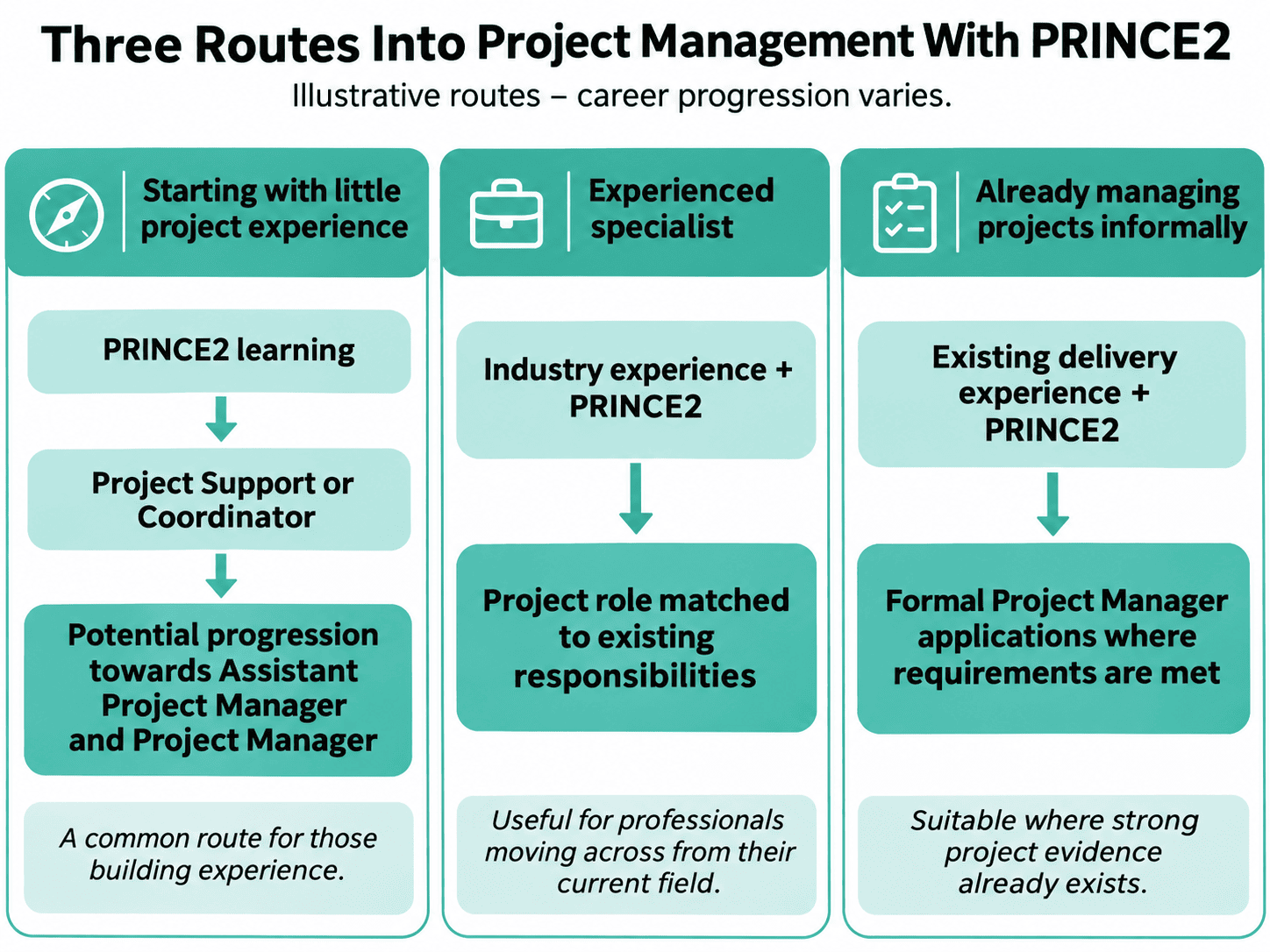
Show three illustrative routes:
- Starting with little project experience: PRINCE2 learning → Project Support or Coordinator → potential progression towards Assistant Project Manager and Project Manager.
- Experienced specialist: Industry experience + PRINCE2 → project role matched to existing responsibilities.
- Already managing projects informally: Existing delivery experience + PRINCE2 → formal Project Manager applications where requirements are met.
Is PRINCE2 Worth It If You Want to Become a Project Manager?
PRINCE2 can be worth pursuing if you want structured Project Management knowledge, your target employers value the method, and you’re prepared to combine certification with practical experience. Its value may be more limited if you expect the qualification alone to secure employment or if your preferred roles require different specialist skills or credentials.
Before enrolling, look at the vacancies you’re interested in.
Ask yourself what the qualification would add to your existing experience and which gaps would remain afterwards.
You may also want to compare different qualification pathways.
Read Is PRINCE2 Worth It? or explore APM vs PRINCE2.
Common Mistakes When Using PRINCE2 to Change Career
One of the biggest mistakes is treating certification as a substitute for experience.
Other common problems include applying only for established Project Manager positions despite limited delivery evidence, overlooking transferable experience, and describing ordinary operational work as though it were project leadership.
Some applicants also spend too much time memorising terminology and too little time preparing genuine examples of their work.
A better approach is to assess your starting point accurately, target suitable roles, and build the experience needed for the next step.
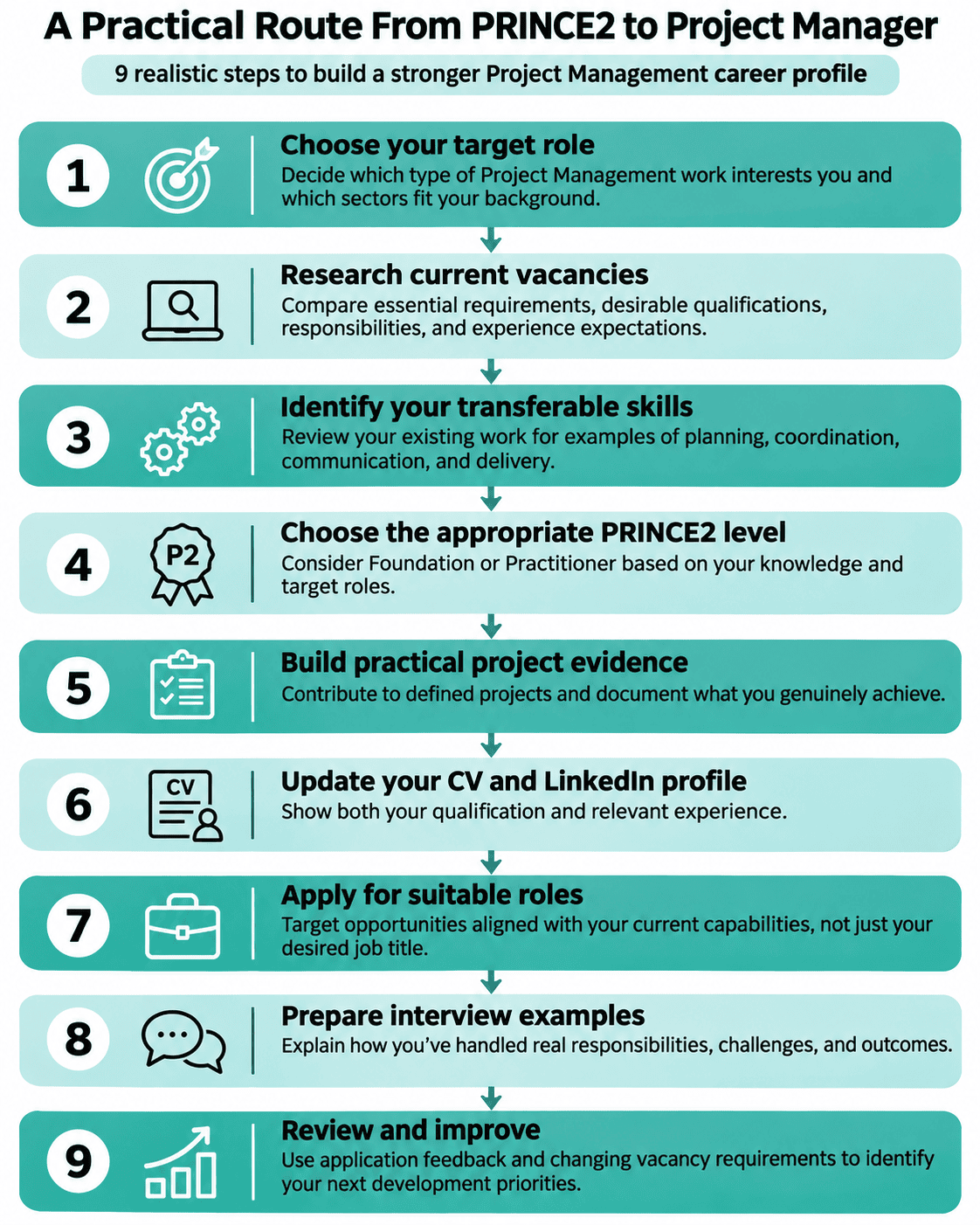
A Practical Route From PRINCE2 to Project Manager
You don’t need to complete these steps in a rigid order. Use them to identify your strongest starting point and the gaps you need to address.
Not sure how your current experience could translate into a Project Management career? A conversation with a Course & Career Advisor could help you explore the available training routes.
Frequently Asked Questions
Can PRINCE2 Help You Become a Project Manager?
Yes. PRINCE2 provides structured Project Management knowledge and a recognised qualification that can strengthen your professional profile. It may be especially useful if you’re changing careers or formalising experience gained in another role. However, it works best alongside transferable skills, relevant project experience, and evidence of your contribution to actual work.
Is PRINCE2 Enough to Become a Project Manager?
PRINCE2 alone doesn’t establish that you have the experience required to manage projects. Employers may also expect evidence of planning, coordination, stakeholder communication, problem-solving, and delivery. Requirements vary by vacancy, so the appropriate next step depends on your existing experience and the type of role you’re targeting.
Can I Become a Project Manager With No Experience?
You may be able to enter the profession through project support, coordination, or development opportunities. However, moving directly into a Project Manager position without relevant delivery evidence can be difficult. It’s also worth reviewing your existing responsibilities, as you may already have useful project experience without having held a formal Project Management title.
Is PRINCE2 Foundation Enough to Start a Project Management Career?
Foundation can provide a useful starting point because it demonstrates formal understanding of the PRINCE2 method. It may complement applications for project-related roles, particularly when paired with relevant skills. However, Foundation doesn’t automatically make you eligible for a particular position, and employers may have additional experience or qualification requirements.
Do I Need PRINCE2 Practitioner to Become a Project Manager?
Not necessarily. Practitioner may be valuable where employers expect applied PRINCE2 knowledge or specifically request the qualification. Other employers may accept Foundation, equivalent certifications, or relevant experience. Practitioner demonstrates applied method understanding through assessment, but it doesn’t replace evidence of managing projects in the workplace.
What Experience Do I Need Alongside PRINCE2?
Relevant experience may include planning work, coordinating teams, communicating with stakeholders, tracking deadlines, handling risks and issues, or contributing to defined project outcomes. The level of responsibility expected depends on the vacancy. Support roles may require less direct project leadership experience than established Project Manager positions.
Do Employers Value PRINCE2?
PRINCE2 can be valued by employers, but requirements differ. Some advertisements may list it as essential, others as desirable, and some may accept alternative qualifications. Review vacancies in your target sector to understand how much emphasis employers place on certification compared with practical experience and specialist knowledge.
Do I Need a Degree to Become a Project Manager?
A degree isn’t universally required. UK career guidance identifies university study, apprenticeships, workplace progression, and direct applications as possible routes into Project Management. Some employers and graduate programmes may specify degree requirements, while others focus more heavily on professional experience and relevant qualifications. Always check the essential criteria for individual vacancies.
How Long Does It Take to Become a Project Manager?
There’s no standard timeframe. Your starting experience, sector, target role, and opportunities to contribute to projects all influence how quickly you can progress. Someone already managing significant workstreams may have a shorter transition than someone who has never participated in a project. Completing PRINCE2 is one milestone, not the entire career journey.
What Job Should I Apply for First After PRINCE2?
That depends on your experience. Project Administrator, Project Support Officer, Project Coordinator, and Assistant Project Manager positions may be worth exploring. If you already have substantial project delivery responsibility, a Project Manager role might be appropriate. Compare the vacancy’s essential requirements with your actual skills rather than choosing based on certification alone.
Is PRINCE2 Worth It for a Career Change?
PRINCE2 can be a worthwhile investment when it aligns with the roles you want and helps address a genuine knowledge gap. Its value is strongest when combined with existing transferable skills, relevant experience, and a practical application strategy. Before committing, compare target vacancies and consider whether Foundation, Practitioner, or another qualification best matches your goals.
What Should You Explore Next?
If you’re considering Project Management, the next step is to compare your current experience with the roles you’re interested in.
Explore the jobs you can pursue with PRINCE2, learn more about becoming a Project Manager, or compare PRINCE2 Foundation and Practitioner.
Ready to build formal PRINCE2 knowledge for your Project Management career?
PRINCE2 can help you prepare for Project Management. The next step is building the experience and evidence that make your career goals achievable.