How Do I Start a Career in HR?
Many people start with the same question: “How do I start a career in HR?”
To get into Human Resources (HR) in the UK, you can start by building a basic understanding of human resources, developing transferable skills, gaining an entry-level qualification such as the CIPD Level 3 Foundation Certificate in People Practice, and applying for junior HR roles such as HR Administrator, HR Assistant, People Assistant, or Recruitment Administrator.
A typical beginner-friendly route looks like this:
- Understand what HR actually involves.
- Identify your transferable skills.
- Study an entry-level HR qualification.
- Build practical confidence with HR processes and terminology.
- Apply for entry-level HR roles.
- Continue progressing into HR Advisor, HR Officer, HR Manager, or specialist people roles.
If you are completely new to HR, the CIPD Level 3 Foundation Certificate in People Practice is usually the most suitable starting point. If you already have HR experience or want to move towards more strategic people management roles, the CIPD Level 5 Associate Diploma in People Management may be a better next step.
What Skills Are Needed for HR?
There are several different skills that are needed for HR. To build a successful career in HR, you’ll need a mix of people skills, business awareness, and practical administration skills.
Some of the most important HR skills include:
Communication
HR professionals communicate with employees, managers, candidates, external providers, and senior leaders. You’ll need to explain information clearly and professionally.
Confidentiality
HR usually involves sensitive information – including pay, absence, performance, employee relations, and personal data. Employers need to trust that you can handle information responsibly.
Organisation
HR teams manage records, processes, deadlines, and documentation. Strong organisational skills are essential (especially in entry-level HR administration roles).
Attention to detail
Small mistakes in HR documents, contracts, or employee records can create confusion – or risk. Accuracy matters.
Empathy and professionalism
HR involves people, yes, but it also involves policies, fairness, and boundaries. You need to be approachable without becoming too emotionally involved.
Problem-solving
Managers and employees often come to HR when something needs to be fixed, clarified, or improved. You need to think practically and calmly.
Understanding of employment law and people practice
You do not need to be an employment law expert at entry level, but you do need to understand the basics. This is one of the reasons HR training is so helpful if you’re looking to get into HR in the UK.
What Qualifications Do I Need For HR?
The CIPD Level 3 Foundation Certificate in People Practice is usually the answer for those asking “What qualifications do I need for HR?”
It’s an entry-level HR qualification designed for people who are new to HR, new to learning and development, or looking to build a strong foundation in people practice.
With ITonlinelearning’s CIPD Level 3 Foundation Certificate, you will study key areas such as:
- Business, culture and change in context
- Principles of analytics
- Core behaviours for people professionals
- Essentials of people practice
- Recruitment
- Employee relations
- Talent development
- Employment law
- Organisational practice
This helps you build the language, confidence, and understanding needed to apply for junior HR roles.
Which HR Qualification is Best?
Deciding which HR qualification is best depends on your current experience and career goals.
The best HR certifications in the UK are accredited by the Chartered Institute of Personnel and Development (CIPD), with the most popular choices being the CIPD Level 3 Certificate in People Practice and the CIPD Level 5 Associate Diploma in People Management.
What is the difference between CIPD Level 3 and CIPD Level 5?
The main difference between CIPD Level 3 and CIPD Level 5 is the level of knowledge, depth, and career stage they are designed for.
CIPD Level 3 is an entry-level qualification. It’s best suited to people who are new to HR, changing careers, or looking to apply for junior roles such as HR Administrator, HR Assistant, People Assistant, or Learning and Development Assistant.
CIPD Level 5 is a more advanced qualification. It’s better suited to people who already have some HR, L&D, management, or workplace experience and want to progress into roles such as HR Advisor, HR Officer, HR Manager, People Manager, or HR Business Partner.
A simple way to look at it is this:
| Qualification | Best for | Typical career goal |
| CIPD Level 3 Foundation Certificate in People Practice | Beginners, career changers, and people with little or no HR experience | Getting started in HR or applying for entry-level HR roles |
| CIPD Level 5 Associate Diploma in People Management | People with some HR, L&D, or management experience | Progressing into more senior, specialist, or strategic HR roles |
Choose CIPD Level 3 if:
You should choose CIPD Level 3 if you:
- Are new to HR.
- Have no previous HR experience.
- Want to apply for HR Administrator or HR Assistant roles.
- Are changing careers.
- Want to understand the basics before moving further.
- Do not yet feel confident with HR terminology, employment processes, or people practice.
Choose CIPD Level 5 if:
You should consider CIPD Level 5 if you:
- Already have some HR, L&D or management experience.
- Have completed CIPD Level 3 and want to progress.
- Want to move towards HR Advisor, HR Officer, HR Manager or People Manager roles.
- Want deeper knowledge of employee relations, talent management, employment law, and strategic people management.
The CIPD Level 5 Associate Diploma in People Management is a more senior-level qualification and is better suited to people who are ready to take the next step.
Even though there are no formal prerequisites for ITonlinelearning’s CIPD Level 5 course, we recommend having CIPD Level 3 or some HR or L&D understanding before starting.
Ready to explore your options?
What Does HR Actually Involve?
Human Resources (usually shortened to HR) is the part of an organisation that focuses on people at work.
That includes supporting employees, helping managers, making sure workplace policies are followed, and contributing to a positive, fair, and productive working environment.
Depending on the role and organisation, HR professionals may be involved in:
- Recruitment and onboarding,
- Employee records and HR administration,
- Employment contracts and workplace policies,
- Employee relations,
- Performance management,
- Learning and development,
- Reward and benefits,
- Equality, diversity and inclusion,
- Organisational change,
- Workforce planning, and/or
- Supporting managers with people-related issues.
At entry level, you are unlikely to be responsible for complex employee relations cases or strategic workforce planning from the get-go. You’re more likely to start by supporting HR administration, recruitment processes, onboarding, employee queries, data updates, and policy-related tasks.
That makes HR a realistic career path for people who are organised, professional, discreet, good with people, and confident handling information.
Can You Get into HR with No Experience?
Yes, you can get into HR with no direct HR experience in the UK, especially if you’re applying for entry-level roles.
Many people move into HR from roles like:
- Administrator,
- Office assistant,
- Customer service advisor,
- Retail supervisor,
- Team leader,
- Recruitment consultant,
- Payroll administrator,
- Training coordinator,
- Manager or assistant manager,
- Healthcare administrator,
- Education administrator, and/or
- Hospitality supervisor.
These backgrounds can give you valuable transferable skills, even if your job title has never included “HR” specifically.
For example, if you have worked in customer service, you may already have strong communication and problem-solving skills. If you have worked in administration, you may already understand confidentiality, record-keeping and process management. If you have managed a team, you may already have experience with rotas, performance conversations, absence reporting or staff development.
The key is learning how to connect your existing experience to the skills employers look for in HR.
Do You Need a Degree to Work in HR?
Some HR roles may ask for a degree (especially in larger organisations or graduate schemes), but many entry-level HR jobs focus more on your skills, attitude, administration ability, communication skills, and relevant HR knowledge.
For many beginners, a CIPD qualification is a more direct route into HR than a general degree because it focuses on the knowledge and behaviours needed in real HR roles.
Entry-Level HR Jobs to Look For
When you are searching for your first HR job, do not only search for “HR jobs”. That can bring up a wide range of roles, including positions that require several years of experience.
Instead, look for beginner-friendly job titles, like:
- HR Administrator
- HR Assistant
- People Administrator
- People Assistant
- Recruitment Administrator
- Recruitment Coordinator
- Talent Acquisition Assistant
- Learning and Development Assistant
- Training Administrator
- Payroll and HR Administrator
- Office Administrator with HR duties
- Business Administrator in an HR department
Some job adverts may ask for CIPD Level 3 as a requirement, while others may say “CIPD Level 3 desirable” or “working towards CIPD”. This means you may still be considered if you are currently studying, since this shows that you’re serious about developing your HR career.
Our HR Career Programmes includes an HR-oriented CV redraft, LinkedIn profile optimisation, 1-to-1 mock interviews, assistance with cover letters, and job sourcing support.
How to Get into HR Without Experience: Step-by-Step
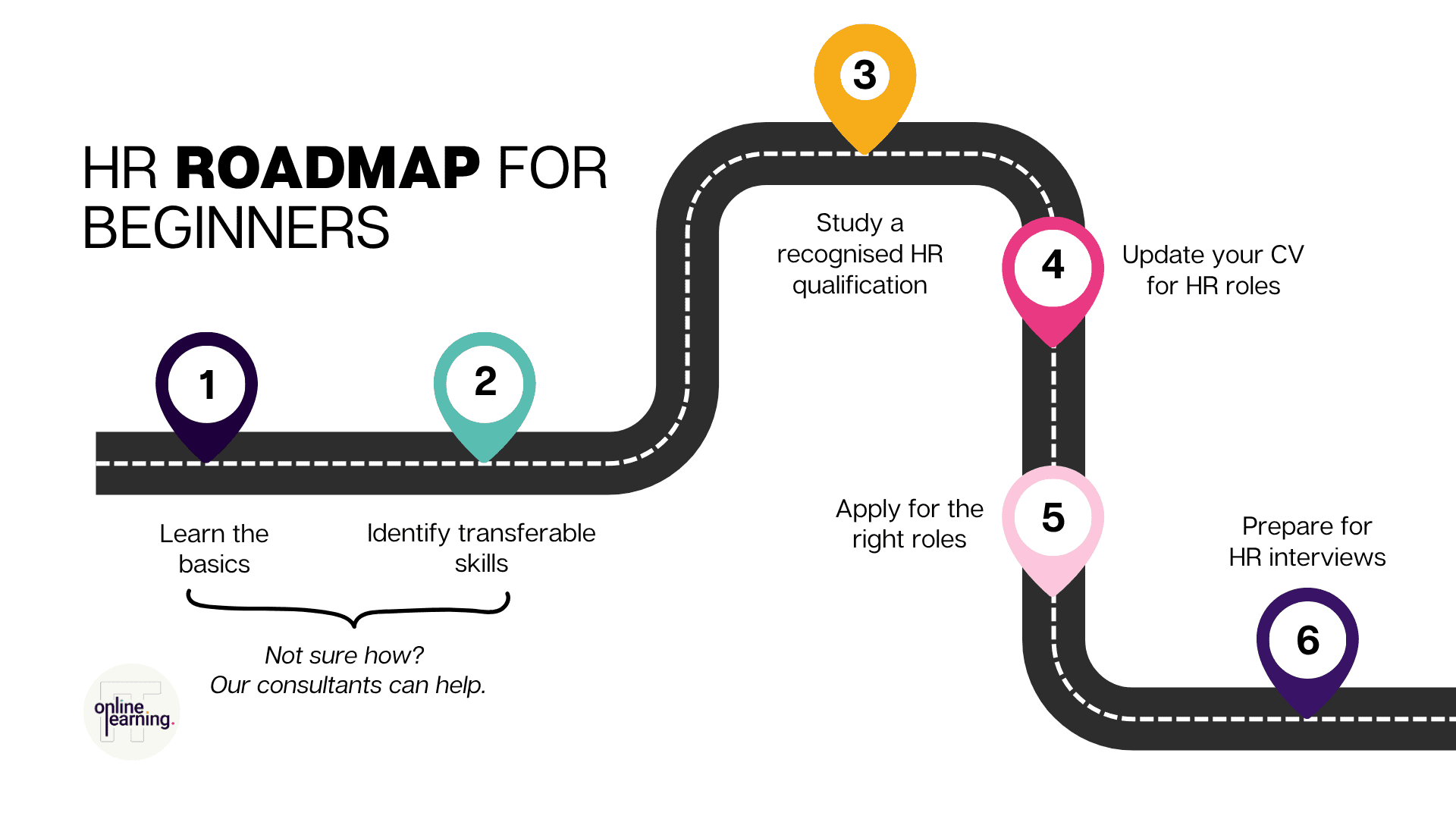
Step 1: Learn the basics of HR
Start by understanding what HR does and how it supports an organisation.
You don’t need to know everything immediately, but you should become familiar with the main areas of HR, including recruitment, onboarding, employee relations, policies, learning and development, and employment law.
This will help you speak more confidently in applications and interviews.
Step 2: Identify your transferable skills
Before you assume you have “no relevant experience”, look at what you have already done.
HR uses many transferable skills, including:
- Communication,
- Confidentiality/discretion,
- Organisation,
- Attention to detail,
- Problem-solving,
- Emotional intelligence,
- Professionalism,
- Data handling,
- Administration,
- Conflict resolution,
- Team support, and
- Time management.
For example, if you have handled customer complaints, supported staff schedules, trained new starters, kept records, dealt with sensitive information or helped managers organise team processes, you probably already have experience that connects well to HR.
Step 3: Study a recognised HR qualification
A recognised HR qualification can help you build credibility, especially if you are applying without direct experience.
The CIPD Level 3 Foundation Certificate in People Practice is designed for beginners and gives you a structured introduction to HR, L&D and people practice.
If you already have HR knowledge, experience, or understanding, the CIPD Level 5 Associate Diploma in People Management is a great place for you to refresh your knowledge and stay aligned with the requirements of intermediate and senior-level HR roles.
Studying CIPD can also help you understand the language used in HR job adverts, which makes it easier to tailor your CV and prepare for interviews.
Step 4: Update your CV for HR roles
Your CV should not just list your previous jobs. It should highlight the parts of your experience that relate to HR.
For example, instead of saying:
“Answered customer queries.”
You could say:
“Handled sensitive customer queries professionally, using clear communication and accurate record-keeping to resolve issues.”
Instead of saying:
“Helped train new team members.”
You could say:
“Supported onboarding and informal training for new team members, helping them understand workplace processes and expectations.”
The goal is to help employers see how your existing experience can transfer into an HR environment.
Even experienced HR professionals can struggle to position themselves as an asset for HR vacancies in a way that lands interviews – and ultimately, secure job offers.
That’s why we offer extensive recruitment support for career changers and experienced HR professionals alike. You’ll have a dedicated Recruitment Advisor, guiding you through mock interviews, providing job sourcing support, redrafting your CV, optimising your LinkedIn profile, and much more.
Step 5: Apply for the right roles
When applying for your first HR role, focus on entry-level opportunities. You may also want to consider roles that combine administration and HR, since these can be a practical stepping stone.
Search for phrases such as:
- HR Administrator no experience
- Entry-level HR
- People Administrator
- Recruitment Administrator
- CIPD Level 3
You can search on job boards such as Indeed, Reed, Totaljobs, CV-Library, and LinkedIn Jobs.
Step 6: Prepare for HR interviews
For entry-level HR interviews, employers may want to know why you’re interested in HR, how you handle confidential information, how organised you are, and how you would deal with people professionally.
You may be asked questions like:
- Why do you want to work in HR?
- What do you understand about the role of HR?
- How would you handle confidential information?
- Tell us about a time you dealt with a difficult person or situation.
- How do you stay organised when managing multiple tasks?
- What interests you about employee relations, recruitment or people development?
- Are you studying or planning to study a CIPD qualification?
A good answer should show that you understand HR is not just “working with people”. It’s about supporting employees and managers fairly, professionally, and in line with workplace policies.
Is HR a Good Career Choice in 2026?
HR can be an immensely rewarding career if you enjoy working with people, solving problems, improving workplaces, and supporting organisational success.
It can also offer strong progression opportunities. Many people begin in HR administration and progress into roles such as:
- HR Advisor
- HR Officer
- HR Business Partner
- HR Manager
- Learning and Development Manager
- Talent Manager
- Employee Relations Advisor
- Organisational Development Specialist
- People Manager
HR is also broad. If you start in general HR, you may later specialise in recruitment, learning and development, reward, employee relations, diversity and inclusion, organisational development, or people analytics.
In other words, you can shape your career over time as you discover which parts of HR interest you most.
How Long Does It Take to Get Into HR?
The time it takes to get into HR depends on your background, confidence, study route, and how actively you apply for roles.
Some people move into HR quickly through an internal opportunity, especially if they already work in administration, recruitment, management, or operations. Others may spend a few months building their knowledge, studying CIPD, and tailoring their CV before securing their first role.
The important thing is to avoid waiting until you feel “perfectly ready”. You can begin building your HR knowledge and applying for suitable roles while you study.
Candidates on the ITonlinelearning HR Career Programmes secure HR roles within 1 to 3 months of completing their CIPD certifications.
Why Study CIPD with ITonlinelearning?
If you’re serious about starting or progressing your HR career, studying with the right training provider can make a big difference.
ITonlinelearning offers CIPD-accredited HR training designed to support learners at different stages of their career journey.
With our CIPD Level 3 Foundation Certificate in People Practice, you receive:
- 12 months of course access
- Self-paced eLearning
- 1:1 tutoring with a specialist HR tutor
- Assignment review and pre-checking
- Free CIPD membership
- Personal study coach
- Official CIPD Level 3 course content
- Live chat support
- Student community forum
This course is ideal if you are starting your HR journey and want to build a strong foundation.
With our CIPD Level 5 Associate Diploma in People Management, you receive:
- 12 months of course access
- Self-paced eLearning
- 1:1 tutoring with a specialist tutor
- Assignment review and pre-checking
- Free CIPD membership
- Personal study coach
- Official CIPD Level 5 course content
- Live chat support
- Student community forum
This course is ideal if you already have some HR or management experience and want to progress into more senior people management roles.
Frequently Asked Questions
Start by learning the basics of HR, identifying your transferable skills, studying an entry-level qualification such as CIPD Level 3, and applying for junior roles like HR Administrator, HR Assistant, or People Assistant.
Yes. A degree is not always required for entry-level HR roles. Many people start in HR through administration, recruitment, customer service, or business support roles, especially when supported by relevant HR training.
The CIPD Level 3 Foundation Certificate in People Practice is usually the best starting point for beginners. It’s designed for people who are new to HR, L&D or people practice.
CIPD Level 3 can strengthen your CV and help you apply for entry-level HR roles. Employers may also look for transferable skills, administration experience, communication skills and a genuine interest in HR.
Yes. ITonlinelearning offers self-paced online CIPD training, allowing you to study around your existing work, family, and personal commitments.
You can apply for roles such as HR Administrator, HR Assistant, People Assistant, Recruitment Administrator, Learning and Development Assistant, and other junior people practice roles.
Choose CIPD Level 3 if you are new to HR. Choose CIPD Level 5 if you already have some HR, L&D, or management experience and want to progress into more advanced roles.
To move into HR management, you will usually need a combination of HR knowledge, practical experience, people management skills, and a more advanced understanding of strategic people practice. CIPD Level 5 can support this progression.
Your Next Step into HR
Getting into HR can feel overwhelming at first, especially if you don’t have direct experience. But there is a clear route into the profession.
If you’re ready to take the first step into HR with no experience, the CIPD Level 3 Foundation Certificate in People Practice is a practical starting point for building your HR career.