How is the UK job market changing?
The UK job market is changing, and anyone starting a career, considering a career change, or thinking about their next professional step is entering a very different environment from even a few years ago.
Recent figures have highlighted particular pressure on people trying to get their first foothold in the workforce.
Data from Indeed, reported by the Financial Times in August 2026, showed that UK job postings open to new or recent graduates were around 7% lower than a year earlier. Graduate openings had reached their lowest level for that time of year since 2020. Overall UK job postings had also fallen during 2026.
At the same time, another change is gathering pace:
Artificial intelligence is becoming part of everyday work.
Skills England says AI is reshaping the skills required across jobs and sectors, with organisations increasingly having to think not only about recruiting AI specialists, but also about helping their existing workforce adapt.
Put those trends together, and it’s understandable that people are asking a big question:
What skills should I be developing now?
The answer isn’t just “learn AI”.
Different careers will need different responses.
Some people will build AI systems. Others will secure the technology around them, use AI within an existing profession, develop stronger technical and digital skills, or lead organisations through AI-enabled change.
Is AI responsible for fewer graduate jobs?
Not necessarily.
Even though it’s tempting to look at weaker entry-level recruitment alongside rapid AI adoption and conclude that one has caused the other, the evidence is more complicated.
Skills England’s 2026 Annual Skills Report acknowledges concerns around graduate and entry-level recruitment but explains that it remains difficult to distinguish AI’s effects from wider labour-market conditions.
Economic uncertainty, employer costs, changing hiring patterns, and wider economic conditions can all affect recruitment.
AI is another part of that picture, but it would be misleading to claim that today’s difficult graduate market is just the result of employers replacing graduates with AI.
That doesn’t mean AI is irrelevant.
It means the better question isn’t:
“Which jobs will AI take?”
It’s:
“How are jobs changing, and what capabilities will people need as they change?”
AI is changing tasks as well as jobs
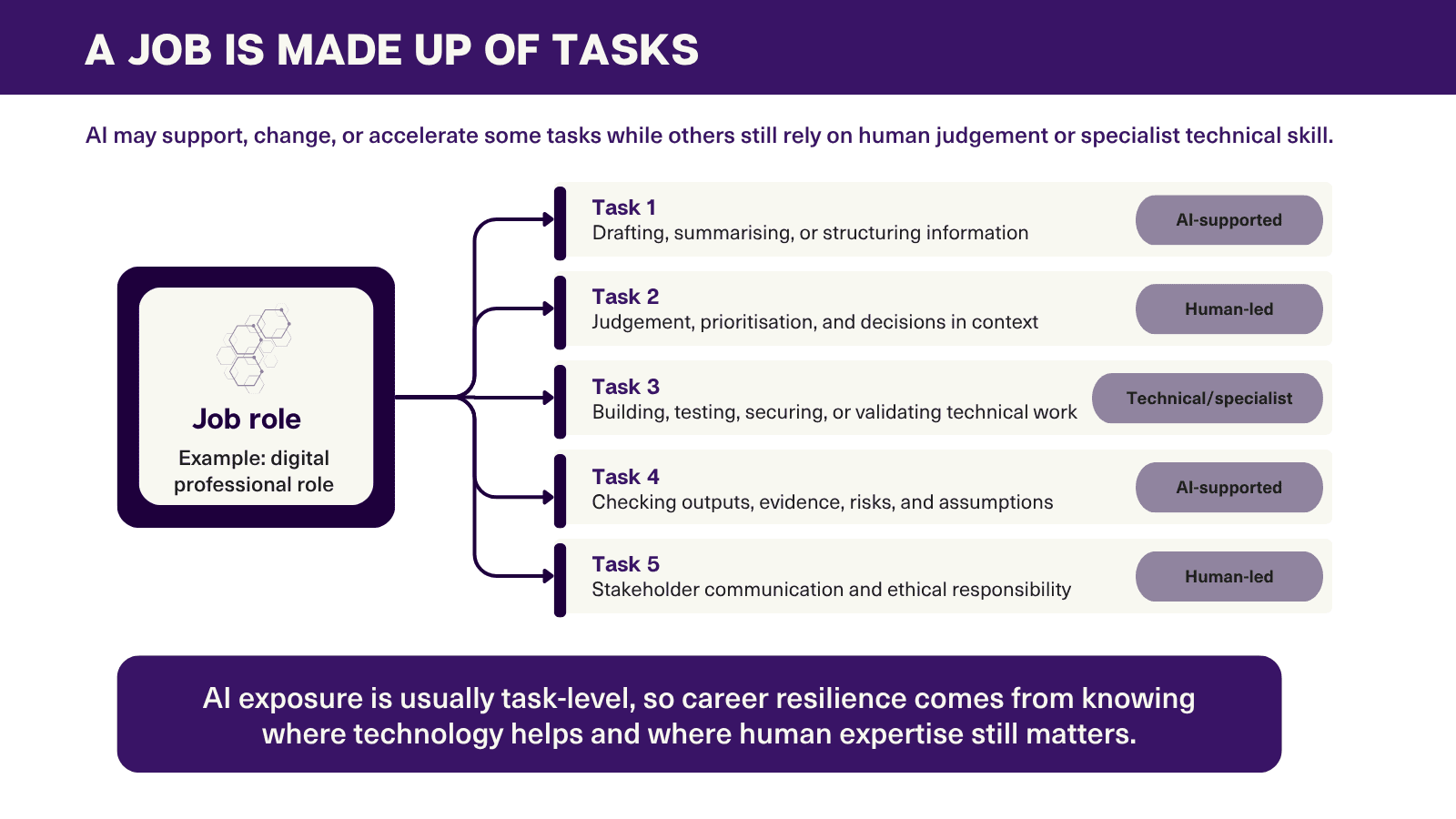
A job is rarely one single activity.
A project manager might create plans, analyse risks, chair meetings, write reports, communicate with stakeholders, and make decisions.
A data analyst might prepare information, investigate trends, create visualisations, verify findings, and explain them to other people.
A cyber security professional might investigate threats, assess vulnerabilities, monitor systems, document incidents, and advise colleagues.
AI may influence some of those tasks far more than others.
Skills England estimates that 70% of UK workers are in occupations containing tasks AI could potentially perform or enhance.
So, exposure to AI doesn’t automatically mean a job disappears. AI can automate a task, accelerate it, support a worker performing it, or change the way the task is completed.
That means future career resilience may increasingly depend on understanding where technology fits into your profession rather than trying to predict which job titles will still exist in ten years.
What skills could become more important?
Skills England’s response is broader than just encouraging everybody to become an AI engineer.
Its 2026 report highlights communication, critical thinking, and analytical ability alongside digital and AI capabilities. It also emphasises the importance of continuous upskilling and reskilling as roles evolve.
For individuals, that creates several possible directions.
1. Building AI
For some people, the opportunity will be technical.
Developing AI solutions can require foundations in areas such as data, programming, machine learning, cloud technologies, prompt engineering, and the development of AI-powered applications.
This route could suit someone who wants to understand what happens behind the interface and become involved in designing or building AI systems.
2. Securing systems and new technologies
As organisations adopt more digital technology, security remains critical.
AI also creates new questions around cyber risk: how AI systems themselves are protected, how attackers might use AI, how organisations test vulnerabilities, and how security professionals respond to increasingly sophisticated threats.
For someone interested in defensive security, penetration testing, threat analysis, governance, or ethical hacking, cyber security represents a different response to technological change.
3. Using AI within an existing profession
You don’t necessarily need to become an AI specialist.
For many people, the more immediate opportunity is learning how AI can support the work they already do.
A project manager might use AI to help structure project information, analyse risks, prepare communications, or organise meeting information.
A business analyst might use it during requirements or process analysis.
A data analyst could use AI when framing questions, preparing data, checking outputs, or communicating findings.
A developer might use AI-assisted tools to explain code, identify bugs, or support refactoring.
The valuable skill isn’t simply generating an answer. It’s knowing how to prompt effectively, evaluate the response, recognise limitations, and decide whether the output can be trusted.
4. Developing practical digital skills
AI hasn’t made foundational technical skills irrelevant.
In many cases, it makes understanding them more valuable.
If AI produces code, someone still needs to know whether that code works.
If it analyses data, someone must understand the data and recognise when the analysis is misleading.
If it produces information, someone needs to check the evidence.
Coding, data literacy, cyber security, digital problem-solving, and practical technology skills therefore continue to provide a foundation for working effectively with newer tools.
5. Leading AI adoption
There is also a completely different side to AI transformation.
Organisations need people who can answer questions such as:
- Where should we actually use AI?
- What risks does it create?
- How will employees be affected?
- What governance should be in place?
- How do we introduce it ethically?
- How do we help teams adapt?
- How do we turn AI investment into meaningful organisational change?
Those aren’t purely technical questions.
They are leadership, management, governance, ethics, and change questions.
That creates opportunities for managers and senior leaders who understand how AI affects people and organisations, even if they never write a line of code.Explore CMI AI qualifications
The human skills around AI matter, too
One of the most useful messages in the Skills England report is that adapting to AI doesn’t mean abandoning human capability.
Communication, critical thinking, analytical ability, judgement, problem-solving, collaboration, and responsible use of technology remain part of the skills picture.
AI can produce information very quickly.
It cannot automatically tell you whether that information is appropriate for your organisation, your customer, your project, or your situation.
People still need to ask good questions.
They need to challenge assumptions.
They need to communicate decisions.
They need to understand context.
And they need to recognise when an apparently confident AI answer is wrong.
That combination of technical capability and human judgement may become increasingly important.
Skills development is becoming an ongoing process
Perhaps the biggest change isn’t any individual technology.
It’s the pace at which working practices can now change.
Skills England talks about building workforce resilience by enabling people to upskill and reskill throughout their careers.
That suggests an important shift in how we think about careers.
Education doesn’t necessarily finish when you leave university, complete an apprenticeship, earn a qualification, or land your first job.
Instead, careers may involve repeated periods of learning as tools, responsibilities, and opportunities evolve.
You might strengthen your existing profession.
You might specialise.
You might move sideways into another field.
Or you might combine skills that previously belonged to separate disciplines.
The goal isn’t to predict the future perfectly.
It’s to become better prepared to adapt when that future arrives.
So, what should you learn next?
There isn’t one answer.
If you’re interested in building technology, technical AI skills may make sense.
If you’re drawn to protecting organisations, cyber security could be a better fit.
If you already work in project management, business analysis, coding, or data, learning how AI affects that profession might be more useful than starting again.
If you want hands-on technical capability, practical digital projects can help you turn theory into experience.
And if you’re responsible for people, teams, or organisational strategy, understanding AI leadership, governance, ethics, and change may be the more relevant route.
The important thing is choosing a direction that matches what you actually want to do.
The job market will continue to change. Specific technologies will change, too.
Developing a combination of professional knowledge, practical skills, digital confidence, and the ability to keep learning will put you in a stronger position to respond.
Frequently Asked Questions About the Changing UK Job Market
The graduate recruitment market is currently challenging. Indeed data reported in August 2026 showed graduate postings around 7% below the previous year and at their lowest level for that time of year since 2020.
However, labour-market conditions vary considerably by industry, occupation, experience, and location. A difficult overall market doesn’t mean opportunities have disappeared, but candidates may face greater competition and benefit from demonstrating practical, relevant skills alongside qualifications.
There isn’t currently enough evidence to conclude that AI is responsible for the wider decline in graduate recruitment.
AI may change, automate, or support particular tasks, but recruitment is also affected by economic conditions, hiring costs, employer confidence, and other factors.
Rather than assuming whole careers will disappear, it can be more useful to understand which tasks within a profession are changing and which skills can complement new technologies.
Most people aren’t likely to need the same level of AI expertise.
Some roles require specialist technical skills, while many workers may benefit more from practical AI literacy: understanding how to use AI tools, evaluate outputs, apply judgement, and use the technology responsibly within their existing profession.
Communication, critical thinking, analytical ability, judgement, problem-solving, collaboration, professional knowledge, and responsible technology use can all complement AI skills.
Technical and digital capabilities will also remain important for people working directly with technology, data, software, or cyber security.
Sources
Department for Work and Pensions and Skills England (2026) Skills England annual skills report 2026. Published 1 June 2026; updated 6 July 2026.
Hill, A. (2026) ‘UK graduate job openings fall to lowest level since pandemic’, Financial Times, 2 August.