How Do You Become a Project Manager?
Become a project manager by learning the fundamentals of project delivery, developing relevant workplace skills, gaining experience with real or simulated projects, and building towards a recognised project management qualification.
There isn’t one compulsory route into the profession. Some project managers begin through graduate schemes or apprenticeships, while others move across from education, operations, administration, IT, construction, marketing, finance, healthcare, or another area in which they have already helped to deliver change.
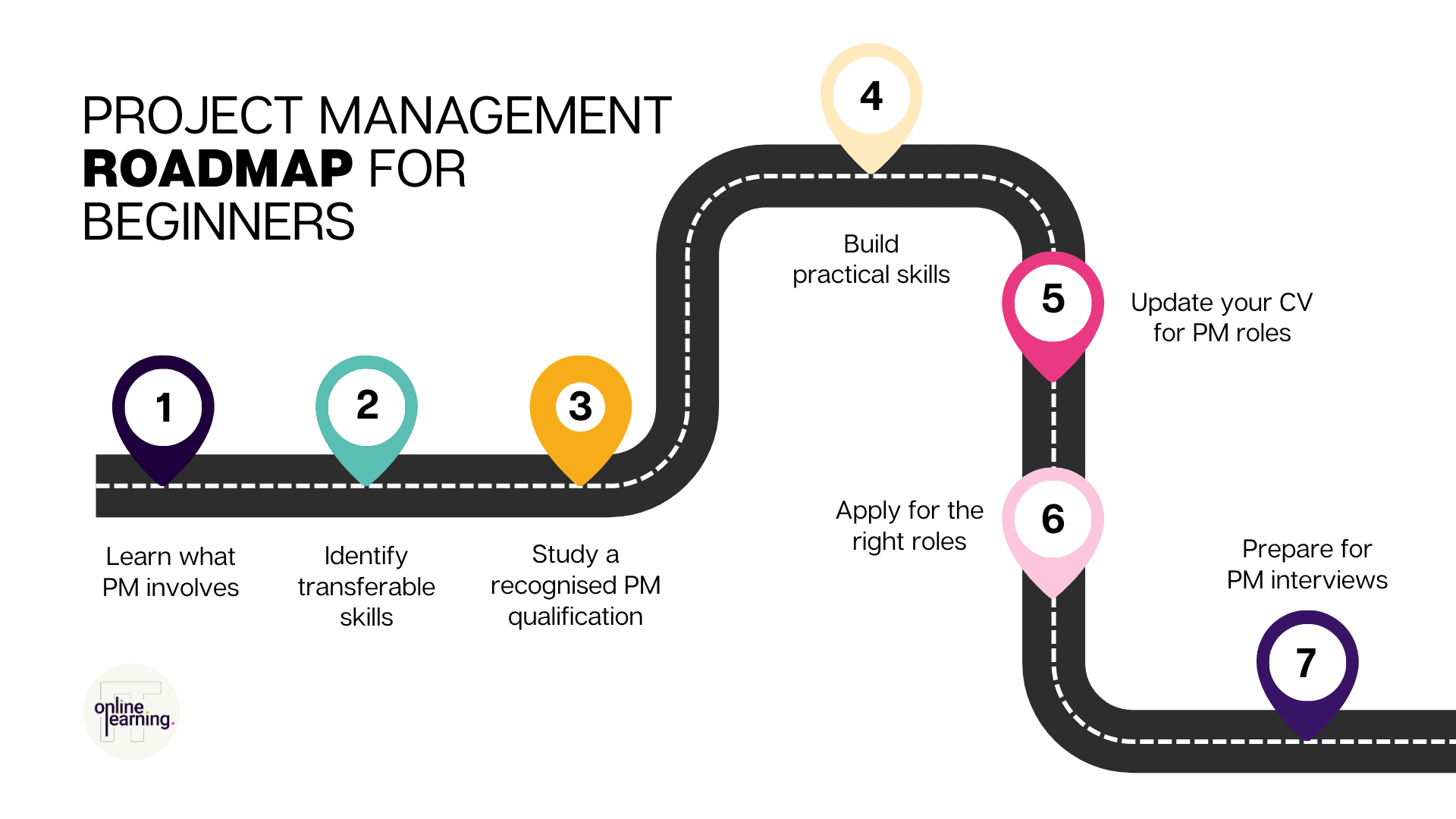
A practical route for many graduates and career changers is to:
- Understand what project management involves.
- Identify the transferable skills you already possess.
- Learn a recognised project management framework.
- Gain practical experience coordinating smaller pieces of work.
- Tailor your CV and LinkedIn profile towards project roles.
- Apply for entry-level positions such as Project Administrator, Project Support Officer, Project Coordinator, or Junior Project Manager.
- Continue building your qualifications and responsibilities as your career develops.
You don’t necessarily need to complete every step before applying for work. Qualifications, practical experience, and job applications can often be developed alongside one another.
What Does a Project Manager Do?
A project manager plans, organises, and coordinates the work needed to deliver a defined outcome within agreed constraints.
Projects are temporary pieces of work created to achieve a specific objective. They might involve implementing a new system, launching a product, moving an office, improving a service, constructing a building, or introducing a new organisational process.
The Association for Project Management describes the project manager as being responsible for the day-to-day management of a project and competent in managing its different aspects.
Depending on the organisation and project, a project manager may:
- Define the project’s objectives and expected outcomes.
- Help establish the scope of the project.
- Create and maintain project plans.
- Break work down into tasks and milestones.
- Coordinate team members, suppliers, and stakeholders.
- Estimate and monitor time, cost, and resources.
- Identify and manage risks.
- Track issues, changes, and dependencies.
- Run project meetings.
- Communicate progress to senior stakeholders.
- Maintain project documentation.
- Support decision-making.
- Resolve obstacles affecting delivery.
- Close the project and review lessons learned.
The role isn’t just about creating plans and asking whether tasks have been completed. Good project managers help people understand what needs to happen, why it matters, who is responsible, and what could prevent the project from succeeding.
Where do project managers work?
Project management skills are used across almost every industry, including:
- Information technology.
- Construction and engineering.
- Financial services.
- Healthcare.
- Central and local government.
- Education.
- Marketing and communications.
- Manufacturing.
- Energy and utilities.
- Retail.
- Logistics.
- Professional services.
- Charities and non-profit organisations.
This variety makes project management particularly attractive to career changers. You may be able to combine newly developed project skills with knowledge of the industry in which you already work.
For example, someone with experience in healthcare administration may understand the operational pressures involved in a healthcare improvement project. A software developer moving towards project management may already understand technical teams and digital delivery. A marketing professional may have experience coordinating campaigns, budgets, suppliers, and deadlines.
Why Become a Project Manager in the UK?
Project management can offer a varied career with opportunities to work across different organisations, industries, and types of change.
Rather than repeating the same operational activities indefinitely, project professionals are often involved in work with a clear objective, defined timescale, and visible result. One project might focus on digital transformation, while the next involves compliance, restructuring, product development, or process improvement.
Common reasons people choose a project management career include:
- The opportunity to work across different sectors.
- A mixture of planning, problem-solving, communication, and leadership.
- Clear progression from project support into management and programme-level roles.
- Transferable skills that can be used in many organisations.
- The satisfaction of helping teams turn an idea into a completed result.
- Opportunities to specialise in areas such as risk, planning, governance, agile delivery, change, or programme management.
- The ability to build on knowledge gained in an existing career.
Project management can also offer strong earning potential as your responsibilities increase. However, salaries vary significantly according to experience, location, sector, project complexity, and the size of the organisation.
According to ITJobsWatch.co.uk, here’s a breakdown of the average salaries that project managers and project-oriented roles earn in the UK:
| Role | Average annual salary |
| Junior Project Manager | £32,500 |
| Project Manager | £60,000 |
| Senior Project Manager | £65,000 |
| Programme Manager | £80,000 |
What Skills Are Required for a Project Manager?
The skills required for a project manager include organisation, communication, planning, leadership, risk management, problem-solving, and the ability to make informed decisions.
You don’t need to arrive in your first project role having mastered every one of these areas. Entry-level employers will often be interested in your potential, transferable experience, and ability to learn.
Organisation and planning
Project managers need to organise tasks, people, information, deadlines, and decisions without losing sight of the project’s overall objective.
This includes being able to:
- Prioritise work.
- Set realistic deadlines.
- Maintain accurate documentation.
- Coordinate multiple activities.
- Identify dependencies between tasks.
- Follow up on agreed actions.
You may already have examples of this skill from organising events, coordinating a campaign, managing rotas, supporting customers, completing academic work, or handling competing workplace deadlines.
Communication
Project managers communicate with people who have different priorities, responsibilities, and levels of technical understanding.
Strong communication involves more than presenting confidently. It also means listening carefully, asking useful questions, adjusting information for the audience, and making expectations clear.
A senior sponsor might need a brief summary of project status, while a delivery team may need detailed information about actions, deadlines, and dependencies.
Stakeholder management
A stakeholder is anyone who affects, is affected by, or has an interest in the project.
Project managers need to understand what different stakeholders expect, how much influence they have, and how they should be kept informed.
Stakeholder management may involve:
- Identifying interested individuals and groups.
- Understanding their priorities and concerns.
- Agreeing how frequently they need updates.
- Managing conflicting expectations.
- Building support for the project.
- Communicating difficult information appropriately.
Leadership
Project managers frequently need to guide people without being their direct line manager.
That requires the ability to create clarity, build trust, encourage accountability, and help a team remain focused when circumstances change.
Leadership in a project environment isn’t about having all the answers. It’s often about helping the right people make decisions and ensuring that agreed actions are followed through.
Risk management
A risk is an uncertain event that could affect the project’s objectives.
Project managers identify potential risks, assess their likelihood and impact, assign responsibility, and agree actions to reduce or manage them.
For example, a system implementation project might be affected by limited user availability, delayed data migration, insufficient testing, or resistance to the new process.
Problem-solving and decision-making
Projects rarely go entirely according to plan.
A good project manager can separate symptoms from causes, gather useful information, consider available options, and support timely decisions.
This doesn’t mean making every decision alone. It means knowing which decisions fall within your authority and when an issue needs to be escalated.
Time and budget awareness
Not every entry-level project role involves direct responsibility for a large budget. However, project professionals should understand how decisions affect time, cost, resources, and quality.
An apparently small delay can affect dependent tasks, increase supplier costs, or reduce the time available for testing.
Adaptability
Project managers work with uncertainty. Requirements change, people become unavailable, suppliers are delayed, and new risks appear.
Adaptability means responding constructively without allowing the project to lose control. Plans can change, but the reasons, effects, and decisions should still be understood and documented.
Which Project Manager Qualifications Do You Need?
There is no single project manager qualification that every employer requires.
The right qualification depends on your experience, the type of organisation you want to work for, and whether you need broad project knowledge, a structured method, or an agile approach.
Recognised routes include APM qualifications, PRINCE2 Project Management, AgilePM, university study, and project management apprenticeships.
APM Project Fundamentals Qualification (PFQ)
The APM Project Fundamentals Qualification, commonly shortened to APM PFQ, is designed to provide an introductory understanding of the project profession.
APM describes PFQ as a starting qualification for developing an understanding of project management principles.
It may suit:
- Complete beginners.
- Graduates.
- Career changers.
- Project team members.
- Administrators moving into project support.
- People who want a broad introduction before choosing a more advanced route.
APM Project Management Qualification (PMQ)
The APM Project Management Qualification, or APM PMQ, develops broader and deeper knowledge across the project profession.
It is generally more appropriate for people who already have some project knowledge or experience and want to demonstrate their understanding across a wide range of project management topics.
APM positions its qualifications as a progressive route supporting professionals at different stages of their careers.
APM PMQ may suit:
- Project coordinators.
- Assistant project managers.
- Existing project managers.
- Professionals with practical experience but no formal qualification.
- People working towards more advanced professional recognition.
PRINCE2® Foundation and Practitioner
PRINCE2 Project Management is a structured project management method.
The Foundation qualification introduces its principles, practices, and processes, while Practitioner focuses on applying and tailoring the method to a project environment. PeopleCert describes PRINCE2 Foundation as suitable across career stages and Practitioner as intended for project management professionals, with prerequisites applying to the latter.
PRINCE2 may be relevant if:
- You want to understand a defined project management method.
- Employers in your target sector mention PRINCE2.
- You work in, or want to enter, a structured project environment.
- You want to understand project roles, governance, controls, and decision points.
- You want to progress from understanding the method to applying it.
Explore PRINCE2 Foundation and Practitioner, or read An Introduction to PRINCE2.
AgilePM® Foundation and Practitioner
AgilePM is designed for project environments that need governance and control while allowing teams to deliver iteratively and respond to change.
Its Foundation level introduces the approach, while Practitioner examines how it can be applied. The Agile Business Consortium identifies aspiring project managers, project team members, business analysts, and PMO staff among the audiences for AgilePM.
AgilePM may be particularly useful if:
- You want to work in an agile or hybrid environment.
- Projects need to adapt as requirements develop.
- You work with digital, technology, product, or transformation teams.
- You want to combine project governance with iterative delivery.
Explore AgilePM Foundation and Practitioner or read more to Understand Agile Foundation and Practitioner Courses.
University degrees
You can study project management at undergraduate or postgraduate level, but a specialist project management degree isn’t compulsory for many roles.
Employers often favour candidates with the relevant vocational certifications over degrees, as these certifications prove job-readiness as well as an understanding of the theory behind project management.
Which Project Management Qualification Should You Choose?
Many learners find themselves contemplating APM vs PRINCE2, but the route you select will depend on your situation – the best project management qualification is the one that closes the most important gap between your current experience and the role you want.
| If you… | You should study… | Because it… |
| Are completely new to project management | APM PFQ | Provides a broad introduction to the project profession |
| Want to learn a structured method | PRINCE2 Foundation & Practitioner | Explains how projects can be directed, managed, controlled, and tailored |
| Already have project experience | APM PMQ | Develops wider knowledge across the project profession |
| Want to work in agile or hybrid delivery | AgilePM Foundation & Practitioner | Combines project management controls with an iterative approach |
| Already manage multiple related projects | MSP Foundation & Practitioner | Introduces programme management rather than individual project management |
Qualifications don’t automatically replace experience, and experience doesn’t always replace formal knowledge.
A strong entry route often combines both. You could study a recognised framework while volunteering for project responsibilities, supporting a project at work, or creating evidence through a realistic simulated project.
How to Become a Project Manager Step by Step
Step 1: Learn how projects are structured
Begin by understanding the main concepts used across project environments.
These include:
- Objectives.
- Scope.
- Deliverables.
- Business cases.
- Stakeholders.
- Risks and issues.
- Schedules.
- Resources.
- Budgets.
- Quality.
- Governance.
- Change control.
- Benefits.
- Lessons learned.
You don’t need to memorise a dictionary of terminology. The aim is to understand how these concepts connect and why they matter during delivery.
Step 2: Review your transferable experience
Many people have performed project-related work without holding a project management job title.
Look for examples in which you have:
- Coordinated several people.
- Planned an event.
- Introduced a process.
- Helped implement new technology.
- Managed a deadline.
- Tracked a budget.
- Communicated with suppliers.
- Trained colleagues.
- Solved an operational problem.
- Supported organisational change.
- Produced progress reports.
- Managed competing priorities.
Instead of writing “helped with an office move” on your CV, you might explain that you coordinated supplier communication, maintained the relocation schedule, tracked outstanding actions, and supported staff communications.
The second version demonstrates project-relevant behaviour.
Step 3: Choose a suitable qualification
Use your target job descriptions to guide your decision.
Review a selection of genuine vacancies and note:
- Frequently mentioned qualifications.
- Common project methods.
- Required tools.
- Repeated responsibilities.
- Preferred industry experience.
- The seniority of the advertised roles.
Don’t choose a qualification solely because it has the longest name or the highest level. An advanced course won’t necessarily be the best starting point if you still need to understand the foundations.
Step 4: Gain practical project experience
Experience doesn’t have to begin with sole responsibility for a large, high-risk project.
You could:
- Volunteer to coordinate a small internal initiative.
- Support a project manager with documentation.
- Maintain an action or risk log.
- Organise a workplace event.
- Help plan a process improvement.
- Join a project team as a subject-matter expert.
- Support a charity or community project.
- Coordinate a small digital, marketing, or operational project.
- Complete a realistic simulated project.
Your objective is to build examples that demonstrate how you plan, communicate, solve problems, manage stakeholders, and respond when circumstances change.
Step 5: Learn commonly used project tools
Project tools vary between employers, so you don’t need to master every platform before applying.
However, you should be comfortable with:
- Spreadsheets.
- Presentation software.
- Document collaboration.
- Task boards.
- Project schedules.
- Meeting and communication platforms.
- Basic reporting dashboards.
Tools such as Microsoft Excel, Microsoft Project, Jira, Trello, Asana, Monday.com, and Microsoft Teams may appear in project environments, depending on the organisation and delivery approach.
Focus on the underlying purpose of the tool. A project manager should understand why tasks, owners, dependencies, deadlines, risks, and updates are being recorded, rather than simply knowing which buttons to click.
Step 6: Improve your project management CV
Your CV should show evidence of delivery, not just a list of duties.
Where possible, structure examples around:
- The situation or objective.
- Your responsibility.
- The action you took.
- The result or improvement.
For example:
Coordinated a six-week onboarding improvement initiative involving HR, IT, and operational managers, maintaining the action plan, arranging progress meetings, and helping the team deliver the revised process on schedule.
Use accurate language and don’t rename yourself as a project manager if that wasn’t your role. You can still highlight project management responsibilities within another position.
Step 7: Apply for realistic entry roles
Your first role may not have the title “Project Manager”.
Useful job titles to search include:
- Project Administrator.
- Project Assistant.
- Project Support Officer.
- Project Coordinator.
- PMO Administrator.
- PMO Analyst.
- Junior Project Manager.
- Assistant Project Manager.
- Implementation Coordinator.
- Change Coordinator.
- Delivery Coordinator.
APM specifically identifies roles such as assistant project manager and project assistant as possible entry points into the profession.
These roles can help you learn how projects operate while working alongside experienced professionals.
Step 8: Prepare project-focused interview examples
Project management interviews often explore how you have handled deadlines, risks, people, priorities, and change.
Prepare examples for questions such as:
- Tell me about a time you coordinated several people.
- How do you prioritise competing deadlines?
- Describe a risk you identified before it became a problem.
- Tell me about a time a plan changed unexpectedly.
- How would you handle a stakeholder who disagreed with the project?
- How do you communicate progress?
- Describe a problem you had to escalate.
- How do you keep track of actions?
- Tell me about a time you influenced someone without formal authority.
You can use examples from work, university, volunteering, community activities, or personal projects, provided they genuinely demonstrate the skill being discussed.
Can You Become a Project Manager Without Experience?
Yes, you can begin working towards becoming a project manager without direct project management experience.
However, you’re more likely to secure an entry or support-level position than to move immediately into responsibility for a large, complex project.
Employers need evidence that you can work in an organised way, communicate with different people, take responsibility, and manage deadlines. You can build that evidence through transferable experience, training, volunteering, simulations, and smaller workplace initiatives.
A realistic no-experience route might look like this:
- Complete an introductory project management qualification.
- Identify project-related responsibilities from previous work.
- Gain experience supporting or coordinating a small initiative.
- Rewrite your CV around relevant outcomes.
- Apply for Project Administrator, Project Support, or Coordinator roles.
- Build experience alongside more advanced training.
- Progress into a Junior Project Manager or Project Manager position.
Don’t dismiss your previous career because it wasn’t labelled project management. Industry knowledge, customer management, budgeting, administration, leadership, data analysis, and technical expertise can all strengthen your application.
Can You Become a Project Manager Without a Degree?
Yes, it is possible to become a project manager without a degree.
Project management is accessible through several routes, including professional qualifications, apprenticeships, direct applications, and progression from an existing role.
Without a degree, you may need to make your evidence particularly clear by demonstrating:
- Recognised project knowledge.
- Strong transferable experience.
- Examples of responsibility and delivery.
- Relevant industry knowledge.
- Commitment to professional development.
- The ability to communicate confidently in interviews.
A professional qualification can help establish that you understand project terminology and practices, but employers will still want to know how you behave and apply your knowledge.
How Long Does It Take to Become a Project Manager?
The time needed to become a project manager depends on your starting point, chosen training route, existing skills, and the level of role you are targeting.
Someone who already coordinates complex work may be able to move into a project-focused position relatively quickly. Someone entering the workforce for the first time may need longer to develop workplace experience.
These aren’t guaranteed timelines. Completing a course doesn’t ensure that you will secure a role within a particular period, and employment outcomes depend on the quality of your applications, previous experience, location, target sector, and job market.
It is usually more useful to measure progress through milestones:
- Can you explain the project lifecycle?
- Do you have a recognised qualification?
- Can you demonstrate project-related skills?
- Have you supported a real or simulated project?
- Is your CV targeted towards relevant roles?
- Can you answer project interview questions confidently?
- Are you applying for positions appropriate to your current experience?
How to Change Careers into Project Management
Career changers often believe they need to start again completely. In practice, project management can allow you to retain valuable knowledge from your previous career while changing the type of responsibility you hold.
Translate your existing skills
Avoid describing yourself only through your previous job title.
For example:
- A teacher may have experience planning programmes, managing stakeholders, assessing risks, and working to fixed deadlines.
- A retail manager may have coordinated teams, budgets, suppliers, targets, and operational change.
- An administrator may have maintained records, organised meetings, tracked actions, and supported several departments.
- A healthcare professional may understand compliance, risk, multidisciplinary teams, and service improvement.
- A marketing professional may already coordinate campaigns with defined budgets, deliverables, and deadlines.
Decide whether to stay in your sector
You may find it easier to secure your first project role in an industry you already understand.
Your sector knowledge can reduce the learning curve and help you communicate with technical or operational stakeholders.
Once you have established direct project experience, it may become easier to move between industries.
Prepare a clear career-change explanation
Employers may ask why you are changing careers.
A strong explanation should connect your previous experience to your new direction:
My previous roles increasingly involved coordinating cross-team initiatives, managing deadlines, and supporting process improvements. Those responsibilities were the parts of my work I found most rewarding, so I’ve developed my formal project management knowledge and am now looking to move into a dedicated project role.
This is more convincing than presenting project management as a sudden or unrelated choice.
How Can ITonlinelearning Support Your Project Management Career?
ITonlinelearning’s Project Management Career Programme combines structured training with study and career support for learners who want a guided route into the profession.
The programme includes:
- 1:1 tutoring with a specialist tutor.
- A Personal Study Coach.
- A free Scrum course.
- Live exam preparation sessions.
- A free exam resit.
- CV and LinkedIn review.
- Free PeopleCert Plus membership.
- 24/7 AI TutorBot access.
- Live Chat support.
- An exclusive resource library.
- A Student Community Forum.
- Interview preparation.
- A job guarantee, subject to the programme’s applicable terms and eligibility requirements.
This may suit learners who want more than an individual qualification and would benefit from support with studying, presenting their experience, and preparing for project management applications.
Where Can a Project Management Career Lead?
Project management can lead to several management, specialist, and strategic career paths.
A typical progression might include:
- Project Administrator or Project Assistant.
- Project Coordinator or Project Support Officer.
- Junior or Assistant Project Manager.
- Project Manager.
- Senior Project Manager.
- Programme Manager.
- Portfolio Manager or Head of Projects.
Progression isn’t always linear. Some project professionals move into specialist positions such as:
- Project Planner.
- Risk Manager.
- Change Manager.
- PMO Analyst.
- PMO Manager.
- Business Analyst.
- Agile Delivery Manager.
- Scrum Master.
- Project Controls Manager.
- Transformation Manager.
Moving from project to programme management
A project delivers a defined output or outcome. A programme coordinates multiple related projects and activities to achieve broader organisational change and benefits.
Experienced project managers moving towards programme-level responsibility may consider MSP Foundation and Practitioner. MSP focuses on managing successful programmes rather than delivering a single project.
As your career develops, related qualifications may help you strengthen specialist areas:
- Change Management Foundation and Practitioner can support work involving organisational and behavioural change.
- Lean Six Sigma Yellow Belt introduces process improvement concepts.
- ITIL Foundation can be relevant to projects delivered in IT and service-management environments.
Ready to Take Your First Step into Project Management?
There is no single formula for becoming a project manager.
You might begin through an apprenticeship, a graduate scheme, a professional qualification, an internal opportunity, or a move from another career. Whichever route you choose, the strongest foundation combines relevant knowledge with practical evidence of how you organise work, communicate with people, manage uncertainty, and contribute to delivery.
Start by choosing a realistic first role, identifying the skills you already possess, and addressing the gaps between your current experience and the opportunities you want to pursue.