What Is PRINCE2 Project Management?
PRINCE2 project management is a structured method for managing projects from initial justification through delivery and closure. It provides principles, practices, processes, defined responsibilities, and controls that help people organise and govern a project while allowing the method to be tailored to the project’s scale, complexity, organisation, and delivery approach.
In simple terms, PRINCE2 helps a project team answer questions like:
- Why are we doing this project?
- Who is responsible for what?
- What are we trying to deliver?
- How will the project be planned and controlled?
- What happens if something moves outside agreed limits?
- When should key decisions be made?
- How should the method change to suit this particular project?
PRINCE2 focuses on managing the project, rather than prescribing how specialists must carry out the technical work itself.
That means a construction team, software team, data team, transformation team, or another specialist group can use its own delivery techniques within the project’s PRINCE2 management environment.
Table: PRINCE2 at a glance
| Question | Answer |
|---|---|
| What is PRINCE2? | A structured project management method. |
| What does PRINCE2 stand for? | Projects in Controlled Environments. |
| Who owns PRINCE2? | PeopleCert owns PRINCE2 through its ownership of AXELOS. |
| What are its main elements? | Principles, people, practices, processes, and project context. |
| How many principles are there? | Seven. |
| How many practices are there? | Seven. |
| How many processes are there? | Seven. |
| Does PRINCE2 require Waterfall? | No. It can work with linear-sequential, iterative-incremental, and hybrid delivery approaches. |
| Can it be used on smaller projects? | Yes. PRINCE2 can be tailored to the project’s scale and complexity. |
| Are PRINCE2 and a PRINCE2 qualification the same thing? | No. PRINCE2 is the method; Foundation and Practitioner are qualifications based on the method. |
What Does PRINCE2 Stand For?
PRINCE2 stands for Projects in Controlled Environments (the “2” comes from the method’s historical development as the successor to the original PRINCE method). The acronym reflects the method’s origins, although PRINCE2 is now primarily used as the established brand name for the project management method.
For a modern learner, though, understanding the acronym is less important than understanding what the current method does: it creates a structured management environment in which responsibilities, decision-making, business justification, planning, delivery, and control can be organised throughout a project.
Is PRINCE2 a Method, Methodology, Framework, or Qualification?
PRINCE2 officially describes itself as a project management method. “PRINCE2 methodology” is a common search term and everyday description, but “method” is the more accurate term when referring to current PRINCE2 guidance.
It’s also important to separate the method from the qualifications built around it.
Table: PRINCE2 terminology explained
| Term | What it means |
|---|---|
| PRINCE2 | The project management method itself. |
| PRINCE2 methodology | Common informal/search terminology for the PRINCE2 method. |
| PRINCE2 framework | A broad informal description sometimes used when discussing its structured governance and management approach. |
| PRINCE2® Foundation | A qualification focused on understanding the method and its core concepts. |
| PRINCE2® Practitioner | A qualification focused on applying and tailoring the method in context. |
PRINCE2® Foundation is the starting qualification for learning the core PRINCE2 method, and PRINCE2® Practitioner is the next step for applying and tailoring it in project scenarios.
Someone can use the PRINCE2 method on a project, study PRINCE2 training, or hold a PRINCE2 qualification – but those statements don’t mean exactly the same thing.
How Does PRINCE2 Work?
PRINCE2 works by combining five integrated elements: principles, people, practices, processes, and project context. The principles guide how the project should be managed; the practices address recurring management concerns; the processes move the project through its lifecycle; people place relationships and behaviour at the centre; and project context shapes how everything is applied.
The important word is integrated.
PRINCE2 is not intended to work as 7 principles in one box, 7 practices in another, and 7 processes in another.
They interact throughout the project.
A useful way to think about it is:
- Principles = the obligations that keep the project recognisably PRINCE2.
- People = the people doing the work, making decisions, leading change, and being affected by it.
- Practices = the aspects of project management that need ongoing attention.
- Processes = the flow of management activity through the project lifecycle.
- Project context = the environment in which those elements must be tailored and applied.
PRINCE2 Method Explorer
Click each integrated element to explore how it contributes to the PRINCE2 method.
Principles
The principles are the guiding obligations that help ensure a project is genuinely being managed using PRINCE2.
- They provide the core foundation of the method.
- They support business justification, product focus, learning, and clear responsibilities.
- They should all be applied, while the way they are applied can be tailored to the project.
PRINCE2 has seven principles that help keep projects justified, structured, and adaptable.
People
People is a central integrated element of PRINCE2 because projects depend on the people doing the work, making decisions, leading change, and being affected by the outcomes.
- It brings attention to leadership, relationships, communication, and collaboration.
- It recognises that projects operate within organisational and project ecosystems.
- It connects human factors with the rest of the PRINCE2 method.
People helps ensure that successful projects are not treated as a process-only exercise.
Practices
Practices are the recurring aspects of project management that need ongoing attention throughout the project lifecycle.
- The seven practices are business case, organizing, plans, quality, risk, issues, and progress.
- They support the ongoing management of a project rather than a one-time activity.
- They work together, so a change in one area can affect several others.
Practices help project teams manage the main ongoing concerns of a project in a structured way.
Processes
Processes describe the management activity used across the project lifecycle, from deciding whether a project is worth initiating through to formal closure.
- They provide a structured flow for directing, managing, and controlling work.
- They connect the project lifecycle with decision points and responsibilities.
- They help turn PRINCE2 from a concept into a practical management method.
PRINCE2 has seven processes that help organise how the project is started, managed, and closed.
Project Context
Project context shapes how PRINCE2 is applied. The method should be tailored to suit the project’s scale, complexity, organisation, environment, and delivery approach.
- It helps keep PRINCE2 proportionate rather than overly rigid.
- It allows the method to support different types of projects and organisations.
- It accommodates linear-sequential, iterative-incremental, and hybrid delivery.
Project context is what makes PRINCE2 flexible and suitable for different real-world environments.
What Are the 7 PRINCE2 Principles?
The seven PRINCE2 principles are guiding obligations that determine whether a project is genuinely being managed using PRINCE2. All seven are intended to be applied, while the way they are applied can be tailored to the project.
The seven principles are:
- Ensure continued business justification
- Learn from experience
- Define roles, responsibilities, and relationships
- Manage by stages
- Manage by exception
- Focus on products
- Tailor to suit the project
Taken together, they help keep the project justified, organised, controllable, outcome-focused, adaptable, and informed by experience.
For example, manage by exception means agreed tolerances can allow decisions to be made at the appropriate management level rather than escalating every small variation. Focus on products keeps planning centred on what the project needs to create, while tailor to suit the project prevents PRINCE2 from becoming a one-size-fits-all set of procedures.
Watch our Introduction to the PRINCE2 Principles Webinar for more information on how the PRINCE2 Principles work together.
Why Is “People” a Core Part of PRINCE2?
People are a central, integrated element of the current PRINCE2 method because projects depend on the people working on them and the people affected by the change they create. So, the method considers areas such as relationships, leadership, collaboration, communication, culture, capability, and change alongside formal processes and controls.
Modern PRINCE2 is not just a process map.
Projects exist within organisational and project ecosystems made up of people with different interests, expectations, responsibilities, and levels of influence. PRINCE2 therefore integrates people considerations into its principles, practices, processes, and organisational arrangements.
This might affect how:
- a team is formed,
- responsibilities are allocated,
- stakeholders are engaged,
- decisions are communicated,
- change is introduced,
- relationships are managed, and
- different levels of autonomy are used.
The stronger people focus is actually one of the major developments in the current version 7 method.
Watch our Introduction to the “People” Element in PRINCE2 Webinar for more information on the People element of PRINCE2.
What Are the 7 PRINCE2 Practices?
The seven PRINCE2 practices are business case, organising, plans, quality, risk, issues, and progress. They are aspects of project management that need ongoing attention throughout the project lifecycle rather than being completed once and forgotten.
Table: The seven PRINCE2 practices
| Practice | The question it helps the project address |
|---|---|
| Business case | Why should the project continue? |
| Organising | Who is involved, and how are responsibilities structured? |
| Plans | What needs to happen, when, how, and by whom? |
| Quality | What does “good enough” mean for the products being delivered? |
| Risk | What uncertainties could affect the project? |
| Issues | How should events, problems, and proposed changes be handled? |
| Progress | Where are we now, where are we heading, and do we need to act? |
The practices work together:
A new risk might affect the plan.
A change to the plan may affect the business case.
A quality problem may become an issue.
A change in forecast progress could trigger escalation.
Watch our Introduction to the PRINCE2 Practices Webinar for more information.
What happened to the PRINCE2 themes?
Older PRINCE2 material refers to “themes”. In the current syllabus or version (7), the term is “practices”.
If you encounter articles, notes, or older course material referring to the “seven PRINCE2 themes”, check which version of PRINCE2 they describe before treating that terminology as current.
What Are the 7 PRINCE2 Processes?
The seven PRINCE2 processes describe the management journey through the project lifecycle, from deciding whether a project is worth initiating to controlling delivery, and formally closing the project.
They are:
- Starting up a project
- Directing a project
- Initiating a project
- Controlling a stage
- Managing product delivery
- Managing a stage boundary
- Closing a project
These should not be confused with seven consecutive boxes that each happen once.
For example, directing a project spans key decision points across the project, while controlling a stage and managing product delivery are used as delivery progresses. Managing a stage boundary supports decisions about moving from one management stage to the next.
PRINCE2 Project Lifecycle Map
Select a process to see where it fits in the project lifecycle, what it is for, and how it connects with the other PRINCE2 processes.
Starting Up a Project
This process takes place before full project initiation. It establishes whether there is enough justification and information to invest in initiating the project.
- Appoint key project roles.
- Review previous lessons.
- Prepare the outline business case and project brief.
- Plan the initiation stage.
Directing a Project
This process enables the project board to exercise overall control without managing the project day to day. It spans the project and provides the main decision points for authorisation, escalation, and closure.
- Authorise initiation and the project.
- Authorise stages and exception plans.
- Give ongoing direction.
- Authorise project closure.
Initiating a Project
This process develops the firm foundations for the project so the organisation understands what will be delivered, why it is worthwhile, how it will be managed, and how progress will be controlled.
- Agree tailoring requirements and management approaches.
- Establish project controls.
- Prepare the project plan and full business case.
- Assemble the project initiation documentation.
Controlling a Stage
This process covers the project manager’s day-to-day management of a management stage. It is used to authorise work, monitor progress, handle issues and risks, and take corrective action within agreed tolerances.
- Authorise work packages.
- Evaluate work package and stage status.
- Capture issues and risks.
- Report highlights and escalate when necessary.
Managing Product Delivery
This process sits between the project manager and the teams delivering specialist products. It helps ensure authorised work is accepted, executed, checked, and reported back when complete.
- Accept a work package.
- Execute the work package.
- Deliver the work package.
- Notify completion.
Managing a Stage Boundary
This process gives the project board the information it needs to review performance and decide whether the project should continue into the next management stage or proceed under an exception plan.
- Prepare the next stage plan.
- Update the project plan and business case.
- Evaluate the stage.
- Request approval for the next stage or exception plan.
Closing a Project
This process provides a controlled point at which acceptance is confirmed, project performance is evaluated, and the project manager recommends closure to the project board.
- Prepare planned or premature closure.
- Confirm project acceptance.
- Evaluate the project.
- Request project closure.
This is an original simplified learning aid based on the current PRINCE2 process model. It is designed to explain the lifecycle without reproducing the source diagram.
What Roles Are Involved in a PRINCE2 Project?
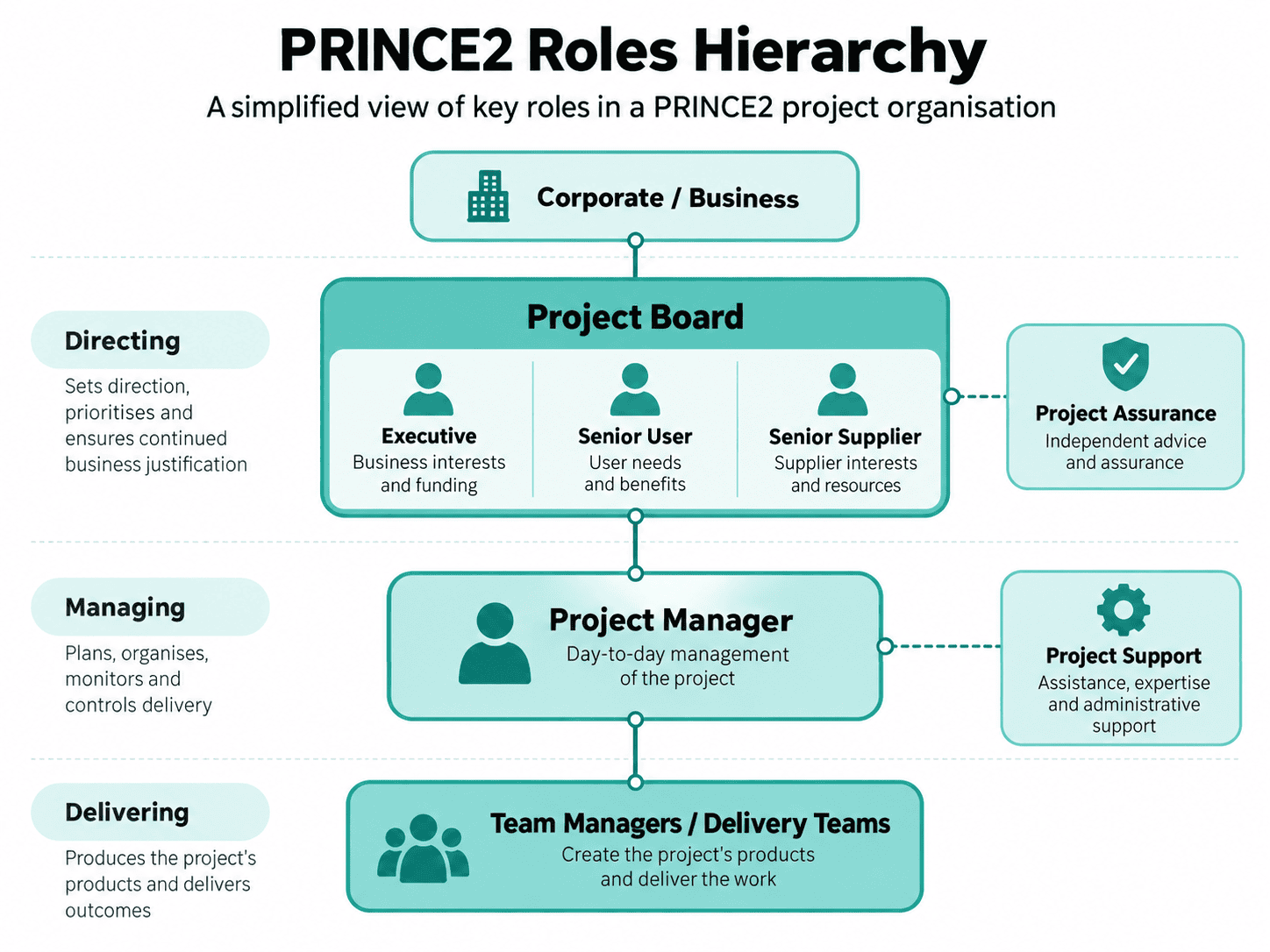
PRINCE2 defines project roles, responsibilities, and relationships so that business, user, supplier, directing, managing, delivering, assurance, and support needs are represented clearly. The roles are functions within a project, not necessarily individual job titles, and some responsibilities can be combined where the project context allows.
At the directing level, the project board brings together three interests:
- Project executive: represents the business interest.
- Senior user: represents those who will use or benefit from the project’s products.
- Senior supplier: represents those supplying the expertise and resources to create them.
The project manager handles day-to-day management within the authority delegated by the project board.
Team managers manage delivery of allocated work packages where that role is used.
Project assurance provides independent assurance to the project board, while project support can provide administrative and specialist support.
These roles all fall within one of four organisational levels: commissioning, directing, managing, and delivering.
What Does PRINCE2 Control on a Project?
PRINCE2 manages project performance across seven targets: benefits, cost, time, quality, scope, sustainability, and risk.
Targets and tolerances help the project team understand expected performance and when a forecast deviation requires escalation.
Table: What are the seven PRINCE2 performance targets?
| Performance target | Core management question |
|---|---|
| Benefits | Why are we doing this, and what value should it create? |
| Cost | Can the project remain affordable? |
| Time | When must products, stages, and the project be completed? |
| Quality | Will the products meet the agreed requirements? |
| Scope | What is and is not being delivered? |
| Sustainability | What sustainability expectations must the project and its products meet? |
| Risk | How much uncertainty can the project and business accept? |
This is where tolerance becomes especially useful.
Tolerance defines how far performance may vary from an agreed target before the deviation needs to be escalated to the next management level (this supports the PRINCE2 principle of “manage by exception”).
Is PRINCE2 Agile or Waterfall?
PRINCE2 is neither inherently Agile nor inherently Waterfall. It’s a project management method that can provide governance and control around different delivery approaches, including linear-sequential, iterative-incremental, and hybrid delivery.
“Project management” and “specialist product delivery” are not the same thing.
A project might use:
- a largely linear sequence for construction,
- short iterative cycles for software,
- or a hybrid approach where infrastructure is developed sequentially while a digital product is developed iteratively.
PRINCE2 can sit above those delivery choices by helping the project maintain responsibilities, justification, controls, decisions, tolerances, and stage-level governance.
PRINCE2 can accommodate Agile, Waterfall-style sequential delivery, or hybrid combinations instead of just requiring one of them.
Table: How does PRINCE2 work with different delivery approaches?
| Delivery approach | How it broadly works | How PRINCE2 can fit |
|---|---|---|
| Linear-sequential | Major delivery activities happen largely in sequence. | PRINCE2 provides project governance, decision points, stages, roles, and control around the delivery work. |
| Iterative-incremental | Products evolve through repeated cycles and increments. | PRINCE2 can govern the overall project while iterative techniques manage specialist delivery. |
| Hybrid | Different parts of the project use different delivery approaches. | PRINCE2 provides a common management environment across the combined approach. |
Can PRINCE2 Be Used for Small Projects?
Yes. PRINCE2 can be tailored for simpler or smaller projects rather than applying the same level of documentation, governance, reporting, and control to every project.
Tailoring can affect areas such as:
- the number of management stages,
- how frequently progress is reported,
- how much documentation is needed,
- how roles are combined,
- which supporting techniques are used,
- how formal project controls need to be, and
- how the project’s tolerances are set.
This is one of the most important ideas to understand before concluding that PRINCE2 is “too heavy”.
A poorly tailored implementation can definitely create unnecessary administration – but that’s different from saying the method itself requires every project to use the same amount of documentation or ceremony.
In reality, PRINCE2 is intended to be tailored to the project context and scale. Simpler projects can use proportionate governance, documentation, stages, and controls.
What Types of Projects Can Use PRINCE2?
PRINCE2 is designed to be applicable across different purposes, scales, types, organisations, locations, cultures, and delivery methods because it separates project management from the specialist work required to create the project’s products.
That means the method can support projects in areas like:
- IT and software,
- digital transformation,
- business change,
- construction and infrastructure,
- product development,
- data,
- cyber security,
- operations improvement,
- public-sector change,
- research, and
- organisational transformation.
The important question isn’t usually “Does PRINCE2 understand our technical work?”
It’s “Can PRINCE2 provide an appropriate way to govern and manage the project while our specialists use the techniques required to deliver it?”
That separation is what makes the method transferable – the official manual itself uses scenarios covering data and application development, infrastructure, cyber-related product development, and a not-for-profit campaign to demonstrate different applications.
What Are the Benefits of PRINCE2?
PRINCE2 can provide a common, tailorable structure for project governance and management. Its benefits include clearer responsibilities, continued attention to business justification, staged decision-making, defined controls, product focus, ongoing learning, and the ability to work across different project contexts and delivery methods.
What are the key benefits and features of PRINCE2?
- Clear accountability: responsibilities are defined instead of assumed.
- Continued business justification: the project should continue to make sense rather than existing just because it has already started.
- Management by stages: major commitments and decisions can be reviewed at appropriate points.
- Management by exception: teams can work within agreed authority without escalating every routine decision.
- Product focus: attention stays on what needs to be created and accepted.
- Structured risk, issue, quality, and progress management: these remain active management concerns.
- Common terminology: people across teams and organisations can share a consistent project vocabulary.
- Tailoring: the method can be adapted to project scale, complexity, organisation, and delivery approach.
- Learning: previous and current project experience feeds back into decision-making.
One important caveat is that PRINCE2 does not remove uncertainty or guarantee project success. A method still depends on sensible application, capable people, sound decisions, suitable specialist practices, and an organisational environment that supports the project.
Watch our webinar on the Features and Benefits of PRINCE2 for more information.
Who Is PRINCE2 Suitable For?
PRINCE2 can be relevant to people who manage projects, support them, govern them, contribute specialist work, or want a structured understanding of project management. PRINCE2 training has been designed for both entry-level and experienced project personnel, as well as people undertaking specific PRINCE2 roles and Agile practitioners who need project-level controls.
So, it may be useful for:
- aspiring Project Managers,
- Project Coordinators,
- existing Project Managers,
- PMO professionals,
- programme and transformation teams,
- project sponsors,
- people who sit on project boards,
- team leads,
- subject-matter specialists working regularly on projects,
- Agile professionals who need broader project governance, and
- professionals moving from operational work into project-based work.
PRINCE2 is not restricted to someone whose job title is “Project Manager”.
PRINCE2 Foundation vs Practitioner: What Is the Difference?
PRINCE2® Foundation focuses on understanding the PRINCE2 method and its core concepts, while PRINCE2® Practitioner focuses on applying and tailoring PRINCE2 in project scenarios.
Table: Foundation vs Practitioner
| PRINCE2® Project Management Foundation | PRINCE2® Project Management Practitioner | |
|---|---|---|
| Primary focus | Understanding the method | Applying and tailoring the method |
| Best suited to | Beginners and professionals needing PRINCE2 knowledge | Professionals ready to demonstrate application in context |
| Typical learning emphasis | Principles, practices, processes, roles, People, and terminology | Application, tailoring, and scenario-based judgement |
| Prerequisites | PeopleCert does not list a previous PRINCE2 qualification as a requirement | PeopleCert requires an accepted prior project management qualification |
| Natural pathway | Starting point | Progression after the appropriate prerequisite |
PeopleCert currently accepts several qualifications as Practitioner prerequisites, including PRINCE2 Foundation and certain APM, PMI, and IPMA qualifications.
Someone starting from scratch will therefore commonly begin with Foundation before moving to Practitioner.
Compare PRINCE2 Foundation and Practitioner in detail in our blog: PRINCE2 Foundation and Practitioner: What’s the Difference?
Is PRINCE2 Worth Learning?
PRINCE2 can be worth learning when you need a structured way to understand project governance, responsibilities, business justification, planning, risk, issues, quality, progress, and decision-making, particularly if you work in or want to move into project-based roles.
Whether it’s the right qualification for you depends on what you need from your training.
PRINCE2 may be relevant if you want to:
- understand a structured project management method,
- work more effectively within PRINCE2 environments,
- develop knowledge of project governance and control,
- formalise existing project experience,
- move towards project coordination or management,
- understand how responsibilities sit across different management levels, or
- build from Foundation-level understanding towards practical application.
It may make sense to compare PRINCE2 with other approaches when your objective is different. For example, someone considering broader professional Project Management knowledge may also investigate APM, while an experienced professional working in a different international certification environment might compare PRINCE2 and PMP.
Frequently Asked Questions About PRINCE2
What is PRINCE2 Project Management?
PRINCE2 Project Management is a structured, tailorable method for managing projects. It combines principles, people, practices, processes, and project context to help organisations establish clear responsibilities, maintain business justification, plan and control delivery, manage uncertainty, and make decisions throughout the project lifecycle.
What does PRINCE2 stand for?
PRINCE2 stands for Projects IN Controlled Environments. It is the established name of the project management method now owned by PeopleCert.
Is PRINCE2 a methodology?
“PRINCE2 methodology” is a common search term, but PRINCE2 officially describes itself as a project management method. The distinction is useful when writing about PRINCE2 accurately, although people often use methodology, method, and framework informally when discussing it.
What are the 7 principles of PRINCE2?
The seven PRINCE2 principles are ensure continued business justification; learn from experience; define roles, responsibilities, and relationships; manage by stages; manage by exception; focus on products; and tailor to suit the project. They provide the guiding obligations for applying PRINCE2.
What are the 7 PRINCE2 practices?
The seven current PRINCE2 practices are business case, organising, plans, quality, risk, issues, and progress. They are recurring aspects of project management that should be addressed throughout the project lifecycle. Older material may call similar areas “themes”, but practices is the current terminology.
What are the 7 processes of PRINCE2?
The seven processes are starting up a project, directing a project, initiating a project, controlling a stage, managing product delivery, managing a stage boundary, and closing a project. Together, they describe the management activity required across the project lifecycle.
Is PRINCE2 Waterfall or Agile?
PRINCE2 is not inherently Waterfall or Agile. It can provide project governance and management around linear-sequential, iterative-incremental, or hybrid delivery. The delivery method should be selected and tailored according to the project’s context and requirements.
Is PRINCE2 suitable for beginners?
Yes. PRINCE2 is relevant to entry-level project personnel as well as experienced professionals. For someone pursuing certification, PRINCE2® Project Management Foundation is the introductory qualification focused on understanding the method and its core concepts.
Can PRINCE2 be used on small projects?
Yes. PRINCE2 can be simplified and tailored for less complex projects. The level of governance, documentation, reporting, roles, controls, and number of stages should reflect the needs and context of the project rather than being applied identically every time.
What is the difference between PRINCE2 Foundation and Practitioner?
PRINCE2® Project Management Foundation focuses on understanding PRINCE2 terminology and the components of the method. PRINCE2® Project Management Practitioner goes further by assessing the ability to apply and tailor PRINCE2 in project scenarios. Practitioner has prerequisite requirements, while Foundation is the usual entry point.
Is PRINCE2 worth it?
PRINCE2 can be valuable if you want structured knowledge of project governance, planning, responsibilities, control, risk, issues, quality, and business justification or if you expect to work in an environment that uses the method. Whether a PRINCE2 qualification is the best next step depends on your role, experience, employer requirements, and wider career goals.
What Should You Do Next?
You don’t need to memorise the entire PRINCE2 method before deciding whether it’s relevant to you.
Start with the question that brought you here.
If you want to understand how the method works, explore the principles, practices, processes, people, and project context in more depth.
If you’re already considering certification, compare PRINCE2® Project Management Foundation and PRINCE2® Project Management Practitioner before choosing your route.
And if you’re trying to work out how PRINCE2 fits alongside Agile, APM, PMP, or the type of projects you already manage, use the comparison and practical guides in this PRINCE2 resource hub.