What Happened to the PRINCE2 Themes?
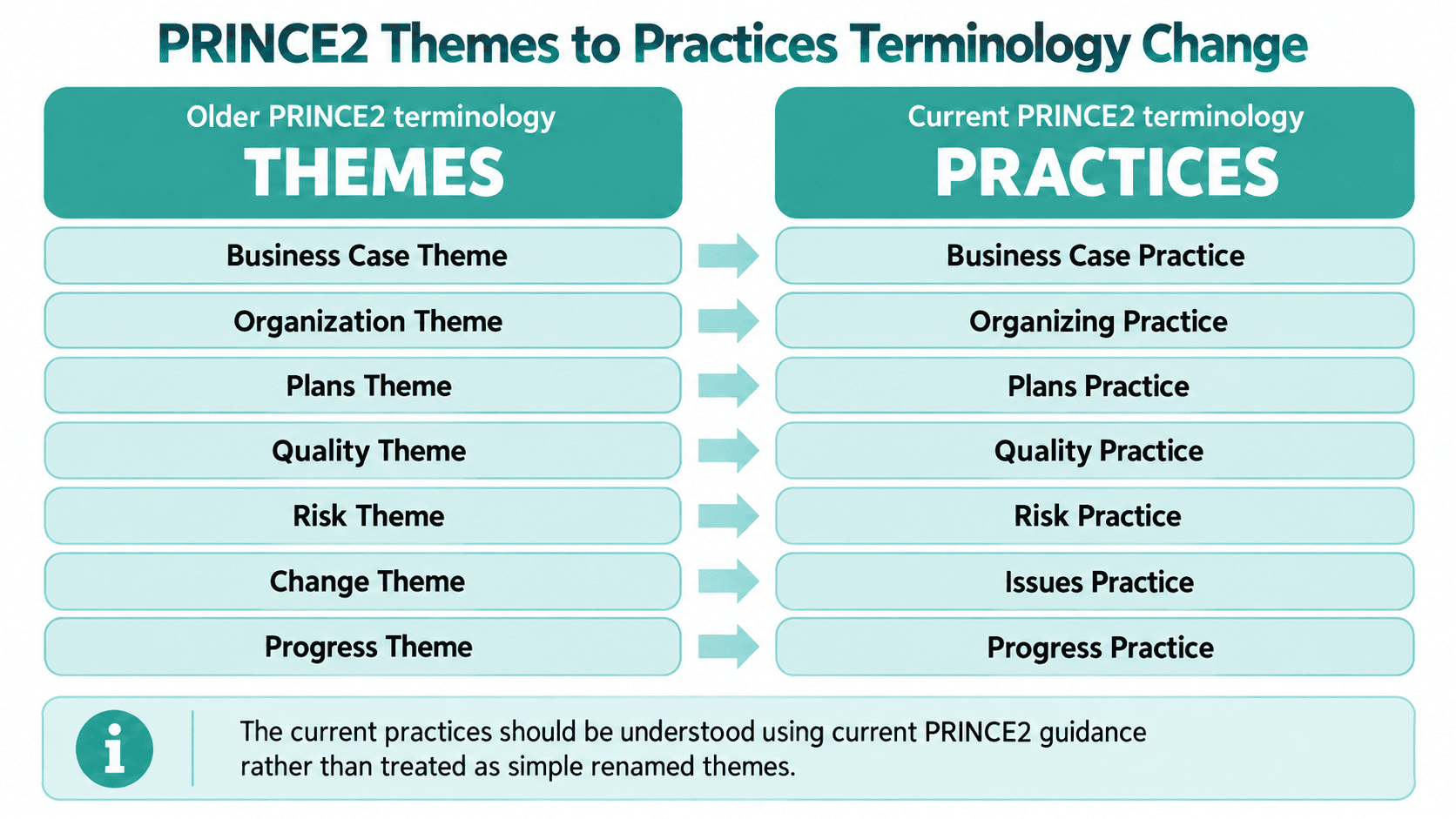
The PRINCE2 themes were part of older versions of the PRINCE2 Project Management method. In the current method, introduced with PRINCE2 7 in 2023, the equivalent area of guidance is organised into seven practices. Although several familiar project management topics remain, the guidance has also evolved. If you’re learning current PRINCE2, you should use the term practices rather than themes.
In simple terms:
Older PRINCE2 terminology: Seven themes
Current PRINCE2 terminology: Seven practices
The seven current PRINCE2 practices are:
- Business Case
- Organizing
- Plans
- Quality
- Risk
- Issues
- Progress
You might still encounter the term themes in older textbooks, training materials, or online articles. That doesn’t necessarily make those resources useless, but it does mean you should check which version of the method they describe.
If you’re looking for a detailed explanation of what each current practice does, explore our guide to the seven PRINCE2 practices.
Are PRINCE2 Themes Now Called Practices?
Yes, practices are the terminology used in current PRINCE2 where older editions used themes. However, describing the update as a simple renaming would leave out important changes to the method.
PRINCE2 has retained several familiar areas of project management, including planning, risk management, quality, and maintaining a valid business justification.
What has changed is how the current guidance presents and develops these areas.
For example, the older Change theme is now represented by the Issues practice, which takes a broader view of identifying and addressing matters that could affect a project.
PeopleCert explains that the Issues practice distinguishes between identifying an issue and deciding whether it requires a change to the project’s agreed baseline. Not every issue is a change request.
So, while the old and current terminology are closely related, the most reliable approach is to learn the current practices from current PRINCE2 guidance.
What Were the Seven PRINCE2 Themes?
The seven PRINCE2 themes in the sixth edition were Business Case, Organization, Quality, Plans, Risk, Change, and Progress.
These themes represented aspects of project management that needed to be addressed throughout a project. They helped project teams consider questions such as why the project was justified, who was responsible for decisions, what needed to be delivered, and how progress would be controlled.
The seven themes were:
- Business Case: The justification for undertaking and continuing the project.
- Organization: The structure of responsibilities and accountability.
- Quality: Defining and checking what the project must deliver.
- Plans: Establishing how and when work should be carried out.
- Risk: Identifying and responding to uncertainty.
- Change: Controlling issues and changes affecting the project’s agreed baselines.
- Progress: Monitoring performance and making control decisions.
These descriptions refer to the older method. They are included to help you recognise historical terminology, not as a substitute for learning the current practices.
If you studied PRINCE2 several years ago, you’ll probably recognise many of these concepts. The important next step is understanding how they appear within the current method.
What Are the Seven Current PRINCE2 Practices?
The seven current PRINCE2 practices are Business Case, Organizing, Plans, Quality, Risk, Issues, and Progress.
Practices cover aspects of project management that need continuing attention. They are not simply tasks completed once at the beginning of a project.
| Current practice | What it helps the project manage |
|---|---|
| Business Case | Why the project remains worthwhile |
| Organizing | Who is accountable, responsible, and involved |
| Plans | What will be delivered, how, when, and by whom |
| Quality | What the outputs must achieve and how they will be checked |
| Risk | Uncertain events that could affect objectives |
| Issues | Matters requiring assessment, decisions, or action |
| Progress | Performance against plans and when intervention is needed |
For example, imagine a company is introducing a new online booking platform.
The Business Case practice helps the organisation continue assessing whether the investment is justified. Plans provide a basis for coordinating the work, while Quality helps establish what the platform needs to do and how it will be accepted.
If a supplier identifies a potential delay, the Risk practice helps the team understand and respond to the uncertainty. If a problem actually arises, the Issues practice supports its assessment and resolution.
Meanwhile, Progress helps the Project Manager understand whether the work remains within agreed tolerances and when a decision needs to be escalated.
These practices work together rather than independently.
For a more detailed explanation, including how each practice operates within a project, read our complete PRINCE2 Practices guide.
PRINCE2 Themes vs Practices: What’s Different?
The main difference between PRINCE2 themes and practices is their place within different editions of the method. Themes belong to older PRINCE2 guidance, while practices belong to the current method.
| Comparison | Older PRINCE2 | Current PRINCE2 |
|---|---|---|
| Terminology | Themes | Practices |
| Edition context | PRINCE2 sixth edition (2017) | PRINCE2 7 (2023) |
| Number | Seven | Seven |
| Example responsibility area | Organization | Organizing |
| Managing changes and issues | Change theme | Issues practice |
| Guidance to study | Older-edition material | Current PRINCE2 guidance |
| Wider method structure | Seven themes alongside principles and processes | Practices integrated with principles, people, processes, and project context |
Some differences are easy to recognise from the names. Others become clearer when you look at how the guidance has developed.
For instance, the older Organization theme and current Organizing practice concern how people are structured and responsibilities are assigned. However, current PRINCE2 places greater emphasis on the people involved in projects and their working relationships.
Likewise, the transition from Change to Issues is particularly important because it reflects a broader approach to identifying and managing project issues, not merely controlling requests for change.
The key takeaway: Don’t assume that knowing the old seven themes means you’ve automatically covered everything in the current seven practices.
Why Did PRINCE2 Change?
PRINCE2 7 was introduced in 2023 to update the method for contemporary project management. Its development drew on practitioner feedback and considered changes in how projects are managed, including increased attention to people, sustainability, digital information, and flexible delivery approaches.
PeopleCert’s explanation of the update emphasises making the method easier to understand and apply while retaining its established foundations.
The changes include:
- Greater emphasis on people, relationships, and communication.
- More explicit consideration of sustainability.
- Improved guidance on adapting PRINCE2 to different project contexts.
- Clearer connections between processes and practices.
- Updated explanations and terminology.
However, these broader improvements should not be interpreted as proof that every terminology change had one specific cause.
What matters for learners is that the current practices form part of the updated method. Understanding them in their current context is more useful than memorising a list of renamed headings.
Where Do Practices Fit Into the Current PRINCE2 Method?
Practices are one of the five integrated elements of the current PRINCE2 method.
These five elements work together to provide a structured but adaptable approach to managing projects.
| Element | Its role in PRINCE2 |
|---|---|
| Principles | The guiding obligations that underpin the method |
| People | The individuals, relationships, and interactions involved in the project |
| Practices | Aspects of project management requiring continual attention |
| Processes | Activities used to direct, manage, and deliver the project |
| Project context | The circumstances that influence how the method is applied |
For example, a project might need to manage uncertainty through the Risk practice, apply the principle of managing by exception, and assess that uncertainty through activities within the relevant PRINCE2 processes.
The people involved must communicate and make decisions, while the project’s circumstances influence how the approach is tailored.
This is why the practices shouldn’t be learned in isolation.
If you’re new to the wider method, our complete guide to PRINCE2 Project Management explains how its elements fit together.
You can also explore the role of people in PRINCE2 to understand why relationships and collaboration are an important part of the current guidance.
What Is the Difference Between PRINCE2 Principles, Practices, and Processes?
PRINCE2 principles guide how projects should be managed, practices identify what requires ongoing management attention, and processes organise the activities used to manage the project lifecycle.
These three concepts have different purposes, even though they work together.
| Element | Simple explanation | Example |
|---|---|---|
| Principles | The obligations guiding project management | Manage by exception |
| Practices | What needs continual management attention | Risk |
| Processes | The activities used to manage the project | Controlling a Stage |
Imagine you’re managing the delivery of a new customer-service system.
The manage by exception principle establishes how authority is delegated and when matters must be escalated.
The Progress practice helps you monitor performance against agreed plans and tolerances.
The Controlling a Stage process provides management activities for monitoring work, reviewing issues, and taking appropriate action during a stage.
These are related ideas, but they aren’t interchangeable.
You can explore each element in more detail through our PRINCE2 Principles guide and PRINCE2 Processes guide.
Can You Still Use Older PRINCE2 Themes Material?
No. Older PRINCE2 themes material can still be useful for understanding the history of the method and recognising concepts that have continued into the current edition, but the older material should not be your only source when learning current PRINCE2.
For example, an older resource explaining why a project needs a valid Business Case may still provide useful background. But that doesn’t mean every procedure, term, management product, or explanation in the resource reflects current guidance.
If you’re using an older textbook, online course, or revision guide, consider the following:
- Check the edition. Look for whether the resource covers PRINCE2 7 or an earlier edition.
- Check the terminology. References to themes may indicate older content.
- Compare the guidance. Don’t assume older descriptions fully reflect the current practices.
- Use current learning materials. Prioritise resources aligned with the version of PRINCE2 you’re studying.
A resource using the term themes isn’t automatically inaccurate in its historical context. The problem arises when older guidance is presented as though it describes the current method without qualification.
Which PRINCE2 Terminology Should You Learn Today?
If you’re studying or applying current PRINCE2, learn the seven practices and their relationship to the other integrated elements.
If you’re referring specifically to an older edition, using the word themes can still be appropriate.
A useful rule is:
Discussing current PRINCE2? Use practices.
Discussing an older PRINCE2 edition? Use themes when that is the terminology used in the source.
For someone preparing for a current qualification, the important goal isn’t simply remembering the seven practice names. It’s understanding why each practice matters, how it supports project management, and how it interacts with the wider method.
If you’re considering a qualification, ITonlinelearning offers routes covering PRINCE2® Project Management Foundation and PRINCE2® Project Management Practitioner.
Our Foundation vs Practitioner comparison can help you understand the difference between these learning routes.
Frequently Asked Questions About PRINCE2 Themes and Practices
Does PRINCE2 Still Have Themes?
No. The current PRINCE2 method uses seven practices rather than the seven themes found in older editions. You may still see references to themes in historical guidance, older study materials, and online resources that haven’t been updated. If you’re studying current PRINCE2, use the practices terminology and refer to current guidance.
Are PRINCE2 Themes and Practices the Same?
Not exactly. Themes and practices cover several related aspects of project management, but they belong to different editions of PRINCE2. The current method includes updated explanations, terminology, and guidance. Although there is continuity between the two approaches, you shouldn’t assume that every older theme is identical in scope or application to a current practice.
What Replaced the Seven PRINCE2 Themes?
The current PRINCE2 method uses seven practices: Business Case, Organizing, Plans, Quality, Risk, Issues, and Progress. These practices address aspects of project management that require attention throughout a project. They form part of the current method alongside principles, people, processes, and project context.
When Did PRINCE2 Themes Change to Practices?
The terminology changed with the introduction of PRINCE2 7 in September 2023. Earlier editions, including the sixth edition, used themes, while the seventh edition introduced practices as the current terminology. The update also included broader changes to the method, so the distinction goes beyond the names used for these areas of guidance.
What Is the Difference Between the Old Change Theme and the Current Issues Practice?
The older Change theme addressed the management and control of issues and changes. The current Issues practice places broader emphasis on identifying, assessing, and responding to matters that could affect a project. This distinction matters because not every issue requires a change to the project’s agreed baseline. The current approach also emphasises communication and identifying issues early.
Should I Learn Themes or Practices for Current PRINCE2?
You should learn practices when studying the current PRINCE2 method. The seven practices are part of PRINCE2 7, alongside the other integrated elements. Understanding older themes may help you interpret historical resources, but current learning should focus on the terminology, explanations, and guidance applicable to the current method.
Are Older PRINCE2 Study Materials Still Useful?
Older PRINCE2 materials can provide helpful background, particularly when explaining concepts that have continued across editions. However, they shouldn’t be assumed to reflect the current method or qualification syllabus. Check the edition of your resources, identify any legacy terminology, and use current guidance as your primary reference when preparing for a current PRINCE2 qualification.
What Is the Difference Between PRINCE2 Principles, Practices, and Processes?
PRINCE2 principles establish the obligations that guide how projects should be managed. Practices address aspects of project management that require continual attention, such as risk, quality, and progress. Processes describe the management activities used throughout the project lifecycle. These elements work together rather than serving as alternative names for the same thing.
What Should You Explore Next?
The easiest way to move from older PRINCE2 terminology to the current method is to start with the seven practices and then understand how they connect to the wider framework.
If you searched for PRINCE2 themes, you were looking for an important part of the method. You just need to make sure you’re learning it using the current terminology and guidance.
To continue learning, explore our detailed guide to the seven PRINCE2 practices or our complete introduction to PRINCE2 Project Management.
If you’re considering PRINCE2 training and would like help understanding the Foundation and Practitioner routes, our Course & Career Advisors can help you explore your options.