How Does PRINCE2 Measure Project Progress?
PRINCE2 progress is measured by comparing actual achievements with approved plans, assessing forecast performance against agreed targets, and checking whether work is expected to remain within tolerance. The Progress Practice uses monitoring, reporting, stage reviews, and exception controls to help managers decide whether work is on track, corrective action is needed, or a higher-level decision is required.
Put simply, PRINCE2 doesn’t just ask how much work has been completed. It asks whether the project is achieving what was planned, whether its objectives remain achievable, and whether the people managing it still have authority to continue.
| Report | Main purpose | Control type |
|---|---|---|
| Checkpoint Report | Update the Project Manager on Work Package progress | Time-driven |
| Highlight Report | Update the Project Board on stage and project status | Time-driven |
| End Stage Report | Review the stage and support the decision to proceed | Event-driven |
| Exception Report | Report a forecast or actual stage/project tolerance breach | Event-driven |
| End Project Report | Review overall project performance and support closure | Event-driven |
These reports form part of a wider control system. They help the right people receive the information needed to make decisions without becoming involved in every delivery activity.
What Is the PRINCE2 Progress Practice?
The PRINCE2 Progress Practice establishes how a project monitors achievements against its plans, forecasts future performance, and responds when agreed limits are expected to be exceeded.
It is one of the seven PRINCE2 practices and operates throughout the project lifecycle.
The practice addresses three important questions:
- Where are we now?
- Where are we going?
- Should we carry on?
The first question concerns current performance. The second concerns likely future outcomes. The third considers whether the project remains sufficiently viable and controlled to justify continuing.
These questions connect progress management with the Plans Practice, the Business Case Practice, and the Manage by Exception principle.
For an overview of how these elements work together, explore our seven PRINCE2 practices.
What Does Progress Mean in PRINCE2?
In PRINCE2, progress measures how far the objectives of a plan have been achieved.
That means looking at the planned objectives and determining what has actually been delivered against them.
Consider a project to introduce an employee self-service portal. The team may have completed several development tasks, but that alone doesn’t establish whether the project is progressing satisfactorily.
The Project Manager also needs to understand which planned products have been completed, whether they meet their quality requirements, how much work remains, and whether the agreed objectives can still be achieved.
This is why PRINCE2 focuses on products rather than simply the amount of activity taking place.
A team can be very busy without delivering the planned results.
Why Does PRINCE2 Measure Both Actual and Forecast Performance?
PRINCE2 uses actual and forecast performance because knowing what has happened isn’t enough to determine whether a project is under control.
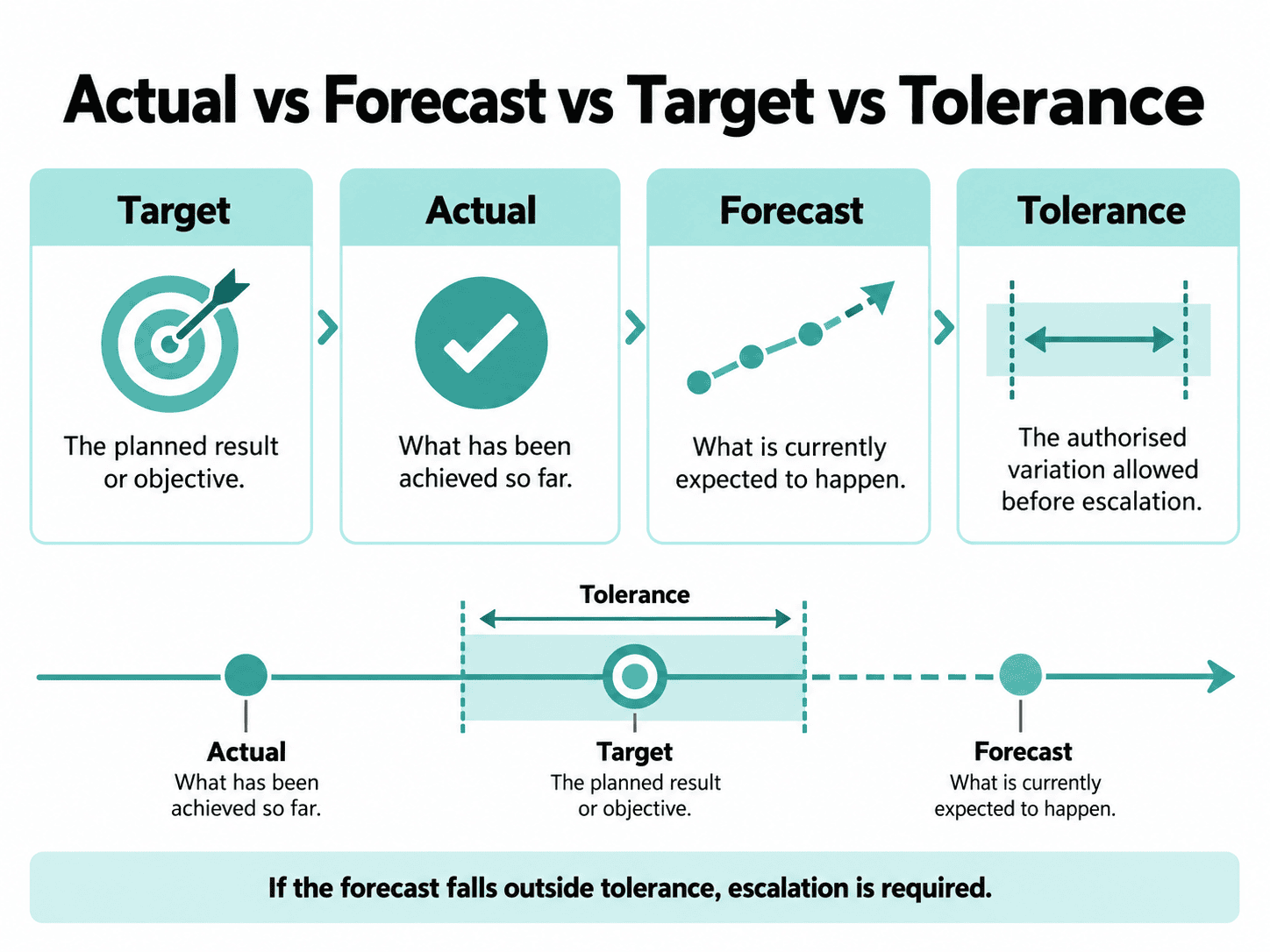
Actual performance shows the achievements and results recorded so far.
Forecast performance describes what is currently expected to happen, taking account of available information, historical performance, and anticipated developments.
For example, imagine that a management stage has a planned duration of ten weeks.
At the end of week five, approximately half of the planned work has been completed. Looking at completed work alone, progress might appear reasonable.
However, a supplier has confirmed that a critical integration will arrive later than expected. The revised forecast now indicates that the stage will take twelve weeks.
The actual results describe the position today. The forecast identifies a potential future problem.
The Project Manager must compare that forecast with the agreed time tolerance to determine whether the delay can be managed locally or needs escalation.
This is one of the most important distinctions for anyone studying or applying PRINCE2.
What Is PRINCE2 Progress Measured Against?
Progress is measured against the agreed objectives, targets, and tolerances established through PRINCE2 plans and other relevant management information.
The level of detail depends on which part of the project is being monitored.
| Control level | Main planning information | What is monitored? |
|---|---|---|
| Project | Project Plan, Business Case, and relevant project baselines | Overall objectives, performance, and continued justification |
| Management stage | Stage Plan | Stage achievements, outstanding work, forecasts, and tolerances |
| Delivery | Work Package description and, where used, Team Plan | Progress towards the authorised products and Work Package objectives |
| Individual products | Product Descriptions and product information | Product status and achievement of relevant quality requirements |
The Project Plan provides the overall view of how project objectives will be achieved. Stage Plans provide more detailed control of the current management stage.
Work Package descriptions establish what delivery teams are authorised to produce and the conditions under which that work is undertaken.
A Team Plan may provide additional detail about how a team intends to deliver its assigned work.
The important point is that each management level needs a suitable basis against which to assess performance.
Which Seven PRINCE2 Performance Targets Are Monitored?
PRINCE2 uses seven performance targets to support planning and control: benefits, cost, time, quality, scope, sustainability, and risk.
The targets aren’t all measured in the same way. Each requires relevant information and suitable tolerances.
| Target | Progress monitoring question |
|---|---|
| Benefits | Are the expected benefits still credible and achievable? |
| Cost | Are actual expenditure and forecast costs within agreed limits? |
| Time | Are planned completion dates still achievable within tolerance? |
| Quality | Are products meeting their required specifications and acceptance criteria? |
| Scope | Are the agreed products and requirements being delivered within authorised boundaries? |
| Sustainability | Are relevant sustainability targets and commitments being met or forecast to be met? |
| Risk | Is the project’s aggregated risk exposure within agreed limits? |
Time and Cost
Time and cost monitoring considers both current results and the forecast position.
For example, a stage might currently be within its approved budget but be expected to exceed that budget because additional specialist work is required.
The forecast matters even before the extra expenditure occurs.
Scope and Quality
Scope monitoring considers whether the agreed products are being delivered.
Quality monitoring considers whether those products meet their relevant specifications and acceptance criteria.
Completing development activities doesn’t necessarily mean a product has satisfied its quality requirements.
Benefits and Sustainability
Benefits monitoring helps assess whether the project’s expected outcomes still support its justification.
Sustainability monitoring considers the agreed requirements and targets for the project and its products.
PRINCE2 7 explicitly includes sustainability among its performance targets.
Risk
Risk monitoring considers the project’s exposure to uncertainty against agreed limits.
A developing threat may also affect time, cost, or other performance forecasts.
The Project Manager should therefore consider how the different performance targets interact without assuming that satisfactory performance in one area compensates for a breach in another.
How Do Tolerances Help PRINCE2 Measure Progress?
Tolerances establish how far performance may vary from agreed targets without requiring escalation to the next management level.
A target establishes the intended result. A tolerance defines the permitted deviation.
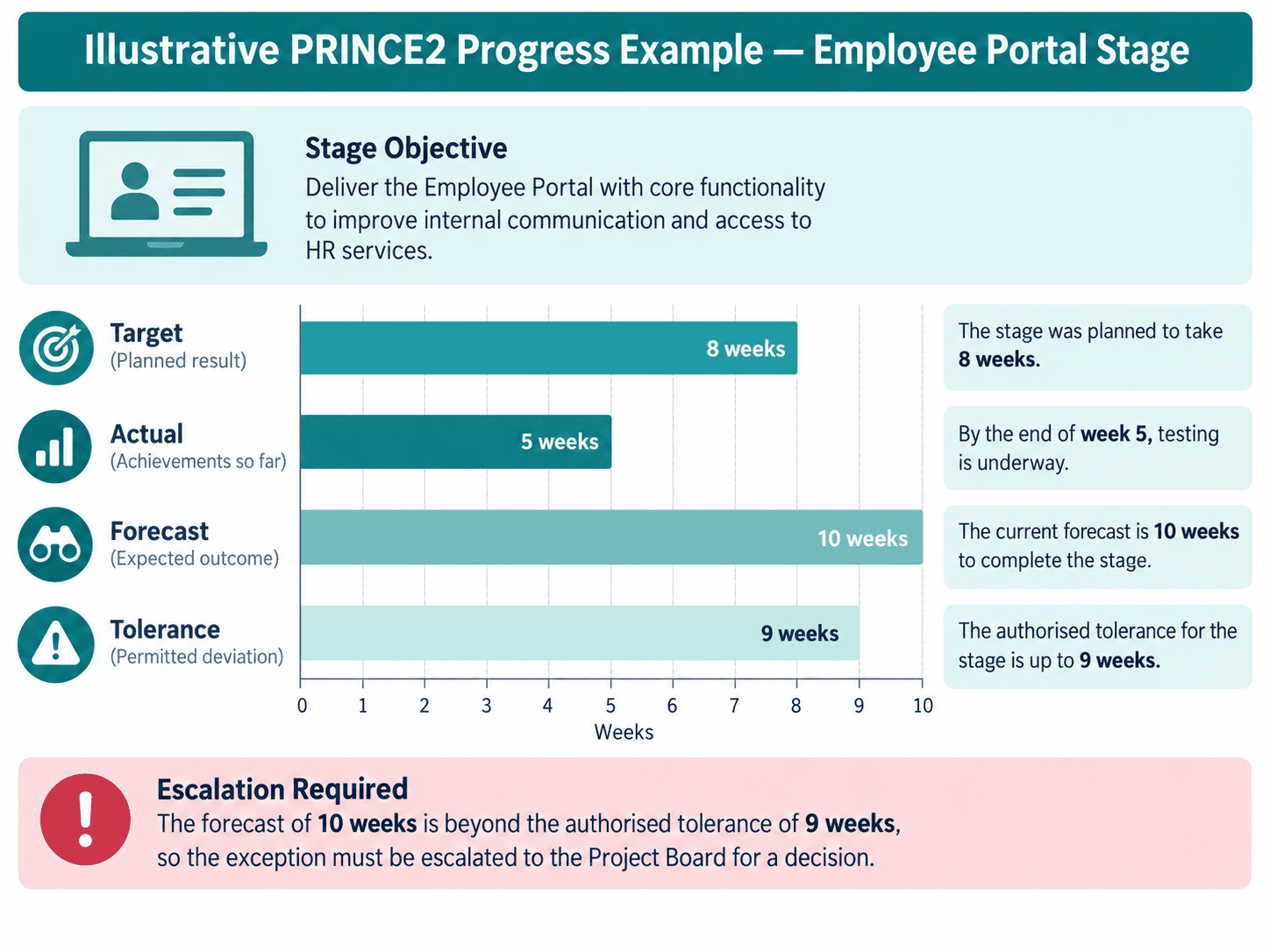
For example, a management stage may have a target duration of eight weeks and an authorised positive time tolerance of one additional week.
The Project Manager can manage an expected completion of eight and a half weeks within that time tolerance, provided the response remains within all other relevant delegated authority.
However, a forecast of ten weeks exceeds the agreed upper limit of nine weeks.
The stage is then in exception.
This distinction matters because PRINCE2 doesn’t require every variation from a target to be escalated.
Read our guide to PRINCE2 tolerances for a detailed explanation.
How Does Management by Exception Control Project Progress?
Management by Exception allows authority to be delegated between management levels within agreed tolerances.
The business layer establishes project-level limits. The Project Board authorises management stages, and the Project Manager agrees suitable limits for Work Packages.
Each level monitors performance and manages within its delegated authority.
If the forecast indicates that the relevant tolerance will be exceeded, the matter is referred to the next management level for a decision.
This prevents unnecessary escalation while ensuring important deviations receive attention.
For example, a Team Manager doesn’t need to ask the Project Board to approve a minor scheduling adjustment within the authorised Work Package.
But if the overall Stage Plan is forecast to exceed its time tolerance, the Project Manager cannot simply treat that as an ordinary adjustment.
The issue must be escalated through the relevant exception procedure.
Explore Management by Exception in PRINCE2 for a fuller explanation.
What Progress Controls Does PRINCE2 Use?
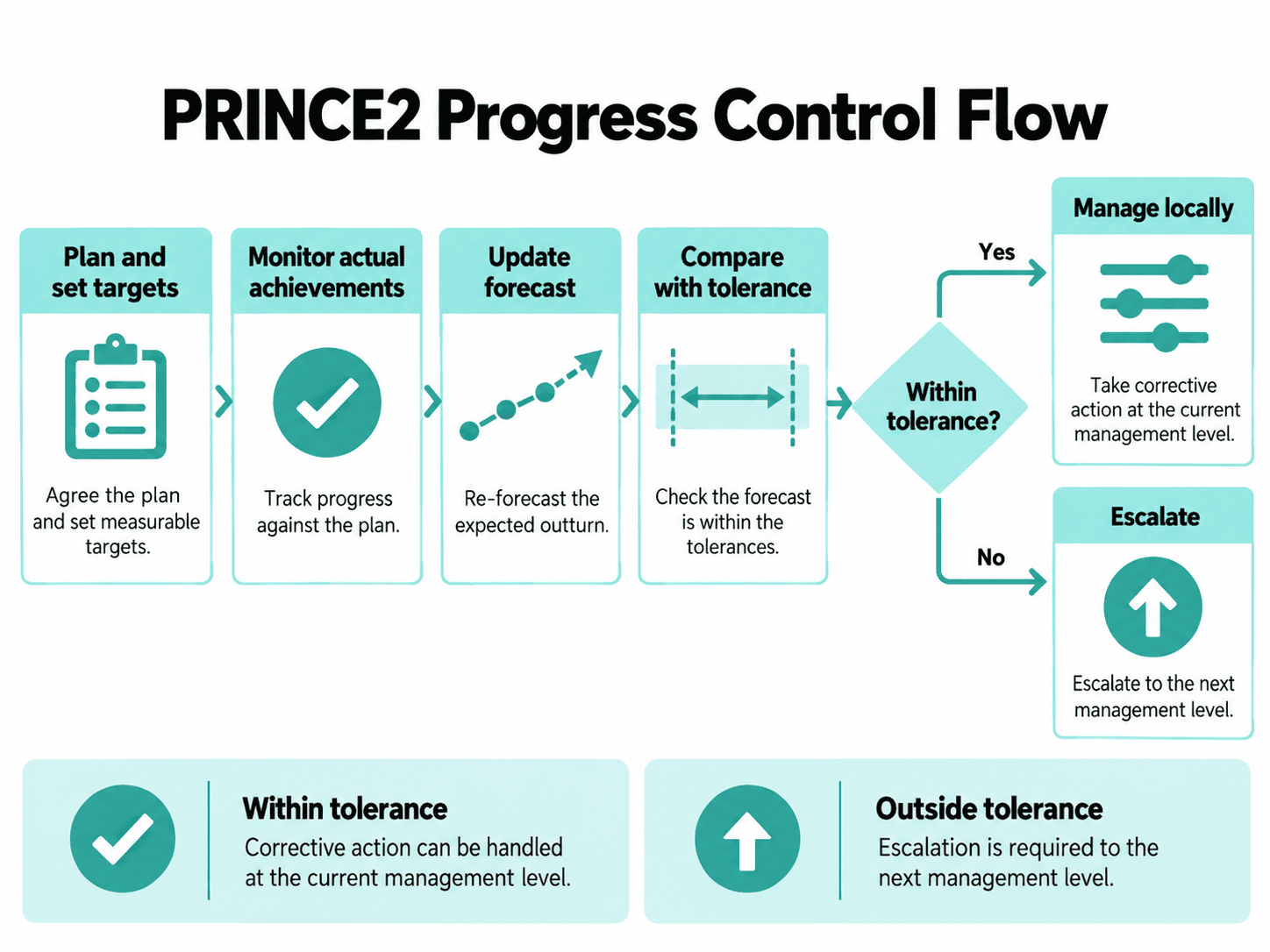
PRINCE2 uses time-driven and event-driven controls to monitor performance, review progress, and support management decisions.
In PRINCE2, monitoring progress, reporting progress, and controlling progress aren’t quite the same thing. Monitoring checks performance over time, reporting communicates relevant information, and control involves making decisions when a particular event or situation requires action. Reporting can be both time-driven and event-driven.
Time-Driven Controls
Time-driven controls take place at predefined intervals.
Checkpoint Reports and Highlight Reports are examples.
Their frequency is agreed according to the project’s requirements and the level of control needed.
A particularly important point is that PRINCE2 does not require every project to produce these reports weekly.
Event-Driven Controls
Event-driven controls occur when a particular event takes place.
Examples include reaching the end of a management stage, completing initiation information for authorisation, or identifying an exception that requires a decision.
PRINCE2 distinguishes continuous monitoring from management decisions. Reviewing progress may happen regularly, while formal decisions are made when a relevant control event occurs.
This helps avoid unnecessary management activity.
Which PRINCE2 Reports Are Used to Monitor Progress?
PRINCE2 uses different reports because delivery teams, Project Managers, and Project Boards need different levels of information.
What Is a Checkpoint Report?
A Checkpoint Report provides the Project Manager with information about the progress and status of a Work Package.
It is produced by the Team Manager at the frequency agreed for that Work Package.
It can communicate completed products, work underway, upcoming work, relevant quality activities, issues, risks, and actual or forecast performance against Work Package tolerances.
Checkpoint Reports support routine delivery-level monitoring.
What Is a Highlight Report?
A Highlight Report is a periodic update from the Project Manager to the Project Board.
It summarises the status of the current management stage and provides relevant information about overall project progress.
The report can cover achievements, planned work, forecasts, tolerance status, corrective actions, important issues, and risks.
Its purpose is to keep the Project Board informed without requiring members to supervise day-to-day delivery.
What Is an End Stage Report?
An End Stage Report summarises progress to date, reviews the performance of the current stage, and provides information for the Project Board’s decision about what should happen next.
It helps the Project Board consider whether the project should proceed to another management stage.
The review considers actual performance, products, relevant quality information, issues, risks, lessons, and future forecasts.
What Is an Exception Report?
An Exception Report informs the Project Board when a Stage Plan or Project Plan has exceeded, or is forecast to exceed, agreed tolerances.
It provides an explanation of the deviation, its consequences, possible responses, and a recommendation.
Unlike routine progress reports, an Exception Report is used to obtain management direction when authority limits are affected.
What Is an End Project Report?
An End Project Report reviews how the project performed against the project initiation documentation used to authorise it.
It considers overall performance, the products delivered, relevant lessons, and any follow-on recommendations.
It supports the Project Board’s decision about project closure.
What Is a Lessons Report?
A Lessons Report communicates learning from a particular experience, management stage, or the overall project.
It may be produced during the project rather than being reserved for closure.
Lessons can also be captured through other reports and the Lessons Log.
For more information about these reports, explore our PRINCE2 Management Products guide.
Who Monitors Progress in PRINCE2?
Responsibility for progress monitoring is distributed across management levels.
| Role or level | Main responsibility |
|---|---|
| Business layer | Establishes overall project tolerances and decides project-level exceptions |
| Project Board | Directs the project, authorises stages, and considers significant deviations |
| Project Manager | Controls the authorised stage, monitors progress, updates forecasts, and reports |
| Team Manager | Monitors authorised Work Package delivery and informs the Project Manager about forecast deviations |
| Project Assurance | Independently checks project and stage progress and supports confidence in the reported position |
| Project Support | Assists with project records, reporting tools, and information management |
How Is Progress Monitored at Team Level?
The Team Manager monitors the products and work authorised through the Work Package.
Progress information is shared with the Project Manager through agreed Checkpoint Reports.
If the Work Package is forecast to exceed tolerance, the Team Manager raises an issue with the Project Manager.
How Does the Project Manager Monitor Stage Progress?
The Project Manager reviews Checkpoint Reports, the Stage Plan, and relevant project information.
This includes records of products, quality activities, risks, issues, and lessons.
The Project Manager uses this information to establish the current position, update forecasts, and identify any corrective action needed within delegated authority.
How Does the Project Board Monitor Progress?
The Project Board receives information through Highlight Reports, End Stage Reports, and Exception Reports.
It uses this information to understand performance, assess continued justification, authorise further work, and decide how significant deviations should be handled.
Project Assurance provides an additional level of confidence by checking whether progress and management information are reliable.
The Project Board directs the project. It doesn’t need to manage individual delivery activities.
Why Are Management Stages Important for Progress Control?
Management stages allow PRINCE2 projects to be planned, monitored, and controlled in manageable sections.
The Project Board authorises one management stage at a time.
Within that authorised stage, the Project Manager manages delivery against the Stage Plan and agreed tolerances.
At the stage boundary, the Project Board can review what has happened and assess what should happen next.
This provides an opportunity to consider the current Business Case, updated Project Plan, proposed next Stage Plan, and relevant risks before committing further resources.
It also means the project doesn’t simply continue because work has already started.
What Happens to Progress Information at a Stage Boundary?
During the Managing a Stage Boundary process, the Project Manager brings together information about performance and future requirements.
This supports reviewing the current stage, updating relevant project information, preparing the next Stage Plan, and providing an End Stage Report for the Project Board.
The Project Board can then assess continued viability and decide whether to authorise the next stage.
Learn more about PRINCE2 stages and the project lifecycle.
What Happens When Progress Is Forecast to Exceed Tolerance?
When a forecast indicates that agreed tolerances will be exceeded, PRINCE2 requires the situation to be escalated to the appropriate management level.
The response depends on whether the deviation concerns a Work Package, management stage, or the overall project.
What Happens at Work Package Level?
If a Work Package is forecast to exceed its agreed tolerance, the Team Manager raises an issue with the Project Manager.
The Project Manager considers the situation and determines what corrective action is needed.
A Work Package deviation does not automatically mean the entire stage is in exception.
What Happens at Stage Level?
If the Stage Plan is forecast to exceed tolerance, the Project Manager prepares an Issue Report to analyse the deviation and then provides an Exception Report to the Project Board.
The Project Board considers the available options and decides how the project should proceed.
What Happens at Project Level?
If the overall Project Plan is forecast to exceed project tolerances, the Project Board must refer the situation to the business layer.
The Project Board cannot independently authorise a deviation outside the limits delegated by the business.
When Is an Exception Plan Needed?
An Exception Plan may be requested following an exception decision.
It provides a replacement plan for the work affected by the exception, where that is the response selected by the appropriate authority.
An Exception Plan is not automatic whenever an exception occurs.
The Project Board may instead decide that another action is appropriate within its authority.
PRINCE2 Progress Monitoring Example
Consider a fictional project to implement an employee self-service portal.
The current management stage includes configuring the platform, preparing data migration, completing integrations, and testing the system.
The Project Board has authorised the stage under the following conditions.
| Measure | Agreed value |
|---|---|
| Target stage duration | 8 weeks |
| Permitted additional time | 1 week |
| Maximum completion within time tolerance | 9 weeks |
| Permitted additional cost | £10,000 |
These figures are illustrative only. They are not standard PRINCE2 tolerances.
Week 3 — Actual Progress and Initial Forecast
By the end of week three, the team has configured the platform, prepared the data migration work, and begun drafting the user guide.
A supplier integration delay is identified.
The revised forecast suggests that the stage will finish three days later than originally planned.
Assuming all other relevant tolerances are also expected to be met, the Project Manager can manage this deviation within the authorised stage limits.
The forecast should still be monitored and updated.
Week 5 — The Forecast Changes
During week five, testing begins later than planned.
The latest information indicates that the stage will now take ten weeks to complete.
The stage target remains eight weeks, and the authorised additional time remains one week.
The forecast completion is therefore one week beyond the permitted upper limit.
Compare Actual, Forecast, Target, and Tolerance
| Measure | Position |
|---|---|
| Actual status | Week 5, with testing underway |
| Original target | Stage completion at week 8 |
| Current forecast | Stage completion at week 10 |
| Upper tolerance limit | Stage completion at week 9 |
| Result | Forecast stage time exception |
The important lesson is that the stage is in exception before week nine has actually arrived.
The current forecast already indicates that the authorised time tolerance will be exceeded.
Take Corrective Action or Escalate
The Project Manager analyses the underlying issue, considers the consequences and available options, and prepares the appropriate reports.
Because the forecast exceeds the agreed stage tolerance, the Project Manager escalates the matter to the Project Board through an Exception Report.
The Project Board then decides how to proceed.
It may request an Exception Plan, consider another response within its authority, or take appropriate further action.
The Project Manager cannot simply treat the additional week as an acceptable adjustment without the necessary decision.
How Do Risks, Issues, Quality, and the Business Case Affect Progress?
Progress information doesn’t come from schedules and budgets alone.
Risks, issues, product quality, and continued business justification can all affect the project’s current position and future outlook.
Risks and Issues
A risk may indicate that an anticipated event could affect future performance.
An issue may reveal a problem or proposed change requiring attention now.
For example, a supplier delay may change the forecast stage completion date before the planned deadline has been missed.
Progress monitoring should incorporate this new information rather than relying on an outdated forecast.
Quality and Product Status
PRINCE2’s focus on products makes quality information particularly important.
The Product Register provides information about product status, while the Quality Register records relevant quality activities and results.
A product that has been developed but has not satisfied its required quality criteria should not automatically be treated as fully complete.
Product status also provides a more meaningful view of progress than simply counting tasks.
Continued Business Justification
Progress monitoring helps management assess whether the project remains worthwhile.
For example, a forecast delay might affect the timing of expected benefits. An increase in forecast costs or risk exposure might also affect the Business Case.
The relevant decision is not only whether the project can finish, but whether completing it remains justified.
How Does PRINCE2 Measure Progress in Agile or Hybrid Projects?
PRINCE2 can monitor progress in projects using iterative-incremental, linear-sequential, or hybrid delivery approaches.
It does not require every delivery team to use identical progress measurements.
For iterative-incremental delivery, frequent delivery of products that satisfy their acceptance and quality requirements can provide valuable information about progress.
Teams may also use supporting techniques such as Kanban boards, burn-down charts, burn-up charts, sprint goals, or release forecasts.
These techniques can inform PRINCE2 progress monitoring, but they aren’t all mandatory PRINCE2 measures.
For example, a team may maintain a burn-down chart to show remaining work.
The Project Manager might use information from this chart, alongside product status and other relevant data, to assess whether the Stage Plan remains achievable within tolerance.
PRINCE2 also allows reporting arrangements to be tailored. Instead of sending a conventional Checkpoint Report, a development team may make relevant progress information available for the Project Manager to review directly.
The important requirement is that the information supports suitable control and timely decisions.
How Should PRINCE2 Progress Controls Be Tailored?
Progress controls should be tailored to the project’s scale, complexity, risks, delivery approach, and reporting needs.
A relatively straightforward project might use concise written updates and simple tracking arrangements.
A complex project involving multiple suppliers could require more detailed forecasts, integrated information systems, and formal reporting procedures.
Tailoring may affect the format, frequency, and detail of reports.
It should not prevent managers from understanding current performance, forecasting outcomes, or identifying when intervention is needed.
The Project Manager recommends the relevant tailoring arrangements, and the Project Board approves the approach within its responsibilities.
Read our guide on how to tailor PRINCE2 for additional examples.
Common PRINCE2 Progress Management Mistakes
Several mistakes can weaken progress control even when teams are producing regular reports.
- Only reporting past achievements: Actual performance must be considered alongside forecasts.
- Equating activity with progress: The focus should remain on achieving the objectives and products in the plan.
- Relying entirely on percentage complete: Percentage figures may not explain product quality, outstanding risks, or future tolerance breaches.
- Escalating every small deviation: Management by Exception allows authorised managers to act within tolerance.
- Waiting for an actual breach: Forecast tolerance breaches require attention before the deviation occurs.
- Ignoring quality information: A product’s progress must be considered alongside its specified quality requirements.
- Using identical reporting arrangements everywhere: Progress controls should be appropriate to the project’s circumstances.
- Treating reports as an end in themselves: Reports should provide information that supports monitoring, decisions, and action.
The aim is to produce useful information, not simply more documentation.
PRINCE2 Progress Monitoring Checklist
Before completing a progress review, consider the following questions:
- Which approved plan are we monitoring?
- What objectives and targets have been agreed?
- Which tolerances apply at this management level?
- What has actually been achieved?
- Which products have been completed?
- Are the relevant quality requirements being met?
- What does the latest forecast indicate?
- Have risks or issues changed the expected outcome?
- Is the remaining work achievable within tolerance?
- Does the Business Case remain supported?
- Can corrective action be taken within delegated authority?
- Is escalation required?
- Who needs to receive the progress information?
- What lessons should be recorded or applied?
Frequently Asked Questions About PRINCE2 Progress
How Does PRINCE2 Measure Project Progress?
PRINCE2 measures progress by comparing actual achievements against approved plans and performance targets, then using forecasts to establish whether the remaining work is achievable within agreed tolerances. Progress reports, management-stage reviews, and exception controls help the appropriate management level determine what action or decisions are needed.
What Is the PRINCE2 Progress Practice?
The Progress Practice establishes how project performance is monitored against plans, how future outcomes are forecast, and how deviations requiring escalation are controlled. It operates throughout the project lifecycle and supports decisions about whether work should continue, change, or stop.
What Is the Difference Between Actual and Forecast Progress?
Actual progress concerns what has been achieved so far. Forecast progress concerns what is expected to happen based on the available information. Both are important because satisfactory current performance doesn’t necessarily mean the project is forecast to achieve its remaining objectives within tolerance.
What Is a Highlight Report in PRINCE2?
A Highlight Report is a time-driven progress update produced by the Project Manager for the Project Board. It provides a summary of stage status, relevant project performance, achievements, forecasts, issues, risks, and tolerance information at agreed reporting intervals.
What Is a Checkpoint Report in PRINCE2?
A Checkpoint Report is a periodic update from a Team Manager to the Project Manager about Work Package progress. It helps the Project Manager understand what has been completed, what remains, and whether the Work Package is expected to stay within its authorised tolerances.
Who Monitors Project Progress in PRINCE2?
Team Managers monitor their Work Packages, Project Managers monitor authorised management stages, and the Project Board oversees overall project performance. The business layer establishes project-level authority, while Project Assurance checks relevant progress information and supports confidence in management reporting.
What Happens When Progress Is Forecast to Exceed Tolerance?
The forecast deviation must be escalated to the appropriate management level. A Team Manager raises a Work Package issue with the Project Manager. For a stage-level exception, the Project Manager provides an Exception Report to the Project Board. Overall project-level exceptions are referred by the Project Board to the business layer.
Does PRINCE2 Measure Progress Using Percentage Complete?
PRINCE2 does not require every project to rely on one universal percentage-complete calculation. Suitable percentage measures may contribute to progress monitoring, but managers must also consider plans, completed products, quality information, forecasts, and relevant tolerances.
Does PRINCE2 Use Earned Value Management?
Earned Value Management is recognised in the PRINCE2 7 manual as a possible supporting project management technique. However, it is not a mandatory measurement approach for every PRINCE2 project. Projects may use appropriate techniques that support their agreed management and control arrangements.
Does PRINCE2 Use Milestones?
Yes. Milestones can be used as relevant points for planning and monitoring, including event-driven reviews. However, PRINCE2 doesn’t prescribe one universal milestone structure for every project. The appropriate milestones and controls depend on the agreed plans and project context.
How Often Should Progress Be Reported?
PRINCE2 does not prescribe a universal reporting frequency. Checkpoint Reports and Highlight Reports are time-driven controls, but their timing is agreed according to the level of monitoring and control required. Reporting frequency can change as the project develops.
How Does PRINCE2 Measure Progress in Agile Projects?
PRINCE2 can use progress information from iterative-incremental delivery, including completed products, sprint outcomes, Kanban boards, and burn-down charts. This information contributes to reviewing actual performance, forecasting results, and checking agreed tolerances. PRINCE2’s management controls remain adaptable to the chosen delivery method.
What Should You Explore Next?
Effective PRINCE2 progress monitoring comes down to understanding three things: what the project has achieved, what it is forecast to achieve, and whether management needs to intervene.
The Progress Practice brings plans, reporting, tolerances, and management decisions together so that problems can be addressed while there is still an opportunity to respond.
For PRINCE2 Foundation and Practitioner learners, understanding these relationships is particularly useful because it shows how the method’s principles, practices, and processes support each other.
If you’d like to develop your understanding further, explore ITonlinelearning’s PRINCE2 Foundation and Practitioner training.
Want to understand how PRINCE2 helps you monitor performance, forecast problems, and stay in control?