What Are the PRINCE2 Processes?
PRINCE2 processes are the seven connected sets of management activities used to direct, manage, and deliver a project across its lifecycle. They cover the journey from deciding whether a project idea is worth developing, through initiation and delivery, to its formal closure. Some happen once, while others operate throughout or repeat during different project stages.
The seven PRINCE2 processes are:
- Starting Up a Project
- Directing a Project
- Initiating a Project
- Controlling a Stage
- Managing Product Delivery
- Managing a Stage Boundary
- Closing a Project
Together, these processes provide the management journey through a PRINCE2 project. They should not, however, be mistaken for seven separate project stages.
A PRINCE2 project is divided into stages for planning, control, and decision-making. Different processes operate within, across, and between those stages. For example, Directing a Project spans the project at board level, while Controlling a Stage and Managing Product Delivery can be used repeatedly during delivery.
Learn how the processes fit into the complete PRINCE2 method in our blog: What Is PRINCE2 Project Management? A Complete Guide to the PRINCE2 Methodology.
PRINCE2 Project Lifecycle Map
Select a process to see where it fits in the project lifecycle, what it is for, and how it connects with the other PRINCE2 processes.
Starting Up a Project
This process takes place before full project initiation. It establishes whether there is enough justification and information to invest in initiating the project.
- Appoint key project roles.
- Review previous lessons.
- Prepare the outline business case and project brief.
- Plan the initiation stage.
Directing a Project
This process enables the project board to exercise overall control without managing the project day to day. It spans the project and provides the main decision points for authorisation, escalation, and closure.
- Authorise initiation and the project.
- Authorise stages and exception plans.
- Give ongoing direction.
- Authorise project closure.
Initiating a Project
This process develops the firm foundations for the project so the organisation understands what will be delivered, why it is worthwhile, how it will be managed, and how progress will be controlled.
- Agree tailoring requirements and management approaches.
- Establish project controls.
- Prepare the project plan and full business case.
- Assemble the project initiation documentation.
Controlling a Stage
This process covers the project manager’s day-to-day management of a management stage. It is used to authorise work, monitor progress, handle issues and risks, and take corrective action within agreed tolerances.
- Authorise work packages.
- Evaluate work package and stage status.
- Capture issues and risks.
- Report highlights and escalate when necessary.
Managing Product Delivery
This process sits between the project manager and the teams delivering specialist products. It helps ensure authorised work is accepted, executed, checked, and reported back when complete.
- Accept a work package.
- Execute the work package.
- Deliver the work package.
- Notify completion.
Managing a Stage Boundary
This process gives the project board the information it needs to review performance and decide whether the project should continue into the next management stage or proceed under an exception plan.
- Prepare the next stage plan.
- Update the project plan and business case.
- Evaluate the stage.
- Request approval for the next stage or exception plan.
Closing a Project
This process provides a controlled point at which acceptance is confirmed, project performance is evaluated, and the project manager recommends closure to the project board.
- Prepare planned or premature closure.
- Confirm project acceptance.
- Evaluate the project.
- Request project closure.
This is an original simplified learning aid based on the current PRINCE2 process model. It is designed to explain the lifecycle without reproducing the source diagram.
The Seven PRINCE2 Processes at a Glance
| Process | When it happens | Main purpose | Key outcome or decision |
|---|---|---|---|
| Starting Up a Project | Before the project is formally initiated | Check whether the idea is viable enough to justify more detailed initiation work | Request a decision on whether initiation should begin |
| Directing a Project | Across the project at board level | Enable the Project Board to make key decisions and provide overall direction | Authorise initiation, the project, stages or exceptions, and closure |
| Initiating a Project | During the initiation stage | Establish a sound basis for how the project will be managed | Provide enough information for the Project Board to decide whether to authorise the project |
| Controlling a Stage | During each delivery stage | Manage the Project Manager’s day-to-day control of the stage | Keep work progressing within authorised tolerances or escalate when necessary |
| Managing Product Delivery | While delivery teams complete authorised work | Connect the Project Manager’s control with the teams producing the project’s products | Agreed work packages are accepted, delivered, and reported back |
| Managing a Stage Boundary | Near the end of a stage, and when an exception plan is required | Review performance and prepare information for the next major decision | Ask the Project Board to authorise what happens next |
| Closing a Project | At the planned or premature end of the project | Bring the project to a controlled conclusion | Confirm handover and request formal project closure |
The simplest way to remember the PRINCE2 process model is not as seven boxes in a straight line, but as a management journey with different activities happening at different levels of the project.
How Do the PRINCE2 Processes Fit Into the Project Lifecycle?
The PRINCE2 project lifecycle moves from early assessment, through initiation and delivery, to controlled closure. PRINCE2 then places its processes around that journey according to who needs to act, what needs to be decided, and which level of management is responsible.
PRINCE2 Version 7 shows a lifecycle containing:
Pre-project → Initiation stage → Subsequent stage or stages → Final stage → Closure
A PRINCE2 project has at least two stages: an initiation stage and a final stage. Additional delivery stages can be added according to the needs and context of the project.
The processes fit around that structure broadly as follows:
- Starting Up a Project happens before full initiation.
- Initiating a Project provides the detailed foundation for the project.
- Directing a Project operates at Project Board level across the journey.
- Controlling a Stage manages each authorised delivery stage.
- Managing Product Delivery governs the interface between the Project Manager and the teams delivering agreed work.
- Managing a Stage Boundary supports decisions about moving from one stage to another and can also be used when preparing an exception plan.
- Closing a Project manages the formal end of the project.
What Does Each of the Seven PRINCE2 Processes Do?
The seven PRINCE2 processes each address a different part of managing the project. The following explanations focus on what each process is trying to achieve, when it matters, and how it might look in a real project.
1. Starting Up a Project
Starting Up a Project checks whether an initial project idea is sufficiently viable and worthwhile to justify undertaking detailed initiation work. It happens before the project is fully initiated and establishes essential information, key management roles, an initial business justification, the preferred project approach, and a plan for the initiation stage.
In plain English, this is where the organisation asks:
“Do we know enough about this idea to justify spending more time and resources developing it?”
The emphasis is deliberately light compared with full initiation. There is very little value in creating detailed plans for an idea that has not even passed an initial viability check.
At a high level, the process may include:
- reviewing lessons that could help the project;
- appointing the Project Executive and Project Manager;
- establishing the wider project management team;
- developing an outline business case;
- deciding on an appropriate project approach;
- assembling the project brief;
- planning the initiation stage;
- requesting authorisation to initiate the project.
Mainly involved: The business commissioning the project, Project Executive, Project Manager, and other members of the emerging project management team.
What it enables: A Project Board decision on whether the project should proceed into initiation.
A simple example
Imagine a retailer is considering replacing its online checkout system.
Starting Up a Project would not involve designing the new checkout in detail. Instead, the team might clarify what problem needs solving, appoint the people responsible for managing the potential project, consider possible delivery approaches, establish an initial case for investment, and decide what work would be needed to investigate the project properly.
The outcome is enough information to ask: should we initiate this project?
2. Directing a Project
Directing a Project enables the Project Board to exercise overall control and make the key decisions that sit above the Project Manager’s day-to-day authority. It covers decisions such as authorising initiation, authorising the project, approving a stage or exception plan, providing ongoing direction, and authorising project closure.
Unlike some of the other processes, Directing a Project should not be imagined as a short step that happens once and then disappears.
It operates at the directing level throughout the project’s management journey.
The Project Board does not normally run the project’s daily work. Instead, it provides direction, authorises major commitments, reviews information supplied by the Project Manager, and makes decisions that exceed the Project Manager’s delegated authority.
At a high level, this includes decisions about:
- whether initiation should begin;
- whether the project itself should be authorised;
- whether another stage should proceed;
- how an exception should be handled;
- important matters escalated for direction;
- whether the project should formally close.
Mainly involved: The Project Board, including the Project Executive, Senior User, and Senior Supplier roles, with information and requests generally coming from the Project Manager.
What it enables: Governance without requiring senior decision-makers to micromanage day-to-day delivery.
A simple example
Suppose the Project Manager for the checkout replacement has completed the initiation work and presents the business case, plans, controls, and other information required to proceed.
The Project Board reviews that information and decides whether the project should be authorised.
Later, the board may approve the next stage, respond to an exception, or ultimately authorise closure.
That decision-making activity forms part of Directing a Project.
3. Initiating a Project
Initiating a Project establishes a solid management foundation before significant resources are committed to delivery. It develops the information needed to understand what the project will deliver, why it remains justified, how it will be managed, how progress will be controlled, and how the overall project should proceed.
Starting Up a Project asks whether the idea deserves proper investigation.
Initiating a Project goes deeper.
This is where the project establishes the management arrangements required to move forward with greater confidence.
At a high level, initiation includes work around:
- the detailed business case;
- the overall project plan;
- management approaches and controls;
- how PRINCE2 will be tailored;
- the project’s management structure;
- how progress, risk, issues, quality, communication, change, and other management needs will be handled;
- the Project Initiation Documentation.
Mainly involved: The Project Manager leads much of the initiation work, supported by the Project Board, project assurance, project support, and relevant stakeholders.
What it enables: A well-informed decision about whether to authorise the project itself.
A simple example
For the retailer’s checkout project, initiation might establish the expected products, budget and schedule assumptions, major risks, quality requirements, decision controls, reporting arrangements, responsibilities, and detailed business justification.
Instead of asking, “Does replacing the checkout sound sensible?”, the organisation can now ask:
“Do we understand this project well enough to commit to delivering it?”
4. Controlling a Stage
Controlling a Stage is the Project Manager’s main process for managing an authorised delivery stage day to day. It covers authorising work, monitoring its progress, reviewing stage status, dealing with issues and risks, reporting highlights to the Project Board, and taking corrective action when the stage can still be kept within agreed tolerances.
This is where much of the ongoing management activity becomes visible.
Once the Project Board has authorised a stage, the Project Manager needs to ensure that agreed work is started at the right time, progress is monitored, problems are addressed, and senior management receives the information it needs.
Typical activities include:
- authorising work packages;
- checking their status;
- receiving completed work;
- monitoring the overall stage;
- reviewing issues and risks;
- taking corrective action within delegated authority;
- reporting highlights;
- escalating when a forecast suggests tolerances will be exceeded.
Mainly involved: The Project Manager, working with Team Managers, project support, project assurance, the Project Board, and other relevant stakeholders.
What it enables: Day-to-day control without requiring every decision to be escalated to the Project Board.
A simple example
The checkout project has entered a delivery stage covering development and integration.
The Project Manager authorises agreed packages of work, receives progress information, checks whether delivery remains within the approved stage tolerances, addresses manageable problems, and sends regular highlight information to the Project Board.
If a forecast shows that an agreed tolerance will be exceeded, the matter may need to move beyond normal stage control and be escalated.
5. Managing Product Delivery
Managing Product Delivery governs the relationship between the Project Manager and the teams responsible for creating the project’s specialist products. It provides a controlled way for teams to accept agreed work, carry it out, monitor it, report progress, complete the required products, and notify the Project Manager when the work package is finished.
This process is really useful for understanding an important PRINCE2 point:
Managing the project is not the same as carrying out all the specialist work within it.
A Project Manager can manage a website project without personally writing code, creating designs, configuring servers, or carrying out testing.
Managing Product Delivery creates the management interface between those responsibilities.
At a high level, teams:
- accept an authorised work package;
- agree what is expected;
- carry out and monitor the work;
- report progress;
- manage delivery within delegated tolerances;
- escalate where necessary;
- complete the agreed products;
- notify the Project Manager when the work package has been completed.
Mainly involved: Team Manager and delivery team, working with the Project Manager.
What it enables: Clear accountability between project-level management and specialist delivery.
A simple example
A development team receives an authorised work package to build the retailer’s new payment integration.
Before beginning, the Team Manager confirms what must be delivered, when it is expected, applicable constraints, and reporting requirements.
The team completes and monitors the work, reports progress, and returns the completed work package once the agreed products are ready.
6. Managing a Stage Boundary
Managing a Stage Boundary gives the Project Board the information needed to decide what should happen after the current stage. The Project Manager reviews the stage, updates relevant project information, prepares the next stage plan where appropriate, revisits the business case, and requests authorisation to continue. It’s also used when an exception plan needs to be prepared.
Stage boundaries are deliberate control points.
Instead of authorising all project delivery at once and hoping the original assumptions remain valid, PRINCE2 allows senior decision-makers to reconsider the project as it progresses.
At a normal stage boundary, the Project Manager may:
- evaluate performance in the current stage;
- review lessons;
- prepare the next stage plan;
- update the project plan where necessary;
- review and update the business case;
- update other management information;
- request authorisation for the next stage.
The process also supports exception planning if agreed tolerances are forecast to be exceeded.
Mainly involved: The Project Manager prepares the information, while the Project Board makes the resulting authorisation decision through Directing a Project.
What it enables: Stage-by-stage control based on current information rather than assumptions made at the very beginning.
A simple example
The first delivery stage of the checkout project is nearly complete.
The Project Manager reviews what was achieved, updates forecasts, checks whether the project remains justified, and produces a plan for the next stage.
The Project Board can then decide whether continuing with that next stage still makes sense.
7. Closing a Project
Closing a Project provides a controlled way to bring the project to an end rather than simply stopping work when the final product appears to be finished. It supports final acceptance and handover, reviews how the project performed, identifies any remaining follow-on actions, and enables the Project Manager to request formal closure from the Project Board.
PRINCE2 recognises both planned closure and premature closure. The manual also makes clear that final handover is confirmed through the Closing a Project process.Closing matters because completing delivery activity is not automatically the same thing as completing the project properly.
At a high level, the process can involve:
- preparing for planned closure or responding to premature closure;
- confirming the status of the project’s products;
- checking acceptance and handover;
- evaluating project performance;
- capturing lessons;
- identifying follow-on actions;
- reviewing arrangements for benefits that may be assessed after the project;
- requesting formal closure.
Mainly involved: The Project Manager prepares the closure information, while users, the Project Board, project assurance, the business, and suppliers may have responsibilities around acceptance, confirmation, review, or follow-on action.
What it enables: An agreed, visible point at which project management formally ends.
A simple example
The retailer’s new checkout has been delivered and accepted.
Before the project team disbands, the Project Manager confirms handover, reviews performance against what was authorised, records lessons and any unresolved follow-on actions, and asks the Project Board to authorise closure.
The board can then formally close the project rather than allowing it to fade into business as usual.
How Do the Seven PRINCE2 Processes Work Together?
The PRINCE2 process model works because different processes answer different management questions at different points and levels of the project.
A simplified project journey could look like this:
- Starting Up a Project: Is this idea worth investigating properly?
- Directing a Project: Should the organisation authorise that investigation?
- Initiating a Project: How will the project actually be managed and controlled?
- Directing a Project: Should the project now be authorised?
- Controlling a Stage: How is the current authorised stage progressing?
- Managing Product Delivery: How are delivery teams completing the work entrusted to them?
- Managing a Stage Boundary: What have we learned, and should another stage be authorised?
- Controlling a Stage & Managing Product Delivery: Manage the next authorised stage and its delivery work.
- Closing a Project: Is the project ready to be formally concluded?
- Directing a Project: Should closure be authorised?
That sequence can expand when a project has additional stages, different delivery structures, or an exception that needs to be managed.
That’s also why describing PRINCE2 as seven consecutive project phases is misleading.
Some processes repeat.
Some overlap in time at different management levels.
Directing a Project sits above much of the journey; it doesn’t just occpuy one small section of it.
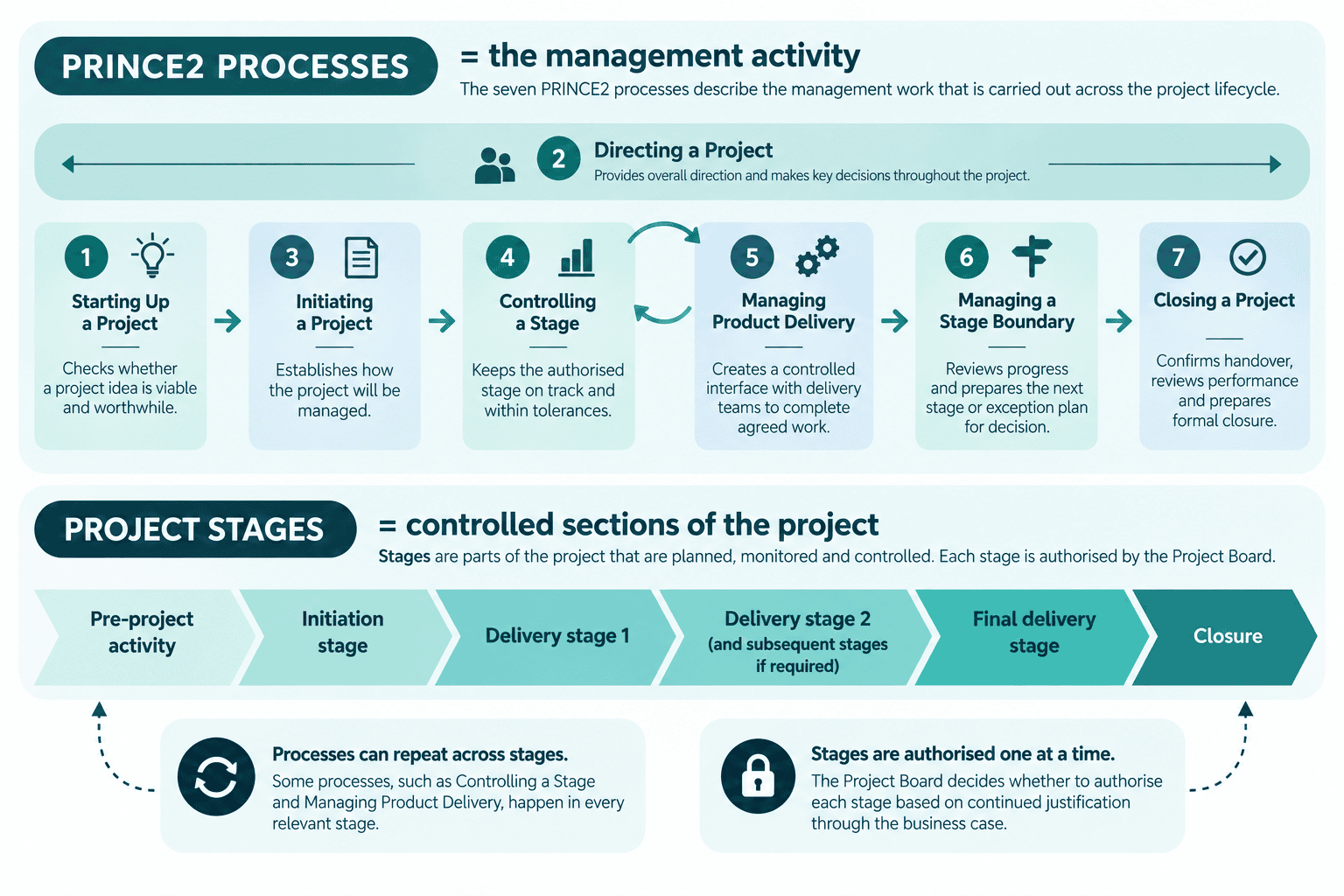
What Is the Difference Between PRINCE2 Processes and Stages?
PRINCE2 processes describe management activities and responsibilities across the project, while stages divide the project into manageable sections for planning, authorisation, monitoring, and control.
They are related, but they are not the same thing.
| PRINCE2 processes | PRINCE2 stages |
|---|---|
| Describe sets of management activities | Divide the project into sections |
| Help define who does what and when | Provide planning and control intervals |
| Seven processes form part of the method | The number of stages can vary by project |
| Some processes repeat across stages | Each stage represents a defined part of the project |
| Directing a Project spans multiple stages | The Project Board authorises stages individually |
| Managing a Stage Boundary connects stage-level decision points | A boundary is the point at which progress and continued justification can be reviewed |
PRINCE2 uses stages partly so that commitments and decisions don’t all have to be made at the start of the project.
Stage length can vary according to factors such as complexity, risk, planning horizon, and the location of important decision points.
PRINCE2 stages also don’t overlap. They create deliberate points at which the project can be reviewed before moving forward.
Are PRINCE2 Processes the Same as Project Phases?
No. PRINCE2 processes should not automatically be treated as seven project phases.
“Project phases” is common Project Management language and a useful term, but PRINCE2 has more specific terminology.
Within PRINCE2:
- processes describe structured management activity;
- stages divide the project for planning and control;
- the project lifecycle describes the wider journey from project initiation through to acceptance of the project product.
The PRINCE2 glossary defines the project lifecycle as “the period from project initiation to acceptance of the project product”.
An organisation may use its own technical or delivery phases alongside PRINCE2. For example, software delivery might involve discovery, design, development, testing, and deployment activities.
Those delivery phases do not have to replace the PRINCE2 management processes – the two can be designed to work together.
Are the PRINCE2 Processes Always Sequential?
The PRINCE2 processes create a logical journey, but they do not just run once each in a seven-step sequence.
Starting Up a Project comes before detailed initiation, and Closing a Project sits at the end, but several processes operate differently:
- Directing a Project operates across the wider project at Project Board level.
- Controlling a Stage is used for authorised delivery stages.
- Managing Product Delivery can occur repeatedly as teams deliver work packages.
- Managing a Stage Boundary is repeated at relevant stage boundaries and may also be used for exception planning.
- additional stages create additional cycles of control, delivery, review, and authorisation.
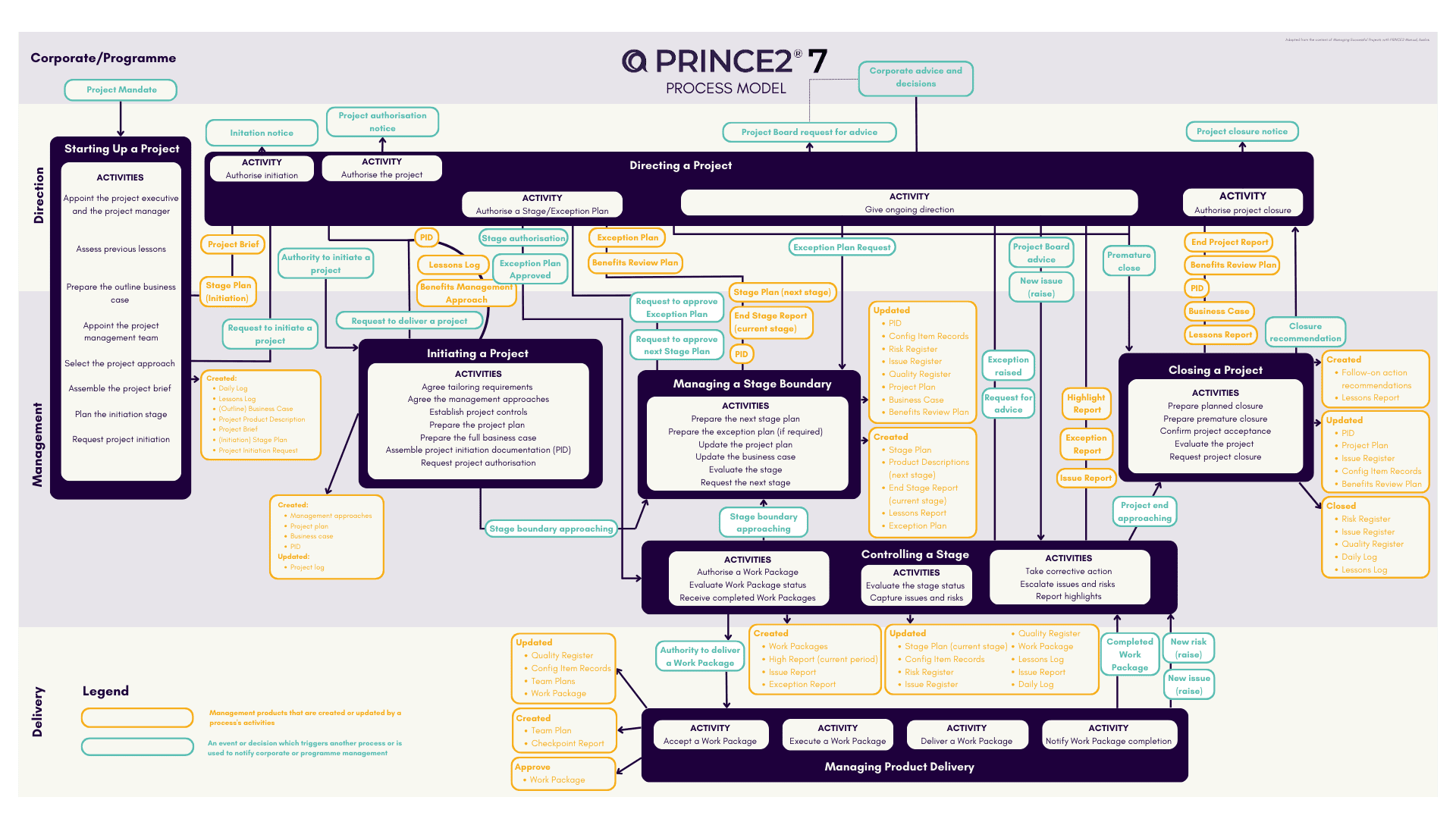
The current PRINCE2 process model explicitly shows Controlling a Stage and Managing Product Delivery repeating across delivery stages, while Directing a Project runs above the lifecycle.
Think of the seven processes as a management system around the project journey, rather than seven dominoes that fall once in a fixed order.
How Do Processes, Principles, and Practices Work Together?
PRINCE2 processes explain the management journey, principles guide how a genuine PRINCE2 project should be managed, and practices address important aspects of Project Management that need attention throughout the project.
The current PRINCE2 method brings together five integrated elements:
- principles;
- People;
- practices;
- processes;
- project context.
Principles
The seven PRINCE2 principles guide how the method is applied.
They include ideas such as continued business justification, learning from experience, managing by stages, managing by exception, focusing on products, and tailoring the method to the project.
Explore the seven PRINCE2 principles in our blog, The 7 PRINCE2 Principles Explained, or watch our webinar, PRINCE2 Principles.
Practices
The seven PRINCE2 practices address recurring areas of Project Management:
- Business Case
- Organising
- Plans
- Quality
- Risk
- Issues
- Progress
These practices support effective management across the project rather than belonging exclusively to one process.
Processes
The processes provide the management journey and recommended activity across the project lifecycle.
A useful way to think about the relationship is:
Principles help shape how you manage.
Practices help determine what needs ongoing management attention.
Processes help organise management activity across the lifecycle.
People apply all of these within the specific project context.
Can the PRINCE2 Processes Work With Agile or Hybrid Delivery?
Yes. The PRINCE2 processes can be tailored to projects using linear-sequential, iterative-incremental, or hybrid delivery approaches.
PRINCE2 manages the project rather than prescribing one specialist delivery method.
PRINCE2 Version 7 explicitly discusses iterative-incremental approaches, including Agile techniques such as sprints, timeboxes, user stories, product backlogs, and Kanban.
For example, a PRINCE2 stage might contain several Agile sprints.
The Project Board could still authorise that stage, the Project Manager could still control work within agreed tolerances, and the team could still use iterative delivery techniques to produce products.
The language and management products can also be tailored where appropriate – the official manual even gives an example in which sprints or timeboxes can operate within stages while remaining consistent with the principle of managing by stages.
How Do the PRINCE2 Processes Fit Into PRINCE2 Training?
The seven processes are one part of the wider PRINCE2 method, alongside the principles, people, practices, and project context.
If you’re learning PRINCE2 formally, understanding the process model helps you see how these elements come together across a real project rather than learning them as isolated definitions.
The seven PRINCE2 Processes are part of the knowledge developed through PRINCE2® Project Management Foundation, and Practitioner then develops the ability to apply and tailor the method in project situations.
ITonlinelearning offers routes including:
- PRINCE2® Project Management Foundation
- PRINCE2® Project Management Practitioner
- PRINCE2® Project Management Foundation and Practitioner
Frequently Asked Questions About PRINCE2 Processes
What are the 7 PRINCE2 processes?
The seven PRINCE2 processes are Starting Up a Project, Directing a Project, Initiating a Project, Controlling a Stage, Managing Product Delivery, Managing a Stage Boundary, and Closing a Project. Together, they describe management activity from the early assessment of a project idea, through initiation and controlled delivery, to final project closure. They do not represent seven separate project stages.
How many PRINCE2 processes are there?
There are seven PRINCE2 processes in the current method. They form one of PRINCE2’s integrated elements and provide management activity for directing, managing, and delivering the project throughout its lifecycle. The wider method also includes principles, people, practices, and project context.
What is the first PRINCE2 process?
Starting Up a Project is the first PRINCE2 process. It takes place before detailed project initiation and is designed to establish whether an idea is sufficiently viable and worthwhile to justify further investment in initiation. It includes establishing key roles, an outline business justification, an initial project definition, the project approach, and planning for the initiation stage.
What is the last PRINCE2 process?
Closing a Project is the final PRINCE2 process in the project management journey. It brings the project to a controlled conclusion by addressing matters like acceptance, handover, project evaluation, lessons, follow-on actions, and the request for formal closure. The Project Board then makes the closure decision through Directing a Project.
What is the PRINCE2 process model?
The PRINCE2 process model shows how the seven processes interact across the project lifecycle and different levels of project management. It demonstrates that processes are not simply seven consecutive phases. For example, Directing a Project operates across the wider lifecycle, while Controlling a Stage and Managing Product Delivery may repeat across multiple delivery stages.
What is the difference between PRINCE2 processes and stages?
Processes describe management activities, while stages divide the project into manageable sections for planning, monitoring, control, and authorisation. There are always seven PRINCE2 processes, but the number and length of project stages can vary. A project has at least an initiation stage and a final stage, with additional stages added where appropriate.
Are PRINCE2 processes the same as project phases?
No. “Project phases” is commonly used in Project Management more broadly, but PRINCE2 formally distinguishes processes from project stages. Processes structure management activity, while stages divide the project for control. Organisations can still use delivery phases such as design, build, testing, or deployment within a project managed using PRINCE2.
Which PRINCE2 process happens throughout the project?
Directing a Project operates across the wider project lifecycle at Project Board level. It covers major authorisation and direction decisions, including authorising initiation, authorising the project, approving stages or exception plans, providing ongoing direction, and authorising project closure. Day-to-day project management remains delegated to the Project Manager within agreed authority.
Are PRINCE2 processes sequential?
PRINCE2 processes have a logical lifecycle relationship, but they don’t each run only once in a simple seven-step sequence. Starting Up and Initiating occur early, while Closing occurs at the end. Directing spans much of the lifecycle, and processes such as Controlling a Stage, Managing Product Delivery, and Managing a Stage Boundary may be repeated as the project moves through multiple stages.
How do PRINCE2 processes relate to the practices?
The processes organise management activity across the project lifecycle, while the seven practices address important areas that need to be managed throughout it. For example, risk, quality, planning, issues, progress, organisation, and the business case can all affect activities in multiple processes. The practices therefore support the processes rather than mapping neatly one practice to one process.
Can PRINCE2 processes be used with Agile?
Yes. PRINCE2 can be tailored to work with iterative-incremental and hybrid delivery, as well as linear-sequential approaches. For example, a PRINCE2 stage can contain Agile sprints or timeboxes while Project Board authorisation, stage-level control, tolerances, and the wider process structure continue to govern the project. The current manual explicitly discusses sprints, timeboxes, backlogs, user stories, and Kanban in iterative delivery contexts.
What to Explore Next
Understanding the seven processes gives you the journey through PRINCE2.
The next step is understanding the other parts of the method that shape what happens along that journey.
You can continue with:
- Explore the Seven PRINCE2 Principles
- See how the complete PRINCE2 method fits together in What Is PRINCE2 Project Management? A Complete Guide to the PRINCE2 Methodology
- Compare PRINCE2 Foundation vs PRINCE2 Practitioner
Sources
- PeopleCert (2026) PRINCE2® Project Management (Version 7). PeopleCert.