What Does the PRINCE2 People Element Mean?
The PRINCE2 people element is one of the five integrated elements of PRINCE2 Project Management. It focuses on the people working on a project, the relationships between them, and those affected by the changes it delivers. It recognises that effective leadership, collaboration, communication, organisational culture, and stakeholder engagement all influence how successfully a project is managed.
In other words, PRINCE2 doesn’t just consider what needs to happen during a project. It also considers the people involved, how they work together, and how they respond to change.
The People element addresses three central areas:
- Leading successful change: Understanding the people affected by a project and supporting the transition to new ways of working.
- Leading successful teams: Building effective project teams through leadership, collaboration, relationships, and shared ways of working.
- Communication: Ensuring information, perspectives, and feedback flow between the people involved in or affected by a project.
These areas are closely connected. Successful change depends on effective teams, and effective teams depend on communication, trust, and an understanding of the people around them.
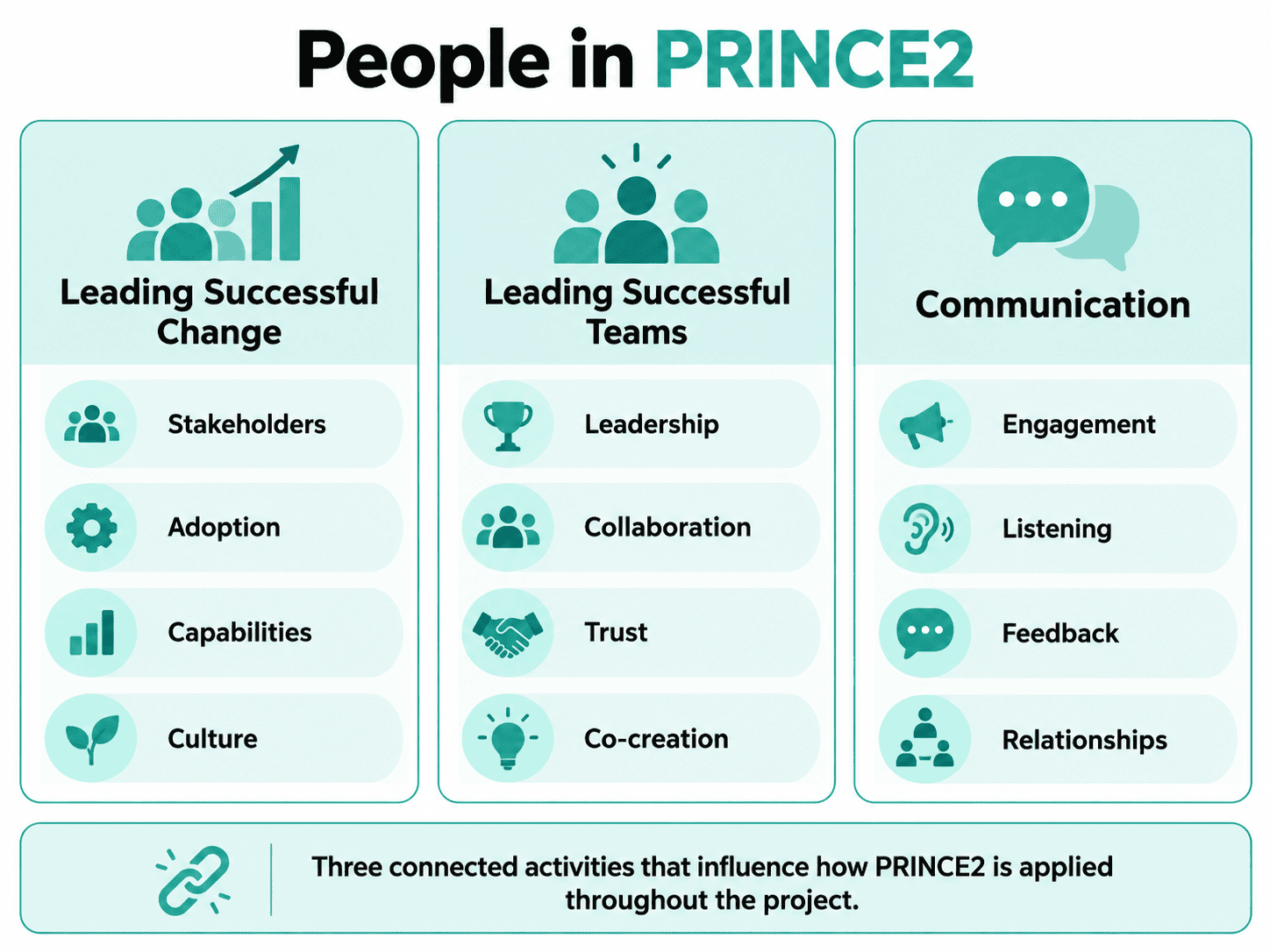
People is not a separate activity that happens alongside project management. It influences how the whole method is applied.
To see where it fits, explore our guide to the five integrated elements of PRINCE2.
Why Does People Matter in PRINCE2?
People matter in PRINCE2 because projects rely on individuals and groups to make decisions, deliver work, support change, and use the resulting products. Even when the technical work is completed successfully, the intended outcomes may be harder to achieve if people haven’t been properly involved, supported, or prepared.
Imagine a business introducing a new customer management system.
The software could be delivered on time, tested successfully, and meet its agreed requirements.
But what happens if employees don’t understand why the system is changing? What if the people expected to use it haven’t been involved in its development, or their managers aren’t prepared to support the transition?
The product might be ready, but the organisation might not be.
This is why the People element considers more than the delivery team. It looks at the relationships, capabilities, and organisational conditions needed to introduce change effectively.
It also recognises that people don’t necessarily share the same priorities.
A senior manager might be concerned about business performance. Employees might be concerned about how their daily responsibilities will change. Suppliers might be focused on technical requirements and delivery commitments.
None of these perspectives can just be ignored.
By understanding these different interests and building appropriate relationships, the project team can make better-informed decisions and reduce avoidable misunderstandings.
What Are the Organisational and Project Ecosystems in PRINCE2?
PRINCE2 distinguishes between the organisational ecosystem and the project ecosystem to help project teams understand the wider environment in which a project operates and the people directly involved in or affected by it.
These ecosystems are related, but they aren’t interchangeable.
What Is the Organisational Ecosystem?
The organisational ecosystem includes the people and groups within an organisation, together with its relationships with external parties.
This can include employees, senior leaders, owners, customers, suppliers, partners, regulators, and other relevant stakeholders.
A project doesn’t operate independently of this environment.
For example, a business implementing a new payroll system may need to consider its HR and Finance departments, existing technology suppliers, employee representatives, and applicable regulatory requirements.
Each forms part of the wider environment that may influence the project.
What Is the Project Ecosystem?
The project ecosystem is made up of the elements of the business directly involved in or affected by the project, along with the associated users and suppliers.
It includes the people delivering and managing the work, but can also include people who don’t hold formal project roles.
For example, employees preparing to use the new payroll system might not be members of the project management team. However, their needs, knowledge, and readiness for change could still influence project decisions.
The important distinction is that the project ecosystem extends beyond the formal project organisation.
Organisational Ecosystem vs Project Ecosystem
| Organisational ecosystem | Project ecosystem |
|---|---|
| The wider organisation and its external relationships | Those parts of the business involved in or directly affected by the project, plus associated users and suppliers |
| Exists beyond the lifecycle of an individual project | Forms around the needs and circumstances of the particular project |
| Includes broad organisational relationships | Focuses on relationships relevant to the project’s delivery and effects |
| Influences organisational expectations, constraints, and priorities | Influences how people participate, collaborate, and respond to project decisions |
These ecosystems can overlap, and their relationships can change as the project progresses.
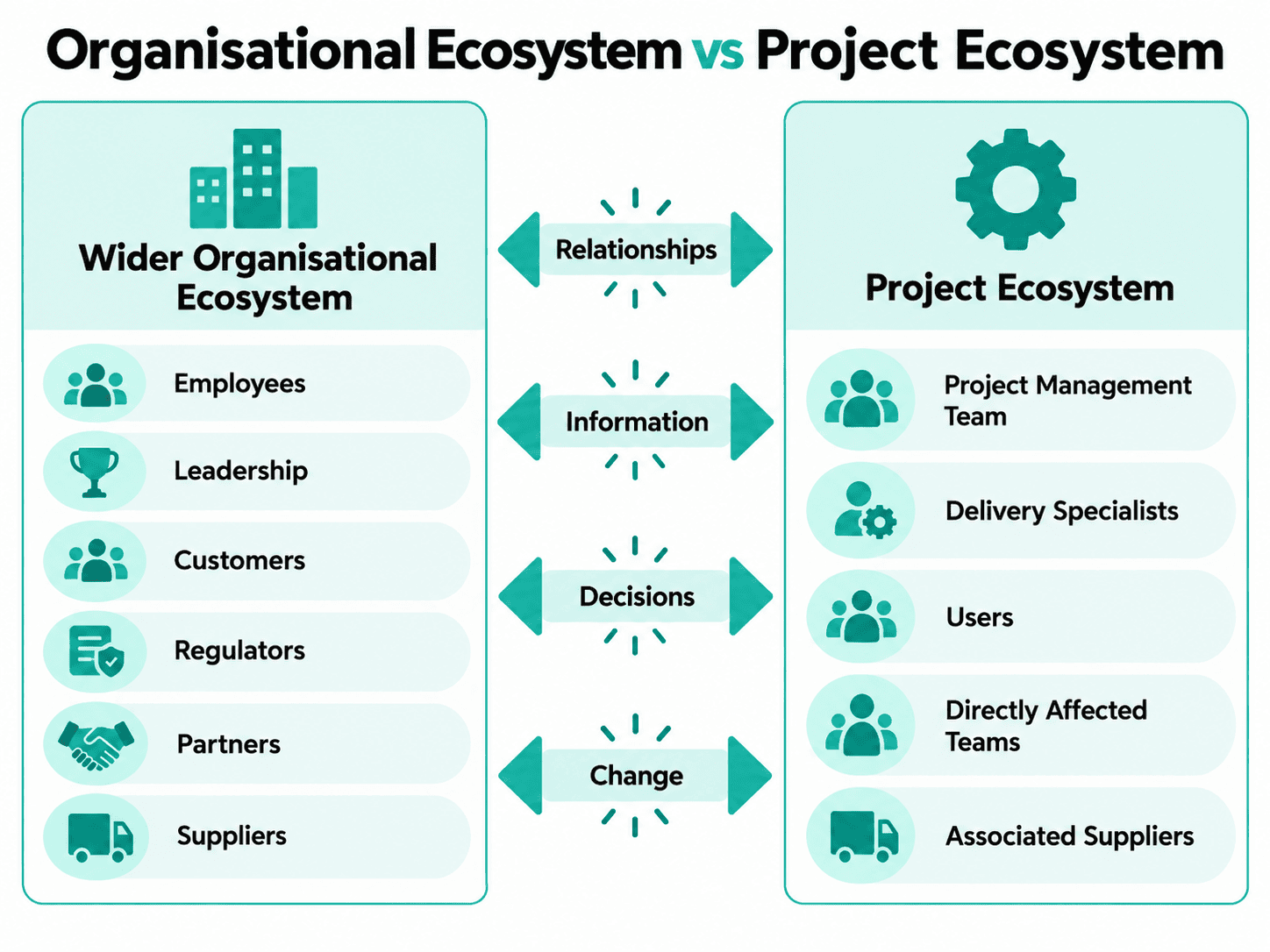
Understanding both ecosystems helps the project team identify whose knowledge is important, who may influence decisions, and who needs to be involved as circumstances change.
How Does PRINCE2 Support Successful Change?
PRINCE2 supports successful change by recognising that projects move organisations from an existing situation towards a different way of operating. Its People guidance considers the capabilities, responsibilities, relationships, culture, and supporting activities needed to make that transition possible.
This matters because delivering a project product isn’t always the same as successfully introducing the resulting change.
Take a company replacing its paper-based approval process with an online system.
The project team may be responsible for delivering the technology, but the change affects how employees submit requests, how managers approve them, and how Finance monitors expenditure.
The new system could work perfectly from a technical perspective while still creating problems if people don’t understand how their responsibilities have changed.
What Is the Change Management Approach in PRINCE2?
PRINCE2 uses a change management approach to describe how the organisation will move from its current state towards the intended target state.
This approach forms part of the Project Initiation Documentation and can consider:
- What needs to change, including responsibilities, processes, capabilities, and working practices.
- Which people and areas of the organisation will be affected.
- What the future way of working should look like.
- Whether interim arrangements will be necessary.
- What activities, such as consultation, trials, training, or knowledge transfer, will support the transition.
- Who will be responsible for the supporting activities.
The level of detail should suit the project rather than becoming an unnecessarily complicated exercise.
For a relatively straightforward internal improvement, the approach might be concise. A major organisational transformation could require more substantial planning and coordination.
Why Are Stakeholder Relationships Important During Change?
Stakeholder relationships matter because the people affected by a project may also influence how effectively its changes are introduced.
A stakeholder could be someone who uses the finished product, provides specialist knowledge, approves a decision, or experiences a change to their normal working arrangements.
Some may have formal authority. Others may influence opinions and behaviour through their relationships with colleagues.
For example, an experienced team supervisor may have no formal role in a technology project but could help explain practical concerns that senior decision-makers haven’t considered.
PRINCE2 encourages project teams to identify important stakeholders, understand their perspectives, and maintain relationships throughout the project.
This isn’t a one-off exercise completed during initiation.
As the project moves forward, different people may become more influential, new concerns may arise, and relationships may need attention.
Our PRINCE2 Stakeholder Management guide explains how to identify, analyse, and engage the people who can influence or be affected by a project.
What Does PRINCE2 Say About Leading Successful Teams?
PRINCE2 recognises that successful project teams need more than clearly assigned tasks. Effective leadership involves motivating people, building relationships, creating shared ways of working, and helping individuals with different skills and priorities work towards common objectives.
Project teams are often temporary.
They may bring together employees from different departments, external suppliers, technical specialists, and people who have never worked together before.
Some individuals may also divide their time between the project and their usual responsibilities.
These conditions create challenges that can’t always be resolved through formal authority alone.
Leadership vs Management in PRINCE2
Leadership and management are closely connected, but they have different emphases.
| Leadership | Management |
|---|---|
| Motivates people towards shared objectives | Coordinates and directs agreed work |
| Relies on influence, relationships, and collaboration | Uses agreed responsibilities and ways of working |
| Helps people understand and support the project’s purpose | Helps ensure assigned activities are carried out |
| Encourages alignment and cooperation | Supports the execution and control of tasks |
A Project Manager may need to do both.
For example, allocating responsibilities and monitoring delivery are management activities. Helping two departments resolve competing priorities and agree on how to collaborate calls for leadership.
Crucially: leadership isn’t limited to the Project Manager.
Team Managers, project leaders, and other influential individuals can help establish the conditions in which people work effectively.
What Makes a PRINCE2 Project Team Effective?
PRINCE2’s People guidance highlights several important considerations.
1. Appropriate skills and capabilities
People need the knowledge and capabilities required for the work assigned to them.
Where gaps exist, the project may need training, support, or different responsibility arrangements.
2. Clear objectives and expectations
Team members should understand what the project is trying to achieve, how their contribution fits into the wider work, and what others expect from them.
3. Trust and psychological safety
People should feel able to ask questions, offer different perspectives, and raise concerns without unnecessary fear of negative consequences.
This makes it easier to identify problems and learn from experience.
4. Collaboration across boundaries
Projects often depend on departments and suppliers working together despite different priorities and reporting arrangements.
These relationships need deliberate attention.
5. Compatible ways of working
A team needs practical agreements about how work will be coordinated, how information will be shared, and how problems will be addressed.
These arrangements may need to evolve as the team develops.
6. Opportunities to build relationships
Regular, purposeful interaction can strengthen cooperation.
For remote or hybrid teams, this may involve creating opportunities for informal conversations and shared learning rather than relying entirely on scheduled progress meetings.
What Are Collaboration and Co-Creation in PRINCE2?
Collaboration means people from across the project ecosystem working together towards the project’s objectives.
Co-creation is a more specific form of collaboration, involving users and important stakeholders in shaping project products or agreed ways of working.
For example, imagine a business developing a new employee onboarding portal.
The technical team could design the portal independently and present the completed product to HR.
Alternatively, HR representatives, new employees, and technical specialists could work together to shape requirements, explore practical problems, and test early versions.
The second approach introduces co-creation.
It helps bring different perspectives into the work before decisions become difficult or expensive to change.
Co-creation doesn’t mean every stakeholder makes every decision. Formal responsibilities, governance, and decision-making authority still apply.
Why Is Communication Important in PRINCE2?
Communication is important in PRINCE2 because project stakeholders need information they can understand, opportunities to raise concerns, and ways to influence matters relevant to them. Effective communication helps build shared understanding, maintain relationships, and support decisions throughout the project.
Importantly, communication involves more than distributing project reports.
A report might explain that a project is progressing according to plan. It might not reveal that employees are confused about an upcoming change or that two delivery teams have conflicting assumptions.
PRINCE2 therefore considers both formal communication and the wider conversations through which people exchange knowledge and develop relationships.
What Is the Communication Management Approach?
The communication management approach explains how information and feedback will be exchanged across the project ecosystem.
It forms part of the Project Initiation Documentation.
A communication management approach can consider:
- Which stakeholder groups need to be engaged.
- What information is relevant to each audience.
- Why particular communication is needed.
- Which channels and formats are suitable.
- How frequently communication should happen.
- Who is responsible for different communication activities.
- How feedback will be received and considered.
The approach should develop as the project and stakeholder relationships evolve.
For practical guidance on planning communication and choosing appropriate channels, see our PRINCE2 Communication Management guide.
Why Should Communication Be Two-Way?
Two-way communication allows stakeholders to share information with the project rather than simply receive messages from it.
Imagine an organisation introducing new shift-management software.
A project update might explain when the software will become available and how employees can access it.
But employees may also need opportunities to explain that the proposed process conflicts with their actual working patterns.
Without this feedback, the project team might not discover the problem until implementation.
Listening is therefore an important part of PRINCE2 communication.
The objective isn’t simply to send more messages. It’s to help information flow between the people who need it.
Should Every Stakeholder Receive the Same Communication?
No. PRINCE2 communication should reflect the needs, concerns, and circumstances of different stakeholder groups.
For example:
| Audience | Likely communication need | Suitable approach |
|---|---|---|
| Senior decision-makers | Progress, major risks, exceptions, and decisions | Concise management updates and appropriate escalation |
| Delivery teams | Work priorities, dependencies, and technical decisions | Team discussions and shared working information |
| Employees affected by change | What will change, when, and how it affects them | Practical explanations, demonstrations, and opportunities for questions |
| Suppliers | Requirements, interfaces, dependencies, and delivery expectations | Coordinated technical and delivery discussions |
| External stakeholders | Relevant impacts, arrangements, and opportunities for feedback | Accessible, audience-appropriate communication |
*These are illustrative approaches, not a prescribed communication format for every project.
How Does Organisational Culture Affect a PRINCE2 Project?
Organisational culture affects a PRINCE2 project by influencing how people communicate, make decisions, collaborate, respond to authority, and approach change. Project teams may develop their own ways of working, but these should remain compatible with the wider organisational environment.
Culture isn’t simply the atmosphere in an office.
It includes the shared values, attitudes, expectations, and working habits that influence how people behave.
Consider a company where employees are accustomed to making decisions informally and quickly.
If a project introduces an unnecessarily complex approval process, employees may struggle to understand why routine decisions now require so much administration.
Alternatively, a project involving multiple suppliers and strict regulatory obligations may need more formalised arrangements than employees are accustomed to.
In both situations, the project team should understand the existing culture before deciding how people will work together.
PRINCE2 also recognises that a project’s culture can develop over time.
As team members build relationships, learn from experience, and adapt their working practices, the arrangements established at the beginning may no longer fit perfectly.
For this reason, the project team should periodically check whether its agreed ways of working remain appropriate.
A useful warning sign: If people continually work around an established procedure, the problem may not simply be that they are refusing to follow instructions. It may indicate that the procedure no longer fits how the project operates.
That doesn’t mean governance should be abandoned. It means the project team should examine the underlying cause and consider whether adjustments are appropriate.
PRINCE2 Project Culture: Myth vs Reality
Think PRINCE2 is just about processes and governance? Select each card to uncover the reality behind four common misconceptions.
What Is the Difference Between People and Roles in PRINCE2?
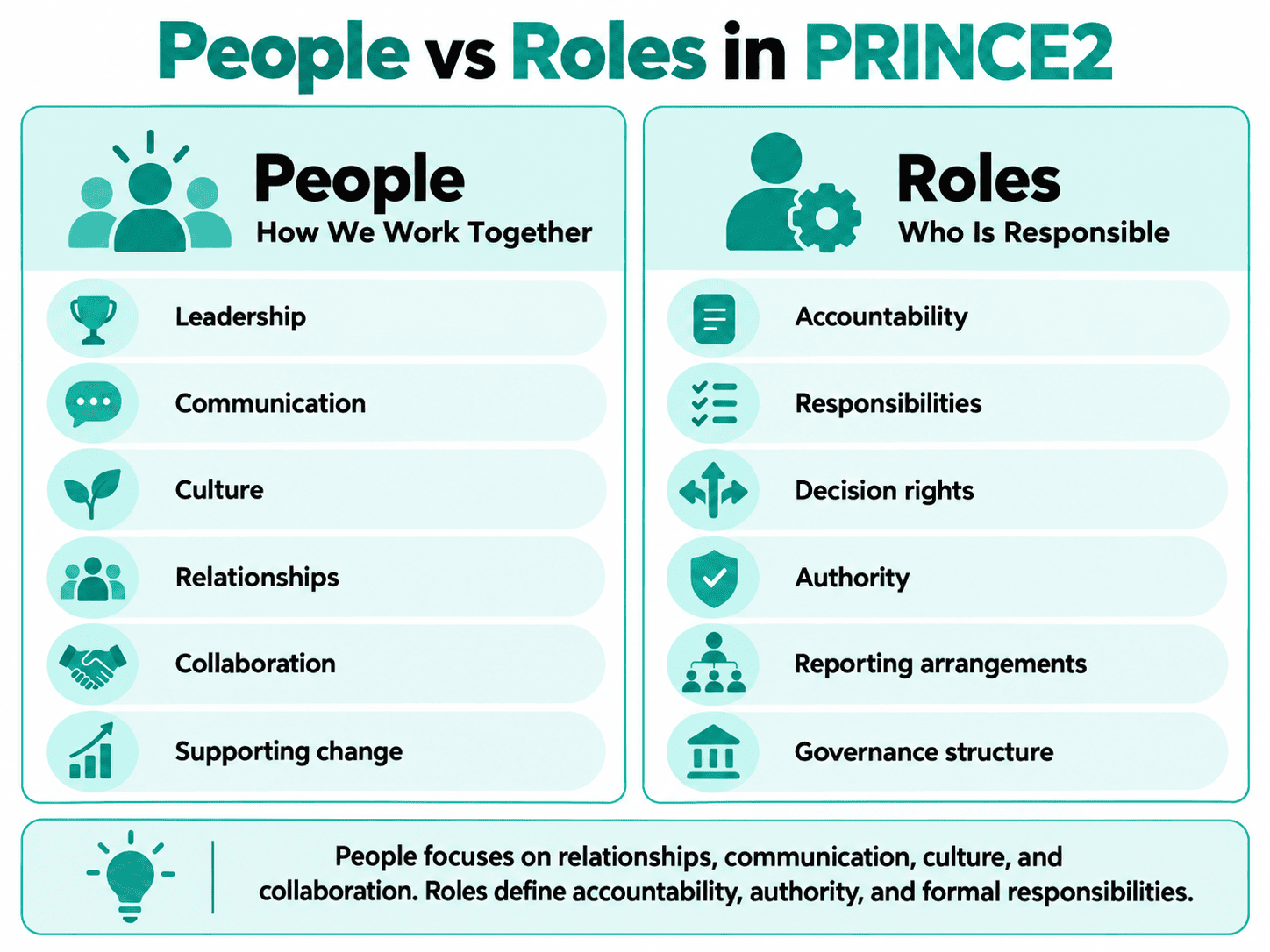
The People element of PRINCE2 addresses the wider human factors that influence projects, including leadership, relationships, communication, collaboration, and change. PRINCE2 roles define the formal responsibilities, accountability, and decision-making arrangements within the project’s management structure.
The two are closely connected, but they answer different questions.
PRINCE2 People vs Roles
| People | Roles and Responsibilities |
|---|---|
| How people work together | Who is formally responsible |
| Leadership and motivation | Accountability and authority |
| Stakeholder relationships | Project management team structure |
| Communication and collaboration | Defined responsibilities and decision rights |
| Culture and team effectiveness | Role descriptions and reporting arrangements |
| Supporting change | Allocating and governing project responsibilities |
For example, the Project Manager may have formal responsibility for managing the project.
However, having that responsibility doesn’t automatically mean everyone will collaborate effectively.
The Project Manager may need to build trust with suppliers, understand competing priorities, encourage communication between departments, and help resolve disagreements.
These are People considerations.
Similarly, a Senior User has a defined role within the project’s governance arrangements, but effective user engagement also depends on understanding relationships with the wider user community.
The key distinction: Roles establish who is responsible. People considers how individuals and groups interact to make the project work.
For a detailed explanation of the Project Board, Project Manager, Team Manager, and other formal positions, explore our guide to PRINCE2 roles and responsibilities.
How Does People Work with the Other PRINCE2 Elements?
People is one of the five integrated elements of PRINCE2, working alongside Principles, Practices, Processes, and Project Context. These elements are applied together, so people-related considerations influence how the method operates throughout the project.
Rather than treating People as a separate subject, it helps to consider how it contributes to each of the other elements.
How People Connects to the Five Integrated Elements
| Integrated element | Relationship to People |
|---|---|
| People | Addresses leadership, relationships, teamwork, communication, and change |
| Principles | Guides how people collaborate, share responsibilities, learn, and exercise delegated authority |
| Practices | Incorporates people considerations into areas such as organising, planning, quality, and risk management |
| Processes | Establishes management activities and interactions between people at different management levels |
| Project Context | Influences how the method is applied to the organisation, delivery approach, stakeholders, and team capabilities |
People and PRINCE2 Principles
The principle “Define roles, responsibilities, and relationships” has a particularly direct connection to People.
It recognises that projects need clear accountability as well as effective relationships between the people involved.
Other principles also have important human dimensions.
For example, “Learn from experience” depends on people sharing knowledge and reflecting on lessons.
“Manage by exception” depends on appropriate delegation, clear expectations, and confidence in the people making decisions.
Explore how these obligations work in our guide to the seven PRINCE2 principles.
People and PRINCE2 Practices
The Organizing practice helps establish the project’s formal management structure and ensure appropriate representation of business, user, and supplier interests.
However, People considerations extend across the other practices too.
The Quality practice involves understanding user expectations. Planning requires coordination between individuals and teams. Risk and Issues management depend on people identifying, sharing, and responding to information.
Explore the seven PRINCE2 practices to understand how these areas are managed throughout a project.
People and PRINCE2 Processes
PRINCE2 processes organise management activity throughout the project lifecycle.
People make the decisions, exchange information, and carry out the work involved in those processes.
For example, Starting Up a Project involves establishing the basis for managing the project, including important relationships and responsibilities.
Initiating a Project provides the opportunity to establish approaches for communication and change.
Managing Product Delivery involves coordination between the Project Manager and those responsible for producing the agreed outputs.
You can explore these activities in our guide to the seven PRINCE2 processes.
People and Project Context
A project team’s skills, organisational relationships, working culture, and stakeholder environment all influence how PRINCE2 should be applied.
A straightforward internal project with a small, experienced team may need different communication arrangements from a large project involving external suppliers, several departments, and geographically dispersed stakeholders.
This is why PRINCE2 is designed to be tailored to the project rather than applied identically in every situation.
How Is the People Element Tailored to Different Projects?
The People element is considered when tailoring PRINCE2 to suit a project’s size, complexity, stakeholder relationships, organisational culture, delivery method, and team capabilities. The objective is to establish management and communication arrangements that are appropriate for the people and organisations involved.
Tailoring doesn’t mean removing the importance of leadership, collaboration, or stakeholder engagement.
It means considering how these areas should be addressed in the particular circumstances.
For example:
| Project context | Possible People considerations |
|---|---|
| Small internal project | Direct communication, a relatively small stakeholder network, and simple working arrangements |
| Large multi-department project | More structured stakeholder coordination, multiple communication channels, and clear interfaces between teams |
| Remote project team | Deliberate relationship-building, accessible communication, and opportunities for informal interaction |
| Multi-supplier project | Clear organisational interfaces, shared expectations, and attention to differences in working culture |
| Major organisational change | Wider stakeholder engagement, capability development, and arrangements for preparing affected teams |
*These are examples, not fixed PRINCE2 rules.
How Does People Work in Agile or Hybrid Projects?
PRINCE2 can support linear-sequential, iterative-incremental, and hybrid delivery approaches. The People element remains relevant because collaboration, leadership, stakeholder relationships, and communication are necessary regardless of how specialist work is organised.
For instance, an Agile delivery team might use frequent discussions, demonstrations, and feedback to collaborate with users.
PRINCE2 can accommodate these practices while retaining appropriate project governance and decision-making arrangements.
In a hybrid project, some activities may follow a more sequential approach while others use iterative delivery.
The project team may therefore need to establish compatible communication arrangements across groups working in different ways.
The key is to apply PRINCE2 in a way that supports the chosen delivery approach without losing the method’s principles.
How Does the People Element Work in Practice?
Consider a fictional UK business introducing a new customer booking platform across several regional offices.
The project involves an internal technology team, an external software supplier, customer service employees, regional managers, and senior business decision-makers.
The technical objective is to introduce a booking platform that meets agreed requirements.
However, the People element encourages the project team to look beyond the technology itself.
Step 1 – Understand Who Is Involved
The project team identifies the different groups contributing to or affected by the change.
Customer service employees will use the platform daily. Regional managers may need new reporting information. Technology specialists will develop and support the system.
Each group brings different knowledge and expectations.
Representatives from the relevant teams discuss how the existing booking process works and what needs to improve.
This helps identify assumptions before they become problems.
It also allows the project team to understand concerns that may not appear in technical requirements.
Step 3 – Agree How People Will Work Together
The project team establishes responsibilities, communication arrangements, and suitable ways of collaborating.
For example, technical specialists and customer service representatives might review early versions of the platform together.
Their feedback can inform development decisions.
Step 4 – Prepare People for Change
Introducing the platform may require changes to employee routines, customer communications, and management reporting.
The project considers what preparation, training, and support will be required.
Step 5 – Review Relationships and Communication
As the project progresses, the needs of different groups may change.
Early development might involve close collaboration with technology specialists.
Later activities could require more attention to users, operational managers, and those responsible for supporting the live service.
The project team reviews its arrangements accordingly.
The lesson: A project can follow appropriate processes and produce the required outputs while still encountering difficulties if the people affected by its decisions haven’t been sufficiently considered.
The People element helps ensure those human factors remain part of how the project is managed.
How Does People Fit into PRINCE2 Training?
The People element forms part of understanding how current PRINCE2 Project Management works. Learning the method involves understanding not only the formal project structure, but also how leadership, communication, relationships, and change considerations influence its application.
If you’re new to PRINCE2, the Foundation qualification provides a starting point for understanding the method’s concepts and terminology.
The Practitioner qualification focuses on applying and tailoring PRINCE2 in project situations.
Both relate to the wider PRINCE2 method, rather than treating People as an entirely separate subject.
At ITonlinelearning, you can explore:
- PRINCE2® Project Management Foundation
- PRINCE2® Project Management Practitioner
- PRINCE2® Project Management Foundation and Practitioner
Not sure which qualification is right for you?
Our guide to PRINCE2 Foundation vs Practitioner explains the differences and can help you decide where to begin.
Frequently Asked Questions About People in PRINCE2
What Does People Mean in PRINCE2?
People is one of the five integrated elements of PRINCE2 Project Management. It addresses the people working on a project, those affected by it, and the relationships needed to manage and deliver change. Its main areas are leading successful change, leading successful teams, and communication. These activities are supported by considerations such as stakeholder relationships, collaboration, culture, and co-creation.
Is People One of the Five Integrated Elements of PRINCE2?
Yes. People is one of the five integrated elements of PRINCE2, alongside Principles, Practices, Processes, and Project Context. It is integrated into how the method operates rather than being an optional addition. People-related factors affect how responsibilities are fulfilled, how stakeholders collaborate, how information is exchanged, and how project decisions are made.
How Does PRINCE2 Manage Stakeholders?
PRINCE2 addresses stakeholders by considering the individuals, groups, and organisations that can influence or be affected by a project. Project teams should identify relevant stakeholders, understand their perspectives, establish appropriate relationships, and consider how engagement needs evolve. The communication management approach helps organise engagement and feedback, while the change management approach considers people affected by the transition to new ways of working.
What Does PRINCE2 Say About Leadership?
PRINCE2 recognises leadership as an important part of motivating people and helping them work towards project objectives. Effective leadership involves collaboration, influence, relationships, and shared understanding. It is particularly important because project teams often include individuals from different departments or organisations who may have competing priorities. Leadership is therefore relevant beyond the Project Manager alone.
How Does PRINCE2 Support Successful Teams?
PRINCE2 supports successful teams by encouraging clarity of purpose, suitable capabilities, effective relationships, collaboration, and agreed ways of working. Its People guidance also recognises the importance of psychological safety, trust, and opportunities for team members to exchange knowledge. The method’s project management arrangements can support these factors through clear roles, plans, communication approaches, and responsibilities.
How Does Communication Work in PRINCE2?
PRINCE2 uses a communication management approach to establish how information and feedback will flow between the people involved in or affected by a project. The approach considers stakeholder needs, communication channels, responsibilities, timing, and opportunities for feedback. Communication includes listening and relationship-building, not simply providing formal progress reports.
What Is the Project Ecosystem in PRINCE2?
The project ecosystem includes the parts of the business involved in or directly affected by a project, together with its associated users and suppliers. It extends beyond those who hold formal project management roles. Understanding this ecosystem helps the project team consider the people, relationships, and organisational interfaces that influence delivery and change.
What Is the Organisational Ecosystem in PRINCE2?
The organisational ecosystem includes the internal parts of an organisation and its relationships with external groups, such as customers, partners, suppliers, regulators, and other stakeholders. A PRINCE2 project operates within and interacts with this wider environment. Understanding these relationships helps the project team identify relevant constraints, influences, and people who may need to be involved.
What Is the Difference Between People and Roles in PRINCE2?
People addresses the human aspects of managing projects, including leadership, communication, relationships, teamwork, culture, and change. Roles establish the formal responsibilities, accountability, and decision-making arrangements within the project. Both are necessary. Clear responsibilities help people understand what is expected of them, while effective relationships and collaboration help them fulfil those responsibilities.
How Does PRINCE2 Support Organisational Change?
PRINCE2 supports organisational change through its People guidance and change management approach. The project team considers the current and intended future states, the people and organisational areas affected, and the activities required to support the transition. These may include consultation, training, knowledge transfer, and changes to responsibilities or working practices. The approach should reflect the project’s circumstances.
Can the People Element Be Tailored?
Yes. The way People considerations are addressed can be tailored to the project’s environment, complexity, organisational culture, stakeholder relationships, and team capabilities. For example, a smaller project may use more direct communication, while a complex multi-organisation project may require more structured engagement. Tailoring should preserve PRINCE2’s principles while ensuring that project arrangements are appropriate.
Can PRINCE2 Work with Agile or Hybrid Teams?
Yes. PRINCE2 can be used alongside iterative-incremental, Agile, and hybrid delivery methods. Teams may use collaborative practices such as demonstrations, regular discussions, and feedback activities while working within the project’s agreed governance arrangements. The People element helps ensure that relationships, leadership, communication, and team capabilities are considered when adapting the method to different delivery approaches.
What Should You Explore Next?
The People element shows that successful project management involves more than creating plans, monitoring progress, and following processes.
It also requires an understanding of the people delivering the work, those affected by the project, and the relationships that connect them.
PRINCE2 brings these considerations into the wider method through leadership, communication, collaboration, stakeholder engagement, and change.
If you’d like to develop your understanding further, these guides are a useful next step:
- The Five Integrated Elements of PRINCE2 – Understand where People fits within the wider method.
- PRINCE2 Roles and Responsibilities – Explore the formal project management structure.
- The Seven PRINCE2 Principles – Understand the guiding obligations behind project management.
- Complete Guide to PRINCE2 Project Management – Explore how the entire method works.
If you’re considering a PRINCE2 qualification, you can also speak with an ITonlinelearning Course & Career Advisor about your options.