How Does PRINCE2 Software Project Management Work?
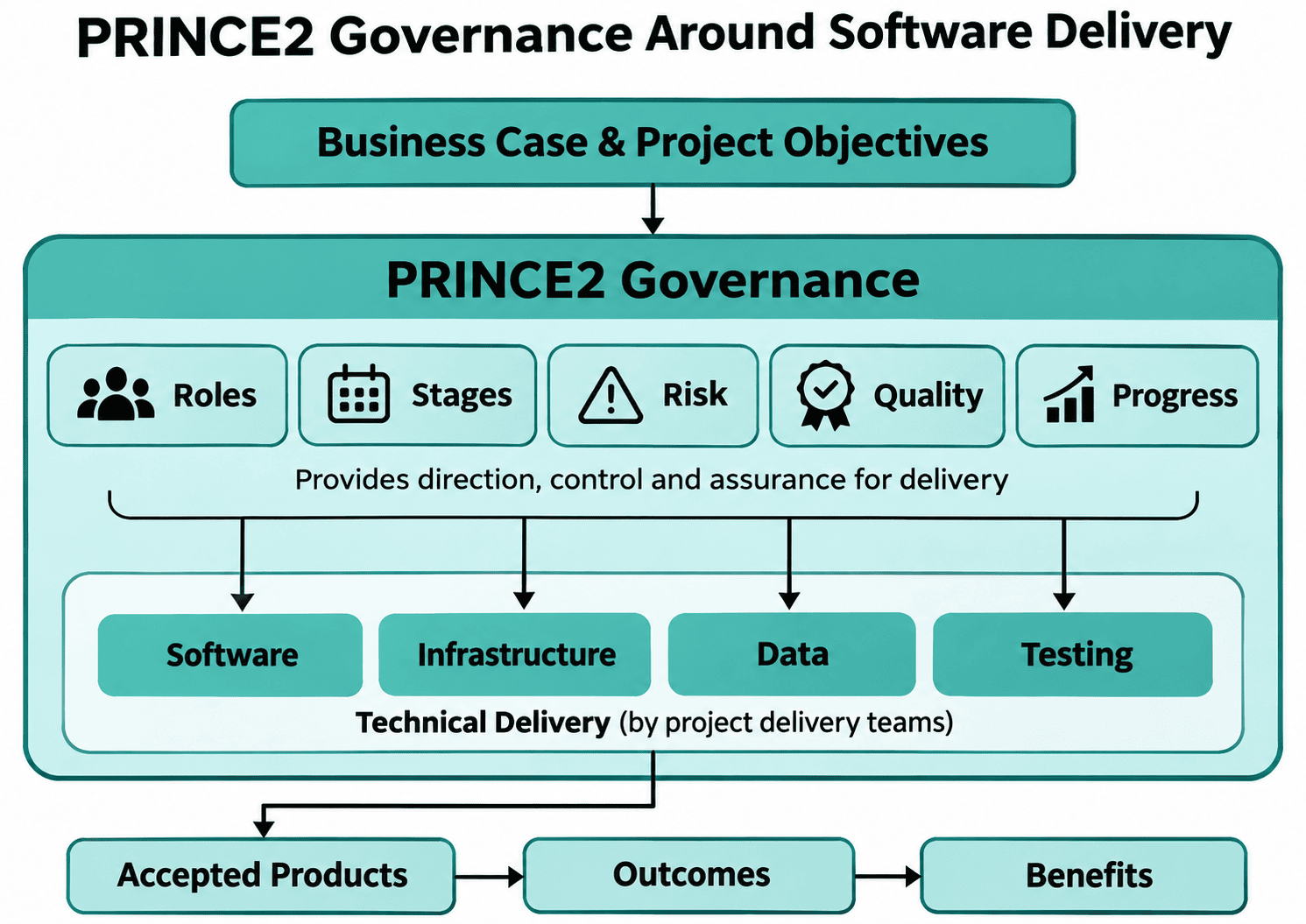
PRINCE2 software project management provides governance around how software and IT projects are justified, planned, authorised, monitored, and controlled. It covers the Business Case, roles, management stages, products, quality, risks, issues, progress, and tolerances. Technical teams can still use iterative-incremental, linear-sequential, or hybrid delivery approaches, including appropriate Agile, Scrum, and DevOps practices.
PRINCE2 doesn’t tell developers how to write software. It helps the wider project remain justified, coordinated, controlled, and accountable while that software is being delivered.
That distinction matters because software projects involve much more than development. They may also require infrastructure, data migration, supplier agreements, security considerations, staff training, and operational handover.
A technically successful application isn’t necessarily a successful project if the investment no longer makes sense or the organisation can’t use what has been delivered.
The key points are straightforward:
- PRINCE2 does not require Waterfall software development.
- A PRINCE2 management stage is not the same as a Scrum Sprint.
- Software teams can use appropriate delivery practices within agreed project-management arrangements.
- PRINCE2 controls significant project decisions without requiring senior management to approve every technical change.
Can PRINCE2 Be Used for Software and IT Projects?
Yes. PRINCE2 can be used for software development and wider IT projects when the method is appropriately tailored to their context.
The current method is designed to work across different industries, project types, and delivery approaches. It separates managing the project from the specialist activities needed to create its products.
Can PRINCE2 Be Used for Software Development?
Yes. PRINCE2 can govern software development while technical teams choose how to design, build, integrate, and test their solutions.
For example, a software project might need to deliver a customer portal, authentication integration, reporting functionality, user guidance, and a support process.
PRINCE2 helps establish what is required, who is responsible, how the work will be authorised, and how performance will be assessed.
The development team remains responsible for suitable engineering decisions within its authority.
Is PRINCE2 Suitable for IT Projects Beyond Software Development?
Yes. Software development is only one possible component of an IT project.
Illustrative PRINCE2 IT projects include:
- Implementing a customer relationship management system.
- Migrating services to cloud infrastructure.
- Refreshing an organisation’s network.
- Introducing a cybersecurity solution.
- Implementing an enterprise resource planning system.
- Migrating information between platforms.
- Rolling out a new service-management system.
- Developing and introducing a customer-facing application.
These are practical examples, not official PRINCE2 project categories.
Each project may need different technical expertise, but all could benefit from clear business justification, responsibilities, planning, governance, and control.
What Does PRINCE2 Actually Manage in a Software or IT Project?
PRINCE2 manages the project as an investment and an organised change initiative. Specialist delivery approaches determine how the required technical products are created.
The responsibilities overlap in places, particularly around planning, quality, communication, and risk. The distinction is about their typical emphasis, not two completely separate organisations.
| PRINCE2 project-management emphasis | Technical delivery emphasis |
|---|---|
| Why the investment is justified | How the technical solution is designed |
| What products the project must deliver | How software and infrastructure are developed |
| Who authorises project-level decisions | Who makes specialist engineering decisions |
| Project and management-stage plans | Technical delivery plans and activities |
| Agreed product quality and acceptance | Technical testing and verification |
| Project risks, issues, and tolerances | Technical uncertainties and delivery problems |
| Overall forecasts and governance reporting | Team-level progress and delivery evidence |
| Business outcomes and benefits | Creating and supporting usable technical products |
Consider a team developing an online booking system.
The Project Board may need to know whether the system remains affordable, whether the planned release is achievable, and whether the expected benefits still justify the investment.
The technical team may need to decide which integration approach will work best, how to structure automated tests, and how to manage the software build.
Both types of decision matter. They simply belong at different levels of authority.
Does PRINCE2 Require Waterfall Software Development?
No. PRINCE2 does not require Waterfall. The current method explicitly accommodates linear-sequential, iterative-incremental, and hybrid delivery.
These describe how products are delivered, rather than different versions of PRINCE2.
Linear-Sequential Delivery
Work follows a sequence in which later steps depend on earlier activities or products.
An infrastructure implementation might require an environment to be prepared before dependent systems can be installed and verified.
Iterative-Incremental Delivery
Products develop through repeated cycles of design, development, testing, and feedback.
A software team might introduce basic portal functionality, review the results, and progressively enhance the solution.
Hybrid Delivery
Different parts of the project use different approaches.
For example, infrastructure provisioning might follow a dependency-driven sequence while application development proceeds through several iterations.
PRINCE2 can provide one management structure around these workstreams without forcing them to use identical delivery techniques.
For a fuller explanation, read Is PRINCE2 Waterfall?.
How Can PRINCE2 Work With Agile, Scrum, and DevOps?
PRINCE2 can work alongside Agile, Scrum, and DevOps because it doesn’t prescribe one specialist development method.
However, Agile, Scrum, and DevOps aren’t interchangeable terms. Their roles and purposes need to be understood independently.
Can PRINCE2 Work With Agile Software Development?
Yes. PRINCE2 can provide project-level control while Agile software teams develop and refine products incrementally.
An Agile team might adjust implementation details as new information emerges. PRINCE2 provides a way to assess changes affecting wider project scope, cost, quality, risk, or continued justification.
This doesn’t mean every backlog adjustment needs Project Board approval.
It means the project should establish which decisions the team can make independently and which need wider consideration.
Read more about how PRINCE2 works with Agile.
How Can PRINCE2 Work With Scrum?
A Scrum Team can develop products within a PRINCE2-managed project.
Scrum uses Sprints, defined accountabilities, and regular inspection and adaptation to support product development.
PRINCE2 can manage the wider project through its Business Case, management stages, authorised work, tolerances, and governance arrangements.
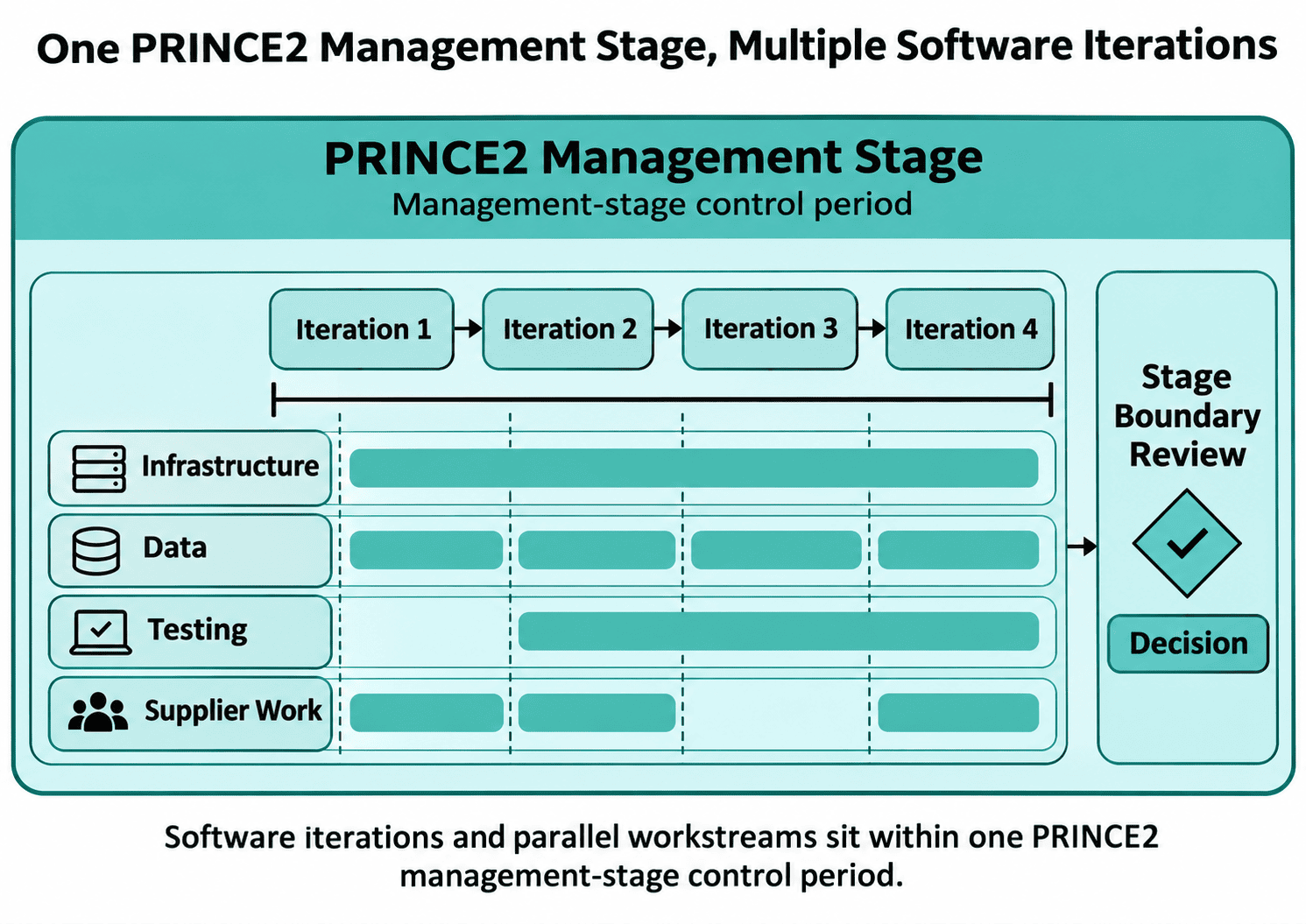
For example, one PRINCE2 management stage may contain several Scrum Sprints. Information from the Sprints can inform the Project Manager’s assessment of progress.
There are important distinctions:
- The PRINCE2 Project Manager is not automatically the Scrum Master.
- The Senior User is not automatically the Product Owner.
- A management stage is not a Sprint.
- A Work Package is not automatically a Sprint Backlog.
PRINCE2 allows tailoring around iterative delivery, but the purpose of each framework’s concepts must remain clear.
Read PRINCE2 vs Scrum for a fuller comparison.
Can PRINCE2 Work With DevOps?
Yes. PRINCE2 can govern a project whose technical teams use DevOps practices.
DevOps emphasises collaboration between development and operations, often supported by automation, continuous integration, continuous delivery, and monitoring.
These practices can help teams build, test, deploy, and maintain software. They don’t replace the need to justify a project investment, manage cross-workstream dependencies, or authorise significant changes.
For example, automated testing might provide evidence that a software build meets technical standards. The wider project still needs to determine whether all required products are acceptable and whether deployment is authorised under its agreed arrangements.
PRINCE2 doesn’t prescribe continuous integration or continuous delivery pipelines.
Why Might Hybrid Delivery Suit an IT Project?
Different IT workstreams often have different constraints.
An illustrative implementation might involve:
- Iterative application development.
- Sequential infrastructure preparation.
- Staged data migration.
- Security reviews at agreed decision points.
- Incremental staff training.
- Contract-driven supplier milestones.
Managing these activities through one overall project doesn’t mean forcing every team into the same delivery pattern.
It means coordinating their dependencies and ensuring that the combined work supports the project’s objectives.
Explore PRINCE2 hybrid project management.
How Do Project Context and Tailoring Affect IT Projects?
PRINCE2 should be applied according to the circumstances of the project, rather than as an identical set of activities and documents every time.
Its Project Context element includes organisational context, commercial context, delivery method, sustainability, and project scale.
For a software or IT project, additional practical considerations might include legacy infrastructure, the number of suppliers, system integrations, data sensitivity, technical maturity, and the number of users affected.
These are illustrative IT considerations, not additional official PRINCE2 context categories.
How Should PRINCE2 Be Tailored for Software Projects?
Tailoring means deciding how to apply the method while retaining its principles.
A software project could tailor:
- Management stages: Select control periods appropriate to investment decisions, uncertainty, and delivery dependencies.
- Management products: Use suitably structured information rather than producing unnecessary standalone documents.
- Reporting: Draw on existing delivery information where it provides reliable project evidence.
- Team interfaces: Agree how the Project Manager and technical teams will authorise work and exchange progress information.
- Quality arrangements: Define acceptance requirements while allowing specialist teams to choose suitable testing techniques.
- Issue handling: Establish which technical matters can be resolved locally and which require project-level decisions.
- Tolerances: Give appropriate autonomy while retaining clear escalation boundaries.
- Communication: Provide relevant information to users, technical teams, suppliers, and decision-makers.
Tailoring should reduce avoidable duplication. It shouldn’t eliminate meaningful governance or remove the method’s fundamental principles.
For more examples, see How to Tailor PRINCE2.
How Do PRINCE2 Management Stages Work in Software Projects?
A PRINCE2 management stage is a period of project management and control. It isn’t necessarily a technical development phase, Sprint, or software release.
The Project Board authorises a stage and delegates day-to-day management within agreed tolerances to the Project Manager.
At the appropriate stage boundary, the project reviews performance, plans the next stage, and considers whether continued investment remains justified.
PRINCE2 projects have at least two management stages, including an initiation stage.
PRINCE2 Management Stage vs Sprint: What’s the Difference?
| Feature | PRINCE2 management stage | Scrum Sprint |
|---|---|---|
| Primary purpose | Project management and control | Product development, inspection, and adaptation |
| Duration | Determined by project context and control needs | Fixed length of one month or less |
| Main authority | Project Board authorises the stage; Project Manager manages within delegated tolerance | Scrum Team works within Scrum accountabilities |
| Planning | Stage Plan | Sprint Goal and Sprint Backlog |
| Progress information | Stage performance, forecasts, products, and tolerances | Progress towards Sprint Goal and usable Increment |
| Relationship | Can contain multiple delivery iterations | Can operate within a wider management stage |
Imagine a twelve-week PRINCE2 management stage containing four two-week software iterations, alongside infrastructure preparation and integration testing.
The remaining time could include coordination, acceptance work, or other stage activities, depending on the plan.
The four iterations don’t automatically become four management stages. Equally, the stage needn’t finish at the same moment as a software release.
How Does Product-Based Planning Work in Software Projects?
Product-Based Planning begins by establishing what the project must produce before developing the activities, estimates, and schedules required to create those products.
This is particularly useful when software projects involve several teams and technical dependencies.
Instead of starting with a vague activity such as “build the application”, the project can identify the outputs needed for a usable, acceptable solution.
For a fictional customer portal, these might include:
- Configured application.
- Account authentication integration.
- Customer data integration.
- Support-request functionality.
- Tested solution.
- User guidance.
- Operational support arrangements.
- Deployment and handover products.
These are illustrative outputs, not a mandatory software product list.
Read more about Product-Based Planning in PRINCE2.
What Is a Software Product in PRINCE2?
A product is an identifiable result or input that can be described and checked.
It isn’t simply an activity.
| Product | Activity |
|---|---|
| Configured authentication service | Configure authentication |
| Completed integration test results | Perform integration testing |
| Approved user guidance | Write user guidance |
| Prepared deployment package | Assemble deployment components |
| Operational support procedure | Define support arrangements |
PRINCE2 distinguishes the overall Project Product from its component products and the management information used to control delivery.
For example, the Project Product might be:
Customer self-service portal ready for agreed operational use.
Its Project Product Description would establish the overall expectations and acceptance requirements. Individual products may have more specific Product Descriptions.
How Can a Product Breakdown Structure Help?
A Product Breakdown Structure (PBS) organises the products required within a plan into a hierarchy.
For the customer portal, an illustrative structure could be:
Customer Self-Service Portal Ready for Use
- Application solution
- User interface
- Authentication integration
- Customer profile function
- Support-request function
- Customer data integration
- Tested solution and quality evidence
- User guidance
- Operational support arrangements
- Deployment and handover products
This shows what must exist, not the order in which developers should work.
A PBS isn’t automatically a feature backlog, task list, or Sprint Backlog.
How Can PRINCE2 Help Manage Software Dependencies?
Product-Based Planning also helps expose relationships between required products.
For example:
- Authentication integration may be needed before certain account integration tests can finish.
- A supplier API may need to be available before customer profile integration can be verified.
- Integrated functionality may be needed before relevant system testing.
- Evidence of agreed quality may be needed before the corresponding acceptance decision.
- Operational support preparations may need completion before handover.
A Product Flow Diagram can help clarify product dependencies and sequencing.
Technical teams may maintain much more detailed engineering dependency information. PRINCE2 provides a way to make dependencies affecting the wider project visible.
How Do PRINCE2 Work Packages Work With Software Teams?
Work Packages provide a means of defining and authorising delivery work, including the products required, relevant constraints, responsibilities, and reporting arrangements.
In a typical PRINCE2 arrangement, the Project Manager authorises delivery through the appropriate team-management interface.
The team then organises its specialist work and returns progress and product information as agreed.
For example, a Work Package could cover delivery of an authentication integration with specified quality expectations, dependencies, and progress reporting.
The software team might use iterative planning, technical tasks, and automated tests to complete it.
PRINCE2 can also be tailored to use Sprints and user stories in place of conventional Work Package and Product Description arrangements where appropriate.
This flexibility shouldn’t be mistaken for a universal rule that one Sprint always equals one Work Package.
The project must retain appropriate authorisation, accountability, product focus, and control.
How Does PRINCE2 Planning Work With Agile Software Teams?
PRINCE2 distinguishes plans at different management levels.
The Project Plan provides the overall project perspective.
A Stage Plan supports management and control of the current stage.
Team Plans, where appropriate, support the delivery work assigned to teams.
A Scrum Team may additionally use Scrum’s Product Backlog, Sprint Goal, and Sprint Backlog. These are Scrum concepts, not automatically PRINCE2 management products.
The important requirement is that information can move between delivery planning and project management without unnecessary duplication.
How Does PRINCE2 Control Scope and Changing Requirements?
PRINCE2 allows requirements and delivery details to evolve. However, changes affecting agreed products, baselines, performance targets, or business justification must be considered within the project’s controls.
This distinction is particularly important for iterative software development.
Can Software Requirements Change in a PRINCE2 Project?
Yes. Detailed software requirements do not necessarily have to be fixed permanently before development starts.
The degree of flexibility depends on the agreed delivery approach, product requirements, scope tolerance, and delegated authority.
For example, a delivery team may be able to refine how a form works without changing the approved product or expected outcome.
However, introducing an entirely new mobile application when only a web portal was authorised could change the project’s scope, costs, dependencies, and benefits.
What’s the Difference Between Local Refinement and Project Scope Change?
| Proposed change | Likely treatment |
|---|---|
| Improve wording of an error message | Local delivery refinement if within authority |
| Reorder existing backlog items | Potentially local, subject to commitments and dependencies |
| Change the implementation technique without affecting agreed requirements | Technical decision if within authority |
| Add an unauthorised mobile application | Project-level scope assessment |
| Replace a planned internal system with a customer-facing platform | Significant project change requiring appropriate authority |
The impact matters more than whether the request sounds technically simple.
A small change can have major integration, security, contractual, or business consequences.
How Are Software Bugs, Quality, and Risks Managed in PRINCE2?
PRINCE2 provides separate but connected practices for Issues, Quality, and Risk.
Technical teams remain responsible for suitable specialist techniques, while project management considers the consequences for approved products, project objectives, forecasts, and decisions.
Is Every Software Bug a PRINCE2 Issue?
No. A routine software defect doesn’t necessarily need detailed, formal project-level issue management.
For example, a developer might correct a minor display defect through the team’s normal delivery process.
However, a defect that prevents a product from meeting an agreed specification, creates a major scope change, or threatens stage tolerance may require attention through PRINCE2’s Issues Practice and associated controls.
An off-specification is one of the issue categories recognised by PRINCE2.
The response should be proportionate. Not every technical bug needs an Issue Report or a Project Board decision.
The key questions are:
- Does the defect affect agreed quality requirements?
- Can it be resolved within the team’s authorised boundaries?
- Does it affect a controlled baseline?
- Could it change the forecast against tolerances?
- Is a project-level decision needed?
Read more about PRINCE2 Issue Management.
How Does PRINCE2 Manage Software Quality?
PRINCE2’s Quality Practice helps establish what is expected of products, how quality will be assessed, who is responsible, and how acceptance will be determined.
For a software project, technical quality evidence might come from:
- Automated testing.
- Manual testing.
- Integration testing.
- Performance testing.
- Security testing.
- Peer reviews.
- User acceptance testing.
These are examples of specialist techniques, not tests universally prescribed by PRINCE2.
The project should agree relevant quality criteria rather than rely on a vague statement that the software works.
For example, a portal’s authentication integration might need agreed evidence that authorised users can access the correct functions and that specified access controls operate as expected.
Read more about PRINCE2 Quality Management.
Is Scrum’s Definition of Done the Same as PRINCE2 Quality Criteria?
No. Scrum’s Definition of Done establishes a shared understanding of the quality measures an Increment must satisfy.
PRINCE2 quality criteria and acceptance arrangements relate to the requirements and assessment of project products.
They can complement each other, but they are not identical concepts.
A technically completed Increment doesn’t automatically establish acceptance of the overall Project Product.
What Risks Should Software and IT Projects Consider?
PRINCE2 treats risk as uncertainty that could affect objectives. The Risk Practice supports identifying, assessing, planning responses to, and controlling risks.
Illustrative IT project risks include:
- A supplier API may be delayed.
- Migrated data may not meet required quality.
- Legacy infrastructure may not support an integration.
- Specialist resources may become unavailable.
- Security requirements may prove more complex than expected.
- Users may be reluctant to adopt a new system.
- Deployment could disrupt an existing service.
A useful risk description identifies the cause, uncertain event, and potential effect rather than simply stating “integration risk”.
Security also needs consideration throughout product delivery. Depending on the project, it may influence requirements, Risk, Quality, supplier decisions, and acceptance.
The UK National Cyber Security Centre’s secure development guidance provides relevant technical context. PRINCE2 itself doesn’t prescribe cybersecurity engineering controls.
How Does PRINCE2 Measure Software Project Progress?
PRINCE2 measures progress by comparing actual performance and forecasts against agreed plans and tolerances.
Technical delivery metrics can provide valuable information, but they don’t automatically describe the status of the entire project.
A software team might monitor completed increments, testing results, delivery throughput, outstanding defects, or release forecasts.
These measures should be interpreted in relation to the Stage Plan and wider project commitments.
For example, completing several planned features may be encouraging. But if the supplier integration needed for acceptance is delayed, the project may still face a significant schedule risk.
Read more about how PRINCE2 measures progress.
Is Agile Velocity the Same as Project Progress?
No. Velocity, where used, is a team-level measure of delivery throughput based on the team’s estimation approach.
It doesn’t independently establish:
- Whether the Business Case remains justified.
- Whether the total project scope is achievable.
- Whether integration dependencies are resolved.
- Whether products meet agreed acceptance criteria.
- Whether the stage remains within tolerance.
- Whether expected business benefits remain realistic.
PRINCE2 needs a reliable project-level view, not simply a collection of team metrics.
Do Software Teams Need Extra PRINCE2 Reports?
Not necessarily.
PRINCE2 requires appropriate management information, but tailoring can avoid duplicate reporting.
Existing dashboards, test summaries, release forecasts, and team delivery information may be used to inform project reporting, provided they contain the necessary information and are reliable.
The Project Board generally needs a different level of detail from developers.
Developers may need to understand a specific integration failure. The Project Board may need to know whether that failure threatens the stage’s agreed delivery date, cost, risk exposure, or Business Case.
How Do Tolerances and Management by Exception Help Software Teams?
Tolerances define permitted variation against a plan’s targets without requiring escalation to the next management level.
PRINCE2 recognises tolerances across seven performance areas:
- Benefits.
- Cost.
- Time.
- Quality.
- Scope.
- Sustainability.
- Risk.
Appropriate tolerances can give delivery teams and Project Managers room to make decisions without unnecessary senior-management intervention.
Why Is Management by Exception Useful?
Management by Exception establishes delegated authority and requires escalation when a tolerance breach is forecast.
For example, a Project Manager shouldn’t need the Project Board to approve every small implementation decision.
However, suppose a stage is planned to take eight weeks, with an upper time tolerance allowing completion by week nine.
During week five, an integration problem produces a credible revised forecast of ten weeks.
The Project Manager must escalate the forecast exception through the appropriate arrangements rather than waiting until week nine.
The important distinction is forecast breach versus actual breach.
The software team may continue managing authorised technical work, while the appropriate management level decides how the wider exception should be addressed.
How Does PRINCE2 Manage IT Suppliers and Stakeholders?
PRINCE2’s Organizing Practice and Project Context help clarify business, user, and supplier interests, responsibilities, and relationships.
An IT project may involve cloud providers, SaaS vendors, external developers, infrastructure suppliers, or implementation partners.
Supplier management may need to address products, dependencies, acceptance responsibilities, change arrangements, risks, and reporting.
A supplier’s own delivery process doesn’t remove the project’s responsibility to understand dependencies and coordinate decisions.
Who Does What in a PRINCE2 Software Project?
Project Board: Directs the project and provides appropriate authorisation. It includes representation of business, user, and supplier interests.
Executive: Has overall accountability for the project’s success and its Business Case.
Senior User: Represents user interests, requirements, and expected benefits.
Senior Supplier: Represents the interests and resources required to design, develop, and deliver the specialist products.
Project Manager: Manages the project day to day within delegated authority, coordinating plans, work, risks, issues, progress, communication, and reporting.
Team Manager: Where used, manages the delivery of allocated specialist products. PRINCE2 can tailor this responsibility for Agile teams.
Project Assurance: Provides assurance relating to business, user, and supplier interests on behalf of the Project Board.
Project Support: Provides administrative, information-management, and other support where needed.
Software roles such as Solution Architect, Developer, Technical Lead, Product Owner, and Scrum Master may coexist with these PRINCE2 roles.
They aren’t automatically equivalent.
A tailored project may allocate multiple responsibilities to an individual or arrange collective responsibility where appropriate, but it still needs clarity about accountability.
How Should Users Be Involved?
Users should contribute according to the needs of the project.
Their involvement may include defining requirements, reviewing proposed products, providing feedback, participating in acceptance activities, preparing for operational change, and evaluating outcomes.
PRINCE2’s People element also emphasises relationships and communication.
Different audiences need different information. Technical teams need delivery detail; users need clarity about changes affecting them; and the Project Board needs decision-relevant project information.
Why Do the Business Case and Benefits Matter in Software Projects?
A software project should remain focused on why the technology is being delivered, not simply whether the team can build it.
PRINCE2’s principle of continued business justification requires the project to remain worthwhile throughout its lifecycle.
The Business Case may change if costs increase, expected benefits weaken, a supplier becomes unavailable, or another solution becomes more suitable.
A technically achievable solution isn’t necessarily worth completing.
Why Isn’t Deploying Software the Same as Delivering Benefits?
A deployed product enables change, but the expected business benefit may depend on how people use it.
Consider a customer self-service portal.
Product: A functioning customer portal ready for agreed use.
Capability: Customers can complete defined account and support tasks online.
Outcome: Customers begin using the portal rather than contacting support for those routine tasks.
Benefit: The organisation experiences fewer routine support requests and potentially improved customer access.
The benefit depends on adoption and actual operational results.
The project might hand over the portal before all benefits are realised. The organisation still needs suitable ownership and arrangements for reviewing benefits after closure.
Is a Software Project Finished When the System Goes Live?
Not necessarily. Go-live is a deployment milestone, not automatically the same as project closure.
Before closing, the project needs to establish whether its required products have been appropriately accepted, whether outstanding matters have been addressed or transferred, and whether the necessary arrangements for ongoing use are in place.
Depending on the project, practical work might include:
- Confirming acceptance.
- Completing operational documentation.
- Preparing user support.
- Providing relevant training.
- Confirming supplier handover arrangements.
- Assigning operational ownership.
- Resolving or transferring outstanding issues.
- Establishing responsibilities for future benefit measurement.
These activities are illustrative, not a fixed mandatory checklist for every software project.
Are Software Releases the Same as PRINCE2 Management Stages?
No. Releases concern making software available, while management stages provide project-management control periods.
Several software releases may occur within a management stage. Alternatively, a significant release may provide a useful point around which a stage boundary is planned.
The correct arrangement depends on the project.
How Does a Software Project Transition Into Operations?
The project should make sure its products can be handed over to the people responsible for their continued use and operation.
For example, an organisation may need agreed operational ownership, a support process, maintenance responsibilities, relevant documentation, access arrangements, and a route for responding to incidents.
Ongoing software maintenance and service management may continue after the temporary project organisation has closed.
PRINCE2 provides project-management and closure guidance. It doesn’t replace the organisation’s operational service-management practices.
PRINCE2 Software Project Example: Customer Self-Service Portal
The following fictional example shows how PRINCE2 can govern a software project using different delivery approaches.
Step 1 – Define the Business Objective
A company receives a high volume of routine customer enquiries about account details and support requests.
It proposes a self-service portal to make common tasks easier for customers and potentially reduce avoidable support workload.
The Business Case considers the investment, expected outcomes, benefits, costs, and risks.
The Executive remains accountable for the project’s overall business justification.
Step 2 – Define the Project Product and Required Products
The Project Product is:
Customer self-service portal ready for agreed operational use.
The project identifies component products such as:
- Authentication integration.
- Customer profile functionality.
- Support-request functionality.
- Customer data integration.
- Tested application.
- User guidance.
- Operational support process.
- Deployment and handover products.
Product Descriptions establish relevant requirements and quality expectations.
A Product Breakdown Structure helps clarify the outputs, while a Product Flow Diagram can help identify dependencies.
Step 3 – Choose the Delivery Approach
The project chooses a hybrid approach:
| Workstream | Illustrative delivery approach |
|---|---|
| Portal development | Iterative-incremental |
| Infrastructure | Dependency-driven sequential work |
| Customer data integration | Staged delivery |
| Supplier API integration | Supplier-dependent milestones |
| User training | Incremental preparation |
| Operational handover | Planned readiness and acceptance activities |
PRINCE2 coordinates the overall project without making the different workstreams follow one technical lifecycle.
Step 4 – Plan and Authorise Management Stages
An illustrative management-stage structure is as follows.
Before Stage 1 begins, PRINCE2’s Starting Up a Project process helps determine whether there is sufficient justification to initiate the project. The Project Board then decides whether to authorise initiation.
Stage 1 – Initiation: Confirm the Business Case, overall products, project arrangements, and delivery approach.
Stage 2 – Core solution and integration: Deliver initial portal functionality and key integrations.
Stage 3 – Pilot and readiness: Continue product refinement, testing, feedback, and operational preparations.
Stage 4 – Rollout and transition: Complete agreed release, handover, and closure-related activities.
The Project Board authorises stages according to PRINCE2’s stage-management arrangements.
Software iterations may take place within these stages without becoming separate management stages themselves.
Step 5 – Authorise and Manage Delivery Work
The Project Manager establishes appropriate delivery arrangements with the teams.
Work Packages may be used to authorise defined products, or the project may tailor arrangements to integrate iterative delivery practices.
For example, the software team can organise its development iterations, while the infrastructure team manages dependencies required for the software to operate.
Each team provides agreed evidence of progress and product status.
Step 6 – Control Scope, Quality, Risk, and Issues
During development, customers request an additional mobile application.
The proposed mobile application isn’t part of the agreed Project Product.
The request therefore needs assessment for its potential effects on scope, cost, time, quality, risk, and justification.
Separately, the supplier warns that an essential API might be delayed. The project manages the uncertainty as a risk.
If the supplier confirms the delay, the resulting event may require issue management, updated forecasts, and potentially escalation.
Meanwhile, routine software defects can be handled by the development team within its authorised arrangements.
Step 7 – Integrate Technical Progress Into the Stage Forecast
The Project Manager draws on evidence from development, infrastructure, integration, testing, and supplier work.
For example, successful completion of several iterations may suggest progress in the application workstream.
But the Project Manager also considers whether the delayed supplier API threatens the delivery of the integrated solution.
The project-level forecast needs to reflect the combined position.
If a tolerance breach is forecast, the Project Manager follows the relevant exception arrangements.
Step 8 – Prepare Deployment and Operational Handover
Before closure, the project checks the agreed acceptance position, outstanding actions, operational ownership, support readiness, and handover requirements.
The portal may go live while further operational adoption and benefit measurement continue.
The organisation then evaluates whether customers are using the service and whether the expected operational improvements are occurring.
This separates the successful delivery of a product from the later realisation of business value.
Common Mistakes When Using PRINCE2 for Software and IT Projects
These mistakes can make project management unnecessarily difficult or weaken control:
- Assuming PRINCE2 requires Waterfall. The current method accommodates multiple delivery approaches.
- Treating management stages as Sprints. They serve different management and development purposes.
- Forcing identical Work Package arrangements onto every Agile team. PRINCE2 permits appropriate tailoring.
- Escalating every technical defect. Routine local delivery issues don’t necessarily need formal project-level treatment.
- Allowing unlimited requirement changes. Iterative delivery doesn’t remove scope and change controls.
- Treating velocity as proof of project success. Team throughput doesn’t replace overall forecasts or business justification.
- Duplicating existing delivery reports. Use reliable information already available where suitable.
- Allowing senior managers to micromanage technical decisions. Delegated authority should be clear.
- Ignoring dependencies between suppliers and teams. Integration work can determine the overall delivery forecast.
- Treating go-live as automatic success. Acceptance, operational readiness, outcomes, and benefits still matter.
PRINCE2 Software and IT Project Checklist
Before or during a software project, use these questions to check whether governance and technical delivery are properly connected.
Business Case
- Is the project solving a worthwhile business problem?
- Are expected outcomes and benefits clear?
- Does the investment remain justified?
Products and Planning
- Is the overall Project Product defined?
- Are its component products and quality expectations understood?
- Are cross-workstream dependencies visible?
Delivery and Authority
- Is each workstream using a suitable delivery approach?
- Are management stages distinct from delivery iterations?
- Are responsibilities and delegated decisions clear?
Scope, Quality, and Risk
- Which requirements can evolve within existing authority?
- Which changes need project-level consideration?
- What quality evidence and acceptance decisions are required?
- Are technical, supplier, security, and operational risks addressed?
Progress and Tolerances
- Is actual performance understood?
- Is the forecast realistic?
- Can the work remain within agreed tolerances?
- Are forecast exceptions escalated promptly?
Handover and Benefits
- Are products appropriately accepted?
- Is ongoing operational ownership established?
- Are arrangements in place to evaluate expected benefits?
Frequently Asked Questions
Can PRINCE2 Be Used for Software Development?
Yes. PRINCE2 can manage a software development project by providing governance, business justification, responsibilities, planning, quality management, risk management, and progress controls. The technical team can use a suitable specialist delivery method, including iterative-incremental development. PRINCE2 manages the wider project without prescribing how software must be coded or tested.
Is PRINCE2 Suitable for IT Projects?
Yes. PRINCE2 can support IT projects involving software, cloud infrastructure, system implementations, data migration, and other technology changes. The method needs to be tailored to the project’s complexity, suppliers, delivery approach, and organisational requirements. Its value lies in providing appropriate project management across those different activities.
Does PRINCE2 Require Waterfall?
No. PRINCE2 recognises linear-sequential, iterative-incremental, and hybrid delivery approaches. Its management stages provide periods of project control, not mandatory Waterfall development phases. Teams can develop products iteratively while the project retains appropriate governance and decision-making.
Can PRINCE2 Work With Agile and Scrum?
Yes. PRINCE2 can provide project-level management while Agile teams, including Scrum Teams, develop products through iterative delivery. The project must establish clear interfaces between responsibilities and reporting. A PRINCE2 management stage isn’t the same as a Scrum Sprint, and PRINCE2 roles don’t automatically replace Scrum accountabilities.
Can PRINCE2 Work With DevOps?
Yes. A PRINCE2-managed project can include teams using DevOps practices such as automated integration, testing, deployment, and development-operations collaboration. PRINCE2 remains responsible for appropriate project management and governance. It doesn’t prescribe DevOps practices or treat them as replacements for project-level decisions.
Are PRINCE2 Management Stages the Same as Sprints?
No. A management stage is a period of PRINCE2 project management and control. A Sprint is a Scrum event of one month or less in which the Scrum Team works towards a Sprint Goal. One management stage can contain multiple Sprints, depending on how the project is structured and tailored.
How Does PRINCE2 Handle Changing Software Requirements?
PRINCE2 allows detailed requirements to evolve according to the selected delivery approach and project controls. Teams may refine implementation details within their authority. Changes affecting approved products, baselines, tolerances, or the Business Case need appropriate assessment and decision-making. Not every backlog adjustment automatically requires formal escalation.
Is Every Software Bug a PRINCE2 Issue?
No. Routine defects can be handled through the technical team’s normal delivery practices. A defect may require project-level issue management when it affects agreed product specifications, controlled baselines, authorised scope, or the forecast against tolerances. The reporting and escalation response should be proportionate to its impact.
How Does PRINCE2 Measure Software Project Progress?
PRINCE2 considers actual performance and forecasts against agreed plans and tolerances. Software metrics such as completed increments, testing results, and delivery forecasts may provide evidence, but they must be interpreted in the wider project context. Team-level velocity alone doesn’t demonstrate that the project remains justified or will deliver all required products.
Is Software Go-Live the End of a PRINCE2 Project?
Not necessarily. Go-live may be one important milestone, but project closure depends on the agreed products, acceptance, outstanding work, and handover arrangements. Some benefits may only materialise after operational use begins. PRINCE2 separates completion of the temporary project from the business’s continuing responsibility for benefits and operations.
What Should You Explore Next?
PRINCE2 can be valuable for software and IT projects because it provides management and governance without dictating how every technical product must be developed.
The method works best when the project retains clear justification, products, responsibilities, plans, tolerances, and decisions, while technical teams have appropriate freedom to deliver their work.
If you want to understand these project-management principles in greater depth, PRINCE2 Foundation and Practitioner provides a structured learning route.
AgilePM training may also be worth exploring if you want complementary knowledge of Agile project delivery. It isn’t a requirement for using PRINCE2 on an Agile software project.
Want to build the project-management skills needed to manage software, IT, and hybrid delivery projects?