How Does PRINCE2 Work With Agile Project Management?
PRINCE2 Agile project management combines PRINCE2’s structured approach to project direction, planning, decision-making, and control with Agile ways of developing products. PRINCE2 doesn’t require Waterfall delivery. Instead, it can manage projects using iterative-incremental or hybrid approaches, allowing delivery teams to adapt their work while the wider project remains governed through agreed responsibilities, plans, tolerances, and controls.
PRINCE2 and Agile aren’t necessarily competing choices. PRINCE2 can manage the overall project while Agile techniques support product development through short cycles, frequent feedback, and progressive delivery.
Think of an organisation developing a new customer portal.
The organisation still needs to know why the project is worthwhile, who’s responsible for major decisions, how much it can spend, and when progress should be reviewed.
Meanwhile, the development team might build the portal gradually, testing individual features with customers rather than waiting until everything is complete.
PRINCE2 can provide the wider management structure while the team uses an appropriate Agile delivery approach.
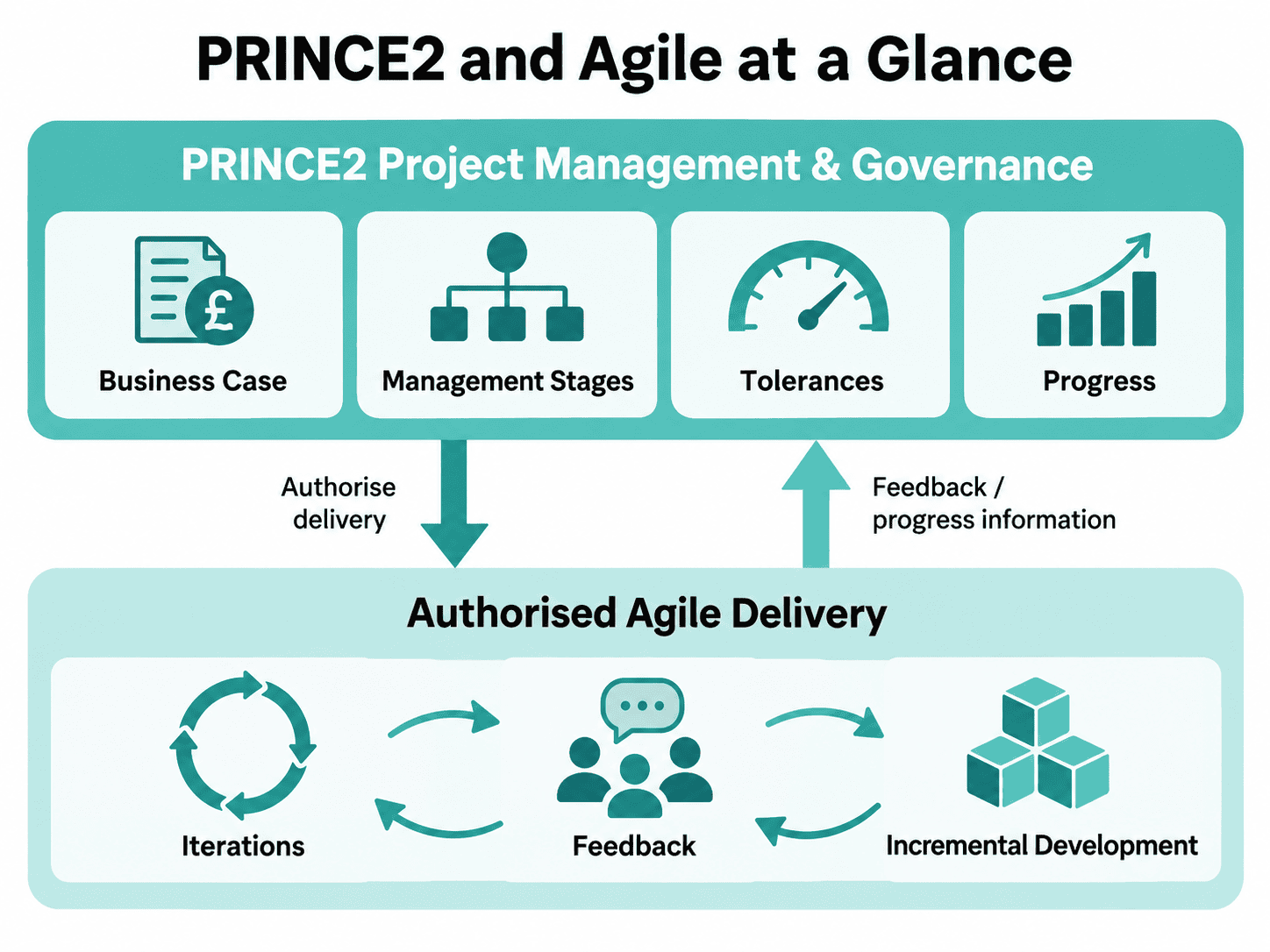
One distinction is particularly important: a PRINCE2 management stage isn’t the same as a Scrum Sprint. A single management stage can contain several delivery iterations, with each operating at a different level of control.
Is PRINCE2 an Agile Method?
PRINCE2 is a project-management method that can support Agile delivery. However, it isn’t itself Scrum, Kanban, AgilePM, or a specialist software-development framework.
Agile is a broad term covering approaches that emphasise collaboration, adaptation, feedback, and delivering value. Different Agile frameworks provide different ways of putting these ideas into practice.
PRINCE2 addresses the management of the project as a whole. Its five integrated elements are:
- Principles
- People
- Practices
- Processes
- Project Context
Together, these help establish how a project is directed, managed, controlled, and adapted to its circumstances.
The seventh edition of PRINCE2 explicitly recognises Agile delivery and explains how specialist development work can operate within a PRINCE2-managed project.
That means a project doesn’t stop being PRINCE2 simply because its delivery teams use Agile techniques.
Is PRINCE2 a Waterfall Method?
No. PRINCE2 isn’t inherently a Waterfall method.
Waterfall commonly describes development where work moves through broadly sequential phases. PRINCE2 doesn’t require that approach.
PRINCE2 distinguishes between managing a project and carrying out the specialist work needed to produce its products.
For example, PRINCE2 can manage a project where infrastructure is installed sequentially, software is developed iteratively, or different workstreams use different approaches.
Its management stages shouldn’t be confused with mandatory Waterfall development phases.
The important question is which delivery approach suits the project, rather than whether PRINCE2 belongs exclusively to one delivery category.
For a more detailed explanation, read our guide to whether PRINCE2 is Waterfall.
What Delivery Methods Can PRINCE2 Work With?
PRINCE2 recognises three broad delivery approaches: linear-sequential, iterative-incremental, and hybrid.
| Delivery approach | How work progresses | How PRINCE2 can manage it |
|---|---|---|
| Linear-sequential | Activities follow a broadly ordered sequence | Provides management stages, planning, controls, and decision-making |
| Iterative-incremental | Products develop through repeated cycles and progressive increments | Manages project-level objectives while delivery teams learn and adapt |
| Hybrid | Different elements use sequential and iterative approaches | Coordinates multiple workstreams within one project-management structure |
Linear-Sequential Delivery
Linear-sequential delivery involves completing activities in a logical order, often because later work depends on earlier outputs.
Consider installing new equipment in a manufacturing facility. Site preparation may need to finish before equipment installation, followed by testing and commissioning.
PRINCE2 can manage this work through agreed plans, responsibilities, tolerances, and controls.
Iterative-Incremental Delivery
Iterative-incremental delivery involves developing products through repeated cycles while progressively producing and refining outputs.
Imagine a team developing a mobile application.
The team might first create account functionality, then develop booking features, and later improve notifications using feedback from users.
Requirements, design, development, and testing can take place repeatedly as the product evolves.
PRINCE2 can manage the overall project without requiring the specialist team to complete every development activity in one fixed sequence.
Hybrid Delivery
Hybrid delivery combines different delivery approaches within a project.
For example, an organisation introducing a new digital service might use:
- Linear-sequential work for installing infrastructure.
- Iterative-incremental development for its customer portal.
- Planned training and operational rollout activities alongside the technical work.
All three workstreams can remain part of the same PRINCE2 project.
Hybrid delivery doesn’t simply mean combining PRINCE2 and Agile. It refers to combining delivery approaches according to the needs of the project.
This distinction matters when choosing a practical way to manage complex work.
How Is PRINCE2 Tailored for Agile Delivery?
Tailoring means adapting how PRINCE2 is applied to suit the project’s context while maintaining its underlying principles.
PRINCE2 isn’t intended to impose identical documentation, reporting arrangements, or management techniques on every project.
For a project using Agile delivery, tailoring might involve:
- Using existing team information to support project reporting.
- Adjusting the frequency and formality of reviews.
- Coordinating management stages with delivery iterations.
- Clarifying how product descriptions relate to features and user stories.
- Agreeing how delivery teams communicate forecasts and issues.
- Defining authority for prioritisation and detailed planning.
- Adapting roles and responsibilities to the delivery organisation.
- Choosing appropriate management products and supporting techniques.
For example, a development team might already maintain a visual board showing completed, current, and outstanding work.
The Project Manager could use relevant information from that board to inform progress reporting rather than requiring the team to duplicate the same information in another format.
However, the information still needs to be sufficient for effective project management.
Tailoring doesn’t mean abandoning the Business Case, removing the seven principles, or allowing teams to operate without appropriate controls.
Under PRINCE2, the Project Manager is responsible for recommending how the method should be tailored, while the Project Board is accountable for approving the approach.
Read our guide to how to tailor PRINCE2 for a closer explanation.
How Does Project Context Influence Tailoring?
PRINCE2 identifies Project Context as one of its five integrated elements.
The delivery approach and management arrangements should reflect factors such as organisational requirements, commercial relationships, sustainability commitments, and project scale.
A small internal development project may require relatively lightweight reporting and straightforward governance.
A project involving several suppliers, regulated data, and contractual delivery obligations may need more formal controls.
Both can use iterative development, but the surrounding management arrangements won’t necessarily look the same.
The purpose of tailoring is to establish controls that are suitable for the work being undertaken.
Are PRINCE2 Management Stages the Same as Agile Sprints?
No. A PRINCE2 management stage is a period of project management and control. A Scrum Sprint is a timeboxed delivery event.
These operate at different levels.
A PRINCE2 management stage gives the Project Manager authority to manage agreed work within specified tolerances. At the stage boundary, the Project Board can review progress, consider continued justification, and decide whether to authorise the next stage.
A Scrum Sprint is a delivery cycle in which a Scrum Team works towards a Sprint Goal and produces a usable Increment.
A management stage can contain multiple Sprints or other iterations.
| Feature | PRINCE2 management stage | Scrum Sprint |
|---|---|---|
| Main purpose | Manage and control an authorised part of a project | Progress product development towards a Sprint Goal |
| Authority | Project Board authorises the stage | Scrum Team operates through Scrum’s accountabilities and events |
| Typical focus | Business justification, plans, tolerances, progress, decisions | Product work, inspection, adaptation, and delivery |
| End point | Stage-boundary review and relevant management decisions | Sprint Review and Sprint Retrospective within the Scrum cycle |
| Relationship | May contain multiple iterations | May operate within a PRINCE2 management stage |
For more detail on the distinction between project-management control periods and delivery activity, explore PRINCE2 stages and the project lifecycle.
How Do PRINCE2 Roles Work With Agile Teams?
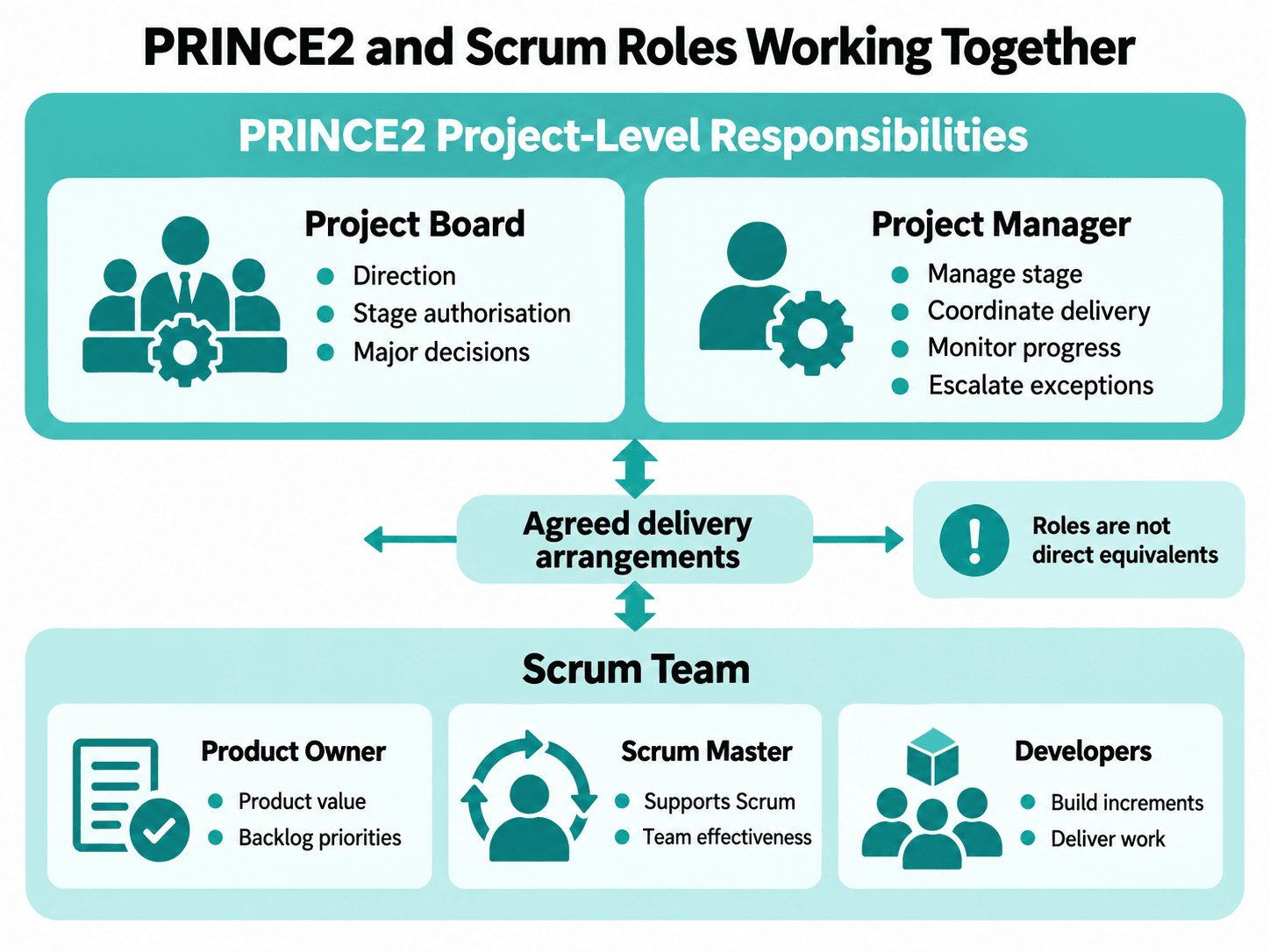
PRINCE2 roles and Agile delivery roles can coexist, but they shouldn’t automatically be treated as equivalent.
The project needs clear responsibilities for directing, managing, and delivering work.
What Does the Project Board Do?
The PRINCE2 Project Board provides project-level direction and decision-making.
It represents the business, user, and supplier interests through the Executive, Senior User, and Senior Supplier roles.
Its responsibilities include authorising stages, considering continued business justification, and making decisions that exceed the Project Manager’s delegated authority.
The Project Board doesn’t need to prioritise every backlog item or supervise each Sprint.
Those activities belong at the appropriate delivery level, according to the agreed organisation and delivery approach.
What Does the Project Manager Do?
The PRINCE2 Project Manager manages the project on behalf of the Project Board.
In a project using Agile delivery, this may include:
- Managing the current stage within its tolerances.
- Coordinating dependencies between teams and suppliers.
- Monitoring project-level risks and issues.
- Reviewing actual performance and forecasts.
- Ensuring authorised work contributes to the agreed products.
- Reporting progress to the Project Board.
- Escalating forecast exceptions.
- Maintaining the integration of delivery work with wider project objectives.
The Project Manager doesn’t automatically become responsible for running Scrum events or maintaining the Product Backlog.
How Does the Team Manager Role Work With Agile Teams?
In PRINCE2, the Team Manager role is concerned with managing delivery of the products entrusted to the team.
The current PRINCE2 manual explicitly allows this role to be held collectively by a development team using Agile methods.
This is important because it avoids forcing a conventional team-management structure onto every Agile delivery environment.
The project still needs clarity about who accepts responsibility for delivery, how progress is communicated, and when matters must be escalated.
However, the arrangement can be tailored to the actual team structure.
Do PRINCE2 Roles Map Directly to Scrum Roles?
No. PRINCE2 roles and Scrum accountabilities aren’t automatically interchangeable.
Scrum defines three accountabilities within the Scrum Team: Product Owner, Scrum Master, and Developers.
The Product Owner is accountable for maximising product value and effective Product Backlog management. The Scrum Master is accountable for establishing Scrum as defined in the Scrum Guide and supporting Scrum Team effectiveness.
These responsibilities differ from those assigned to PRINCE2 project-management roles.
| Proposed equivalence | Is it automatically correct? |
|---|---|
| Project Manager = Scrum Master | No |
| Senior User = Product Owner | No |
| Team Manager = Scrum Master | No |
| Project Board = Scrum Team | No |
A person may be appointed to more than one responsibility where the arrangement is appropriate, but the underlying accountabilities still need to be understood.
For example, the PRINCE2 Senior User and Scrum Product Owner may both have an interest in user needs and product value. That doesn’t mean their responsibilities are identical.
The Senior User represents user interests within the PRINCE2 project-management structure, including the relationship between products and expected benefits.
The Product Owner has a defined accountability for product value and the Product Backlog within Scrum.
Our PRINCE2 vs Scrum comparison explains the differences in more detail.
How Do Work Packages Fit With Agile Delivery?
PRINCE2 Work Packages provide a way to authorise and control work delegated to delivery teams.
A Work Package establishes what is to be delivered and the relevant management arrangements, responsibilities, constraints, and reporting expectations.
A team using Agile techniques can then organise its detailed product-development activities within the agreed authority.
For example, a Project Manager might authorise delivery of customer account functionality.
The development team could then decide how to organise the individual features, technical tasks, testing, and feedback cycles.
The important distinction is between authorising delivery and prescribing every specialist development activity.
PRINCE2 7 also allows tailored alternatives. Its guidance explicitly discusses using Sprints and user stories instead of conventional Work Packages and product descriptions where the project has been tailored accordingly.
Therefore, it’s incorrect to say that every Scrum Sprint must be accompanied by a separate, traditional Work Package document.
What matters is that the project establishes clear delivery responsibilities, authorisation, products, controls, and progress information.
How Do PRINCE2 Tolerances Support Agile Teams?
PRINCE2 tolerances establish how much a plan’s performance can vary before a decision needs to be escalated.
This supports Management by Exception: decisions can be made at the appropriate level without constantly seeking approval from senior management.
PRINCE2 recognises seven performance aspects:
- Benefits
- Cost
- Time
- Quality
- Scope
- Sustainability
- Risk
Tolerances can be set at project, management-stage, and team levels.
For teams using timeboxed iterative delivery, the manual explains that time and cost may be relatively fixed while scope is allowed greater flexibility.
For example, a development team might have a fixed delivery window and an agreed budget, with permission to adjust lower-priority features while protecting mandatory requirements.
That doesn’t mean quality or required project outcomes can simply be sacrificed.
The team must operate within the authority and performance limits established for its work.
If a forecast indicates that the relevant tolerance will be exceeded, the matter must be escalated to the next management level.
This is why Management by Exception can work well alongside Agile delivery: it combines delegated authority with clear decision boundaries.
How Does PRINCE2 Planning Work When Agile Teams Replan Frequently?
PRINCE2 planning and Agile adaptive planning can coexist.
PRINCE2 uses plans at different management levels, including Project Plans, Stage Plans, and, where appropriate, Team Plans.
These plans provide suitable information for decisions at each level.
A Project Plan may identify major products, dependencies, resources, and overall timing. A Stage Plan provides more detail for the work currently authorised.
An Agile delivery team may then develop and refine its detailed delivery plan more frequently.
For example, a project might establish a target for launching a customer portal while allowing its development team to refine individual features after reviewing user feedback.
The project still needs to understand how changing delivery forecasts affect agreed products, costs, time, risks, and expected benefits.
Planning isn’t removed. Instead, the level of detail and timing of planning should suit the work.
Can Product-Based Planning Work With Agile?
Yes. Product-Based Planning can be used with iterative-incremental delivery.
PRINCE2’s Focus on Products principle requires clarity about what the project needs to produce and the expectations those products must satisfy.
This doesn’t automatically mean every technical detail must be permanently fixed before development begins.
The current manual recognises that product descriptions in Agile environments may take forms such as requirements, features, epics, and user stories.
Consider a project to develop a customer service portal.
The high-level products might include:
- A secure customer account function.
- A service request function.
- An administrative reporting function.
The Product Breakdown Structure can help describe these products and their relationships.
Meanwhile, the detailed development work may evolve through features, user stories, and backlog refinement.
Not every backlog item needs to appear as a separate entry in the Product Breakdown Structure.
Read our guides to Product-Based Planning and Product Breakdown Structures for more detail.
How Can Agile Scope Change Without Becoming Scope Creep?
Adaptive requirements and uncontrolled scope expansion aren’t the same thing.
In iterative development, teams may discover better ways to meet an agreed requirement or change the order in which features are developed.
These adjustments may fall within existing authority.
For example, a team might move a lower-priority notification feature into a later iteration to concentrate on resolving a critical usability problem.
That isn’t necessarily a change to the project’s authorised scope.
However, adding an entirely new customer billing system could affect agreed products, costs, dependencies, risks, and the Business Case.
Such a proposal may require project-level change control.
PRINCE2 allows scope to be managed through agreed product definitions, tolerances, and the Issues Practice.
The key is distinguishing acceptable detailed adaptation from changes that affect the project’s authorised boundaries.
Read more about how PRINCE2 manages scope creep.
How Do Quality, Risk, and Issues Work With Agile Delivery?
Agile delivery doesn’t remove the need to manage quality, uncertainty, and changes.
PRINCE2 provides established practices for these responsibilities, while delivery teams can use suitable techniques to support them.
Quality management: PRINCE2 focuses on agreed user quality expectations, product requirements, quality controls, and acceptance. Agile teams may use frequent testing, reviews, demonstrations, and automated checks to help verify that products meet those expectations.
Risk management: Iterative development may expose technical or usability problems earlier, but it doesn’t eliminate project risk. Significant uncertainty still needs to be identified, assessed, controlled, and communicated using the project’s agreed Risk Management Approach.
Issue management: Feedback may reveal defects, new requirements, concerns, or requests for change. Not every delivery task or backlog adjustment needs formal project-level issue treatment. The Issues Practice should be applied according to the project’s tailored controls and the significance of the matter.
A useful distinction is that product development can respond frequently to feedback while project management continues to assess the consequences of significant decisions.
For example, discovering a minor interface problem during testing might be handled by the delivery team.
Discovering that the portal can’t meet a mandatory data protection requirement may create a larger project issue requiring additional decisions.
Both require an appropriate response, but not necessarily the same level of escalation.
How Does PRINCE2 Measure Progress When Teams Use Agile Metrics?
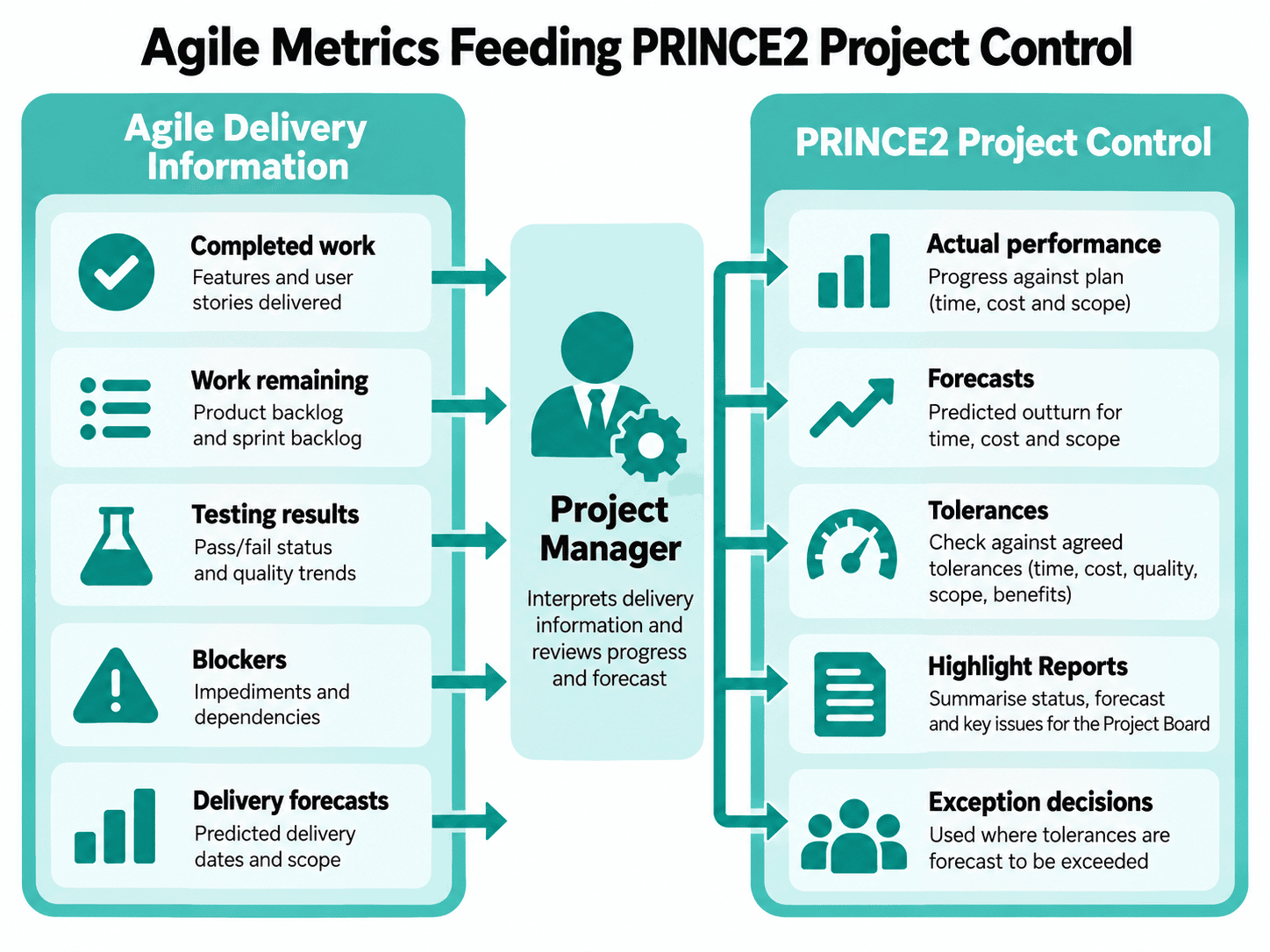
PRINCE2 can use relevant Agile delivery information to support project-level monitoring and forecasting.
The Progress Practice is concerned with understanding actual performance, assessing whether plans remain achievable, and determining when management decisions are needed.
Agile delivery teams might already track:
- Completed product increments.
- Sprint or release forecasts.
- Work remaining.
- Throughput or work completed over time.
- Testing results and outstanding defects.
- Blockers and delivery risks.
These are potential sources of delivery information, not mandatory PRINCE2 performance metrics.
The Project Manager can use appropriate information to assess progress against the Stage Plan and forecast whether tolerances remain achievable.
For example, a Scrum Team might complete several planned features but discover that a critical integration remains unresolved.
The number of completed features alone doesn’t prove that the project is progressing successfully.
The Project Manager must consider the significance of the remaining work, its effect on delivery forecasts, and any impact on the Business Case.
Similarly, Scrum velocity shouldn’t be treated as an overall measure of project success.
Do Agile Teams Still Need PRINCE2 Reports?
Suitable project-level reporting is still needed, but it should be proportionate to the project.
PRINCE2 distinguishes between information needed for delivery management and information needed by the Project Manager or Project Board.
A team may already have a backlog, delivery dashboard, or visual board.
Relevant information from these tools may support PRINCE2 reporting without unnecessary duplication.
The purpose is to communicate useful progress information, not to produce additional paperwork for its own sake.
How Do Agile Communication Activities Fit With PRINCE2?
Agile team communication and PRINCE2 project communication may operate at different levels.
For example, a Scrum Sprint Review helps the Scrum Team and stakeholders inspect the outcome of the Sprint and consider future adaptations.
PRINCE2’s Communication Management Approach addresses communication and feedback across the wider project ecosystem.
Information from team reviews can therefore inform stakeholder engagement, progress assessments, risk management, and project decisions.
The two approaches can complement one another without requiring every Scrum event to become a formal PRINCE2 meeting.
How Do the Business Case, Benefits, and People Fit With Agile Delivery?
PRINCE2’s wider management responsibilities remain important even when delivery is iterative.
Business Case and Continued Justification
The Business Case explains why the project is worthwhile.
Agile delivery can provide new information about costs, feasibility, product value, user needs, and risks.
This information should inform ongoing assessment of the project’s justification.
For example, testing an early portal release might reveal that customers are unlikely to use a particular service.
The organisation may need to reconsider the expected benefits or adjust its plans.
Continued business justification remains a PRINCE2 principle regardless of the delivery approach.
Read more in our guide about the PRINCE2 business case.
Benefits Management
Incremental delivery may sometimes allow a business to begin using parts of a solution earlier.
However, producing an increment doesn’t automatically mean the expected business benefits have been realised.
A usable portal feature is a product output. Reduced customer service workload is a potential benefit that must be measured.
PRINCE2’s Benefits Management Approach helps establish how expected benefits will be measured, when they may be realised, and who is responsible.
People and Stakeholder Feedback
The People element in PRINCE2 addresses collaboration, leadership, relationships, communication, and the people affected by project change.
These concerns can work alongside Agile practices that encourage frequent collaboration and feedback.
For example, customer demonstrations might help the development team identify usability improvements.
However, stakeholder feedback doesn’t automatically authorise changes to project scope.
The team still needs to understand the agreed responsibilities and decision-making arrangements.
This is an area where both PRINCE2 and Agile can contribute meaningfully without becoming the same approach.
Can PRINCE2 Work With Scrum and AgilePM?
Yes, but Scrum and AgilePM are different frameworks with different responsibilities.
How Can PRINCE2 Work With Scrum?
Scrum is a lightweight framework for generating value through adaptive solutions to complex problems.
It uses a Scrum Team consisting of a Product Owner, Scrum Master, and Developers.
Work takes place through Sprints, supported by events and artefacts that enable inspection and adaptation.
A PRINCE2-managed project can use a Scrum Team for specialist product development.
For example:
PRINCE2 Project Board → Project Manager → Authorised Delivery Arrangements → Scrum Team → Sprints and Increments.
This is an illustrative coexistence model, not an official mandatory hierarchy.
The project must clarify how Scrum responsibilities interact with PRINCE2 roles and controls.
Neither the Project Manager nor the Project Board should automatically take over Scrum accountabilities.
For a detailed breakdown, read PRINCE2 vs Scrum.
How Can PRINCE2 Work With AgilePM?
PRINCE2 can work alongside AgilePM where combining the two approaches offers a useful way to manage the project.
AgilePM v3 is an Agile Project Management framework that provides guidance on Agile project leadership, governance, value delivery, planning, and coordination of delivery teams.
It also includes integration with Scrum.
Unlike Scrum, AgilePM has substantial project-management responsibilities of its own.
Therefore, combining PRINCE2 and AgilePM isn’t simply a case of assigning all governance to PRINCE2 and all delivery responsibilities to AgilePM.
The organisation needs to establish which management arrangements it will use, where responsibilities overlap, and how the combined approach will be tailored.
For learners, the qualifications may be complementary.
PRINCE2 develops knowledge of a project-management method applicable across different delivery environments.
AgilePM provides more specific guidance on managing projects using Agile approaches.
You don’t need both qualifications for every project-management role. The appropriate route depends on your responsibilities, existing knowledge, and career goals.
What About PRINCE2 Agile?
PRINCE2 Agile is a separate qualification route focused specifically on applying PRINCE2 alongside Agile ways of working.
The current qualification is PRINCE2 Agile Version 2, which is distinct from the older Version 1 certification.
It provides a more specialised route for people interested in PRINCE2 and Agile integration.
However, PRINCE2 Project Management can already be applied to iterative-incremental and hybrid projects without requiring PRINCE2 Agile certification.
Learners seeking broader project-management knowledge may consider PRINCE2, while AgilePM can be a useful complementary route for developing deeper Agile Project Management knowledge.
The right choice depends on the skills required for the role and the working environment.
PRINCE2 and Agile Project Management Example
Consider a business introducing a customer self-service portal.
The objective is to reduce routine support requests and make it easier for customers to manage their accounts.
The organisation decides to use PRINCE2 for overall project management and Scrum for development of the portal.
(This example is illustrative, rather than a prescribed PRINCE2-Scrum structure.)
Step 1 – Establish Project-Level Governance
The project is established with a Business Case explaining the intended benefits, costs, risks, and reasons for investment.
The Project Board provides direction and authorises the relevant management stages.
The Project Manager coordinates delivery, monitors progress, and manages wider dependencies.
The project includes a stage called “Build and Pilot Customer Portal”.
For illustration, the stage has an eight-week target and an agreed upper time tolerance of nine weeks.
Other performance targets and tolerances are also established where appropriate.
Step 2 – Authorise Delivery and Work Iteratively
The Project Manager establishes suitable delivery arrangements with the development team.
The Scrum Team organises the work through four illustrative Sprints.
| Sprint | Illustrative focus |
|---|---|
| Sprint 1 | Customer authentication and account information |
| Sprint 2 | Profile management |
| Sprint 3 | Support request functionality |
| Sprint 4 | Feedback-led improvements and preparation for the pilot |
The Product Owner manages the Product Backlog according to Scrum’s accountabilities.
Detailed development decisions are made within the team’s agreed responsibilities and authority.
The Project Manager isn’t required to direct every development task.
Step 3 – Use Feedback Without Losing Scope Control
During the second Sprint, customers report that the profile update process is difficult to use.
The Scrum Team reviews the feedback and adjusts the relevant work within its agreed authority.
This doesn’t necessarily require a formal project-level change.
However, a stakeholder also requests a completely new billing function.
That proposed addition could affect the agreed project products, budget, timeline, and Business Case.
The request therefore needs appropriate project-level assessment rather than automatically entering the Product Backlog as authorised additional scope.
Step 4 – Feed Delivery Information Into Project Forecasts
The Scrum Team provides relevant information about completed work, outstanding issues, testing, and likely delivery dates.
The Project Manager uses this to assess progress against the Stage Plan.
During week five, the development team discovers a significant integration problem.
The revised forecast indicates that the stage will take ten weeks rather than the planned eight.
That forecast exceeds the agreed upper time tolerance of nine weeks.
Step 5 – Escalate the Forecast Exception
The Project Manager cannot simply treat the forecast ten-week duration as an ordinary delivery-team adjustment.
The forecast exceeds the stage’s delegated time tolerance.
Under PRINCE2 Management by Exception, the Project Manager escalates the forecast exception to the Project Board for a decision.
The Project Board considers the consequences, available options, and continued justification.
The team can still use Scrum to organise its development work. However, that doesn’t remove the need for an authorised project-level decision.
Step 6 – Review the Stage and Decide What Happens Next
Once the stage reaches its appropriate boundary, the Project Board reviews the stage results and the proposed next stage.
It considers whether the project remains justified, what has been delivered, what risks remain, and whether further work should be authorised.
The next delivery stage might include wider rollout, additional functionality, user training, and operational handover.
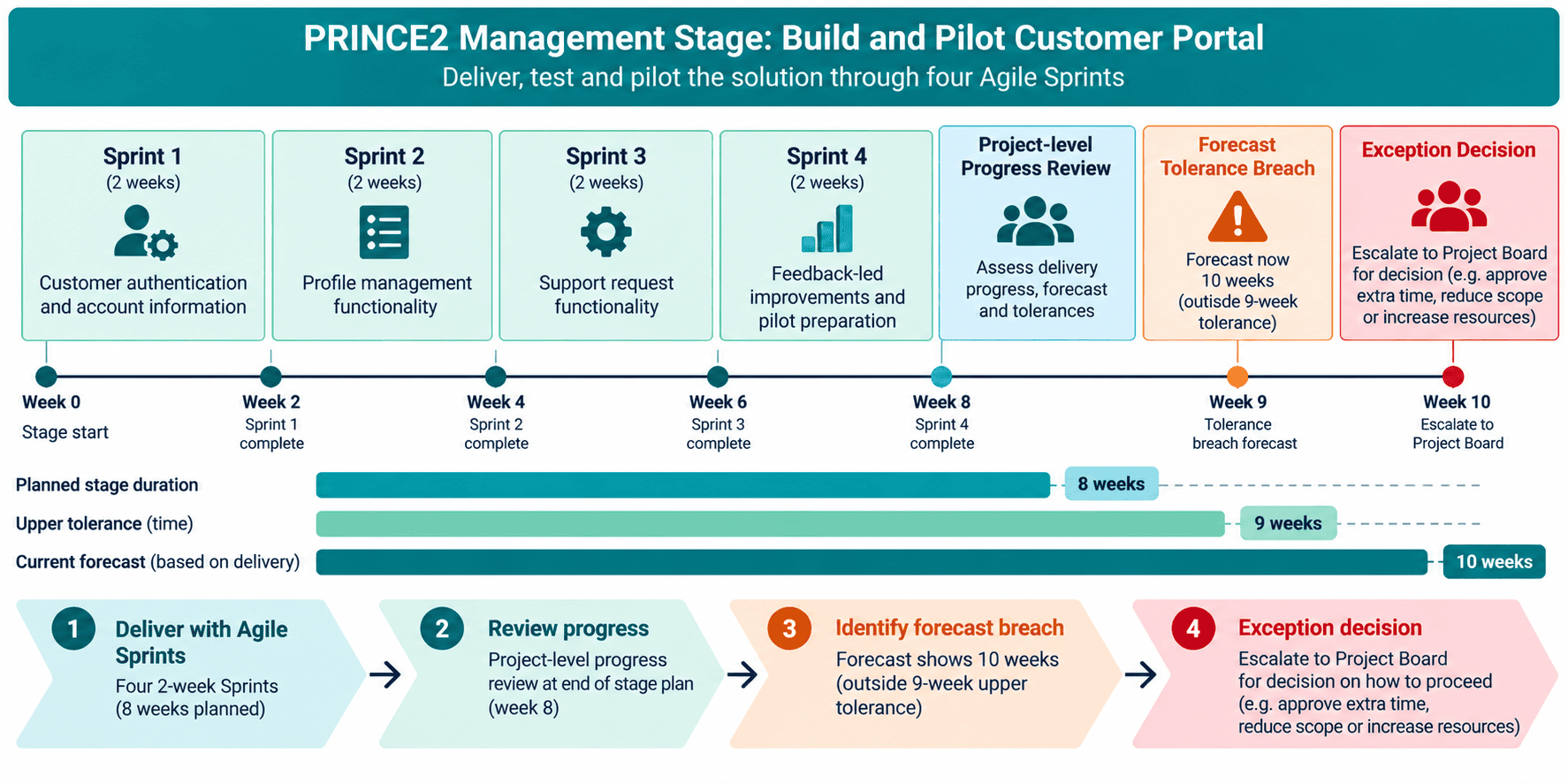
The example demonstrates that iterative product development and structured project control can operate together.
Common Mistakes When Combining PRINCE2 and Agile
Combining approaches successfully requires more than adding Scrum terminology to a PRINCE2 project plan.
Common mistakes include:
- Assuming PRINCE2 means Waterfall. This confuses project management with specialist delivery methods.
- Treating Agile as an absence of planning. Agile teams still need suitable planning, coordination, and control.
- Equating management stages with Sprints. They operate at different management levels.
- Automatically mapping PRINCE2 roles to Scrum roles. Responsibilities must be considered individually.
- Forcing conventional Work Package documentation onto every Sprint. PRINCE2 allows tailored delivery arrangements.
- Treating every backlog adjustment as a formal project change. The appropriate treatment depends on the agreed scope and delegated authority.
- Allowing substantial scope expansion without control. Flexibility must still operate within authorised project boundaries.
- Duplicating reporting unnecessarily. Existing delivery information may support project management where it provides sufficient detail.
- Treating velocity as proof of project success. Delivery metrics need to be interpreted alongside project objectives, risks, quality, and benefits.
- Failing to tailor PRINCE2. Applying identical controls to every environment can create unnecessary work or insufficient control.
The objective isn’t to force two approaches into an artificial hierarchy.
It’s to establish an effective way of managing the project while allowing specialist teams to deliver products appropriately.
PRINCE2 and Agile Integration Checklist
Before combining PRINCE2 with Agile delivery, review the following questions.
- Have we selected a delivery approach suitable for the project’s context?
- Do we know which workstreams will be iterative, sequential, or hybrid?
- Are the Project Board, Project Manager, and delivery-team responsibilities clear?
- Have we defined how delivery work will be authorised?
- Do team members understand their delegated authority?
- Are appropriate tolerances established?
- Do management stages and delivery iterations have clearly defined purposes?
- Is it clear which requirements can evolve?
- Have we established when a change requires project-level approval?
- Do Agile delivery metrics provide useful project-management information?
- Are quality expectations and acceptance arrangements agreed?
- Have we established suitable risk and issue escalation procedures?
- Does the reporting approach avoid unnecessary duplication?
- Is the Business Case reviewed as new information becomes available?
- Have we tailored PRINCE2 without abandoning its principles?
Frequently Asked Questions About PRINCE2 and Agile
Can PRINCE2 Be Used With Agile?
Yes. PRINCE2 can be used to manage projects where delivery teams follow Agile approaches. The seventh-edition manual explicitly recognises iterative-incremental and hybrid delivery. PRINCE2 can provide project-level management, business justification, responsibilities, stages, and controls while teams use suitable Agile techniques to develop products through repeated cycles.
Is PRINCE2 Waterfall?
No. PRINCE2 is not inherently Waterfall. It recognises linear-sequential, iterative-incremental, and hybrid delivery methods. Its management processes and stages do not require specialist development to follow a Waterfall lifecycle. The delivery approach should be chosen and the method tailored according to the project’s circumstances.
Is PRINCE2 an Agile Methodology?
PRINCE2 is a project-management method rather than a dedicated Agile delivery framework. However, it is compatible with Agile approaches and includes guidance for tailoring its application to iterative-incremental delivery. It can therefore be used in Agile environments without becoming Scrum, Kanban, or AgilePM.
Can PRINCE2 Work With Scrum?
Yes. A Scrum Team can develop products within a PRINCE2-managed project. PRINCE2 may provide overall project direction, management, and control while Scrum provides a framework for iterative product development. The project must clarify how its responsibilities and decision-making arrangements interact with the Scrum Team’s accountabilities.
Are PRINCE2 Management Stages the Same as Sprints?
No. A PRINCE2 management stage is a period of project management and control, while a Scrum Sprint is a timeboxed delivery event. One management stage may contain several Sprints. Stage boundaries support project-level review and authorisation, whereas Sprints support inspection, adaptation, and product development.
Is the PRINCE2 Project Manager the Same as a Scrum Master?
No. The PRINCE2 Project Manager manages the project on behalf of the Project Board. The Scrum Master is accountable for establishing Scrum and supporting the Scrum Team’s effectiveness. A person may hold more than one responsibility in a suitable arrangement, but the roles aren’t automatically equivalent.
Is the PRINCE2 Senior User the Same as a Product Owner?
No. The PRINCE2 Senior User represents user interests within the project-management structure and has responsibilities concerning products and expected benefits. The Scrum Product Owner is accountable for maximising product value and effective Product Backlog management. Their interests may overlap, but their defined responsibilities differ.
Can Product-Based Planning Work With Agile?
Yes. Product-Based Planning clarifies what the project needs to produce and the requirements its products must satisfy. Agile development teams can then plan and refine detailed delivery activities iteratively. PRINCE2 also recognises that Agile product descriptions may take forms such as features, epics, requirements, and user stories.
How Does PRINCE2 Control Scope in Agile Projects?
PRINCE2 controls scope through agreed products, plans, tolerances, and issue-management arrangements. Agile teams may refine requirements or reprioritise work within delegated authority. Proposed changes that affect authorised scope, project objectives, or other controlled baselines may require project-level assessment and approval.
Can PRINCE2 Use Agile Metrics?
Yes. Relevant Agile delivery information can contribute to PRINCE2 progress monitoring and forecasting. Completed increments, work remaining, testing results, and delivery forecasts may help the Project Manager assess whether a stage remains achievable. However, individual Agile metrics, such as velocity, shouldn’t automatically be treated as measures of overall project success.
Do Agile Teams Still Need PRINCE2 Reports?
Projects still require suitable information for governance and management, but PRINCE2 reporting can be tailored. Existing Agile dashboards, visual boards, and team information may support project-level reports where they provide the necessary detail. The aim is useful communication and control rather than unnecessary duplication.
How Does the Business Case Work With Agile?
The Business Case continues to explain why the project is worthwhile. Iterative delivery can provide new information about costs, risks, feasibility, customer needs, and expected benefits. PRINCE2 uses this information to support continued business justification and decisions about whether the project should proceed or change direction.
Can PRINCE2 and AgilePM Be Used Together?
Yes. PRINCE2 and AgilePM may be combined where the organisation establishes clear responsibilities and a coherent approach. AgilePM v3 is itself an Agile project-management framework, so some responsibilities overlap with PRINCE2. Any combined arrangement should be deliberately tailored rather than assuming the frameworks operate at completely separate levels.
Should I Learn PRINCE2 and AgilePM?
Learning both can be useful if your responsibilities involve structured project management and Agile delivery environments. PRINCE2 develops knowledge of a widely applicable project-management method, while AgilePM provides more specific guidance for Agile projects. Neither qualification automatically requires the other, and the best route depends on your current skills and intended role.
What Should You Explore Next?
PRINCE2 and Agile aren’t necessarily competing approaches.
PRINCE2 can provide the method for managing and controlling a project, while Agile techniques help delivery teams develop products iteratively, respond to feedback, and adapt their detailed work.
The important part is establishing suitable responsibilities, decision-making arrangements, tolerances, and communication between project management and delivery teams.
If you want to develop your understanding of the PRINCE2 method, Foundation and Practitioner training provides a route from learning the fundamentals to applying them in project scenarios.
Want to understand how PRINCE2 and Agile approaches could fit your project-management career?