How to Prepare for the PRINCE2 Practitioner Exam
To understand how to prepare for PRINCE2 Practitioner exam questions, begin with the current syllabus and use its assessment criteria to guide your revision. Allocate study time according to syllabus weighting and your weaker areas, connect each criterion to the official manual, and practise applying and analysing PRINCE2 in project scenarios. Use mock exams to evaluate your reasoning, improve weak areas, and develop your time management.
The PRINCE2® Project Management Practitioner qualification is designed to assess whether you can apply and tailor PRINCE2 appropriately within a project context.
This means knowing the principles, practices, processes, and terminology is important, but it isn’t enough on its own. You also need to understand how the different elements of the method work together and whether a particular management approach is appropriate for a given situation.
The most effective Practitioner revision combines syllabus-led study, application and analysis practice, effective manual navigation, and detailed review of mock-exam answers.
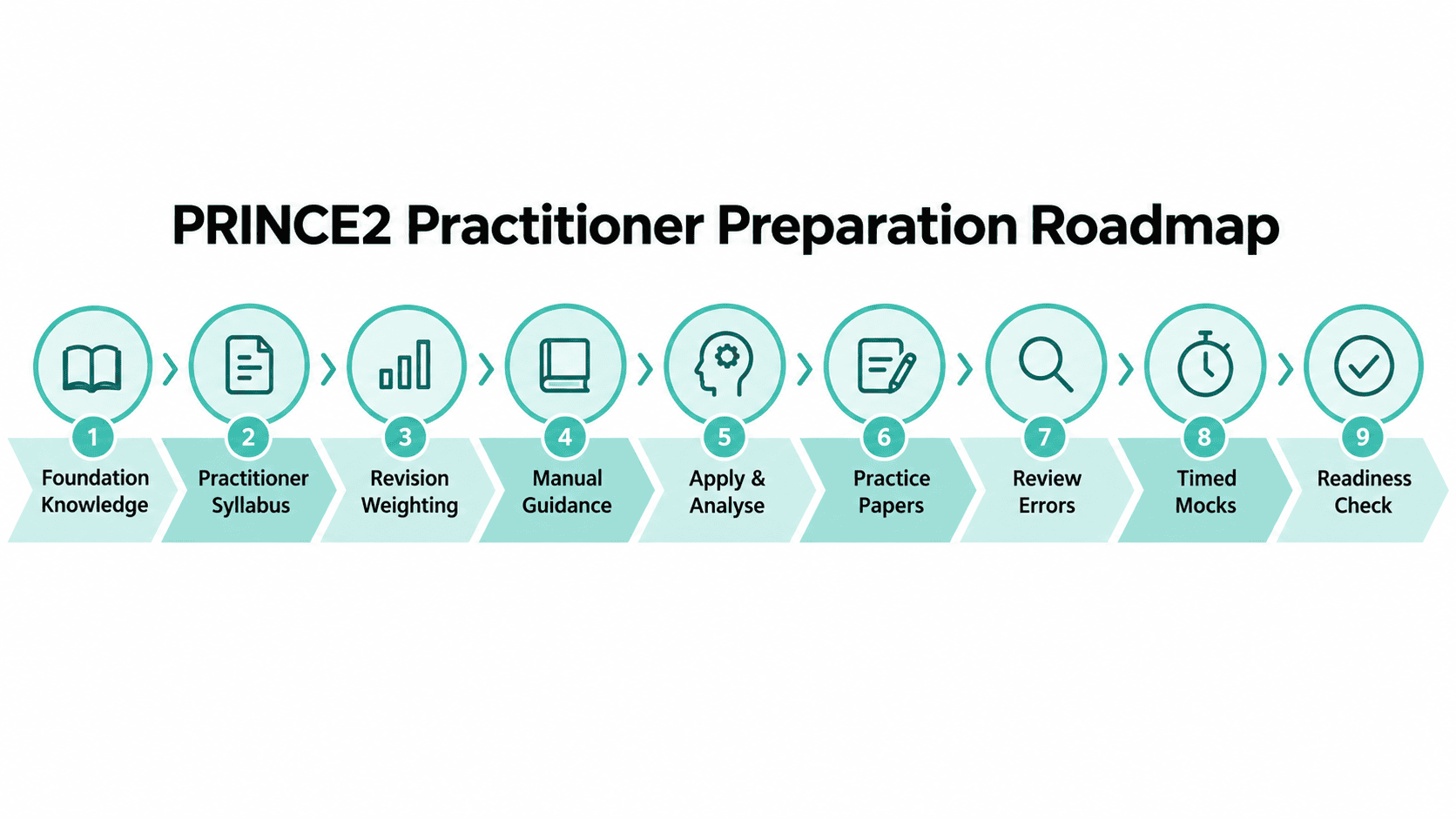
A Step-by-Step PRINCE2 Practitioner Preparation Method
- Consolidate your Foundation knowledge. Make sure you understand the method before attempting more advanced application questions.
- Review the official Practitioner syllabus. Identify the learning outcomes, assessment criteria, and areas with greater exam weighting.
- Plan your revision. Allocate study time according to syllabus weighting, existing knowledge, and weaker areas.
- Connect the syllabus to the manual. Use the official references to find the guidance associated with each assessment criterion.
- Practise applying PRINCE2. Work through project scenarios and identify which guidance is relevant.
- Develop your analysis skills. Examine whether proposed management approaches are appropriate for the circumstances.
- Learn to navigate the manual. Practise finding relevant guidance without relying on lengthy searches.
- Complete practice papers. Use questions to test your understanding and reasoning.
- Review your mistakes. Identify why an answer was incorrect or uncertain.
- Strengthen weak areas. Return to the relevant syllabus criteria and manual guidance.
- Complete timed mock exams. Practise maintaining your reasoning and manual-navigation skills under time constraints.
- Check your readiness. Look for consistent understanding, application, analysis, and improvement before sitting the assessment.
How Is Preparing for Practitioner Different from Foundation?
The main difference between Foundation and Practitioner preparation is the level of thinking required.
Foundation preparation focuses on developing knowledge and understanding of the PRINCE2 method. Practitioner preparation builds on that knowledge and concentrates on applying and analysing the method in different project situations.
This doesn’t mean Foundation is simply about memorising definitions. Strong Foundation preparation involves understanding how the different elements of PRINCE2 relate to one another.
However, Practitioner expects you to take that understanding further.
| Foundation preparation | Practitioner preparation |
|---|---|
| Understand PRINCE2 terminology and concepts | Interpret PRINCE2 guidance in context |
| Explain the principles | Analyse whether principles are being applied appropriately |
| Understand the purpose of each practice | Apply and evaluate practices in project scenarios |
| Understand process activities and responsibilities | Assess whether process activities and responsibilities are appropriate |
| Recognise relevant management products | Determine how management products should support a project |
| Identify knowledge gaps | Identify knowledge, application, and analysis gaps |
For example, at Foundation level, you should understand managing by exception, including how tolerances relate to delegated authority.
At Practitioner level, you may need to examine a project situation where a tolerance is forecast to be exceeded and determine whether the proposed response is appropriate.
The underlying PRINCE2 knowledge remains essential, but you’re now using it to evaluate decisions.
If you want to revisit the distinction between the qualifications, read our PRINCE2 Foundation vs Practitioner comparison.
What Should You Revise for the PRINCE2 Practitioner Exam?
Your PRINCE2 Practitioner revision should follow the official Version 7 syllabus, which identifies four main learning outcomes.
These cover applying the principles, effective people management, applying and tailoring the practices, and applying and tailoring the processes.
Rather than treating every chapter of the manual equally, use these learning outcomes to identify what you need to understand and demonstrate.
PRINCE2 Practitioner Syllabus Weighting
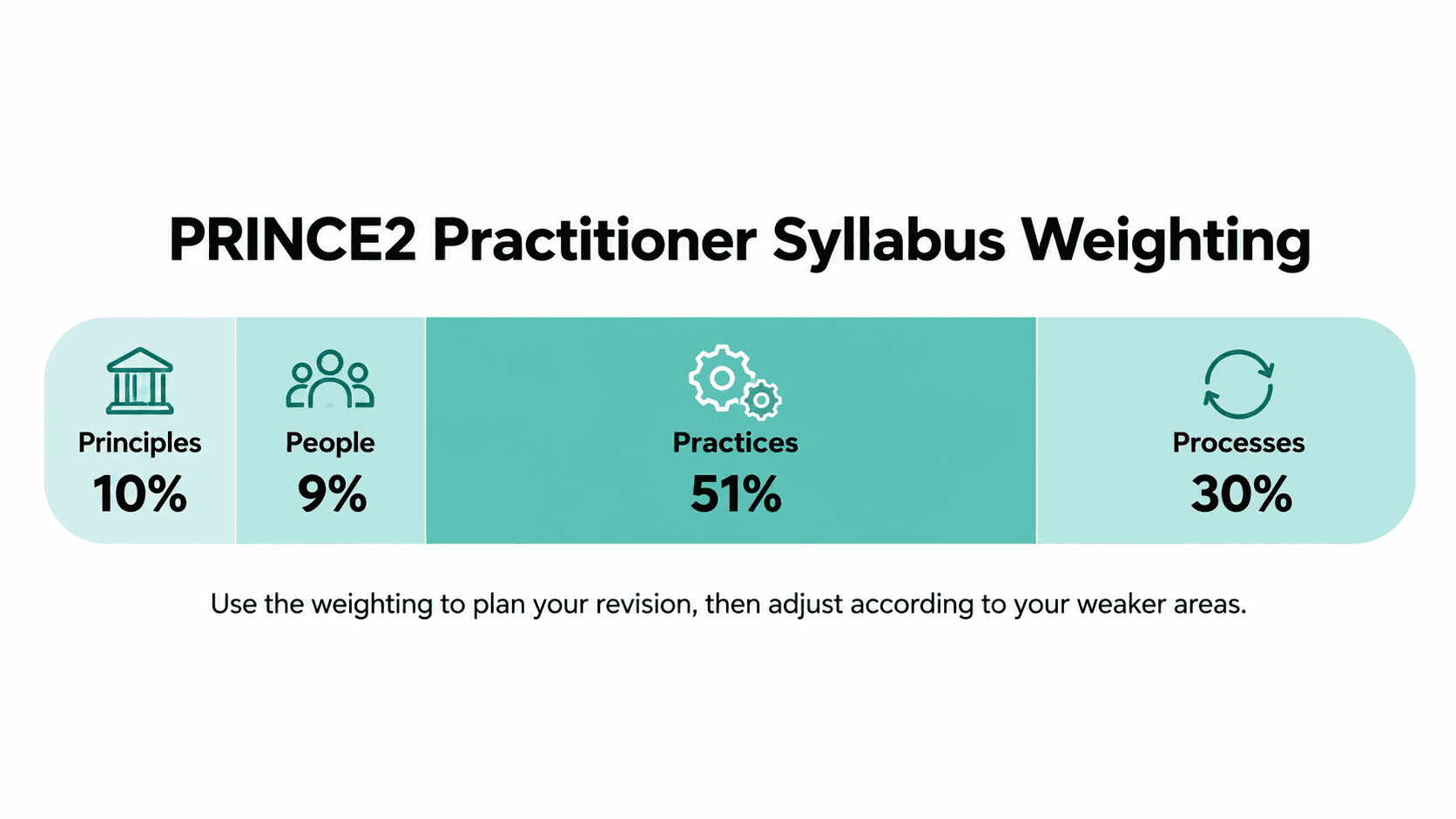
The official PRINCE2 7 Practitioner syllabus assigns the following weighting to each learning outcome.
| Learning outcome | Exam weighting |
|---|---|
| Principles | 10% |
| People | 9% |
| Practices | 51% |
| Processes | 30% |
| Total | 100% |
This weighting tells you how the assessment is distributed across the four learning outcomes.
Practices and Processes account for a combined 81% of the available marks, making them the most important areas for revision.
However, this doesn’t mean you should ignore Principles or People. Both are assessed, and their guidance is closely connected to how the practices and processes are applied.
The weighting should guide your initial revision plan, not encourage you to prepare for only part of the syllabus.
Why Does Syllabus Weighting Matter?
Syllabus weighting helps you make informed decisions about how much time to spend revising different areas.
Without a revision plan, it’s easy to spend too much time on topics you already understand, particularly those that feel familiar or straightforward.
For example, you might feel confident explaining the seven principles and continue reviewing them because they’re easy to remember.
However, if you haven’t developed the ability to apply and analyse the practices, you’re overlooking an area that accounts for more than half of the exam.
A better approach is to use the official weighting as a starting point and then adapt your revision according to how you’re performing.
How to Use Practitioner Syllabus Weighting to Plan Revision Time
Imagine you have 20 hours available for focused revision.
Using the official syllabus weighting gives you the following starting allocation:
Example 20-Hour Practitioner Revision Plan
| Syllabus area | Weighting | Suggested initial time |
|---|---|---|
| Principles | 10% | 2 hours |
| People | 9% | 1 hour 48 minutes |
| Practices | 51% | 10 hours 12 minutes |
| Processes | 30% | 6 hours |
| Total | 100% | 20 hours |
This is an illustrative allocation, not a required study schedule.
You might discover that you’re already confident applying several practices but regularly struggle with process responsibilities. In that case, it would make sense to allocate more time to Processes than the initial weighting suggests.
Similarly, if your practice papers repeatedly reveal problems with people management or applying the principles, those areas deserve additional attention.
The best revision plan considers both the importance of a syllabus area and how well you currently understand it.
What Should You Study Within Each Learning Outcome?
Learning Outcome 1: Principles — 10%
The syllabus expects you to analyse how the seven PRINCE2 principles are applied in context.
Your revision should focus on how each principle influences project management decisions, not simply recalling its definition.
The seven principles are:
- Ensure continued business justification
- Learn from experience
- Define roles, responsibilities, and relationships
- Manage by stages
- Manage by exception
- Focus on products
- Tailor to suit the project
For each principle, consider what appropriate application looks like and how you would recognise an approach that conflicts with the guidance.
You can refresh your understanding with our guide to the seven PRINCE2 principles.
Learning Outcome 2: People — 9%
The People learning outcome focuses on applying and evaluating the management of people within projects.
The syllabus includes leadership and team management, managing change and those affected by a project, communication, and people-related management products.
For example, you should be able to consider whether a proposed leadership approach is appropriate for the project team and circumstances.
You should also understand the purpose and application of the Communication Management Approach and Change Management Approach.
Our People in PRINCE2 guide provides additional background.
Learning Outcome 3: Practices — 51%
Practices is the highest-weighted learning outcome.
The syllabus covers applying the seven practices and analysing whether their application is effective and appropriate for the project context.
These are:
- Business Case
- Organising
- Plans
- Quality
- Risk
- Issues
- Progress
For each practice, your revision should cover relevant management products, roles, responsibilities, techniques, and tailoring considerations.
For example, knowing the purpose of the Risk practice is a useful starting point. Practitioner preparation requires you to consider how risk management should work in a particular project and whether the proposed approach is appropriate.
You can revisit these topics in our guide to the seven PRINCE2 practices.
Learning Outcome 4: Processes — 30%
Processes accounts for the second-largest proportion of the assessment.
The syllabus covers applying and tailoring the seven PRINCE2 processes:
- Starting Up a Project
- Directing a Project
- Initiating a Project
- Controlling a Stage
- Managing Product Delivery
- Managing a Stage Boundary
- Closing a Project
Your revision should cover the activities, inputs, outputs, responsibilities, and application of practices within each process.
You also need to develop the ability to analyse whether process activities and responsibilities are appropriate for the project.
Explore our guide to the seven PRINCE2 processes if you need to revisit how they work together.
How Should You Use the PRINCE2 Practitioner Syllabus to Revise?
Use the Practitioner syllabus as a structured revision checklist rather than simply reading the official manual from beginning to end.
Each syllabus learning outcome identifies an area of capability, while its assessment criteria explain what you need to demonstrate.
The syllabus also provides references to the official manual, helping you locate the guidance relevant to each assessment criterion.
This gives you a practical revision sequence:
Learning Outcome → Assessment Criterion → Manual Reference → Understand → Apply → Analyse → Practise → Review
Why Do Learning Outcomes and Assessment Criteria Matter?
Learning outcomes describe the broader knowledge and capabilities you are expected to demonstrate.
Assessment criteria identify the more specific expectations within those learning outcomes.
For Practitioner, these distinctions are particularly important because the assessment covers both applying guidance and analysing whether proposed approaches are appropriate.
The syllabus identifies these thinking levels using Bloom’s taxonomy.
- Bloom’s Level 3 — Apply: Use relevant knowledge in a given situation.
- Bloom’s Level 4 — Analyse: Examine the information provided and reason whether a proposed course of action is effective or appropriate.
Understanding which level applies to a criterion helps you choose the right revision activity.
For an application-focused criterion, practise using the guidance in a project example.
For an analysis-focused criterion, practise evaluating approaches, recognising important contextual factors, and explaining why one response is more appropriate than another.
The Syllabus-to-Manual Revision Method
Follow these steps for each assessment criterion:
- Find the learning outcome. Identify the broader part of the method being assessed.
- Identify the assessment criterion. Note the specific knowledge or capability expected.
- Check the Bloom’s level. Determine whether the focus is application or analysis.
- Locate the manual reference. Use the official syllabus to find the relevant section of the PRINCE2 guidance.
- Explain the concept. Summarise the important guidance in your own words.
- Apply it to a scenario. Consider how the guidance should be used in an original project example.
- Analyse an approach. If required by the criterion, assess whether a proposed action is appropriate.
- Practise questions. Test your understanding using suitable practice materials.
- Review the result. Identify what you understood and what still needs attention.
Example: Using the Syllabus to Revise Managing by Exception
The official syllabus includes analysing the application of managing by exception under assessment criterion 1.1.
It directs learners to section 2.5 of the official guidance.
A useful revision exercise would follow this sequence:
Assessment criterion: 1.1 — applying PRINCE2 principles in context.
Manual reference: Section 2.5 — managing by exception.
Understand: Explain tolerances, delegated authority, and exception escalation.
Apply: Imagine a Project Manager forecasting that a management stage will exceed its agreed cost tolerance. Consider the appropriate management response.
Analyse: Examine a proposed decision and determine whether it respects the relevant authority and escalation arrangements.
Practise: Complete relevant questions or work through another original scenario.
Review: If your reasoning was incorrect, return to the guidance and identify what you misunderstood.
This approach develops a deeper understanding than simply memorising the definition of managing by exception.
What Does Apply and Analyse Mean in the Practitioner Exam?
Applying PRINCE2 means using the relevant guidance in a particular project situation.
Analysing PRINCE2 means examining the information provided and determining whether a management approach is effective or appropriate.
The distinction matters because the two skills require different types of thinking.
Applying PRINCE2 Guidance
Application involves recognising which guidance is relevant and understanding how it should be used.
For example, imagine a project team needs to establish how risks will be identified, assessed, and managed.
You would need to recognise the relevant Risk practice guidance and understand how it should support the project.
Analysing PRINCE2 Guidance
Analysis involves evaluating whether an approach makes sense in the circumstances.
For example, imagine the project has a proposed risk management approach, but its reporting responsibilities or response arrangements are inappropriate for the project’s complexity.
You would need to consider the relevant guidance, identify the problem, and determine whether the approach is suitable.
In other words, application asks you to use the guidance, while analysis asks you to evaluate how effectively and appropriately it has been used.
How to Reason Through a Practitioner Scenario
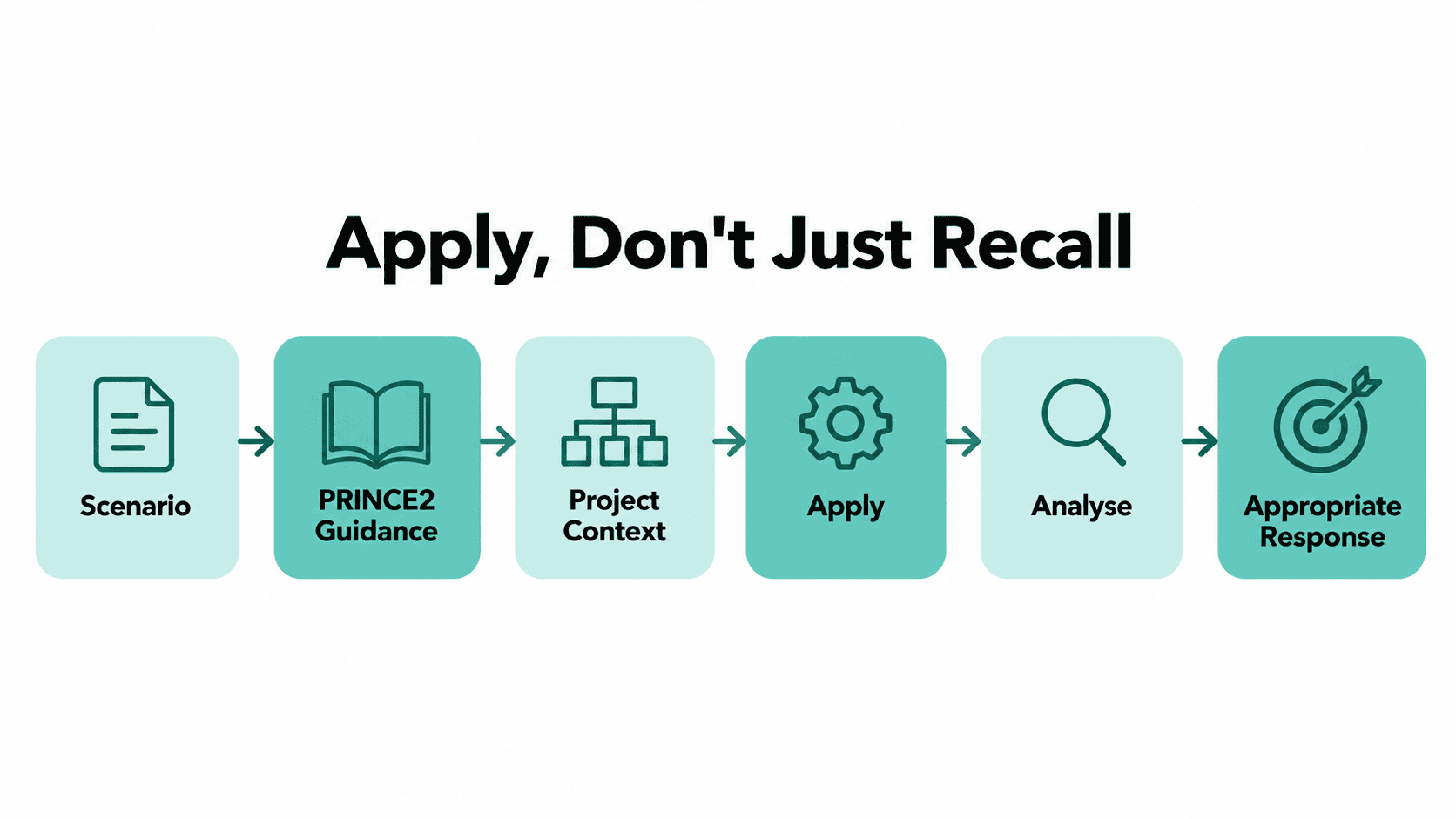
When practising scenario-based questions, use the following method:
- Identify the situation. What is happening in the project?
- Find the relevant guidance. Which PRINCE2 principle, practice, process, or responsibility is involved?
- Recall the guidance. What does PRINCE2 recommend?
- Consider the context. Which details influence how the guidance should be applied?
- Evaluate the options. Which response is most appropriate?
- Explain your reasoning. Why are the alternatives less suitable?
The final step is especially important. Being able to explain why an answer is correct helps distinguish genuine understanding from remembering a previous practice-paper response.
Why Is Tailoring Important for Practitioner Preparation?
Tailoring is important because PRINCE2 must be applied appropriately to the circumstances of each project.
Practitioner preparation should help you understand how the same method can be used in different environments without assuming that every project requires identical arrangements.
For example, a relatively straightforward internal project may require less extensive reporting and documentation than a complex project involving multiple organisations.
However, tailoring doesn’t mean abandoning PRINCE2 principles or removing essential management controls.
When practising application and analysis, ask:
- What is different about this project’s circumstances?
- Which PRINCE2 guidance applies?
- What level of control and documentation would be appropriate?
- Does the proposed approach preserve the method’s principles?
- Would the same approach be suitable for a different project?
The official Practitioner syllabus repeatedly includes project context and tailoring when assessing the application of practices and processes.
For more detail, read our guide to tailoring PRINCE2.
How Should You Use the PRINCE2 Manual When Revising?
The official PRINCE2 manual should support your understanding and help you locate relevant guidance. It shouldn’t replace learning.
Effective manual use involves understanding the concepts, becoming familiar with the book’s structure, and knowing where to find supporting information.
Rather than repeatedly reading the entire manual, use the syllabus to direct your revision.
Connect Manual Sections to Assessment Criteria
The Practitioner syllabus contains references to relevant sections of the official manual.
These are particularly useful for targeted revision.
For example:
Example Practitioner Syllabus-to-Manual References
| Syllabus criterion | Revision focus | Official manual reference |
|---|---|---|
| 1.1 | Applying PRINCE2 principles | Chapter 2 |
| 2.1 | Leadership and team management | Sections 3.3 and 3.1 |
| 2.2 | Managing change and people affected by the project | Sections 3.2 and 3.1 |
| 3.5.1 | Applying the Risk practice | Sections 9.2, 9.3, and 9.5, plus the relevant roles table |
| 3.5.2 | Analysing the Risk practice | Sections 9.2, 9.3, 9.4, and 9.7 |
| 4.4.1 | Applying Controlling a Stage | Relevant tables in Chapter 16 |
| 4.4.2 | Analysing Controlling a Stage | Relevant guidance in Chapter 16 |
These references are drawn from the official Version 7 syllabus. Use the complete syllabus to check the relevant references for every criterion.
This approach makes the manual easier to navigate and ensures your revision remains connected to the assessed requirements.
Practise Finding Information Before Exam Day
Try locating the guidance for the following topics:
- Managing by exception
- Leadership and team management
- Risk management
- Progress and tolerances
- Project roles and responsibilities
- Tailoring
- Management products
For each topic, locate the relevant guidance, read it, and explain how it connects to the Practitioner syllabus.
Then return to the same topic during a later revision session and check whether you can find the information more efficiently.
How Do You Prepare for an Open-Book Practitioner Exam?
Prepare for an open-book Practitioner exam by developing your understanding first and using the manual to support your reasoning.
The Practitioner assessment permits reference to the official PRINCE2 book under PeopleCert’s examination rules. However, access to the manual doesn’t mean you can rely on finding every answer during the assessment.
You still need to interpret scenarios, identify relevant guidance, and determine whether an approach is appropriate.
Effective vs Ineffective Open-Book Preparation
| Less effective approach | Better approach |
|---|---|
| Assuming the manual will provide every answer immediately | Understanding the guidance before the exam |
| Searching the manual for every question | Consulting it when clarification is needed |
| Rereading chapters without practising | Using the manual alongside scenario exercises |
| Memorising page numbers without understanding the content | Learning the structure and relationships between topics |
| Relying on open-book access to compensate for weak knowledge | Strengthening knowledge, application, and analysis |
During revision, practise answering questions from your understanding first.
Then use the manual to confirm your interpretation, check relevant details, or investigate an area you found difficult.
You should also confirm the current rules governing permitted reference materials before the assessment.
For the exam format, current open-book rules, pass mark, and exam-day arrangements, see our guide to how the PRINCE2 Practitioner exam works.
How Should You Use PRINCE2 Practitioner Practice Papers?
Practice papers are valuable because they help you test whether you can apply and analyse PRINCE2 guidance.
However, their value comes from understanding your answers, not simply achieving a high score.
After completing a practice paper, review the questions you answered incorrectly, guessed, or found difficult.
For each question, ask:
- What was being assessed?
- Which syllabus assessment criterion was relevant?
- What official manual guidance applied?
- Which detail in the scenario mattered?
- Why was the correct response appropriate?
- Why were the alternative responses less suitable?
- Was the mistake caused by knowledge, application, analysis, reading, navigation, or time pressure?
This turns practice papers into a structured learning activity.
Is It Worth Repeating the Same Practitioner Practice Papers?
Yes. Repeating a practice paper can help you assess whether your understanding has improved, provided you approach the questions with fresh reasoning.
If you’ve already completed a paper, leave some time before attempting it again where practical.
When you return to it, don’t rely on remembering which answer was correct.
Instead, explain your reasoning before checking the answer key.
You should be able to identify the relevant PRINCE2 guidance, explain how it applies, and justify why one response is more appropriate than the others.
The goal is to improve your understanding, not your memory of the answer key.
How Should You Use PRINCE2 Practitioner Mock Exams?
Mock exams should form part of a revision cycle rather than being treated as isolated tests.
A useful progression is:
- Complete topic-specific application exercises.
- Attempt mixed-topic scenario questions.
- Complete a full practice paper.
- Review incorrect and uncertain answers.
- Identify the relevant assessment criteria.
- Return to the official manual.
- Strengthen weaker areas.
- Complete a timed mock exam.
- Review your reasoning and repeat the process where necessary.
How Many PRINCE2 Practitioner Mock Exams Should You Take?
There isn’t a universal number of mock exams that guarantees readiness.
The number you need will depend on your preparation, the quality of your review, and how consistently you can apply PRINCE2.
Useful readiness indicators include:
- Consistent performance across different practice papers.
- Understanding why answers are correct or incorrect.
- Recognising relevant syllabus criteria.
- Applying guidance to unfamiliar scenarios.
- Navigating the manual efficiently.
- Completing practice within the current exam time limit.
Repeating the same mock until you achieve a high score isn’t necessarily as useful as demonstrating sound reasoning across different questions.
Why Did You Get the Practitioner Practice Question Wrong?
Understanding why you made a mistake helps you decide what to revise next.
Not every incorrect answer indicates a knowledge gap. You may understand the relevant PRINCE2 guidance but struggle to apply it, miss an important scenario detail, or spend too much time searching the manual.
PRINCE2 Practitioner Error Diagnosis
| Type of error | What happened? | What to do next |
|---|---|---|
| Knowledge gap | You didn’t understand the relevant guidance | Return to the manual and explain the concept |
| Application gap | You knew the guidance but applied it incorrectly | Practise using it in different scenarios |
| Analysis gap | You missed an important contextual factor | Compare alternative responses and their suitability |
| Terminology confusion | You confused related PRINCE2 concepts | Create a comparison and revisit the relevant guidance |
| Navigation problem | You couldn’t locate information efficiently | Practise finding the relevant section |
| Reading error | You misunderstood the question or scenario | Practise identifying the important information |
| Time-pressure error | You rushed or spent too long on a question | Review pacing and complete targeted timed practice |
How Can You Build a PRINCE2 Practitioner Study Plan?
A useful Practitioner study plan should combine official syllabus weighting with your personal revision needs.
The time required will vary depending on your existing knowledge, experience, course progress, and available study hours.
Rather than prescribing a fixed number of days, divide your preparation into phases.
Phase 1 — Consolidate Your Foundation Knowledge
Refresh your understanding of the principles, people guidance, practices, processes, roles, and management products.
Pay particular attention to concepts you cannot explain confidently.
Phase 2 — Work Through the Practitioner Syllabus
Identify the learning outcomes, assessment criteria, and Bloom’s levels.
Use the official weighting to create an initial allocation of revision time.
Phase 3 — Connect the Syllabus to the Manual
Locate the official manual references and summarise the relevant guidance.
Practise finding these sections without relying on a lengthy search.
Phase 4 — Develop Application and Analysis
Work through original project examples and scenario-based practice questions.
Focus on determining which guidance applies and whether proposed approaches are appropriate.
Phase 5 — Complete Practice Papers and Diagnose Mistakes
Review incorrect and uncertain answers.
Record recurring weaknesses and revise the relevant assessment criteria.
Phase 6 — Complete Timed Mock Exams
Practise applying your knowledge under realistic time constraints.
Pay attention to scenario-reading time, manual navigation, and your ability to maintain sound reasoning.
Phase 7 — Review Weak Areas and Check Readiness
Not sure how to divide your revision time?
Choose an example study schedule below to see how you could allocate your available hours using the official PRINCE2 Practitioner syllabus weighting.
These are illustrative schedules, not required study durations. Adjust the allocation according to your existing knowledge, practice results, and weaker areas.
PRINCE2 Practitioner Revision Planner
Not sure how to divide your revision time? Choose a study schedule below to see how you could allocate your time using the official PRINCE2 Practitioner syllabus weightings.
Remember: This is a suggested starting point, assuming equal confidence across all syllabus areas. Adjust your revision time based on your practice results and weaker topics.
Practices and Processes together account for 81% of the Practitioner exam, but you should still prepare across the entire syllabus.
Focus on understanding, applying, and analysing PRINCE2 guidance rather than simply memorising definitions or practice paper answers.
Source: PeopleCert PRINCE2 7 Practitioner syllabus. Revision times are proportional recommendations, not official study requirements. Times are rounded to the nearest minute.
When Should You Start Timed Practitioner Practice?
Introduce timed practice once you have developed a reasonable understanding of the syllabus and have begun applying the guidance to project scenarios.
Starting with timed full papers too early can encourage rushing and guessing before you’ve developed the reasoning skills needed for Practitioner.
Begin with untimed application exercises, then move towards timed questions and full mock exams.
Timed practice helps you understand how long you spend reading scenarios, evaluating responses, and consulting the manual.
How Should You Practise Time Management for Practitioner?
When completing timed practice:
- Read the scenario carefully enough to identify the relevant information.
- Determine which PRINCE2 guidance applies before evaluating the options.
- Avoid unnecessary manual searches when you can already justify your reasoning.
- Recognise when you’re spending disproportionate time on one question.
- Review whether mistakes were caused by rushing or overanalysis.
- Practise maintaining a consistent pace across different questions.
Always use the current official examination time limit when completing realistic mock exams.
For the current exam duration and format, refer to our PRINCE2 Practitioner exam guide.
How Do You Know When You’re Ready for the PRINCE2 Practitioner Exam?
Readiness involves more than achieving a high score on a familiar mock exam.
Look for evidence that you can understand, apply, and analyse PRINCE2 consistently.
Use the following checklist:
- I understand the main PRINCE2 concepts rather than relying only on definitions.
- I have reviewed the current Practitioner syllabus and its weighting.
- I can connect assessment criteria to relevant manual guidance.
- I can recognise which PRINCE2 guidance applies in a project scenario.
- I can explain why a particular management response is appropriate.
- I can explain why alternative responses are less suitable.
- I understand how project context influences tailoring.
- I can locate relevant manual guidance efficiently.
- I have identified and addressed recurring mistakes.
- My performance is reasonably consistent across different practice papers.
- I can complete realistic timed practice without consistently rushing.
These are preparation indicators, not guarantees of examination success.
What Should You Do in the Final Few Days Before the Practitioner Exam?
In the final few days, focus on strengthening weaker areas rather than attempting to relearn the entire syllabus.
By this stage, you should have worked through the learning outcomes, practised application and analysis, and completed suitable practice papers.
A targeted review will help you make better use of your remaining study time.
Final Practitioner Preparation Checklist
- Revisit recurring reasoning errors.
- Review weaker assessment criteria.
- Practise locating important manual guidance.
- Check your understanding of application and analysis.
- Revisit tailoring and project-context considerations.
- Complete realistic timed practice if needed.
- Confirm that you understand mock answers rather than remembering them.
- Check current assessment arrangements and permitted reference materials.
What Should You Do the Day Before the Practitioner Exam?
Keep your revision focused and manageable.
Review your weak-area notes, revisit important manual locations, and avoid trying to learn large new sections.
Confirm your examination arrangements and permitted reference materials using the current PeopleCert guidance.
You don’t need to spend the entire day completing additional mock exams. Focus on being prepared to apply what you’ve learned.
Common PRINCE2 Practitioner Exam Preparation Mistakes
Several revision habits can make Practitioner preparation less effective.
| Mistake | Better approach |
|---|---|
| Treating Practitioner like Foundation | Practise application and analysis |
| Ignoring syllabus weighting | Use it to guide initial revision priorities |
| Studying only the highest-weighted areas | Prepare across all learning outcomes |
| Ignoring assessment criteria | Connect each criterion to manual guidance |
| Reading the manual passively | Apply guidance to project scenarios |
| Memorising mock answers | Rebuild the reasoning behind each response |
| Relying too heavily on open-book access | Develop understanding and manual-navigation skills |
| Completing mocks without reviewing mistakes | Diagnose errors and revise weak areas |
| Ignoring project context | Practise evaluating tailoring and suitability |
| Focusing only on mock scores | Assess how consistently you can justify answers |
| Leaving timed practice too late | Introduce it after developing application skills |
| Using outdated terminology | Revise with current Version 7 materials |
A useful principle is to treat every practice-paper mistake as information about what you need to study next.
How Can ITonlinelearning Support Your Practitioner Preparation?
Structured training can help if you’re finding it difficult to move from understanding PRINCE2 terminology to applying and analysing the method in project situations.
ITonlinelearning offers PRINCE2® Project Management Practitioner training designed to support learners preparing for the qualification.
The current course provides Trainer support, Study Coach support, and exam-preparation resources that can help you revisit challenging concepts and develop your understanding.
Still unsure whether your Practitioner preparation is on track? Our Course & Career Advisors can help you explore your training options and identify the best next step.
Frequently Asked Questions About PRINCE2 Practitioner Exam Preparation
How Should I Prepare for the PRINCE2 Practitioner Exam?
Start by reviewing the current Practitioner syllabus and using its assessment criteria to guide your revision. Allocate study time according to syllabus weighting and weaker areas, then connect each criterion to the relevant official manual guidance. Practise applying and analysing PRINCE2 in project scenarios, review mistakes carefully, and complete timed mock exams before checking your readiness.
What Should I Revise for PRINCE2 Practitioner?
Revise the four learning outcomes identified in the official Practitioner syllabus: Principles, People, Practices, and Processes. Practices accounts for 51% of the assessment, followed by Processes at 30%, Principles at 10%, and People at 9%. Use these percentages to guide your initial study plan, but revise all four areas and adjust your priorities according to your weaknesses.
How Should I Use the PRINCE2 Practitioner Syllabus?
Use the syllabus as a checklist of what you need to demonstrate. Identify each learning outcome and assessment criterion, check whether application or analysis is expected, and locate the relevant official manual references. Explain the guidance in your own words, practise applying it to project scenarios, and review your understanding through suitable questions.
How Is Practitioner Preparation Different from Foundation?
Foundation preparation focuses on developing knowledge and understanding of PRINCE2. Practitioner builds on that knowledge by requiring you to apply and analyse the method in project contexts. This means revision should include evaluating management approaches, understanding how project circumstances influence decisions, and explaining why one response is more appropriate than another.
What Does Apply and Analyse Mean in PRINCE2 Practitioner?
Apply means using relevant PRINCE2 guidance in a given situation. Analyse means examining the information provided and reasoning whether a proposed course of action is effective or appropriate. Both skills are assessed in Practitioner, so revision should involve more than remembering definitions. Practise using the method in different scenarios and evaluating whether proposed approaches are suitable.
How Should I Use the PRINCE2 Manual When Revising?
Use the official manual alongside the Practitioner syllabus. The syllabus identifies relevant manual references, helping you locate the guidance associated with each assessment criterion. Learn the structure of the manual, explain important concepts in your own words, and practise finding information efficiently. The manual should support your understanding rather than replace it.
How Do You Prepare for an Open-Book Practitioner Exam?
Develop your understanding of PRINCE2 before relying on the manual. During revision, practise identifying relevant guidance and answering application questions using your knowledge, then consult the manual to confirm or clarify your reasoning. Become familiar with where important information is located, and check PeopleCert’s current rules concerning permitted reference materials.
How Do I Improve at PRINCE2 Practitioner Scenario Questions?
Use a consistent reasoning process. Identify what is happening in the scenario, determine which PRINCE2 guidance applies, consider the project’s circumstances, and evaluate the available responses. After completing a question, explain why the correct answer is appropriate and why the alternatives are less suitable. This helps develop transferable application and analysis skills.
Should I Repeat PRINCE2 Practitioner Practice Papers?
Yes, provided you approach them with fresh reasoning. Repeating a practice paper can help you assess whether your understanding has improved, but remembering the answer key isn’t the same as applying PRINCE2. Justify your choices independently, locate relevant manual guidance, and compare your reasoning with your previous attempt.
How Many PRINCE2 Practitioner Mock Exams Should I Take?
There is no universal number of mock exams that guarantees readiness. Focus on whether you can consistently apply and analyse PRINCE2 across different questions. Useful indicators include understanding your answers, recognising relevant syllabus criteria, navigating the manual efficiently, addressing recurring weaknesses, and completing realistic timed practice.
How Do I Know If I’m Ready for PRINCE2 Practitioner?
You should be able to connect syllabus criteria to manual guidance, apply PRINCE2 in different project contexts, and explain why particular management approaches are appropriate. Consistent mock performance, effective manual navigation, and the ability to complete timed practice are additional indicators. These can help you assess your preparation, although they cannot guarantee a pass.
What Should I Do in the Final Week Before Practitioner?
Use the final week for targeted revision. Review recurring mistakes, revisit weaker assessment criteria, practise locating important manual guidance, and reinforce your application and analysis skills. Complete timed practice where necessary, but avoid spending all your remaining time rereading the manual or memorising familiar mock-exam answers.
Prepare to Apply PRINCE2, Not Just Remember It
Effective PRINCE2 Practitioner preparation starts with understanding what the syllabus expects you to demonstrate.
Use the official weighting to plan your revision, connect assessment criteria to the manual, and practise applying and analysing the guidance in different project situations.
Your mock-exam results should help you identify weaknesses, but your ability to explain the reasoning behind your answers is just as important.
The goal isn’t to memorise which answer was correct on a practice paper.
It’s to understand what PRINCE2 guidance applies, why it applies, and how the project context affects the most appropriate response.