PRINCE2 vs Scrum
PRINCE2 vs Scrum is a comparison between two approaches that operate at different levels. PRINCE2 is a structured Project Management method for managing and governing projects, while Scrum is a lightweight Agile framework that helps teams develop products and solve complex problems through iterative, incremental delivery.
They are not direct replacements for one another. A project can use PRINCE2 for overall management and governance while a Scrum Team develops the product within that project.
Understanding this difference can help you decide which approach suits your work, whether they could be used together, and which skills you should develop.
PRINCE2 vs Scrum at a Glance
| Feature | PRINCE2 | Scrum |
|---|---|---|
| What it is | Project Management method | Lightweight Agile framework |
| Main focus | Project management, governance, and control | Product value and iterative delivery |
| Structure | Principles, People, Practices, Processes, Project Context | Values, accountabilities, Events, Artefacts, empiricism |
| Leadership | Project Board, Project Manager, Team Manager, and others | Product Owner, Scrum Master, Developers |
| Planning | Project and stage plans, with other plans as appropriate | Product Backlog, Sprint Planning, Sprint Goal, Sprint Backlog |
| Delivery | Accommodates different specialist delivery approaches | Iterative and incremental development through Sprints |
| Governance | Explicit project-level decision-making and control | Team-level accountabilities and empirical control |
| Can they work together? | Yes | Yes |
PRINCE2 vs Scrum: What’s the Main Difference?
The main difference between PRINCE2 and Scrum is their scope. PRINCE2 manages the wider project, including its business justification, governance, responsibilities, plans, risks, and progress. Scrum focuses on how a self-managing team creates value through product development, feedback, and incremental delivery.
Consider a company developing a new customer portal.
The wider project may need an approved budget, a Business Case, defined responsibilities, risk management, and decisions about whether the investment should continue. PRINCE2 can provide the management structure for these responsibilities.
Meanwhile, a Scrum Team may develop the portal through a series of Sprints, reviewing feedback and refining the product as work progresses.
Both approaches contribute to the same outcome, but they address different management needs.
What Is PRINCE2?
PRINCE2 is a structured, tailorable Project Management method used to direct, manage, and control projects. It provides guidance for organising responsibilities, maintaining business justification, managing risks and issues, controlling progress, and making informed decisions throughout a project’s lifecycle.
The current PRINCE2 method brings together five integrated elements:
- Principles
- People
- Practices
- Processes
- Project Context
These elements work together to help organisations manage projects consistently while adapting the method to their circumstances.
For example, PRINCE2 defines responsibilities for the Project Board and Project Manager, establishes management stages, and uses tolerances to delegate authority and control exceptions.
It also includes practices covering Business Case, Organizing, Plans, Quality, Risk, Issues, and Progress.
Importantly, PRINCE2 does not require every project to use a sequential delivery approach.
A PRINCE2 project can use linear-sequential, iterative-incremental, or hybrid delivery, provided the method is appropriately tailored.
For a more detailed introduction, read our guide to PRINCE2 Project Management.
What Is Scrum?
Scrum is a lightweight Agile framework that helps people, teams, and organisations generate value through adaptive solutions to complex problems.
Rather than prescribing an entire Project Management method, Scrum establishes a framework for product development built around empiricism, Lean thinking, defined accountabilities, events, and artefacts.
Empiricism means making decisions based on what is observed and learned.
It relies on three pillars:
- Transparency: Making relevant work and progress visible.
- Inspection: Regularly examining progress and outcomes.
- Adaptation: Adjusting when new information indicates that a different approach is needed.
Scrum also establishes five values: Commitment, Focus, Openness, Respect, and Courage.
How Does a Scrum Team Work?
A Scrum Team contains three accountabilities:
- Product Owner: Accountable for maximising product value and effective Product Backlog management.
- Scrum Master: Accountable for establishing Scrum and supporting its effectiveness.
- Developers: Accountable for creating a usable Increment each Sprint.
The Scrum Team is self-managing and cross-functional.
Scrum Teams work in Sprints of one month or less. Each Sprint provides a regular cycle for planning, development, inspection, and adaptation, with the goal of producing valuable, usable Increments.
Scrum uses five events: the Sprint, Sprint Planning, Daily Scrum, Sprint Review, and Sprint Retrospective.
It also defines three artefacts and their commitments:
| Artefact | Commitment |
|---|---|
| Product Backlog | Product Goal |
| Sprint Backlog | Sprint Goal |
| Increment | Definition of Done |
These structures support transparency, inspection, and adaptation.
Scrum originated in software development but is also applicable to other types of complex work.
Is Scrum the Same as Agile?
No. Scrum is an Agile framework, but Agile is broader than Scrum. Agile describes a family of values, principles, and ways of working that emphasise collaboration, responsiveness, and delivering value. Scrum provides a specific framework through which teams can apply Agile thinking.
In other words, Scrum is Agile, but not everything Agile is Scrum.
Other approaches can also support Agile ways of working, and organisations may combine techniques according to their needs.
Can PRINCE2 Be Used with Agile?
PRINCE2 is not itself Scrum or an Agile delivery framework. However, the current PRINCE2 method can be used with Agile, sequential, and hybrid delivery approaches.
Its purpose is to provide project-level management and control without mandating one specialist delivery technique.
This means a PRINCE2 project can include Scrum Teams without abandoning its project-management structure.
For a broader comparison, see PRINCE2 vs Agile.
Is Scrum a Project Management Method?
Scrum is not a complete Project Management method in the same sense as PRINCE2. It is a lightweight framework focused on helping teams create value through adaptive solutions to complex problems.
Scrum defines how a Scrum Team works, but it does not prescribe a complete system for project-level business justification, investment decisions, management stages, or organisational governance.
This does not mean Scrum is unstructured.
It has specific accountabilities, events, artefacts, commitments, and rules.
Scrum is also purposefully incomplete. It establishes the essential framework while allowing other techniques, practices, and processes to operate within it.
That is one reason Scrum can work alongside broader Project Management methods such as PRINCE2.
Can PRINCE2 and Scrum Be Used Together?
Yes. PRINCE2 and Scrum can be used together when a project needs both structured project-level management and iterative product development. PRINCE2 can provide governance, business justification, stage control, and delegated authority, while a Scrum Team manages product-development work through Sprints, Increments, and feedback.
For example, a PRINCE2 Project Manager may coordinate the overall project, manage dependencies, and report progress to the Project Board.
A Scrum Team may develop part of the project’s solution through successive Sprints.
Information from Sprint Reviews, Product Backlog changes, and delivery forecasts can inform project-level planning and decisions.
However, this requires clear arrangements for responsibilities, communication, and control.
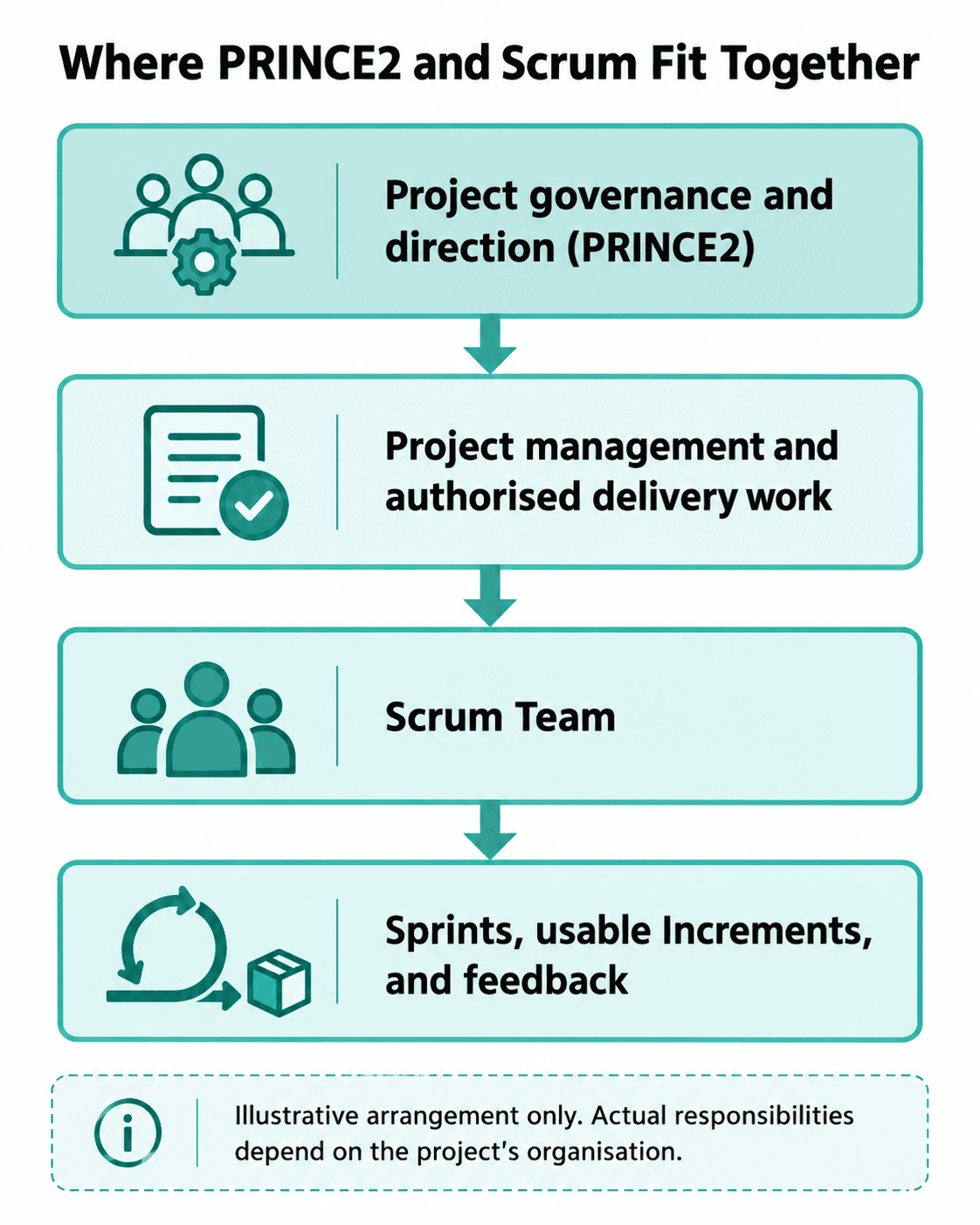
A Scrum Master does not automatically report to a PRINCE2 Project Manager, and Scrum accountabilities should not be replaced with PRINCE2 roles.
For more on adapting the method, explore how to tailor PRINCE2.
How Are PRINCE2 and Scrum Roles Different?
PRINCE2 defines project-management responsibilities, while Scrum defines accountabilities within the Scrum Team. Their roles serve different purposes and should not be treated as direct equivalents.
PRINCE2 responsibilities include project direction, management, assurance, and support. Scrum accountabilities concern product value, Scrum effectiveness, and creating usable Increments.
What Is the Difference Between a PRINCE2 Project Manager and a Scrum Master?
A PRINCE2 Project Manager is responsible for managing a project day to day within authority delegated by the Project Board. A Scrum Master is accountable for establishing Scrum and helping the Scrum Team and organisation understand and use the framework effectively.
| PRINCE2 Project Manager | Scrum Master |
|---|---|
| Manages the project within delegated authority | Establishes and supports effective Scrum |
| Coordinates project plans and controls | Helps people understand Scrum theory and practice |
| Manages project risks, issues, and progress | Helps identify and remove impediments to team progress |
| Reports to and works with the Project Board | Serves the Scrum Team and wider organisation |
| Coordinates project-level responsibilities | Coaches self-management and cross-functionality |
These are not equivalent roles.
A Scrum Master is not simply an Agile Project Manager, and a Project Manager is not automatically the Scrum Master’s manager.
You can explore the wider structure in our PRINCE2 roles and responsibilities guide.
Does Scrum Have a Project Manager?
No. Scrum does not define a Project Manager accountability within the Scrum Team. The Scrum Team consists of the Product Owner, Scrum Master, and Developers.
However, a Scrum Team can operate within a wider project environment that includes a Project Manager.
For example, an organisation may use PRINCE2 or AgilePM to manage a project while one or more Scrum Teams develop its products.
The Project Manager’s responsibilities must be coordinated with the Scrum Team’s accountabilities without undermining self-management.
Is the Product Owner the Same as a Project Manager?
No. The Product Owner is accountable for maximising product value and effective Product Backlog management. A Project Manager manages the wider project, including responsibilities such as planning, governance, coordination, and control.
These responsibilities may interact, but they are not interchangeable.
For example, a Product Owner may order Product Backlog items according to product value, while a Project Manager considers wider project dependencies, budgets, risks, and authorised scope.
Where both roles exist, their decision-making boundaries should be clear.
What Is the Difference Between a PRINCE2 Stage and a Scrum Sprint?
A PRINCE2 management stage is a period used to plan, monitor, authorise, and control part of a project. A Scrum Sprint is a fixed-length event of one month or less in which a Scrum Team works towards a Sprint Goal and creates a valuable, usable Increment.
They serve different purposes.
A management stage provides project-level control and a point at which the Project Board can consider whether the project should continue.
A Sprint creates a regular rhythm for development, inspection, and adaptation.
A PRINCE2 management stage may contain several Scrum Sprints.
Read more about PRINCE2 management stages and the project lifecycle.
Are PRINCE2 Processes the Same as Scrum Events?
No. PRINCE2 processes describe management activities across the project lifecycle, while Scrum events provide regular opportunities for inspection and adaptation within product development.
PRINCE2 has seven processes covering activities such as starting up, initiating, directing, controlling, managing delivery, managing stage boundaries, and closing a project.
Scrum has five events:
- Sprint
- Sprint Planning
- Daily Scrum
- Sprint Review
- Sprint Retrospective
For example, a Sprint Review allows the Scrum Team and stakeholders to inspect the outcome of a Sprint and consider future adaptations.
It is not the same as a PRINCE2 stage-boundary decision.
Similarly, the Daily Scrum is an event for Developers to inspect progress towards the Sprint Goal and adapt their plan, not simply a status meeting for a Project Manager.
Explore our PRINCE2 processes guide for more information.
How Do PRINCE2 and Scrum Approach Planning and Change?
Both PRINCE2 and Scrum involve planning, monitoring, and adaptation, but they organise these activities differently.
How Does PRINCE2 Approach Planning?
PRINCE2 uses plans at appropriate management levels to establish what will be delivered, how the work will be managed, and how progress will be controlled.
Planning can be refined as the project progresses.
PRINCE2 does not require every delivery detail to be fixed at the beginning.
How Does Scrum Approach Planning?
Scrum uses a Product Goal and Product Backlog to provide longer-term product direction.
During Sprint Planning, the Scrum Team establishes a Sprint Goal, selects work, and develops a Sprint Backlog.
Developers adapt their plan as they learn more during the Sprint.
Product Backlog refinement helps clarify future work, and Sprint Reviews provide opportunities to consider feedback and adapt what happens next.
Techniques such as User Stories and estimation may support this work, but they are not mandatory Scrum artefacts.
How Do They Handle Change?
PRINCE2 manages changes through its Issues Practice, delegated authority, tolerances, and project controls.
Scrum responds to new information through inspection, adaptation, and ongoing Product Backlog management.
Neither approach requires teams to ignore change.
Within a combined environment, changes identified during Scrum delivery may affect project-level costs, timelines, scope, risks, or business justification.
Those implications can be managed through the appropriate PRINCE2 controls.
How Do PRINCE2 and Scrum Approach Risk, Quality, and Documentation?
Both approaches address uncertainty, quality, and information management, but they do not prescribe identical mechanisms.
Risk Management
PRINCE2 has an explicit Risk Practice for identifying, assessing, planning responses to, and controlling uncertainty affecting project objectives.
Scrum uses empiricism, frequent inspection, and incremental delivery to improve predictability and expose risks earlier.
Scrum does not prescribe a separate risk-management mechanism equivalent to the PRINCE2 Risk Practice.
Quality Management
PRINCE2 uses its Quality Practice to establish quality expectations, acceptance criteria, and arrangements for ensuring products meet requirements.
Scrum uses the Definition of Done to establish a shared understanding of the quality measures an Increment must satisfy.
Both approaches recognise the importance of quality, although they structure its management differently.
Documentation and Artefacts
PRINCE2 uses management products to support project management and decision-making.
These can be tailored to the project’s circumstances and do not all need to be lengthy documents.
Scrum defines three artefacts: the Product Backlog, Sprint Backlog, and Increment.
Scrum does not prohibit documentation. Teams can maintain additional information where it supports effective work, quality, compliance, or collaboration.
The distinction is not that PRINCE2 requires paperwork while Scrum avoids it.
It is that the approaches define different information and control needs.
For more detail, see our PRINCE2 management products guide.
Which Provides More Project Governance?
PRINCE2 provides more explicit project-level governance than Scrum because it defines arrangements for project direction, business justification, delegated authority, management stages, reporting, and control.
Scrum provides accountability and empirical control within product development, but it does not attempt to define a complete project-governance method.
This distinction becomes particularly relevant when a project involves significant investment, regulatory requirements, multiple suppliers, or decisions that extend beyond the Scrum Team.
Scrum’s transparency and feedback can still support wider governance.
The two approaches can therefore complement each other rather than compete for the same responsibilities.
How Do PRINCE2 and Scrum Approach Team Autonomy?
Scrum emphasises self-managing, cross-functional teams that decide internally who does what, when, and how.
PRINCE2 supports delegated authority through its Manage by Exception principle.
Under PRINCE2, the Project Board delegates authority to the Project Manager within agreed tolerances, while appropriate authority can also be delegated for delivery work.
Both approaches can support empowered teams.
The difference lies in how responsibilities, boundaries, and decision-making are established.
A combined PRINCE2 and Scrum environment should preserve Scrum Team self-management while maintaining necessary project-level accountability.
What Does PRINCE2 + Scrum Look Like in Practice?
Imagine a bank launching a new mobile customer portal.
The project involves customer research, security requirements, regulatory compliance, software development, integration with existing systems, and a planned launch.
PRINCE2 could provide the management structure for the wider project.
At project level, PRINCE2 could help the organisation:
- Maintain a Business Case explaining the investment.
- Establish a Project Board and decision-making responsibilities.
- Plan and authorise management stages.
- Manage budgets, risks, issues, and dependencies.
- Monitor progress and determine whether the project remains justified.
At product-delivery level, a Scrum Team could:
- Establish a Product Goal for the portal.
- Manage and refine the Product Backlog.
- Plan Sprints around valuable outcomes.
- Develop and test usable Product Increments.
- Review feedback with stakeholders.
- Adapt future work based on what has been learned.
For example, feedback during a Sprint Review might reveal that customers struggle with the portal’s identity-verification process.
The Product Owner could consider changes to the Product Backlog.
If those changes have significant implications for the wider project’s budget, schedule, or regulatory commitments, the Project Manager could assess the project-level impact and escalate matters where required.
The Scrum Team continues to manage its work within the agreed arrangements.
This is one possible way of combining PRINCE2 and Scrum, not a mandatory organisational design.
Is PRINCE2 or Scrum Better?
Neither PRINCE2 nor Scrum is universally better. PRINCE2 is more suitable when the main requirement is structured management and governance of a whole project. Scrum is more suitable when a team needs a framework for adaptive product development, iterative delivery, and regular feedback.
The right choice depends on the problem you are trying to solve.
When Might Each Approach Be Useful?
| Your main requirement | Approach to explore |
|---|---|
| Managing an entire project | PRINCE2 |
| Establishing project governance and controls | PRINCE2 |
| Developing products through short feedback cycles | Scrum |
| Supporting a self-managing product-development team | Scrum |
| Managing a project with Scrum-based delivery | PRINCE2 and Scrum |
| Learning broader Agile Project Management | AgilePM |
| Understanding both project governance and iterative delivery | A combination of approaches |
For software development, Scrum may provide a useful team-level delivery framework.
For a large project involving multiple workstreams, PRINCE2 may provide valuable project-level management.
Neither conclusion is automatic. Suitability depends on the organisation, product, complexity, people, and delivery environment.
Should You Learn PRINCE2 or Scrum?
You should explore PRINCE2 if you want to manage projects, understand project governance, or develop knowledge of planning, risk, issues, progress, and project-level decision-making.
You should explore Scrum if you work with Scrum Teams, want to understand iterative product development, or need knowledge of Scrum accountabilities, events, artefacts, and empiricism.
Learning both may be useful if your responsibilities cross project management and product delivery.
Should a Project Manager Learn Scrum?
Yes, Scrum knowledge can be valuable for a Project Manager who works with Agile delivery teams.
Understanding Sprints, Product Backlogs, Scrum accountabilities, and empirical planning can help Project Managers coordinate with teams without imposing inappropriate project-level controls on their day-to-day work.
However, learning Scrum does not mean a Project Manager must become a Scrum Master.
Should a Scrum Master Learn PRINCE2?
PRINCE2 knowledge may be useful for a Scrum Master working in an organisation with formal project governance.
It can help them understand the wider environment surrounding the Scrum Team, including project decisions, delegated authority, reporting, risks, and dependencies.
It is not a universal requirement for becoming a Scrum Master.
Can You Study Scrum Essentials with ITonlinelearning?
Yes. Scrum Essentials introduces the principles and practices of Scrum, including Agile foundations, Scrum accountabilities, events, artefacts, and techniques that support effective Scrum working.
It can be relevant to people joining Scrum Teams, Project Managers, individuals working alongside Scrum Teams, and those responsible for managing people who use Scrum.
You do not need to be pursuing a Scrum Master role to benefit from foundational Scrum knowledge.
If you only want Scrum Essentials, you can speak to an ITonlinelearning Course & Career Advisor about the standalone training option.
Is Scrum Included in AgilePM Training?
Yes. ITonlinelearning’s AgilePM v3 Foundation and Practitioner training includes Scrum Essentials as part of the learning pathway.
The course combines Scrum fundamentals with broader Agile Project Management knowledge, including project governance, planning, delivery, risk management, and AgilePM’s lifecycle and roles.
Scrum Essentials is completed as part of the course pathway, while the Scrum Essentials examination is optional and is not required to progress to AgilePM.
This may be useful if you want to understand Scrum while also developing knowledge of a broader Agile Project Management framework.
What If You Want PRINCE2 and Scrum Knowledge?
If you want knowledge of structured Project Management and Agile product delivery, you can explore a combination of PRINCE2 and Scrum-related training.
One available ITonlinelearning learning route is:
Plus
AgilePM v3 Foundation and Practitioner, including Scrum Essentials
This combination introduces learners to PRINCE2 Project Management, AgilePM’s wider approach to Agile projects, and Scrum fundamentals.
It is not the only way to learn both approaches, and you do not necessarily need all these qualifications.
The most appropriate training route depends on your role, experience, existing knowledge, and career goals.
What Should You Explore Next?
PRINCE2 and Scrum address different needs, so the best learning route depends on what you want to do.
If your goal is to manage projects, establish governance, and coordinate delivery, explore PRINCE2 Foundation and Practitioner.
If you want to understand how Scrum Teams work, enquire about standalone Scrum Essentials.
If you want Scrum knowledge alongside broader Agile Project Management skills, explore AgilePM v3 Foundation and Practitioner.
And if your role combines project-level management with Scrum-based delivery, learning both approaches may provide a more complete perspective.