Quality Management in PRINCE2
PRINCE2 quality management is the practice of defining what project products must achieve, documenting their quality requirements, planning how those requirements will be checked, and confirming that the finished products are acceptable. It brings together quality planning, quality control, and quality assurance to help projects deliver products that meet agreed expectations rather than simply completing activities.
The key question is simple: how will you know that a product is good enough for its intended purpose?
In PRINCE2, quality is not about producing the most expensive or technically advanced result. It is about delivering products that fulfil their agreed requirements.
Quality Planning vs Quality Control vs Quality Assurance
| Area | Main focus | Practical question |
|---|---|---|
| Quality planning | Defining requirements, specifications, and methods | What quality is required, and how will we manage it? |
| Quality control | Checking products against requirements | Does the product satisfy its specifications? |
| Quality assurance | Providing confidence in quality arrangements | Are the quality measures appropriate and reliable? |
What Is PRINCE2 Quality Management?
PRINCE2 quality management is the structured management of requirements, quality specifications, checking activities, and acceptance throughout a project’s lifecycle.
It ensures that the people commissioning, using, and delivering project products share an understanding of what those products need to achieve.
For example, imagine a project developing an employee self-service portal.
Completing the software development work does not necessarily mean that the project has delivered an acceptable product.
The portal must also meet its agreed requirements. These could include secure access, accurate employee information, and the ability to complete specified tasks.
PRINCE2 helps establish those requirements before delivery, incorporate quality activities into plans, and assess the products against the agreed expectations.
What Does Quality Mean in PRINCE2?
In PRINCE2, quality concerns the degree to which the inherent characteristics of a product, service, process, or other subject fulfil its requirements.
In practical terms, a product is assessed against what it was agreed to provide.
Consider two employee portals.
One has hundreds of functions but cannot reliably display the information employees need. The other offers fewer features but consistently meets its agreed requirements.
The second could be the more appropriate product for its intended purpose.
This illustrates an important distinction: quality is not the same as the highest possible specification.
PRINCE2 expects project products to meet their defined requirements and be fit for purpose.
What Is the PRINCE2 Quality Practice?
The PRINCE2 Quality Practice explains how the requirements for project products are established, documented, and managed so that the products delivered fulfil those requirements.
It is one of the seven PRINCE2 Practices and addresses the question: What?
The Quality Practice helps a project establish:
- What products are needed.
- What quality the users expect.
- What requirements and specifications apply.
- How products will be checked.
- Who will carry out the quality activities.
- How results will be recorded.
- How products will be accepted.
Quality management is therefore not a single event or final inspection.
It is applied throughout the project and works alongside the other PRINCE2 Practices.
For a wider explanation of these practices, read our guide to the seven PRINCE2 Practices.
Why Is PRINCE2 Quality Management Product-Focused?
PRINCE2 defines quality around products because a team must understand what it intends to deliver before it can decide how to assess the result.
This reflects the PRINCE2 principle of Focus on Products.
Rather than beginning with a list of activities, the project first establishes the required products and their characteristics.
For example, “write the employee guide” is an activity.
“An employee guide covering the six agreed portal procedures, using approved terminology and meeting specified accessibility requirements” is a more meaningful definition of the product.
The second description gives the team a basis for determining whether the work has produced an acceptable result.
This product-based approach also helps manage scope. If someone asks for an additional feature, the project can assess whether it is already part of the approved product requirements or represents a proposed change.
Learn more about Product-Based Planning in PRINCE2.
Quality Planning, Quality Control, and Quality Assurance in PRINCE2
PRINCE2 quality management involves three related elements: quality planning, quality control, and quality assurance.
Although they work together, each serves a different purpose.
What Is Quality Planning in PRINCE2?
Quality planning establishes and documents the quality specifications for project products and develops the associated Product Descriptions and Quality Management Approach.
It begins with understanding the user’s quality expectations and the criteria for accepting the overall project product.
These requirements are then developed into more detailed product specifications.
Quality planning also establishes how the relevant checks will be organised, what methods will be used, and who will be responsible.
For an employee portal, this could mean defining the accessibility requirements before development and arranging the necessary accessibility checks within the project schedule.
The important point is that quality checking should be planned before the team reaches the end of delivery.
What Is Quality Control in PRINCE2?
Quality control involves monitoring project products and their development or delivery activities to determine whether they comply with relevant standards and specifications. Quality control also involves identifying ways to minimise the causes of unsatisfactory performance, helping teams address recurring problems rather than simply recording failed checks.
Quality control can involve several different activities depending on the product.
Illustrative examples include:
- Inspecting a physical component.
- Testing a software feature.
- Reviewing the accuracy of a document.
- Checking a prototype before full development.
- Demonstrating functionality against agreed requirements.
The results of quality activities are recorded so that the project can establish whether the product has passed or failed its checks.
When a product does not satisfy its requirements, the team must consider what corrective action or further management is needed.
What Is Quality Assurance in PRINCE2?
Quality assurance is a planned activity intended to provide confidence that products will meet their specifications when assessed through quality control.
It focuses on the suitability of the project’s quality control arrangements rather than simply repeating product checks.
In PRINCE2, Quality Assurance is normally undertaken independently of the project team, typically by the business.
For example, an organisation’s Quality Assurance function might assess whether the testing arrangements proposed for a software project are sufficiently robust to demonstrate compliance with its requirements.
This is different from testing an individual feature and recording whether it passes.
Quality Assurance should not be confused with Project Assurance.
Project Assurance operates on behalf of the Project Board and provides assurance about how the project is being conducted. It is independent of the Project Manager, but is part of the project arrangements.
Quality Assurance focuses specifically on confidence in product quality arrangements and is normally independent of the project team.
Quality Expectations, Specifications, and Acceptance Criteria
PRINCE2 distinguishes between the overall quality expected from the project product, the specifications of individual products, and the criteria for accepting the final project product.
Understanding these distinctions is essential for effective quality planning.
What Are User’s Quality Expectations?
User’s quality expectations describe the quality the user expects from the overall project product.
In PRINCE2, these expectations are documented in the Project Product Description.
For example, employees using a new self-service portal might expect it to be accessible, reliable, and straightforward to use.
These are useful starting expectations, but they are not necessarily detailed enough for individual product checks.
The project must develop appropriate requirements and specifications to explain how those expectations will be satisfied.
What Are Acceptance Criteria in PRINCE2?
Acceptance criteria are a prioritised set of conditions the overall project product must satisfy before the user will accept it.
They are recorded in the Project Product Description.
For the employee portal project, illustrative acceptance criteria might include:
- Authorised employees can sign in using the agreed authentication system.
- Employees can access the agreed HR information and complete the required self-service tasks.
- The portal satisfies the agreed accessibility and performance requirements.
- The required operational handover arrangements are completed.
The precise criteria depend on the project’s approved requirements.
Acceptance criteria help prevent disagreement at the end of a project about whether the final product is acceptable.
What Are Quality Specifications in PRINCE2?
Quality specifications describe the quality measures that will be used to assess an individual product and the levels that product must achieve.
They are documented in Product Descriptions.
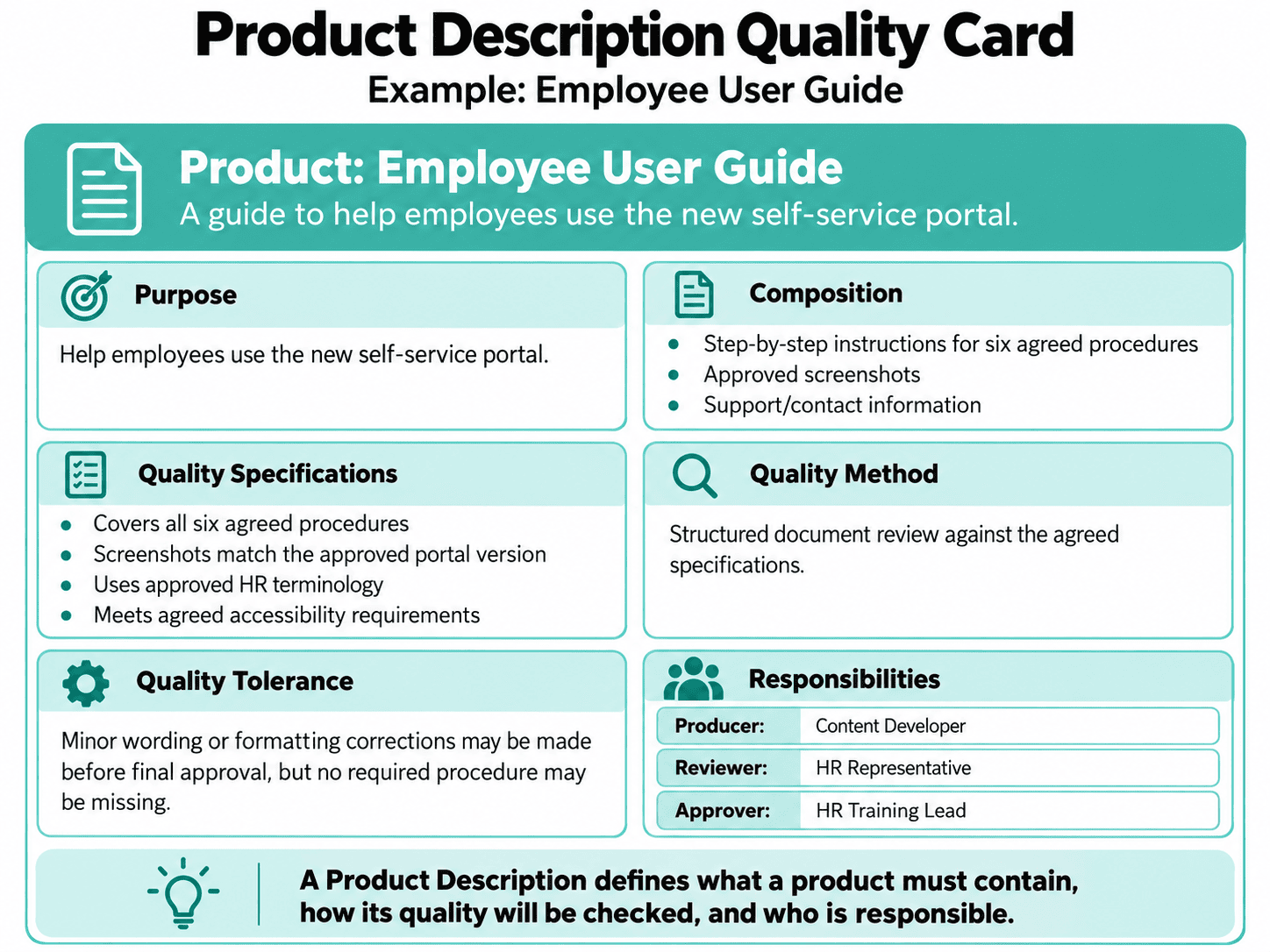
For example, the employee portal project might require a User Guide.
Its quality specifications could state that:
- The guide covers all six agreed user procedures.
- Screenshots match the approved portal version.
- Terminology matches the organisation’s approved HR terminology.
- The document satisfies the agreed accessibility requirements.
These specifications are more useful than describing the guide as “professional” or “high quality”, because the team can establish whether the requirements have been met.
Specifications do not always need to be numerical. They need to provide a sufficiently clear basis for assessment.
Quality Specifications vs Acceptance Criteria: What’s the Difference?
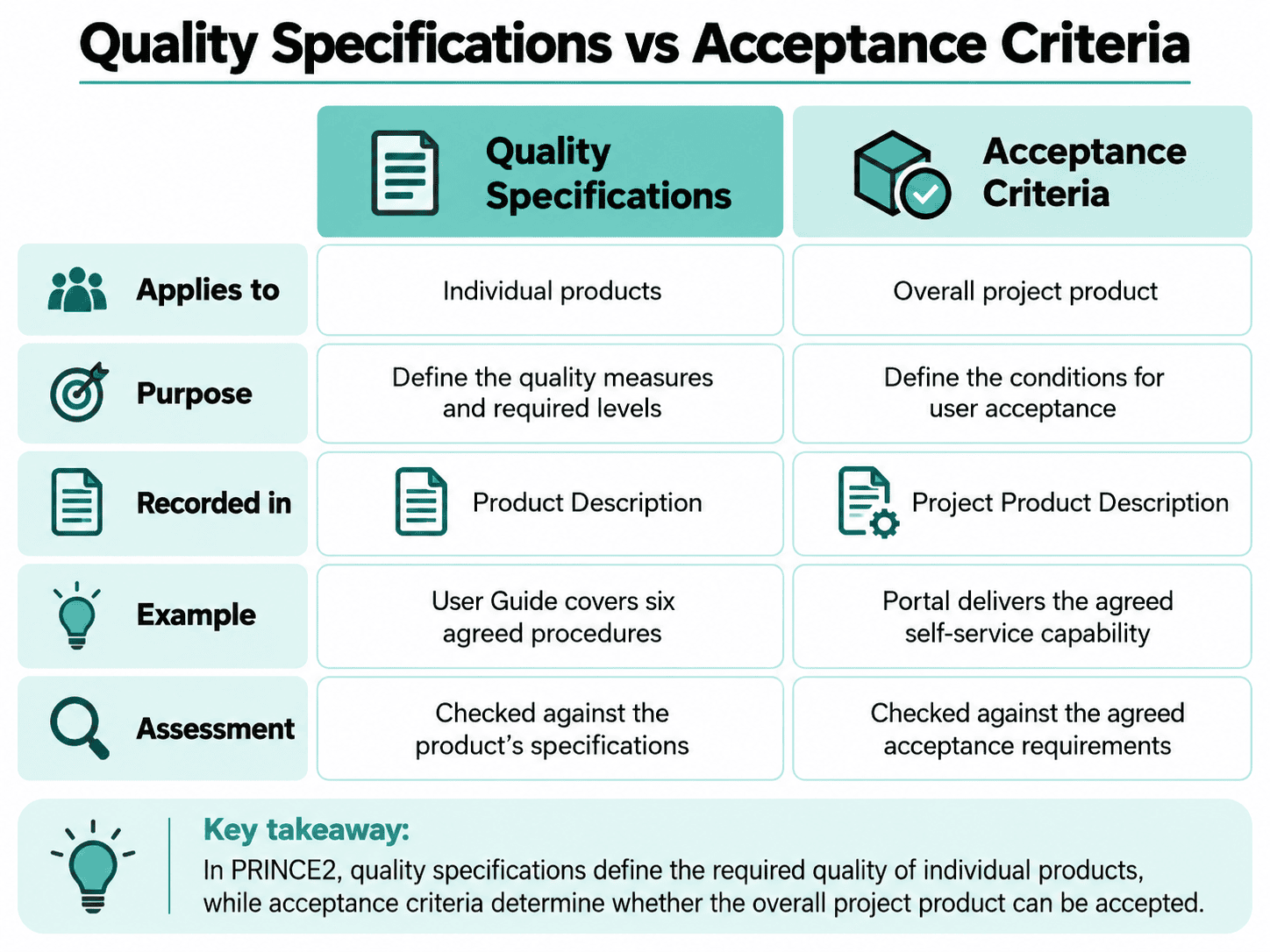
The main difference is that quality specifications define the required quality of individual products, while acceptance criteria establish whether the overall project product can be accepted.
| Comparison | Quality specifications | Acceptance criteria |
|---|---|---|
| Applies to | Individual products | Overall project product |
| Purpose | Establish the required measures and performance levels | Establish the conditions for user acceptance |
| Recorded in | Product Description | Project Product Description |
| Example | User Guide covers six approved procedures | Portal delivers the agreed self-service capability |
| Assessment | Against the product’s specified checks | Against the agreed overall acceptance requirements |
These two concepts are connected.
Individual products must provide the capabilities needed for the final project product to satisfy its acceptance criteria.
How Do Product Descriptions Support Quality?
Product Descriptions explain what individual products must contain, how they will be developed, and how their quality will be assessed.
They help delivery teams understand what they are expected to produce before beginning the work.
PRINCE2 Product Descriptions can include:
- The product’s purpose and composition.
- Relevant quality specifications.
- Quality tolerances.
- Quality methods and the skills required.
- Responsibilities for producing, reviewing, and accepting the product.
For example, a Product Description for an employee training guide might specify that it must explain six defined procedures and undergo a structured review by an appropriate HR representative.
The Product Description gives the producer and reviewer a common reference point.
It can also support estimating, scheduling, resource allocation, and product acceptance.
What Is a Quality Method?
A quality method explains how a product’s quality will be checked.
It could involve testing, inspection, review, or another method appropriate to the product and its requirements.
For example, a structured content review could be appropriate for a User Guide, whereas a software function might need functional testing.
The method should be selected according to the specifications that need to be verified.
What Is the Project Product Description?
The Project Product Description defines the overall project product, including the user’s quality expectations and acceptance criteria.
It is initially developed during Starting Up a Project and provides an important input to subsequent quality planning.
For the employee portal project, the Project Product Description would establish the expected overall capability of the portal.
Individual Product Descriptions would then establish detailed specifications for its constituent products.
You can explore these records further in our PRINCE2 Management Products guide.
What Is the Quality Management Approach in PRINCE2?
The Quality Management Approach explains the quality techniques, standards, procedures, and responsibilities that will be used to achieve the project’s required quality specifications and acceptance criteria.
It forms part of the Project Initiation Documentation.
The approach helps establish:
- How quality planning and control will be performed.
- Which standards and procedures apply.
- Which checking methods and supporting tools will be used.
- Who is responsible for quality activities.
- How quality results will be recorded and reported.
- What resources are needed for quality management.
It connects the project’s quality requirements with practical arrangements for managing them.
The Quality Management Approach is not the same as the Quality Register.
The approach describes how quality will be managed. The register records the activities undertaken and their results.
What Is the PRINCE2 Quality Register?
The Quality Register is a component of the Project Log that records planned and completed quality activities.
It helps the Project Manager and Project Assurance review whether the agreed quality activities have taken place and what their results were.
For example, the register might show that a User Guide is scheduled for review, identify the relevant reviewers, record the review date, and indicate whether the guide passed.
Typical information includes the product being checked, the method used, responsible people, planned and actual dates, and the outcome.
The Quality Register is a record of quality activity, not a replacement for Product Descriptions or the Quality Management Approach.
Where Does the Quality Register Sit in the Project Log?
In PRINCE2 7, the Quality Register forms part of the Project Log.
The Project Log also brings together other changing project information, including issues, risks, lessons, and product records.
A separate Product Register tracks the products required by a plan and their status.
The two registers support different but complementary aspects of project control.
Who Is Responsible for Quality in PRINCE2?
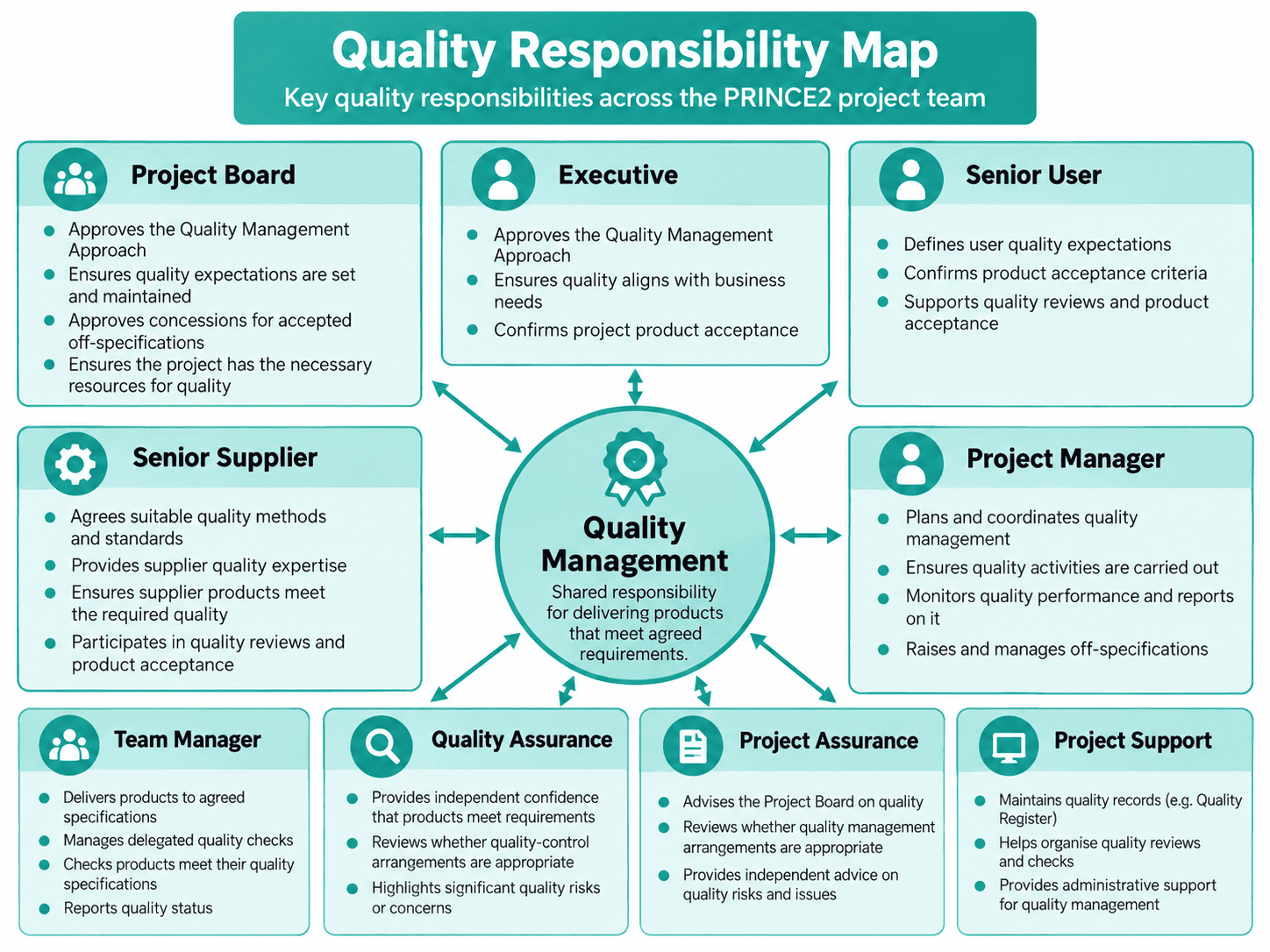
Quality responsibility is shared across the project management structure. It is not solely the responsibility of the Project Manager or the team performing checks.
Different roles contribute to establishing requirements, approving arrangements, producing products, providing assurance, and accepting results.
| Role | Main quality responsibilities |
|---|---|
| Business layer | Provides applicable business standards, project-level quality tolerance, and Quality Assurance expertise |
| Project Executive | Approves the Quality Management Approach and Project Product Description, and confirms project product acceptance |
| Senior User | Provides the user’s quality expectations and acceptance criteria, and is accountable for project product acceptance |
| Senior Supplier | Agrees relevant quality methods and specifications and provides supplier resources and expertise |
| Project Manager | Coordinates quality planning, develops relevant descriptions and arrangements, and ensures agreed controls are implemented |
| Team Manager | Produces products against their descriptions, manages delegated quality checks, and provides quality records |
| Project Assurance | Reviews and advises on quality arrangements and provides assurance to the Project Board |
| Project Support | Supports quality administration and maintains the relevant registers |
What Is the Senior User’s Role in Quality?
The Senior User represents user interests in the project.
This includes providing the user’s quality expectations and acceptance criteria, approving relevant specialist Product Descriptions, and ensuring that suitable people and resources are available for user quality activities.
The Senior User is accountable for the acceptance of the project product.
What Is the Senior Supplier’s Role in Quality?
The Senior Supplier represents supplier interests and helps establish the technical and specialist arrangements necessary to deliver products.
This includes agreeing relevant quality methods and Product Descriptions and providing the people and resources needed for supplier quality activities.
What Is the Project Manager’s Role in Quality?
The Project Manager coordinates the project’s quality planning and management arrangements.
This includes consulting stakeholders, preparing relevant Product Descriptions, developing the Quality Management Approach, and ensuring Team Managers implement the agreed quality controls.
What Does the Team Manager Do?
The Team Manager is responsible for delivering the products within their assigned work, consistent with the agreed Product Descriptions.
They also implement the delegated quality procedures, assemble relevant quality records, and report on product quality status.
How Does Project Assurance Support Quality?
Project Assurance helps the Project Board establish whether the project’s agreed quality arrangements are appropriate and are being implemented.
This can involve reviewing Product Descriptions, advising on quality expertise, and checking compliance with relevant business policies.
Project Assurance is distinct from independent organisational Quality Assurance.
How Are Products Checked and Accepted in PRINCE2?
Products are assessed against their agreed quality specifications using the methods established for the project.
The relevant checks may happen throughout development rather than only when the final product is complete.
Results provide evidence that the product has or has not satisfied the specified requirements.
The person or role authorised to accept an individual product is identified in its Product Description.
Overall acceptance of the project product considers the agreed acceptance criteria and user expectations, together with the supporting quality evidence.
Acceptance may also involve an independent review of the delivered product.
What Happens When a Product Fails a Quality Check?
A failed quality check means that the product has not demonstrated compliance with the relevant specification at that point.
The next action depends on the circumstances.
If the team has reasonable grounds to expect that a further test or inspection will pass, repeating the activity may be appropriate.
If a product cannot meet its specifications, the failure must be assessed against the relevant quality tolerances and requirements.
The project may need corrective work, further review, or formal management through the Issues Practice.
Importantly, a failed test does not automatically mean that every product must be rejected permanently or that the entire project must stop.
The response should reflect the nature of the failure, the approved requirements, and the authority delegated to the relevant management level.
What Are Off-Specifications and Quality Tolerances?
What Is an Off-Specification in PRINCE2?
An off-specification concerns a product that will not meet its agreed quality specifications.
For example, suppose the employee portal is required to support a specific level of simultaneous use.
Testing establishes that it cannot achieve that capability, and the project determines that it will not meet the agreed specification.
This represents an off-specification requiring consideration through the project’s issue arrangements.
The responsible decision-maker may consider corrective work or another authorised response.
A decision to accept an off-specification without corrective action is known as a concession. In PRINCE2, concessions require Project Board approval, and the approved project baseline must be updated to reflect the accepted deviation. They are not informal permission to disregard agreed quality requirements.
What Is Quality Tolerance?
Quality tolerance defines how much an individual product’s quality may deviate before the deviation must be escalated to the next management level.
For example, a product might have an agreed performance target with a specified permitted range.
The tolerance must be explicitly established rather than assumed.
It is important not to confuse an authorised variation with automatically acceptable poor quality.
The product must still satisfy the applicable requirements and acceptance arrangements.
How Does Quality Connect to Manage by Exception?
PRINCE2 uses tolerances to establish delegated authority.
When a relevant quality tolerance is forecast to be exceeded, the situation must be escalated to the next management level.
This allows decisions to be made at the appropriate level rather than requiring senior management involvement in every routine quality activity.
Read more in our guide to Manage by Exception in PRINCE2.
How Does Quality Connect to Other PRINCE2 Practices?
Quality does not operate independently from planning, risk management, issue management, or business justification.
Product-Based Planning and the Product Breakdown Structure
Product-Based Planning identifies the products needed before establishing the activities required to create them.
A Product Breakdown Structure helps identify and organise the products within the project’s scope.
The Product Descriptions then explain the relevant requirements and quality specifications.
The Product Breakdown Structure itself is not a list of quality specifications, but it helps the project identify which products need those specifications.
Read our guides to Product-Based Planning and Product Breakdown Structures.
Quality and Project Plans
Quality activities require time, people, specialist expertise, and sometimes equipment.
These requirements should be considered when developing project, stage, and team plans.
A review involving five specialists, for example, needs to be scheduled and resourced rather than assumed to happen automatically.
Quality and the Risk Practice
A risk is an uncertain event or set of events that could affect project objectives.
A potential quality failure might therefore represent a risk.
For example, there may be uncertainty about whether a new technology can satisfy the product’s required performance level.
Once a failure occurs and requires current management consideration, the Issues Practice may become relevant.
Quality and the Issues Practice
The Issues Practice helps the project assess and respond to matters that require attention, including off-specifications.
When a product cannot meet its agreed quality specification, the project needs to determine how that deviation will be managed.
Read our Risk vs Issue in PRINCE2 guide for further guidance.
Quality and Scope
Scope describes the products that the project is expected to deliver.
Quality concerns how those products satisfy their agreed requirements.
Adding a new feature may change the approved scope. Correcting an existing feature so that it meets its specified requirements concerns quality.
The distinction is important because a product does not become better simply by including more features.
Quality and the Business Case
Poor product quality can affect a project’s expected outcomes and benefits.
For example, an employee portal that employees cannot use effectively might fail to deliver the anticipated reduction in administrative work.
Significant quality problems can therefore influence cost, time, risk, expected benefits, and continued business justification.
This does not mean every quality failure invalidates the Business Case. The effect needs to be assessed.
How Does PRINCE2 Quality Management Work in Agile or Hybrid Projects?
PRINCE2 quality management can be applied to linear-sequential, iterative-incremental, and hybrid delivery approaches.
The management principles remain relevant even when the specialist methods used to create and check products differ.
For example, a software team using iterative delivery might develop and test features progressively.
The project can still define appropriate quality expectations, establish acceptance criteria, and record quality results.
Techniques such as automated testing, peer review, demonstrations, and incremental feedback may be appropriate, depending on the product and delivery method.
These are examples of specialist delivery activities, not universal PRINCE2 requirements.
Product Descriptions can also be adapted to suit iterative delivery, including the use of features and user stories where appropriate.
The key is to preserve effective management of quality while aligning the arrangements with the chosen delivery approach.
How Should Quality Management Be Tailored in PRINCE2?
Quality management should be tailored to the project’s context, complexity, importance, risks, and delivery arrangements.
This can affect the level of documentation, the techniques used, the formality of quality activities, and the resources involved.
For a straightforward internal project, a concise Product Description, simple review procedure, and proportionate quality records may be sufficient.
For a complex project involving significant regulatory requirements, more extensive checking, specialist expertise, and detailed evidence may be necessary.
These examples are illustrative.
Tailoring does not mean removing the need to establish appropriate quality requirements or verify that the products fulfil them.
The project should use arrangements that provide the required level of confidence without introducing unnecessary administration.
Explore our guide to tailoring PRINCE2.
PRINCE2 Quality Management Example
Consider a fictional project to develop an employee self-service portal.
The project will deliver an online portal and supporting guidance that enable employees to access agreed HR information and complete selected self-service tasks.
The following example illustrates how the PRINCE2 quality concepts can work together.
Step 1. Establish User’s Quality Expectations
The HR department and employee representatives explain what they expect from the completed portal.
Their expectations include reliable access, appropriate security, clear information, and an accessible user experience.
These expectations are documented in the Project Product Description.
Step 2. Define Acceptance Criteria
The project establishes the criteria the overall portal must meet for user acceptance.
Illustrative criteria include secure access for authorised employees, successful completion of agreed core tasks, and compliance with the approved performance requirements.
Step 3. Define Individual Product Specifications
The project identifies the individual products required.
One is the employee User Guide.
Its Product Description specifies that the guide must cover six agreed procedures, use approved terminology, and meet the agreed accessibility requirements.
Step 4. Plan Quality Activities
The project establishes how the guide will be reviewed and identifies who will undertake the work.
The activity is included in the relevant plan, and the intended review is recorded in the Quality Register.
Step 5. Perform the Quality Check
The reviewer examines the guide against its specifications.
They discover that one required procedure is missing.
The guide therefore fails the relevant check.
Step 6. Record and Address the Result
The failed review is recorded.
The team adds the missing procedure, and the product undergoes further checking.
The project assesses whether any wider quality issue or escalation is required.
Step 7. Accept the Product
The updated guide satisfies the agreed specifications.
The authorised acceptance role reviews the relevant evidence and accepts the guide.
The overall portal is subsequently assessed against the acceptance criteria established in the Project Product Description.
Common Quality Management Mistakes in PRINCE2 Projects
Several common mistakes can weaken quality management even when a project has documented requirements.
- Leaving quality until the end. Waiting until final testing makes problems harder to identify and correct.
- Using vague descriptions. Terms such as “excellent” or “user-friendly” need enough detail to support meaningful assessment.
- Confusing scope with quality. Additional functionality is not automatically better quality.
- Failing to establish acceptance criteria. Without agreed acceptance requirements, the project risks disagreement at handover.
- Ignoring quality resources. Tests, inspections, and reviews require time and suitable people.
- Leaving responsibilities unclear. A check can be delayed when nobody knows who must perform or approve it.
- Treating a register as the entire Quality Practice. Recording activity does not replace effective planning and control.
- Ignoring failed results. A failed check requires an appropriate response, not simply a record.
- Confusing Quality Assurance with Project Assurance. Their purposes and organisational relationships differ.
- Overcomplicating the approach. Documentation and controls should be proportionate to the project’s needs.
PRINCE2 Quality Management Checklist
Before finalising your project’s quality arrangements, consider the following questions.
- Have the major project products been identified?
- Are the user’s quality expectations documented?
- Are the overall acceptance criteria agreed?
- Do important individual products have clear quality specifications?
- Are applicable quality tolerances defined?
- Are the quality methods appropriate to the products?
- Are the people responsible for checks and acceptance identified?
- Are quality activities included in relevant plans?
- Have sufficient resources been allowed for quality work?
- Are planned quality activities and results recorded?
- Is there an agreed approach for handling failed checks and off-specifications?
- Are Quality Assurance and Project Assurance responsibilities clear?
- Are the quality arrangements proportionate to the project?
Review any areas that remain unclear before relying on the arrangements for delivery and acceptance.
Frequently Asked Questions
What Is Quality Management in PRINCE2?
PRINCE2 quality management establishes the requirements and specifications that project products must meet, plans and implements the relevant quality activities, and supports decisions about product acceptance.
What Is the Purpose of the Quality Practice?
The Quality Practice documents user requirements for project products and establishes how those requirements will be satisfied throughout the project.
What Is the Difference Between Quality Planning and Quality Control?
Quality planning defines the specifications and arrangements for managing quality. Quality control implements checks and monitors whether products comply with their requirements.
What Is Quality Assurance in PRINCE2?
Quality Assurance provides confidence that the quality arrangements will allow products to demonstrate compliance with their specifications. It is normally undertaken independently of the project team.
What Is the Difference Between Quality Specifications and Acceptance Criteria?
Quality specifications define the measures and required levels for individual products. Acceptance criteria establish the conditions the overall project product must satisfy before the user accepts it.
What Is a Quality Register?
The Quality Register is part of the PRINCE2 Project Log. It records planned and completed quality activities and their outcomes.
Who Is Responsible for Quality in PRINCE2?
Quality responsibilities are shared between the business, Project Board roles, Project Manager, Team Managers, Project Assurance, Project Support, and those carrying out specialist quality activities.
What Happens When a Product Fails Quality Control?
The failure is assessed against the product’s specifications and tolerances. Depending on the circumstances, the team may repeat the check, undertake corrective work, or manage the deviation through the project’s issue arrangements.
What Is an Off-Specification?
An off-specification concerns a product that will not satisfy its agreed quality specifications. It is managed through the relevant PRINCE2 issue arrangements.
What Is Quality Tolerance?
Quality tolerance is the permitted variation in product quality before the deviation requires escalation to the next management level.
Can Quality Management Work With Agile Delivery?
Yes. PRINCE2 supports iterative and hybrid delivery approaches. Product quality expectations and management controls remain important, while the specialist checking techniques can be adapted to the delivery method.
What Should You Explore Next?
Quality management is closely connected to the way PRINCE2 defines, plans, controls, and accepts products.
If you want to develop your understanding further, explore our guides to PRINCE2 Practices, Management Products, and Product-Based Planning.
For a structured route through the wider method, explore our PRINCE2 Foundation and Practitioner training.
Want to understand how PRINCE2 helps teams define, control, and accept project products?