What Are the PRINCE2 Roles and Responsibilities?
PRINCE2 roles and responsibilities define who directs, manages, delivers, assures, and supports a project so that accountability and decision-making are clear. The main roles are the Project Executive, Senior User, Senior Supplier, Project Manager, Team Manager, Project Assurance, and Project Support. The Project Executive, Senior User, and Senior Supplier together form the Project Board.
The seven main PRINCE2 roles are:
- Project Executive – provides the single point of accountability for the project and represents the business interest.
- Senior User – represents the people who will use, operate, or benefit from what the project delivers.
- Senior Supplier – represents those providing the specialist expertise, resources, and products needed to deliver the project.
- Project Manager – manages the project day to day within the authority delegated by the Project Board.
- Team Manager – manages the delivery of allocated work within the agreed limits.
- Project Assurance – provides independent assurance that the project is being conducted appropriately from the relevant business, user, and supplier perspectives.
- Project Support – provides administrative, technical, and specialist support to help the project operate effectively.
PRINCE2 does not just create a list of job titles. It creates a structure of project responsibilities and relationships so that the right decisions can be made at the right level.
PRINCE2 Roles and Responsibilities at a Glance
| Role | Main responsibility | Organisational level | Key focus |
|---|---|---|---|
| Project Executive | Overall accountability for the project | Directing | Is the project still worthwhile and properly governed? |
| Senior User | Represents user needs, outcomes, and benefits | Directing | Will the project deliver what users need? |
| Senior Supplier | Represents those supplying specialist resources and expertise | Directing | Can the required products be delivered to the expected standard? |
| Project Manager | Day-to-day management of the project | Managing | Is the project progressing within the authority delegated by the Project Board? |
| Team Manager | Delivery of allocated work | Delivering | Can the agreed products be delivered within the Work Package constraints? |
| Project Assurance | Independent assurance across relevant project interests | Assurance | Is the project being conducted and controlled appropriately? |
| Project Support | Administrative and specialist project support | Support | What practical support does the management team need? |
What Are the Four Organisational Levels in PRINCE2?
PRINCE2 uses four organisational levels to separate commissioning, direction, day-to-day management, and delivery. Authority moves down through these levels, while progress information and exceptions can move back up.
The four levels are:
- Commissioning: the business layer
- Directing: the Project Board
- Managing: the Project Manager
- Delivering: Team Managers and delivery teams
1. Commissioning: the business layer
The business layer sits above the project management team.
It creates the environment in which the project is commissioned and gives the Project Board its overall authority. This includes establishing the project-level limits within which the Project Board can operate.
Think of this layer as answering:
“Why are we commissioning this project, and how much authority are we giving the project?”
The business layer is important, but it is NOT part of the PRINCE2 project management team itself.
2. Directing: the Project Board
The Project Board directs the project on behalf of the business.
Rather than managing the project every day, the Board focuses on major decisions, governance, continued justification, direction, and control.
It brings together three interests:
- business, represented by the Project Executive;
- users, represented by the Senior User; and
- suppliers, represented by the Senior Supplier.
A successful project is not just a project that delivers something – it also needs to remain worthwhile to the business, meet the needs of its users, and remain technically or operationally deliverable.
3. Managing: the Project Manager
The Project Manager manages the project day to day within the authority given by the Project Board.
This is the layer where the wider direction set by the Board becomes coordinated project activity.
The Project Manager monitors progress, delegates work, manages relationships, deals with issues within their authority, and escalates when a situation moves beyond that authority.
4. Delivering: Team Managers and delivery teams
At the delivery level, Team Managers and team members turn the project plan into actual products and outputs.
A Team Manager receives defined work from the Project Manager and manages that work within agreed limits.
This creates a clear chain of delegated authority rather than requiring the Project Board to make decisions about routine delivery activity.
Who Sits on the PRINCE2 Project Board?
The PRINCE2 Project Board comprises the Project Executive, Senior User, and Senior Supplier. Together, these roles represent the business, user, and supplier interests needed to direct the project.
The Project Board is not just a collection of senior managers; each role exists because it brings a different perspective to project decisions.
The Three Project Board Interests
| Project interest | Project Board role | Main perspective |
|---|---|---|
| Business | Project Executive | Is the project worthwhile and aligned with business needs? |
| User | Senior User | Will the outcome meet user needs and create the expected value or benefits? |
| Supplier | Senior Supplier | Can the required products be delivered using suitable expertise and resources? |
Project Executive
The Project Executive is the single point of accountability for the project and chairs the Project Board. The role represents the business interest and remains ultimately accountable for the project’s success.
The Project Executive is concerned with questions like:
- Does the project continue to make business sense?
- Is there sufficient funding and authority?
- Are major decisions aligned with the organisation’s objectives?
- Is the project being governed appropriately?
- Do the expected benefits still justify the investment?
This accountability cannot simply be handed to the Project Manager.
The Project Manager manages the project on behalf of the Project Board, but the Project Executive remains accountable at the directing level.
Imagine a retailer is introducing a new online ordering platform.
The Project Executive might be a senior leader responsible for ensuring that the project continues to support the company’s strategic objectives, remains financially justified, and receives appropriate organisational backing.
They would not normally be deciding how the development team organises its work on Tuesday morning.
That belongs much further down the management structure.
Senior User
The Senior User represents the people who will use, operate, maintain, or benefit from the project’s outputs.
The role is particularly concerned with whether the project will produce something that actually meets user needs and enables the expected outcomes and benefits.
The Senior User may therefore focus on questions like:
- What do users need from the project?
- Are those requirements being represented accurately?
- Will the proposed products work in the real operating environment?
- Are users prepared to adopt what is being delivered?
- Are the expected benefits still realistic?
On the online ordering project, the Senior User might represent store teams, customer service teams, or customers who will rely on the new platform.
A system might technically work perfectly and still fail from the user perspective if it creates a confusing buying process or does not fit operational needs.
That is why user representation exists at Project Board level rather than being treated as an afterthought.
Senior Supplier
The Senior Supplier represents the organisations, teams, or specialists responsible for providing the expertise and resources required to create the project’s products.
The role focuses on whether the proposed solution can be delivered with appropriate quality and technical integrity.
Typical concerns might include:
- Is the proposed solution technically achievable?
- Are the right specialist skills available?
- Can supplier resources realistically support the plan?
- Are delivery commitments achievable?
- Are technical quality considerations being represented in Board decisions?
If an external development company is building the retailer’s platform, the Senior Supplier might represent the supplier organisation at Board level.
Their perspective is different from the Senior User’s.
The Senior User asks whether the solution will work for the people who need it.
The Senior Supplier asks whether the solution can be delivered properly.
Both matter.
A project needs more than delivery capability. It needs a continuing business reason, an outcome that works for users, and a feasible way to create the required products.
What Does the PRINCE2 Project Manager Do?
The PRINCE2 Project Manager is responsible for managing the project day to day within the authority, tolerances, and constraints delegated by the Project Board.
This makes the Project Manager the central management point between project direction and project delivery.
Their role includes coordinating work, monitoring progress, managing relationships, making decisions within delegated authority, and escalating situations that require a higher-level decision.
Typical Project Manager responsibilities include:
- managing the project on behalf of the Project Board;
- coordinating and delegating work;
- agreeing Work Packages with Team Managers;
- monitoring progress against agreed plans and tolerances;
- responding to issues and risks that remain within delegated authority;
- escalating forecast exceptions when delegated authority would be exceeded;
- keeping the Project Board appropriately informed;
- maintaining relationships across the project ecosystem; and
- ensuring day-to-day decisions remain consistent with the direction set by the Project Board.
One of the most important ideas here is delegated authority.
The Project Manager does not need Board approval for every routine project decision.
If an issue remains within the limits already agreed for the stage, the Project Manager can manage it.
When those limits are forecast to be exceeded, the decision moves upwards.
For example
Suppose a Project Manager is managing the rollout of a new internal HR platform.
A small scheduling problem delays one training session but remains comfortably within the agreed stage tolerance.
The Project Manager can deal with it.
If a larger technical problem means the entire stage is now forecast to exceed the authority given by the Project Board, the Project Manager cannot simply redefine that authority.
The situation needs to be escalated.
This relationship is at the heart of Management by Exception, one of PRINCE2’s 7 Principles.
What Does Delegated Authority Mean in Practice?
Delegated authority just means giving someone permission to make certain decisions or take charge within agreed limits.
Imagine Mary and John are parents with two sons, Dean and Sam. Dean is the older brother.
Mary and John go away for a few days and leave Dean in charge of Sam. By doing that, they are delegating some of their authority to Dean.
Dean can now make certain decisions without phoning his parents every time, but he does not have unlimited authority. Mary and John have already set some boundaries.
For example, Sam’s usual bedtime is 20:00. Because it’s the school holidays, Mary and John tell Dean that Sam can stay up until 20:30 if needed.
One evening, Sam is watching a film that finishes at 20:10.
Dean does not need to call his parents for permission. Although Sam has gone beyond his normal 20:00 bedtime, he is still within the tolerance Mary and John gave Dean.
Dean has enough delegated authority to make the decision himself.
Now imagine Dean asks Sam to wash the dishes. A glass breaks, Sam badly cuts his hand, and he needs medical attention.
That’s very different.
The situation is now outside the normal limits Mary and John expected Dean to manage. The agreed tolerance has effectively been exceeded, so Dean needs to escalate the situation to his parents and get direction on what should happen next.
In PRINCE2 terms, you can think of it like this:
The important point is that delegating authority does not mean giving away all control.
The Project Board gives the Project Manager enough authority to manage the project efficiently without asking for approval on every small decision. But when a forecast or situation moves outside the agreed tolerances, the Project Manager must escalate it to the Project Board.
What Does a PRINCE2 Team Manager Do?
A PRINCE2 Team Manager is responsible for delivering the work allocated by the Project Manager within the agreed tolerances and constraints.
The Project Manager manages the overall stage.
The Team Manager focuses on the specific work assigned to their team.
This usually involves:
- planning how the allocated work will be completed;
- managing the team carrying out that work;
- delivering products to the agreed requirements;
- monitoring progress;
- managing issues and risks at team level;
- working within the limits agreed with the Project Manager; and
- keeping the Project Manager informed about progress or potential problems.
For example
On a website transformation project, the Project Manager may oversee the entire project.
A Team Manager could be responsible specifically for the development team delivering the new checkout functionality.
The Team Manager does not take over responsibility for the full project.
They manage the defined package of work entrusted to their team.
PRINCE2 also allows this arrangement to be tailored to the delivery environment. For example, in a self-organising delivery team, the responsibilities normally associated with the Team Manager may be handled collectively, provided the responsibilities and relationship with the Project Manager remain clear.
What Is Project Assurance in PRINCE2?
Project Assurance gives the Project Board confidence that the project is being conducted appropriately and that the business, user, and supplier interests are being properly protected.
Assurance is deliberately different from day-to-day project management.
The Project Manager manages.
Project Assurance independently checks, advises, and provides confidence to the Board.
The three Project Board perspectives create three broad assurance interests:
- Business assurance
- User assurance
- Supplier assurance
The Project Board remains accountable for assurance, even when specific assurance activities are delegated to other suitable people.
Independence matters.
Project Assurance should not simply become another name for someone checking their own work.
For that reason, Project Assurance responsibilities need to remain separate from roles whose work is being assured, including the Project Manager, Team Manager, delivery team, and Project Support.
For example
Let’s say a Project Manager reports that the project remains on track.
Project Assurance might independently examine whether the forecasts, controls, risks, quality arrangements, or business justification support that conclusion.
The purpose is not to undermine the Project Manager, though – it’s just to give the Project Board independent confidence in the information on which it makes decisions.
What Does Project Support Do in PRINCE2?
Project Support provides the administrative, technical, and specialist support needed to help the project management team work effectively.
Depending on the project, this might include:
- arranging and supporting meetings;
- maintaining project information;
- helping with planning tools;
- supporting risk and issue management;
- supporting change control;
- maintaining records;
- collecting project data; and
- providing guidance on project management tools and processes.
So, Project Support can look very different from one organisation to another.
A large project may use a dedicated project office.
A smaller project may allocate support responsibilities to someone already working within the project team.
The important distinction is that Project Support helps the project operate, while Project Assurance independently checks that it is being managed appropriately.
Those responsibilities should remain separate so that assurance retains its independence.
What Is the Difference Between the Project Board and Project Manager?
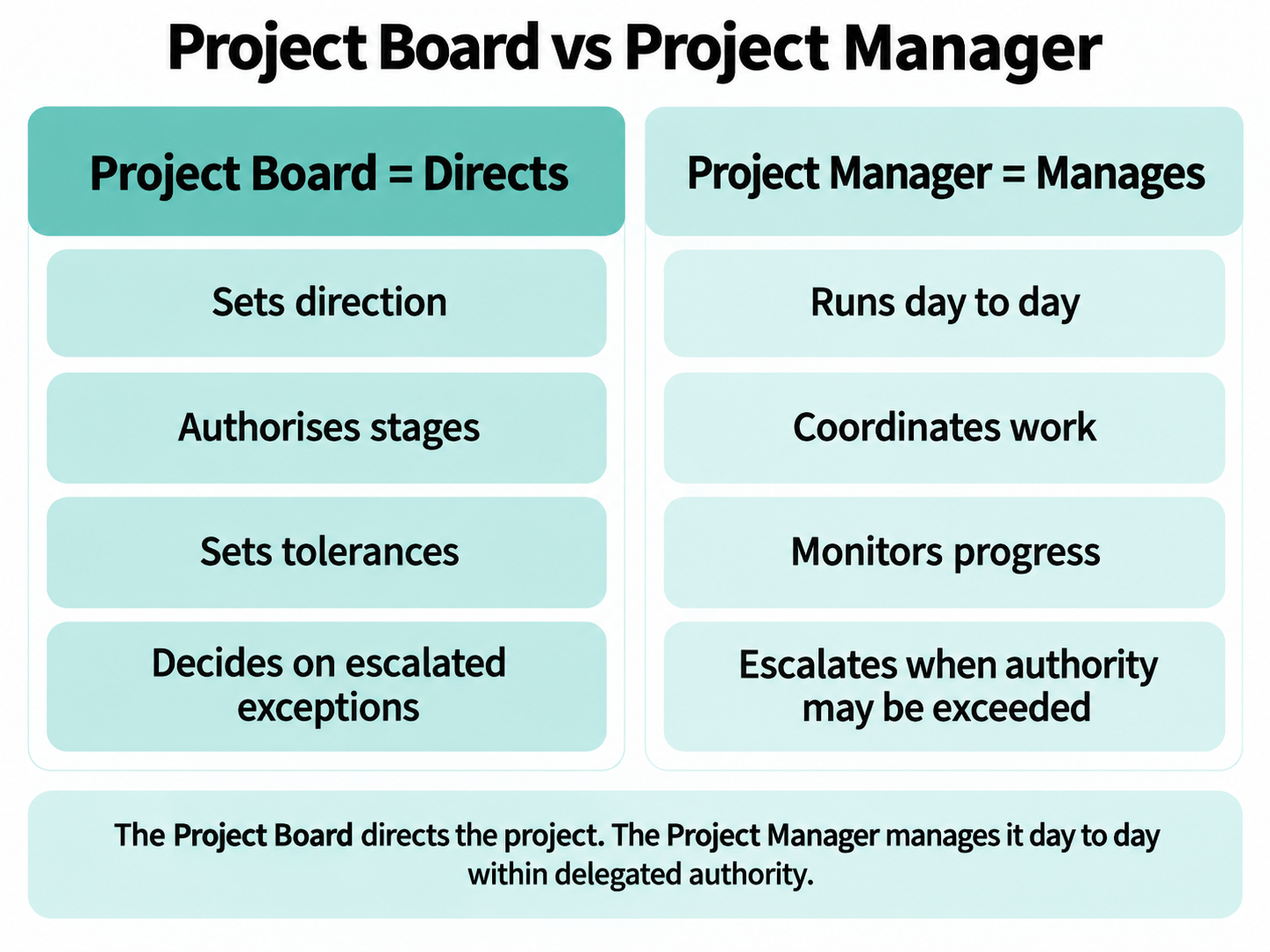
The Project Board directs the project, while the Project Manager manages it day to day within the authority delegated by the Board.
That distinction is fundamental to PRINCE2.
Project Board vs Project Manager
| Project Board | Project Manager |
|---|---|
| Operates at the directing level | Operates at the managing level |
| Provides direction and governance | Runs the project day to day |
| Sets authority and stage tolerances | Works within those tolerances |
| Makes decisions that exceed the Project Manager’s delegated authority | Makes routine decisions within delegated authority |
| Authorises management stages | Coordinates and controls work within the authorised stage |
| Includes Project Executive, Senior User, and Senior Supplier | A single management role |
| Receives escalated exceptions | Escalates forecast exceptions when necessary |
Imagine the Project Board as deciding where the project is allowed to go and under what conditions.
The Project Manager works out how to manage the journey within those conditions.
This separation keeps senior decision-makers in control without requiring them to manage every piece of project activity.
What Is the Difference Between Accountability and Responsibility in PRINCE2?
In practical terms, accountability identifies where ultimate ownership of an outcome or decision sits, while responsibility describes who is expected to perform or manage particular work.
A person can therefore be responsible for doing something without being the final point of accountability for the entire project.
The distinction becomes clearer across the PRINCE2 structure.
Project Executive
The Project Executive is the project’s single point of accountability and remains ultimately accountable for its success.
Project Board
The Board directs the project within the authority given by the business and makes decisions at the directing level.
Project Manager
The Project Manager is responsible for managing the project day to day within delegated authority.
Team Manager
The Team Manager is responsible for delivering the specific work allocated to the team within agreed limits.
This prevents an important governance problem: delegation does not mean that all accountability disappears down the organisational structure.
A Project Executive can delegate substantial management authority while remaining accountable at the appropriate level.
Are PRINCE2 Roles the Same as Job Titles?
No. PRINCE2 roles describe functions and responsibilities within a project; they do not necessarily match someone’s everyday organisational job title.
Someone whose normal title is Operations Director, Head of Product, Lead Engineer, or Business Change Manager could perform a PRINCE2 project role if that allocation is appropriate.
Likewise, someone employed under the job title “Project Manager” by a supplier might actually perform a Team Manager role within the customer’s PRINCE2 project structure.
What matters is not the wording on the person’s business card.
What matters is:
- which PRINCE2 responsibilities they have been allocated;
- what authority they have;
- what decisions they are expected to make;
- who they report to within the project; and
- which project interest they represent.
It’s a myth that “The PRINCE2 Project Manager role must always be held by someone whose organisational job title is Project Manager.”
In reality, PRINCE2 defines project responsibilities and relationships rather than prescribing someone’s permanent organisational job title.
That flexibility helps the method work across different organisations, suppliers, sectors, and delivery models.
Can PRINCE2 Roles Be Combined?
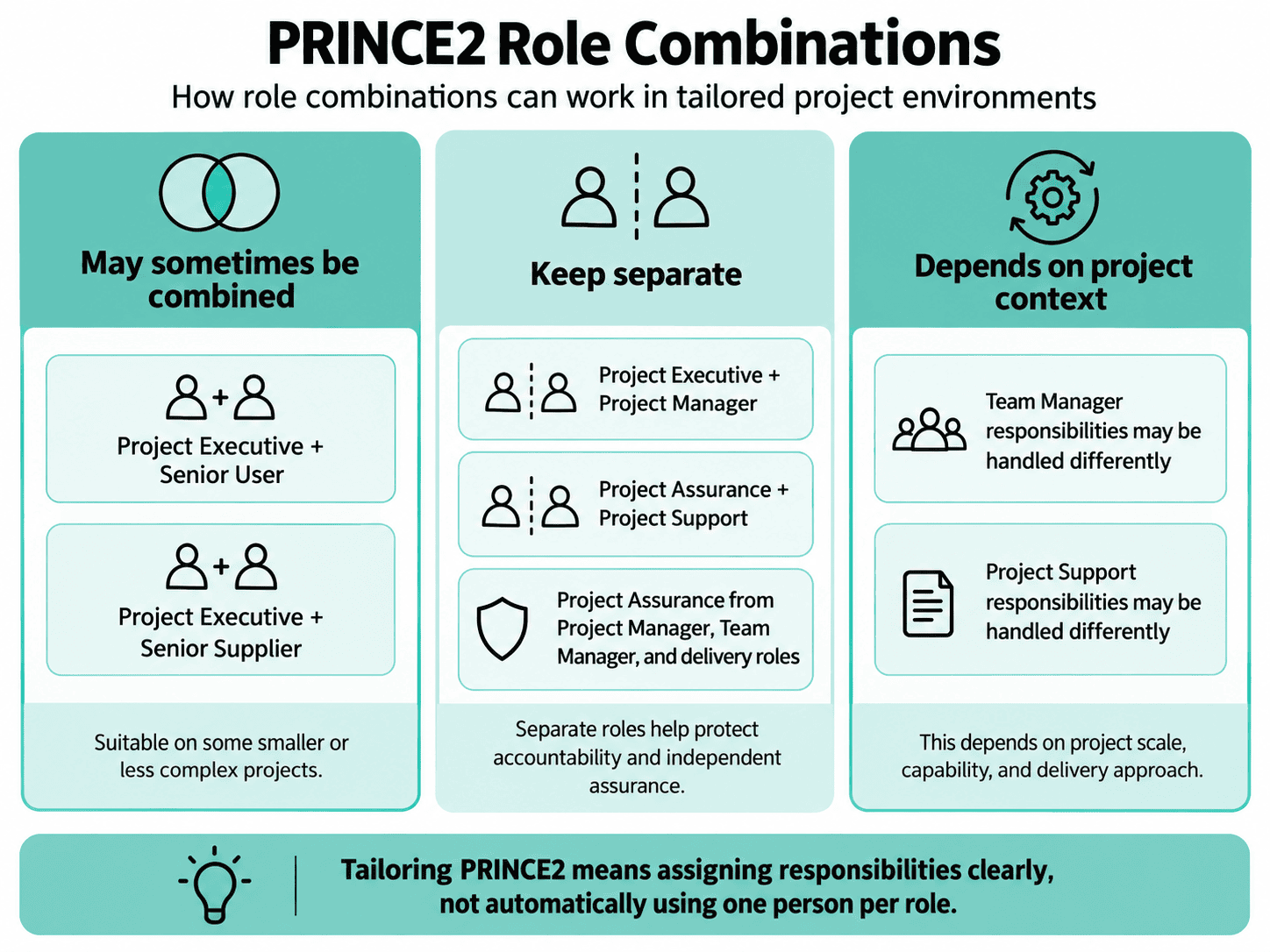
Some PRINCE2 responsibilities can be shared or combined when the project context makes this appropriate, but there are important limits designed to preserve accountability and independent assurance.
For example:
- on a smaller project, the Project Executive may also perform the Senior User or Senior Supplier role;
- combining the Senior User and Senior Supplier perspectives is discouraged because the two interests need sufficiently independent representation;
- the Project Executive cannot be combined with the Project Manager role;
- the Project Executive remains a single point of accountability;
- the Project Manager may personally perform some Team Manager or Project Support responsibilities where appropriate, although the Project Manager role itself remains a single management focus;
- Project Assurance cannot be allocated to the Project Manager, Team Manager, delivery team, or Project Support; and
- Project Support needs to remain separate from Project Assurance so that assurance remains independent.
The aim is not to fill as many boxes as possible; it’s to ensure that all required responsibilities are covered without creating conflicts of interest or weakening governance.
A small internal project, therefore, does not necessarily need seven different people – but it does need clarity about who is doing what.
How Do PRINCE2 Roles Support Management by Exception?
PRINCE2 roles support Management by Exception by placing decisions at different levels and giving each level defined authority within agreed tolerances.
The principle is straightforward: manage what falls within your authority and escalate when a forecast moves outside it.
For example:
If work remains within the relevant limits, the responsible level can continue managing it.
If a forecast shows those limits will be exceeded, the issue moves upwards to the level that has authority to decide what happens next.
This is why clearly defined roles are so closely connected to effective project control.
Without clear roles and authority, “escalate the problem” becomes meaningless because nobody knows where the problem should go.
How Do Business, User, and Supplier Interests Fit Together?
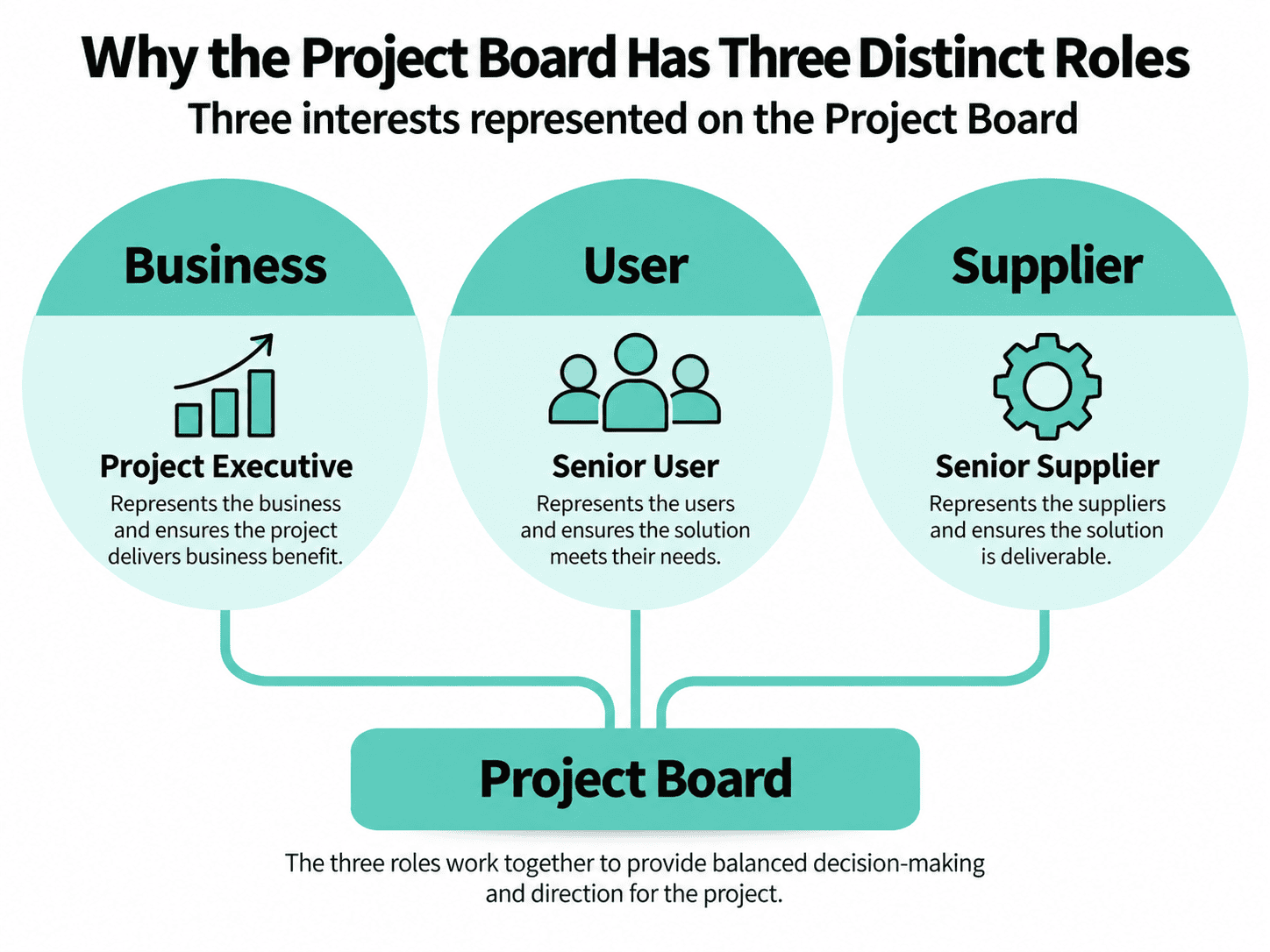
PRINCE2 brings business, user, and supplier interests together because successful projects need all three perspectives.
The business interest asks:
Why are we investing in this project?
The user interest asks:
Will the outcome meet the needs of the people who rely on it?
The supplier interest asks:
Can the required products be created using suitable resources, expertise, and methods?
The Project Executive, Senior User, and Senior Supplier bring these perspectives together on the Project Board.
How Are PRINCE2 Roles Tailored to Different Projects?
PRINCE2 roles can be tailored to the size, complexity, organisational environment, commercial arrangements, and delivery method of a project, provided the necessary responsibilities remain clearly allocated.
That means the same organisational diagram should not automatically be copied onto every project.
A small internal project might have a relatively compact management structure.
A major project involving several organisations could require:
- multiple user or supplier representatives;
- external assurance;
- dedicated Project Support;
- specialist Team Managers;
- supplier representatives;
- additional project governance arrangements; or
- integration with programme-level roles.
An agile or hybrid delivery environment may also use different role names within delivery teams.
The important question is not:
“Does everyone’s job title look exactly like the standard PRINCE2 terminology?”
It’s:
“Have the required responsibilities, authority, relationships, and assurance arrangements been made clear?”
This is the practical value of tailoring.
PRINCE2 gives a governance structure without requiring every project to look identical.
How Do PRINCE2 Roles Fit into PRINCE2 Training?
Understanding roles and responsibilities is part of understanding how the wider PRINCE2 method works.
The roles connect directly with:
- the PRINCE2 principles;
- the seven practices;
- the seven processes;
- Management by Exception;
- management stages;
- business justification;
- project controls;
- stakeholder relationships; and
- tailoring.
For example, learning the Project Manager role in isolation tells you only part of the story.
You also need to understand:
- who delegates authority to the Project Manager;
- what happens when that authority may be exceeded;
- how Team Managers receive work;
- who represents business, user, and supplier interests;
- where assurance sits; and
- how all of these relationships change when PRINCE2 is tailored.
PRINCE2® Project Management Foundation develops understanding of the method’s key concepts and structure, while PRINCE2® Project Management Practitioner develops the ability to apply and tailor PRINCE2 in context.
If you’re unsure which qualification fits your experience or career goals, speaking with someone about your existing knowledge and intended route may be more useful than choosing based on the qualification name alone.
Frequently Asked Questions About PRINCE2 Roles and Responsibilities
What are the main PRINCE2 roles?
The seven main PRINCE2 roles are Project Executive, Senior User, Senior Supplier, Project Manager, Team Manager, Project Assurance, and Project Support. The Project Executive, Senior User, and Senior Supplier form the Project Board. Together, these roles cover project direction, day-to-day management, delivery, assurance, and support.
Who is ultimately accountable for a PRINCE2 project?
The Project Executive is the single point of accountability for the PRINCE2 project and is ultimately accountable for its success. The Project Manager has substantial responsibility for running the project day to day, but this does not transfer the Project Executive’s ultimate accountability to the Project Manager.
Who sits on the PRINCE2 Project Board?
The PRINCE2 Project Board consists of the Project Executive, Senior User, and Senior Supplier. The Project Executive represents the business interest, the Senior User represents user interests and expected benefits, and the Senior Supplier represents those providing the expertise and resources needed to deliver the project’s products.
Who is responsible for day-to-day project management in PRINCE2?
The Project Manager is responsible for day-to-day management of a PRINCE2 project within the authority delegated by the Project Board. The Project Manager coordinates work, monitors progress, manages relationships, makes decisions within agreed tolerances, and escalates forecast exceptions when a decision falls outside their delegated authority.
What is the difference between the Project Executive and Project Manager?
The Project Executive provides the project’s single point of accountability and operates at Project Board level, while the Project Manager manages the project day to day. The Project Executive focuses on continued business justification, governance, and overall direction. The Project Manager turns that direction into coordinated project activity within delegated authority.
What does the Senior User do in PRINCE2?
The Senior User represents the people who will use, operate, maintain, or benefit from the project’s outputs. The role helps ensure that user needs and expected benefits are represented in project decisions and that the products delivered by the project can support the intended outcomes.
What does the Senior Supplier do in PRINCE2?
The Senior Supplier represents those providing the specialist expertise, resources, or products needed to deliver the project. The role gives the Project Board a supplier perspective on feasibility, technical integrity, resources, quality, and whether the proposed products can realistically be delivered.
What does Project Assurance do?
Project Assurance gives the Project Board independent confidence that the project is being managed and controlled appropriately. Assurance considers the relevant business, user, and supplier interests and needs sufficient independence from the Project Manager, Team Managers, delivery teams, and Project Support to provide meaningful oversight.
What does Project Support do?
Project Support provides practical services that help the project operate efficiently. Depending on the project’s needs, this may include administration, record keeping, meeting support, planning assistance, project management tools, data collection, and support for risk, issue, and change management.
Can one person perform more than one PRINCE2 role?
Yes, some PRINCE2 responsibilities can be combined where the project context makes this appropriate, particularly on smaller projects. However, there are limits. The Project Executive cannot also be the Project Manager, assurance needs to remain independent of the people whose work it is assuring, and Project Support should remain separate from Project Assurance.
Are PRINCE2 roles the same as job titles?
No. PRINCE2 roles define project responsibilities and relationships rather than permanent organisational job titles. A person’s normal business title may be different from the PRINCE2 role they perform on a project. What matters is that their project responsibilities, authority, relationships, and accountability are clearly understood.
What Should You Explore Next?
PRINCE2 roles make more sense when you see how they interact with the rest of the method.
A useful next step is to explore:
- how the PRINCE2 principles guide project decisions;
- how the PRINCE2 practices cover areas that need ongoing management;
- how the PRINCE2 processes move the project through its lifecycle.
The key idea to remember is simple:
PRINCE2 is not designed so that one Project Manager controls everything.
It creates clear levels of accountability, direction, management, delivery, assurance, and support so that decisions can be made by the right people at the right level.
Sources
PeopleCert (2026) PRINCE2® Project Management (Version 7). PeopleCert.