What Is a PRINCE2 Business Case?
A PRINCE2 business case is a management product that explains why a project is worth undertaking and whether it remains a worthwhile investment. It brings together the project’s reasons, expected benefits and dis-benefits, costs, timescales, sustainability targets, and major risks so that decision-makers can determine whether the project should start, continue, change, or stop.
In PRINCE2, a project needs more than a good idea. It needs a clear justification for investing time, money, and resources, and that justification must remain valid throughout the project.
This is where the business case becomes especially useful. Rather than being a document that gets approved and forgotten, it provides a reference point for decisions as new information becomes available.
At a glance:
- Purpose: Explain and assess the justification for investing in a project.
- Key question: Is this project still worth doing?
- Accountability: The Project Executive is accountable for the business case during the project.
- Development: The Project Manager develops and maintains it under delegated responsibility.
- Review: It is checked at key decision points, including stage boundaries.
- Outcome: If the project can no longer be justified, it should be changed or brought to a controlled end.
Understanding the business case also helps you understand why PRINCE2 makes decisions in stages instead of committing to the entire project without further review.
What Is the PRINCE2 Business Case Practice?
The Business Case Practice is one of the seven PRINCE2 practices. It provides the mechanisms used to determine whether a project is still justified and supports investment decisions throughout its lifecycle.
The practice addresses the question “Why?”
It helps the project management team develop the justification, assess alternative investments, monitor whether the reasoning remains valid, and confirm whether the expected benefits are achieved.
There is an important distinction here:
- The Business Case Practice describes how business justification is managed.
- The business case is the management product containing the information used to support those decisions.
The business case is therefore one important output of the practice, but the practice involves much more than writing a document.
If you’re learning the wider method, see our guide to the seven PRINCE2 practices.
What Do Desirable, Viable, and Achievable Mean in PRINCE2?
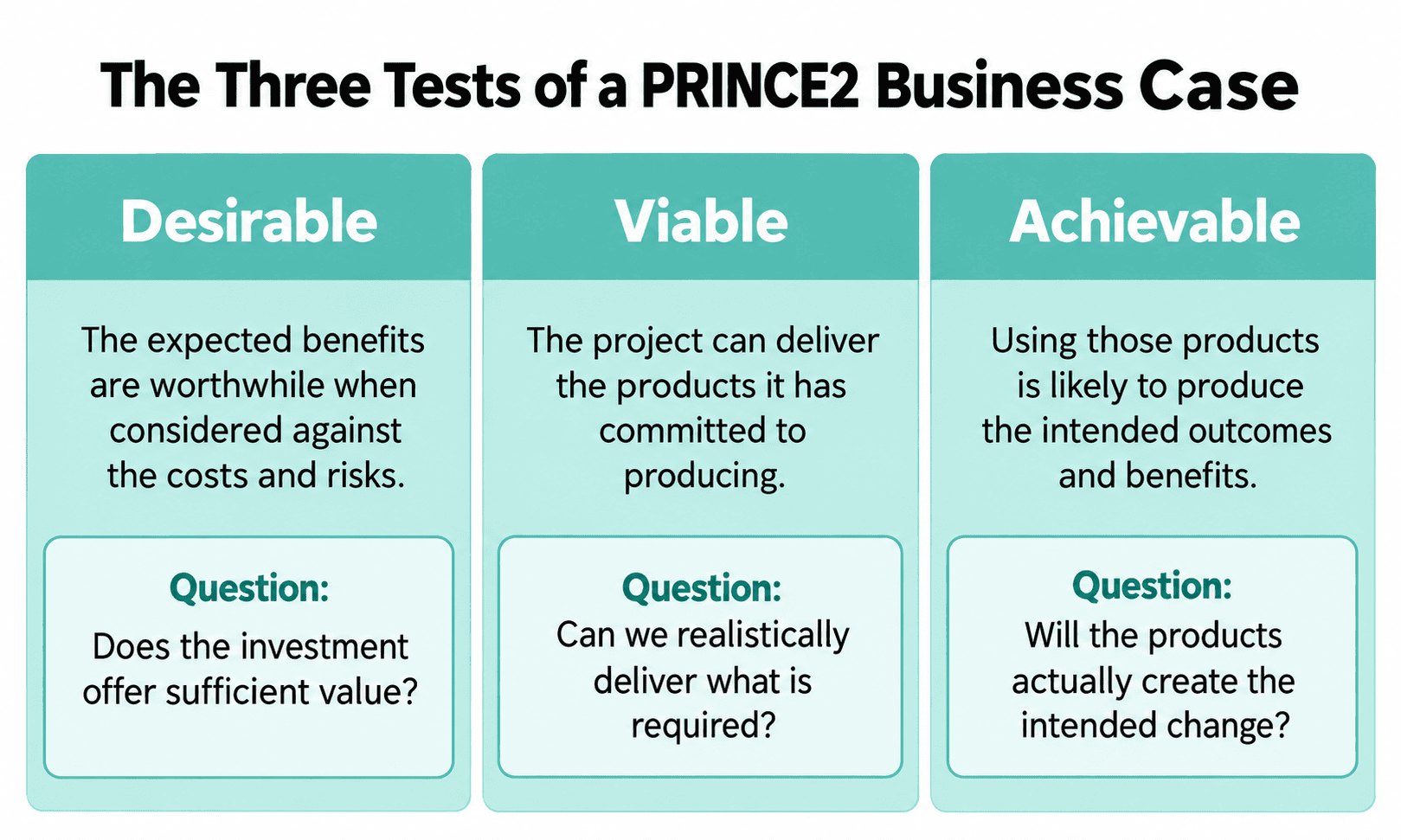
PRINCE2 uses three tests to assess whether a project has sufficient business justification.
| Test | What it means | Question to ask |
|---|---|---|
| Desirable | The expected benefits are worthwhile when considered against the costs and risks. | Does the investment offer sufficient value? |
| Viable | The project can deliver the products it has committed to producing. | Can we realistically deliver what is required? |
| Achievable | Using those products is likely to produce the intended outcomes and benefits. | Will the products actually create the intended change? |
A project might pass two tests but fail the third.
For example, imagine a business investing in a new customer service platform. The platform could be affordable and technically straightforward to deliver, but employees might be unlikely to adopt it without substantial changes to their working practices.
In that situation, delivering the platform may be viable, but achieving the expected benefits is far less certain.
The important lesson: A project isn’t automatically justified because it can be delivered. It must also offer sufficient value and have a credible route to achieving that value.
Why Is Continued Business Justification Important in PRINCE2?
Ensure continued business justification is one of the seven PRINCE2 principles. It means a project must have sufficient justification when it begins and must continue to justify its investment as work progresses.
Business conditions don’t stand still. Costs increase, new risks emerge, priorities change, and expected benefits may become less likely.
Consider a project to introduce a new software system.
At the beginning, the proposed system is expected to reduce administrative work and improve reporting. Halfway through delivery, the organisation discovers that its existing software provider is introducing those same capabilities at a much lower cost.
The original reasons for approving the project may no longer be as convincing.
Continuing simply because money has already been spent would not be a good investment decision.
PRINCE2 addresses this through regular reviews of the business case. Decision-makers can reconsider the available options using the latest forecasts and evidence.
If a project is no longer justified, it should not automatically continue. The appropriate response may be to revise its scope, select another approach, or close it in a controlled manner.
This connects directly to the principles of managing by stages and managing by exception.
What Should Be Included in a PRINCE2 Business Case?
The current PRINCE2 guidance identifies several important areas of information for a business case.
The level of detail should suit the project’s size, complexity, importance, and risk. A relatively straightforward internal project may need a concise document, while a major infrastructure investment may require extensive supporting analysis.
| Section | What to include |
|---|---|
| Executive summary | The main argument for the investment, including significant benefits and expected return on investment. |
| Reasons | Why the project is needed and how it contributes to business objectives. |
| Business options | Alternative approaches considered, their assumptions, and the recommended option. |
| Expected benefits and dis-benefits | Measurable positive and negative consequences compared with the current situation, including benefits tolerances. |
| Sustainability targets | Relevant sustainability performance targets and tolerances. |
| Time | How long the project will take and when benefits are expected to be realised. |
| Costs | Project costs, ongoing operational and maintenance costs, and funding arrangements. |
| Investment appraisal | An assessment of the value of the investment, considering benefits, dis-benefits, and costs. |
| Major risks | Significant threats and opportunities, their potential effects, and planned responses. |
| References | Relevant documents, evidence, and supporting information. |
These sections work together. A business case becomes less persuasive when it promises benefits without explaining the costs, or estimates costs without establishing whether anyone will actually use the project’s outputs.
Business Options: Do Nothing, Do the Minimum, or Do More Than the Minimum
One of the most useful parts of a PRINCE2 business case is its comparison of alternative investments.
The current method describes three basic options:
- Do nothing differently: Continue with the existing situation. This provides a baseline against which other options can be evaluated.
- Do the minimum: Make a limited investment to address the most important need.
- Do more than the minimum: Make a broader investment that could provide additional benefits.
For example, a business experiencing delays in processing customer enquiries could consider:
- Do nothing differently: Continue using the existing email inbox and manual assignment process.
- Do the minimum: Improve the current process with shared templates and clearer responsibilities.
- Do more than the minimum: Introduce a customer service platform with automated routing and reporting.
The most expensive option isn’t necessarily the best one. Each option should be assessed for value, deliverability, expected outcomes, and risk.
Even where a project is required for regulatory or compliance reasons, the organisation should still evaluate different ways of meeting that requirement.
Expected Benefits, Dis-Benefits, and Sustainability Targets
A business case should explain what measurable improvements the project is expected to provide.
Benefits are measurable improvements resulting from outcomes that contribute to business objectives.
Dis-benefits are measurable negative consequences of the change. They are not simply project risks; they are adverse outcomes associated with the chosen course of action.
For example:
- Benefit: Customer enquiries are resolved more quickly.
- Benefit: Staff spend less time allocating incoming requests.
- Dis-benefit: Employees must spend additional time completing new mandatory data-entry steps.
The business case should establish a baseline for these measures so that improvement or decline can be assessed meaningfully.
PRINCE2 7 also includes sustainability targets and tolerances. These could relate to environmental, social, or other sustainability objectives relevant to the organisation and the project.
For instance, a project might have a target for reducing energy consumption, limiting emissions during implementation, or improving accessibility.
The point isn’t to add sustainability language for appearance’s sake. Targets should be relevant, measurable, and aligned with the organisation’s objectives.
Costs, Timescales, Investment Appraisal, and Risks
Expected benefits need to be considered alongside the resources required to achieve them.
A business case should account for more than the initial cost of delivering a project. Depending on the investment, ongoing licensing, maintenance, support, operating costs, and funding arrangements may also be relevant.
An investment appraisal brings this information together to assess whether the proposed investment offers acceptable value.
Financial measures such as return on investment may be appropriate, but not every project can be assessed effectively using financial return alone.
A project motivated by a legal obligation, public benefit, or sustainability commitment may require other forms of evidence to demonstrate its justification.
The business case must also consider major risks, including threats that could undermine the expected benefits and opportunities that could improve the investment’s value.
For more on identifying and assessing uncertainty, read our guide to PRINCE2 risk management.
What Is the Difference Between a Project Output, Outcome, and Benefit?
This distinction is central to understanding a PRINCE2 business case.
A project can deliver exactly what was requested and still fail to achieve the improvement that justified the investment.
| Concept | Customer service example |
|---|---|
| Output | A new customer service system is delivered. |
| Capability | Staff have the system, processes, and access required to manage enquiries in one place. |
| Outcome | Enquiries are allocated and resolved through the new process. |
| Benefit | Average resolution time decreases from four days to two days. |
| Dis-benefit | Staff spend more time recording information during each interaction. |
The output is what the project delivers. The outcome describes the change that follows when the output is used. The benefit is the measurable improvement resulting from that change.
This relationship matters because the Project Manager may be able to control delivery of the system, but the benefits depend on what happens when people actually use it.
A credible business case therefore needs to consider adoption, operational changes, and how expected benefits will be measured.
Who Is Responsible for the Business Case in PRINCE2?
The Project Executive is accountable for the business case throughout the project. The Project Manager is generally responsible for developing and updating it under delegated authority.
Other roles contribute different perspectives and checks.
| Role | Main responsibility |
|---|---|
| Business layer | Provides the project mandate, defines applicable standards, and holds relevant parties accountable for post-project benefits. |
| Project Executive | Is accountable for the business case, ensures ongoing justification, and secures funding. |
| Senior User | Specifies the desired outcomes and benefits and is accountable for their realisation. |
| Senior Supplier | Confirms that the required products can be delivered within the expected costs and constraints. |
| Project Manager | Develops, reviews, and updates the business case under delegated responsibility. |
| Project Assurance | Independently checks matters such as business alignment, financial implications, and effects of change. |
| Project Support | Supports baseline management and change control for the business case. |
The Project Board brings together the business, user, and supplier interests and makes the key decisions about authorising the project and its stages.
It’s important not to confuse preparing the business case with being accountable for its justification.
The Project Manager may develop the document, but the Project Executive remains accountable for the business case during the project.
Read more in our guide to PRINCE2 roles and responsibilities.
When Is the PRINCE2 Business Case Created, Reviewed, and Updated?
The business case develops as the project progresses and more reliable information becomes available.
PRINCE2 uses four activities to support this: develop, check, maintain, and confirm.
1. Develop the Business Case
At the beginning of a project, the business provides a project mandate.
This information is used to develop an outline business case, which forms part of the project brief.
The outline business case provides enough information for the Project Board to decide whether the project should proceed into initiation.
During the initiation stage, more detailed planning and analysis allow the outline justification to be developed into a full business case.
2. Check Whether the Business Case Is Still Valid
The business case is assessed at important decision points to determine whether the project remains desirable, viable, and achievable.
The Project Board checks the justification when deciding whether to authorise initiation, authorise the project, approve the next stage, or approve an exception plan.
The Project Manager also considers the business case when reviewing progress, risks, issues, and significant changes.
3. Maintain the Business Case
As the project develops, the Project Manager updates the business case to reflect actual performance and current forecasts.
This might include:
- Costs already incurred.
- Revised estimates of future spending.
- Changes to the expected benefits.
- New risks or issues.
- Updated sustainability forecasts.
- Changes to the expected delivery date.
The updated information supports more informed decisions at stage boundaries.
4. Confirm the Benefits
Delivering the project’s products isn’t the final test of whether the investment succeeded.
The organisation must also assess whether the expected benefits have been or are likely to be realised.
Some benefits may arise during delivery, particularly where products are released incrementally. Others may only become measurable after the project has closed.
The benefits management approach defines how benefits will be measured, when reviews will take place, and who is responsible.
The Senior User is accountable for realising the benefits. Post-project measurement and reviews must therefore have clear arrangements even after the temporary project organisation has been disbanded.
PRINCE2 Business Case Example
Imagine a medium-sized company receiving customer enquiries through several disconnected inboxes.
Enquiries are occasionally duplicated, difficult to track, or delayed because staff cannot easily see who is responsible for responding.
The business is considering introducing a centralised customer service system.
The example below is fictional and uses illustrative estimates to demonstrate how a business case might be structured.
Example Business Case: Customer Service Improvement Project
Project: Centralised Customer Service Improvement
Reasons: The existing enquiry-handling process creates delays, inconsistent reporting, and duplicated administrative effort. The project aims to support the organisation’s objective of improving customer experience and operational efficiency.
Business options:
| Option | Indicative cost | Expected effect |
|---|---|---|
| Do nothing differently | No new project investment | Existing delays and inefficiencies remain. |
| Do the minimum | £8,000 | Improved procedures and shared templates reduce some manual work. |
| Do more than the minimum | £40,000 | A centralised platform supports routing, reporting, and consistent enquiry management. |
Recommended option: Do more than the minimum, subject to confirming that the anticipated operational benefits justify the additional investment.
Expected benefits:
- Reduce average enquiry-resolution time from four working days to two.
- Reduce manual enquiry-allocation time by an estimated 10 hours per week.
- Improve the completeness of customer service reporting.
Expected dis-benefits:
- Temporary reduction in staff productivity during training and transition.
- Additional time required to capture standardised information.
Sustainability targets: Ensure the selected solution meets the organisation’s accessibility requirements and establish a measurable target for reducing paper-based customer service records, with an agreed tolerance for each measure.
Time: Four months for implementation, with benefits measured over the following 12 months.
Costs: Estimated initial project investment of £40,000, plus ongoing licensing, support, and maintenance costs to be confirmed.
Major risks:
- Low employee adoption.
- Integration difficulties with existing systems.
- Actual time savings falling below forecasts.
- Supplier delivery delays.
Investment appraisal: The initial project investment is estimated at £40,000. However, the financial value of the anticipated time savings, ongoing operating costs, and other measurable benefits has not yet been fully established. A detailed investment appraisal is therefore required to determine whether the expected benefits justify the total costs, dis-benefits, and risks.
Overall justification: This represents an initial business case rather than a final investment recommendation. The project appears to offer potential operational benefits, but further analysis is needed to establish whether the £40,000 investment is justified. The business case should be refined during project initiation, with updated financial estimates, measurable benefit forecasts, and supporting evidence informing the decision to proceed.
Notice what this example doesn’t do: it doesn’t claim that the project is automatically justified because the proposed system has attractive features.
Instead, it identifies the evidence needed to decide whether the investment is worthwhile.
The business case would need to be updated when more reliable costs, timescales, and benefit forecasts become available.
Download a Free PRINCE2 Business Case Template
You don’t need to start with a blank document.
Our free PRINCE2 Business Case Template gives you a practical structure for recording why a project is needed, comparing your investment options, and explaining the expected value of your chosen approach.
It’s designed around the current PRINCE2 Business Case Practice and includes space for:
- Reasons and business objectives.
- Do nothing differently, do the minimum, and do more than the minimum options.
- Expected benefits and dis-benefits.
- Sustainability targets and tolerances.
- Timescales and costs.
- Investment appraisal.
- Major risks.
- Review and approval information.
The template is intended as a starting point. You’ll still need to adapt the content, evidence, and level of detail to your organisation and project.
What Happens If a PRINCE2 Business Case Is No Longer Justified?
A project should not continue indefinitely once its business justification has been lost.
If new information raises concerns about the project’s desirability, viability, or achievability, the Project Board needs to consider the appropriate response.
Depending on the circumstances, this may mean:
- Revising the project scope or selected solution.
- Updating forecasts and re-evaluating the investment.
- Considering a different business option.
- Taking corrective action to protect expected benefits.
- Ending the project in a controlled manner.
Stopping a project can be the responsible investment decision when the resources could be used more effectively elsewhere.
This does not mean every cost increase or delay automatically requires closure. The decision depends on the overall justification, the available alternatives, and the authority of the decision-makers.
PRINCE2 Business Case vs Project Brief, Project Plan, and Project Initiation Documentation
These management products are connected, but they serve different purposes.
| Management product | Main purpose |
|---|---|
| Project brief | Provides the foundation for initiation and includes the outline business case. |
| Business case | Documents why the selected investment is justified. |
| Project plan | Explains how and when the project’s objectives are expected to be achieved. |
| Project initiation documentation (PID) | Brings together the information needed to authorise, direct, and manage the project, including its business case and project plan. |
The business case asks whether the investment is worthwhile.
The project plan explains how delivery is expected to happen.
The project brief helps establish the foundation for initiation, while the PID brings together the agreed information required to manage and control the authorised project.
For a more detailed explanation, see our guides to PRINCE2 management products and creating a project plan using PRINCE2.
Common PRINCE2 Business Case Mistakes
A business case can look complete while still failing to support good decisions.
Some common mistakes include:
1. Confusing outputs with benefits. Delivering a system, building, or process is not automatically a business benefit. The business case needs to explain the measurable improvement that follows.
2. Ignoring alternative options. A preferred solution should be compared against doing nothing differently and making a smaller investment.
3. Overstating the expected benefits. Optimistic forecasts without credible assumptions can make an investment appear more attractive than it is.
4. Leaving out ongoing costs. The full investment may include operating, maintenance, support, and other post-delivery costs.
5. Ignoring dis-benefits or sustainability requirements. Negative consequences and relevant sustainability targets should be considered alongside positive outcomes.
6. Treating the business case as a one-off document. The original justification may change as the project progresses. It needs regular review.
7. Failing to assign responsibility for benefits. Benefits may only emerge after the project closes, so someone must remain accountable for confirming whether they are realised.
PRINCE2 Business Case Checklist
Before presenting a business case for approval or review, use the following questions:
- Does it explain why the project is needed?
- Is there a clear link to business objectives?
- Have alternative investments been considered?
- Are the recommended option and its assumptions explained?
- Are expected benefits measurable and supported by credible forecasts?
- Have dis-benefits been included?
- Are relevant sustainability targets and tolerances identified?
- Are initial and ongoing costs understood?
- Are funding arrangements described?
- Are major threats and opportunities considered?
- Can the project deliver its required products?
- Is there a credible route from those products to the intended benefits?
- Are ownership, review points, and benefit-measurement responsibilities clear?
A useful business case should help a decision-maker reach a reasoned conclusion, not simply provide a collection of estimates.
Frequently Asked Questions About the PRINCE2 Business Case
Is a Business Case Mandatory in PRINCE2?
Every PRINCE2 project must have a valid business justification. This is normally documented in a business case. The level of formality and detail can be tailored to the project, but the need to justify the investment cannot simply be removed.
Who Owns the Business Case in PRINCE2?
The Project Executive is accountable for the business case during the project. The Project Manager is responsible for its development and maintenance under delegated authority. The Project Board uses it to support key authorisation and continuation decisions.
Who Approves the PRINCE2 Business Case?
The Project Board approves the outline business justification when authorising initiation and approves the full business case when authorising the project. It subsequently reassesses the justification at relevant decision points, including stage boundaries.
When Is the Business Case First Created?
An outline business case is developed during the Starting Up a Project process using information from the project mandate. It is included in the project brief. The outline is then refined into the full business case during Initiating a Project.
What Are the Three Business Options in PRINCE2?
The three basic options are do nothing differently, do the minimum, and do more than the minimum. Comparing them helps decision-makers understand what additional value an investment may provide.
What Is the Difference Between a Benefit and a Dis-Benefit?
A benefit is a measurable improvement resulting from a project outcome that contributes to business objectives. A dis-benefit is a measurable negative consequence of an outcome that detracts from those objectives. Both should be considered when assessing the investment.
Does the Business Case Need to Be Updated After Every Stage?
The business case is reviewed at stage boundaries and updated as necessary using actual performance and current forecasts. PRINCE2 expects it to remain current enough to support reliable decisions about continuing the investment.
What Happens to Benefits After the Project Closes?
Benefits may continue to be realised and measured after project closure. The benefits management approach explains the review arrangements, while the Senior User remains accountable for benefit realisation. The business has responsibility for ensuring that appropriate post-project arrangements continue.
Can a PRINCE2 Business Case Be a Spreadsheet?
Yes. PRINCE2 allows management information to be maintained in formats appropriate to the project and organisation. A business case does not have to be a lengthy standalone Word document, provided the required information is available, controlled, and suitable for decision-making.
Is a Business Case the Same as a Project Plan?
No. The business case explains why the investment is justified, while the project plan explains how and when the project is expected to achieve its objectives. The two should remain aligned as forecasts and circumstances change.
Learn to Apply PRINCE2 Business Justification
A PRINCE2 business case is more than a proposal for funding. It is a practical way to keep project decisions connected to the outcomes and benefits that make an investment worthwhile.
When you understand how to develop, review, and maintain a business case, you can make more informed decisions about whether a project should proceed.
If you’d like to build a wider understanding of the method, explore ITonlinelearning’s PRINCE2 Foundation and Practitioner training.
Not sure which PRINCE2 training route would suit your experience or goals? Our team can help you explore your options.