What Is PRINCE2 Practitioner?
PRINCE2 Practitioner is a professional qualification that assesses your ability to apply and tailor the PRINCE2 project management method to different project situations. Officially called PRINCE2® Project Management Practitioner, it’s designed for people who want to demonstrate more than foundational knowledge of the method. Candidates must meet an accepted prerequisite before taking the examination.
PRINCE2 itself is a structured method for managing projects. Practitioner is a qualification based on that method, rather than a separate project management methodology.
The distinction matters because understanding a method and knowing how to apply it appropriately are different things.
For example, you might understand what a Project Board does, why projects are divided into management stages, and how tolerances work. Practitioner moves the emphasis towards deciding how those concepts should be used in a particular project situation.
PRINCE2 Practitioner at a Glance
| Question | Answer |
|---|---|
| Full qualification | PRINCE2® Project Management Practitioner |
| Current version | Version 7 |
| Main purpose | Assess applying and tailoring PRINCE2 |
| Suitable for | Project professionals and people progressing towards application-focused knowledge |
| Prerequisites | An accepted prior qualification |
| Exam | Objective testing, 56 questions and sub-questions worth 70 marks |
| Duration | 150 minutes |
| Pass mark | 60% |
| Open book? | Yes, under PeopleCert rules |
| Certification | Subject to renewal |
| Natural next step | Apply the method, develop experience, and maintain certification |
If you’re still exploring the method itself, our complete guide to PRINCE2 Project Management explains how its main elements work together.
Who Is PRINCE2 Practitioner For?
PRINCE2 Practitioner is intended for people who need to understand how PRINCE2 can be applied in project situations, rather than simply recognising its terminology and structure.
It may be particularly relevant to:
- Project Managers who want to demonstrate their understanding of applying the method.
- Project Coordinators preparing to take on more project management responsibilities.
- PMO professionals who work with project controls, governance, reporting, and management processes.
- Aspiring Project Managers who already meet an accepted prerequisite and want to develop their application-focused knowledge.
- Existing project professionals who work in environments where PRINCE2 is used.
- Foundation-qualified learners who want to progress beyond introductory knowledge.
You don’t need to hold a senior management position to pursue Practitioner. However, you do need to meet PeopleCert’s qualification prerequisites.
It’s also worth considering your intended use of the qualification. Someone who has never encountered PRINCE2 may benefit from building foundational knowledge first, while someone already familiar with structured project management may have different preparation needs.
What Are the PRINCE2 Practitioner Prerequisites?
To take the PRINCE2 Practitioner exam, candidates must hold at least one qualification recognised by PeopleCert as meeting its entry requirements.
PRINCE2® Project Management Foundation is an accepted prerequisite, but it is not the only possible route.
PeopleCert’s current list includes:
- PRINCE2 Project Management Foundation (Version 7)
- PRINCE2 Foundation or Practitioner, 5th or 6th edition
- Project Management Professional (PMP)
- Certified Associate in Project Management (CAPM)
- APM Project Management Qualification (PMQ)
- APM Project Professional Qualification (PPQ)
- IPMA Levels A, B, C, and D
- Junior Project Management Professional (CSPM-2)
- Medium Project Management Professional (CSPM-3)
These are the accepted qualifications displayed in PeopleCert’s current Practitioner listing.
Do You Need PRINCE2 Foundation Before Practitioner?
No. You do not necessarily need to pass PRINCE2 Foundation before Practitioner if you already hold another qualification recognised by PeopleCert.
However, Foundation remains a natural starting point for someone who is new to the PRINCE2 method.
The two routes serve different circumstances:
- New to PRINCE2? Foundation can help you build the terminology and conceptual understanding needed before progressing.
- Already Foundation-qualified? Practitioner is a logical next step if you want to develop and demonstrate application-focused knowledge.
- Hold another accepted qualification? You may meet the formal exam prerequisite without taking Foundation, although you will still need to understand the PRINCE2 method.
- Unsure whether your qualification is accepted? Check the current PeopleCert list before selecting a training route.
For a more detailed explanation, compare PRINCE2 Foundation and Practitioner.
What Does PRINCE2 Practitioner Assess?
PRINCE2 Practitioner assesses the ability to apply and tailor the PRINCE2 project management method in context.
Rather than focusing only on recalling definitions, it examines how the method should be used to address project circumstances and management decisions.
PeopleCert identifies principles, practices, processes, roles, People considerations, communication, and tailoring as important areas of current Practitioner learning.
Applying the Seven PRINCE2 Principles
The seven PRINCE2 principles provide obligations that guide how a PRINCE2 project should be managed.
At Practitioner level, the important question is not simply whether you can name a principle. It is whether you understand what applying that principle means for a project.
For example, the principle of continued business justification means that a project should remain justified throughout its lifecycle.
If costs increase significantly or expected benefits change, the project team must consider whether continuing the project remains justified.
Explore the seven PRINCE2 principles for a deeper explanation.
Applying the Seven PRINCE2 Practices
The seven PRINCE2 practices address aspects of project management that require ongoing attention.
They are:
- Business Case
- Organizing
- Plans
- Quality
- Risk
- Issues
- Progress
Practitioner-level application involves understanding how these areas influence decisions in different situations.
For example, a project facing uncertain supplier delivery dates may need to review risks, adjust plans, and consider whether the resulting forecasts remain within agreed tolerances.
These are connected management considerations rather than isolated activities.
Read our guide to the seven PRINCE2 practices.
Understanding Processes, Roles, and Responsibilities
PRINCE2 uses seven processes to organise project management activity across the lifecycle.
It also establishes responsibilities for directing, managing, and delivering project work.
Applying the method involves understanding which management activities are relevant, who should make particular decisions, and when matters should be escalated.
For example, a Project Manager should not automatically approve a forecast that exceeds their delegated authority simply because they are responsible for day-to-day project management.
Explore the PRINCE2 processes and roles and responsibilities.
Applying People and Communication Considerations
Projects involve people with different responsibilities, interests, expectations, and levels of influence.
PRINCE2 Version 7 gives explicit attention to the People element, including how project teams work together and how change affects stakeholders.
For Practitioner preparation, this means considering how people-related circumstances influence the way a project is managed, rather than treating communication as an administrative afterthought.
Our guide to People in PRINCE2 explores these relationships.
Tailoring PRINCE2 to the Project
Tailoring means adapting how PRINCE2 is applied to suit the project’s circumstances while preserving the method’s principles.
A small internal improvement project may need lighter reporting and fewer separate role holders than a complex programme of organisational change.
However, tailoring does not mean abandoning necessary accountability, business justification, or management controls.
The key question is: What level of management is appropriate for this particular project?
Learn more about how to tailor PRINCE2.
How Does the PRINCE2 Practitioner Exam Work?
The PRINCE2 Practitioner exam is a 150-minute, open-book, objective-testing examination. It contains 56 questions and sub-questions worth a total of 70 marks, and candidates need at least 60% to pass.
The examination assesses application of the method, so understanding how PRINCE2 concepts work together is important.
PRINCE2 Practitioner Exam at a Glance
| Exam feature | Current specification |
|---|---|
| Qualification | PRINCE2® Project Management Practitioner (Version 7) |
| Assessment | Objective testing |
| Questions | 56 questions and sub-questions |
| Total marks | 70 |
| Duration | 150 minutes |
| Pass mark | 60%, equivalent to 42 marks |
| Open book | Yes |
| Reference material | Permitted official core guidance, subject to PeopleCert rules |
A useful distinction is that “56 questions and sub-questions” does not mean “56 available marks”. The current assessment carries 70 marks in total.
Is the PRINCE2 Practitioner Exam Open Book?
Yes. The current PRINCE2 Practitioner exam is open book, but this does not mean candidates can use any study materials they choose.
PeopleCert permits the official core guidance book in approved formats, subject to its examination regulations.
For a physical copy, PeopleCert permits annotation and tabs, but prohibits loose-leaf papers and sticky notes. The official eBook is also an accepted reference format, subject to the applicable examination arrangements.
Because the examination is time-limited, candidates still need to understand the material well enough to interpret situations and locate relevant information efficiently.
Open book should therefore be understood as access to an approved reference, not unrestricted access to study notes or online resources.
Is the PRINCE2 Practitioner Exam Difficult?
The PRINCE2 Practitioner exam can be challenging because it requires candidates to apply their understanding of the method to project situations rather than relying primarily on recognition and recall.
Difficulty will vary depending on your existing knowledge, familiarity with PRINCE2, preparation, and experience interpreting project scenarios.
For example, knowing the definition of a tolerance is one thing. Recognising what should happen when a forecast exceeds an agreed tolerance requires understanding how authority, escalation, and management processes work together.
That doesn’t mean you must already be an experienced Project Manager to prepare for Practitioner. It means you need to develop a sufficiently strong understanding of the method to apply it appropriately.
How Should You Prepare for PRINCE2 Practitioner?
Effective PRINCE2 Practitioner preparation should combine knowledge of the method with practice applying it.
A sensible preparation approach is to:
- Review foundational concepts. Make sure you understand the principles, practices, processes, roles, and current terminology.
- Study the official guidance. Understand how different elements work together and where important information can be found.
- Practise application. Work through project situations and consider the reasoning behind appropriate management responses.
- Understand the examination format. Familiarise yourself with the structure, timing, marking, and permitted reference materials.
- Use appropriate preparation resources. Official sample assessments and structured learning activities can help you identify areas requiring more attention.
- Review weak areas. Focus on understanding why a response is appropriate, not simply memorising an answer.
The goal is to become comfortable making sense of a project situation through the PRINCE2 method.
What Is the Difference Between PRINCE2 Foundation and Practitioner?
The main difference between PRINCE2 Foundation and Practitioner is the level of understanding and application being assessed.
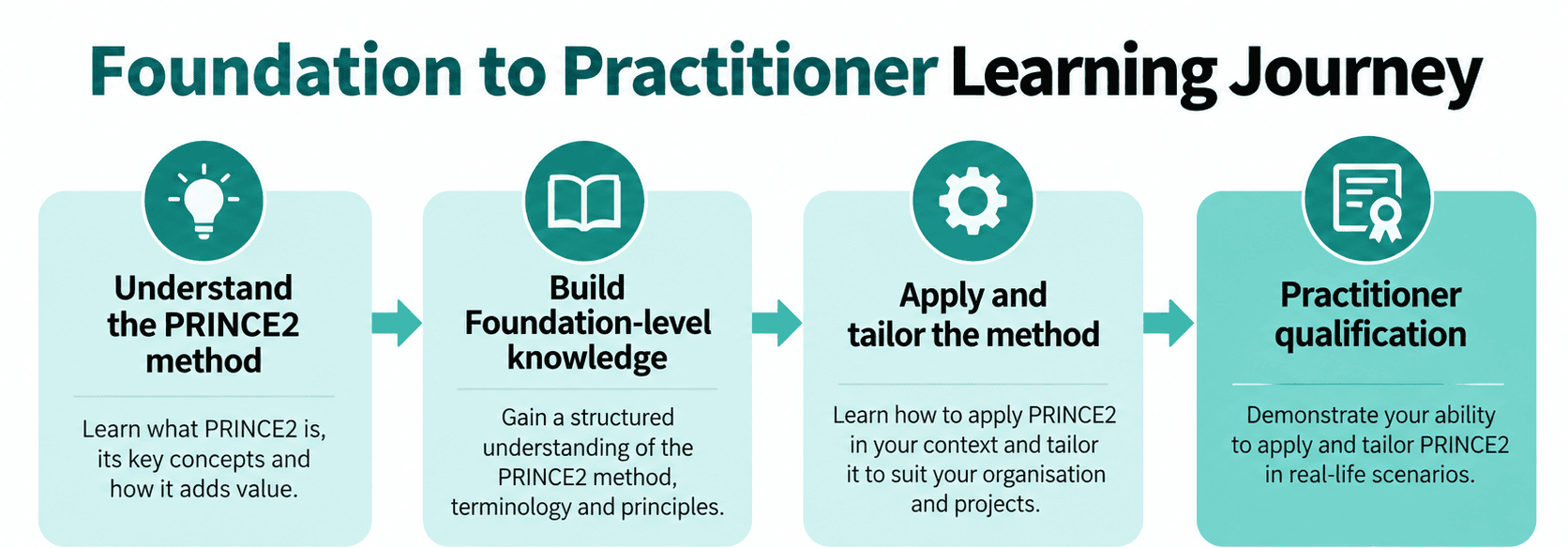
Foundation focuses on understanding the PRINCE2 method. Practitioner focuses on applying and tailoring that method in project situations.
| Feature | Foundation | Practitioner |
|---|---|---|
| Main purpose | Understand the method | Apply and tailor the method |
| Knowledge emphasis | Terminology, structure, and concepts | Contextual application and decisions |
| Prerequisite | No previous PRINCE2 qualification required | Accepted prior qualification required |
| Assessment focus | Understanding and recall | Application in scenarios |
| May suit | Newcomers and people building foundational knowledge | People ready to develop and demonstrate application-focused knowledge |
Foundation and Practitioner are complementary rather than competing qualifications.
If you’re starting from scratch, Foundation is generally the more natural first step. If you already meet a recognised prerequisite and understand PRINCE2, Practitioner may be the more relevant qualification to investigate.
For the full comparison, read PRINCE2 Foundation vs Practitioner: What’s the Difference?
Should You Take PRINCE2 Foundation and Practitioner Together?
Taking Foundation and Practitioner as part of a combined learning route can make sense if you’re starting without a recognised prerequisite and already know you want to progress towards applying the PRINCE2 method.
A combined route may help you plan your learning around both levels, rather than deciding on the next qualification only after completing Foundation.
However, it isn’t automatically the right choice for everyone.
If you are new to Project Management and want to establish whether PRINCE2 is relevant to your goals, starting with Foundation alone may be sufficient.
If you already hold another accepted qualification, you may want to investigate whether you need a separate Foundation examination at all.
The right choice depends on your eligibility, existing knowledge, learning goals, and preferred preparation route.
Is PRINCE2 Practitioner Worth It?
PRINCE2 Practitioner can be worth pursuing if you want to demonstrate your understanding of applying and tailoring the PRINCE2 method, especially when that method is relevant to your work or intended career direction.
Its value depends on what you need from the qualification.
Practitioner may be useful if you:
- work in an organisation that uses PRINCE2,
- want to develop beyond Foundation-level understanding,
- need to interpret project governance and management decisions,
- support projects that require structured controls and reporting,
- want to demonstrate application-focused knowledge to employers, or
- are developing your wider Project Management capabilities.
Its practical value is likely to be strongest when it supports the responsibilities you have, or the responsibilities you are preparing to undertake.
Does PRINCE2 Practitioner Mean You Are an Experienced Project Manager?
No. Passing PRINCE2 Practitioner does not automatically mean someone has extensive professional Project Management experience.
The qualification demonstrates assessed knowledge and application of the PRINCE2 method. Professional experience involves using skills, judgement, and responsibilities in actual working environments over time.
Both can be valuable, but they are not interchangeable.
For example, someone may pass Practitioner before managing their first major project. Another person may have years of Project Management experience but little formal exposure to PRINCE2.
Employers may consider qualifications, experience, technical skills, industry knowledge, and the responsibilities of a particular role when assessing candidates.
Practitioner is therefore best understood as a recognised qualification that can complement practical experience.
Does PRINCE2 Practitioner Expire?
Yes. PRINCE2 Practitioner certification is subject to PeopleCert’s renewal requirements and should not be treated as a lifetime credential that remains current without further action.
PeopleCert provides routes for keeping certification current, including qualifying CPD activity through PeopleCert Plus and certain further examinations within the relevant product suite.
Its current Practitioner listing refers to 60 CPD points for renewal through the membership route.
Candidates should check their individual renewal date and the current PeopleCert certification policy, as the applicable arrangements can depend on their certification status and chosen renewal route.
What Can You Do After PRINCE2 Practitioner?
After PRINCE2 Practitioner, the most useful next step is often to apply your knowledge in actual project environments and continue developing your Project Management capabilities.
That could involve:
- applying PRINCE2 controls and governance to suitable projects,
- developing experience in project planning, reporting, risk, and stakeholder management,
- taking on greater project coordination or management responsibilities,
- strengthening complementary technical and interpersonal skills,
- exploring additional qualifications where relevant to your career, and
- maintaining your certification under current PeopleCert requirements.
The qualification is a milestone in professional development, not the end of learning.
Frequently Asked Questions About PRINCE2 Practitioner
What Is PRINCE2 Practitioner?
PRINCE2 Practitioner is a professional Project Management qualification focused on applying and tailoring the PRINCE2 method in project situations. It assesses more than foundational knowledge and requires candidates to hold an accepted prerequisite qualification. The current version is PRINCE2® Project Management Practitioner (Version 7).
How Many Questions Are in the PRINCE2 Practitioner Exam?
The current PRINCE2 Practitioner exam contains 56 questions and sub-questions, worth a total of 70 marks. It uses an objective-testing format and lasts 150 minutes. Candidates should distinguish the number of questions and sub-questions from the total available marks when reviewing the exam specification.
What Is the PRINCE2 Practitioner Pass Mark?
The PRINCE2 Practitioner pass mark is 60%. As the current examination is worth 70 marks, candidates need at least 42 marks to pass. This is the current PeopleCert specification for Version 7, rather than a pass rate describing how many candidates succeed.
Can You Take PRINCE2 Practitioner Without Foundation?
Yes. PeopleCert accepts certain alternative Project Management qualifications as Practitioner prerequisites. These include specified PMI, APM, and IPMA qualifications. However, candidates must still meet the official requirements, and individual training providers may set their own course-entry conditions.
Is PRINCE2 Practitioner Harder Than Foundation?
Practitioner may feel more demanding because it assesses application and tailoring rather than concentrating on foundational understanding. The challenge depends on how familiar you are with PRINCE2 and how comfortable you are interpreting project situations. Neither examination should be judged solely by its question count or pass mark.
Is PRINCE2 Practitioner Open Book?
Yes. PRINCE2 Practitioner is an open-book examination. Candidates may use approved official core guidance (PRINCE2® Project Management) in accordance with PeopleCert’s rules. Open book does not mean unrestricted access to personal notes, external websites, or other resources. Understanding the method remains important because the exam is time-limited.
Does PRINCE2 Practitioner Make You a Project Manager?
Passing Practitioner does not automatically appoint you to a Project Manager role or prove extensive experience managing projects. It demonstrates assessed knowledge of applying and tailoring PRINCE2. Employers can consider the qualification alongside practical experience, relevant skills, and the requirements of individual vacancies.
Does PRINCE2 Practitioner Need Renewing?
Yes. Practitioner certification is subject to renewal. PeopleCert offers recognised routes for maintaining current certification, including CPD through an eligible membership arrangement and certain further examinations. Certificate holders should check their renewal date and applicable requirements directly with PeopleCert.
Is PRINCE2 Practitioner Worth Doing After Foundation?
Practitioner may be a worthwhile progression if you want to demonstrate application-focused PRINCE2 knowledge. Foundation establishes understanding of the method, while Practitioner develops and assesses its application in project scenarios. The value of progressing depends on your work, intended responsibilities, and whether PRINCE2 is relevant to your goals.
What Should You Explore Next?
PRINCE2 Practitioner is most relevant when you’re ready to move beyond understanding the method and focus on how it should be applied to different project situations.
If you’re new to PRINCE2, Foundation may be the more suitable starting point. If you already meet the prerequisites and want to develop application-focused knowledge, Practitioner may be a logical next step.
You can explore ITonlinelearning’s PRINCE2 Practitioner training to understand the current course options.
If you’re unsure whether Foundation, Practitioner, or a combined route best fits your goals, a Course & Career Advisor can help you compare your options.