Communication Management in PRINCE2®
PRINCE2 communication management helps ensure the right people receive relevant project information and have opportunities to provide feedback. It combines the Communication Management Approach, formal reporting, stakeholder engagement, and day-to-day collaboration. Together, these support informed decisions, effective relationships, project control, and timely escalation, with communication arrangements tailored to the project’s context.
Communication vs Reporting vs Stakeholder Engagement
| Activity | What it involves | Example |
|---|---|---|
| Communication | Exchanging relevant information | Discussing a dependency with a supplier |
| Reporting | Providing structured information for management and control | Sending a Highlight Report to the Project Board |
| Stakeholder engagement | Understanding, involving, and working with stakeholders | Inviting users to review a proposed solution and discuss concerns |
These activities are connected, but they are not interchangeable. A report communicates information, while meaningful engagement often requires conversation, listening, and participation.
What Is PRINCE2 Communication Management?
PRINCE2 communication management is the organised approach to exchanging information, receiving feedback, and maintaining communication across the project ecosystem.
It helps project participants understand what is happening, why it matters, what decisions have been made, and what is expected of them.
This goes beyond sending status updates. Effective communication can help a Project Manager identify concerns, maintain relationships, coordinate delivery, and make sure relevant information reaches the appropriate decision-makers.
For example, the Project Board may need a concise summary of progress against the Stage Plan. A delivery team may require detailed product requirements and decisions. People who will use the finished product may need opportunities to review proposed changes and explain how these will affect their work.
All three groups need communication, but not necessarily the same communication.
Where Does Communication Fit in PRINCE2?
Communication is integrated throughout PRINCE2 rather than being treated as a separate Practice.
PRINCE2 has five integrated elements: Principles, People, Practices, Processes, and Project Context.
Communication contributes to each of these.
- People: Building relationships, sharing information, listening, collaborating, and supporting change.
- Principles: Supporting clear responsibilities, Management by Exception, and learning from experience.
- Practices: Communicating information about plans, quality, risks, issues, business justification, and progress.
- Processes: Supporting decisions, authorisations, delegation, delivery, reporting, and project closure.
- Project Context: Determining how communication should be organised and tailored.
Communication is therefore not an eighth PRINCE2 Practice. It is a people-focused activity that helps the other elements work together.
For a broader explanation, explore our guide to the seven PRINCE2 Practices.
How Does the People Element Influence Communication?
The People integrated element recognises that projects depend on relationships as well as procedures.
Projects bring together individuals with different responsibilities, priorities, knowledge, and expectations. Some contribute directly to delivery, while others may be affected by the changes the project introduces.
PRINCE2 therefore places considerable importance on understanding these relationships and creating suitable ways of working.
Communication supports this by helping people:
- Develop a shared understanding of the project’s purpose.
- Understand their roles and responsibilities.
- Work together across organisational boundaries.
- Raise concerns and provide feedback.
- Build and maintain working relationships.
- Prepare for changes that affect their responsibilities or routines.
For example, a new software platform might be technically successful but still create difficulties if operational teams are not involved in discussing how it will be introduced.
Communicating a launch date is useful. Understanding how the new platform affects daily responsibilities and involving relevant users in preparations goes further.
PRINCE2 also emphasises collaboration and co-creation. In appropriate circumstances, involving users and key influencers in developing products or ways of working can help establish shared understanding.
Culture matters, too. People are less likely to raise concerns openly when they believe negative feedback will be unwelcome.
Strong project leadership helps create an environment in which people can exchange information constructively.
Read more about the People element in PRINCE2.
Why Does PRINCE2 Communication Extend Beyond the Project Team?
A project does not operate in isolation.
PRINCE2 distinguishes between the project ecosystem and the wider organisational ecosystem.
The project ecosystem includes the parts of the business involved in or directly affected by the project, together with associated users and suppliers. The organisational ecosystem extends further to include the organisation’s internal elements and external relationships.
This means effective communication may need to involve people who do not hold formal project management roles.
Depending on the project, they could include operational departments, suppliers, users, customers, regulators, or other affected groups.
Consider an organisation introducing a new customer-service system.
The development team needs technical requirements. The Customer Service Manager needs to understand operational impacts. The Information Security team may need to review relevant controls. Employees who will use the system need information and opportunities to provide feedback.
The communication arrangements should recognise these different needs.
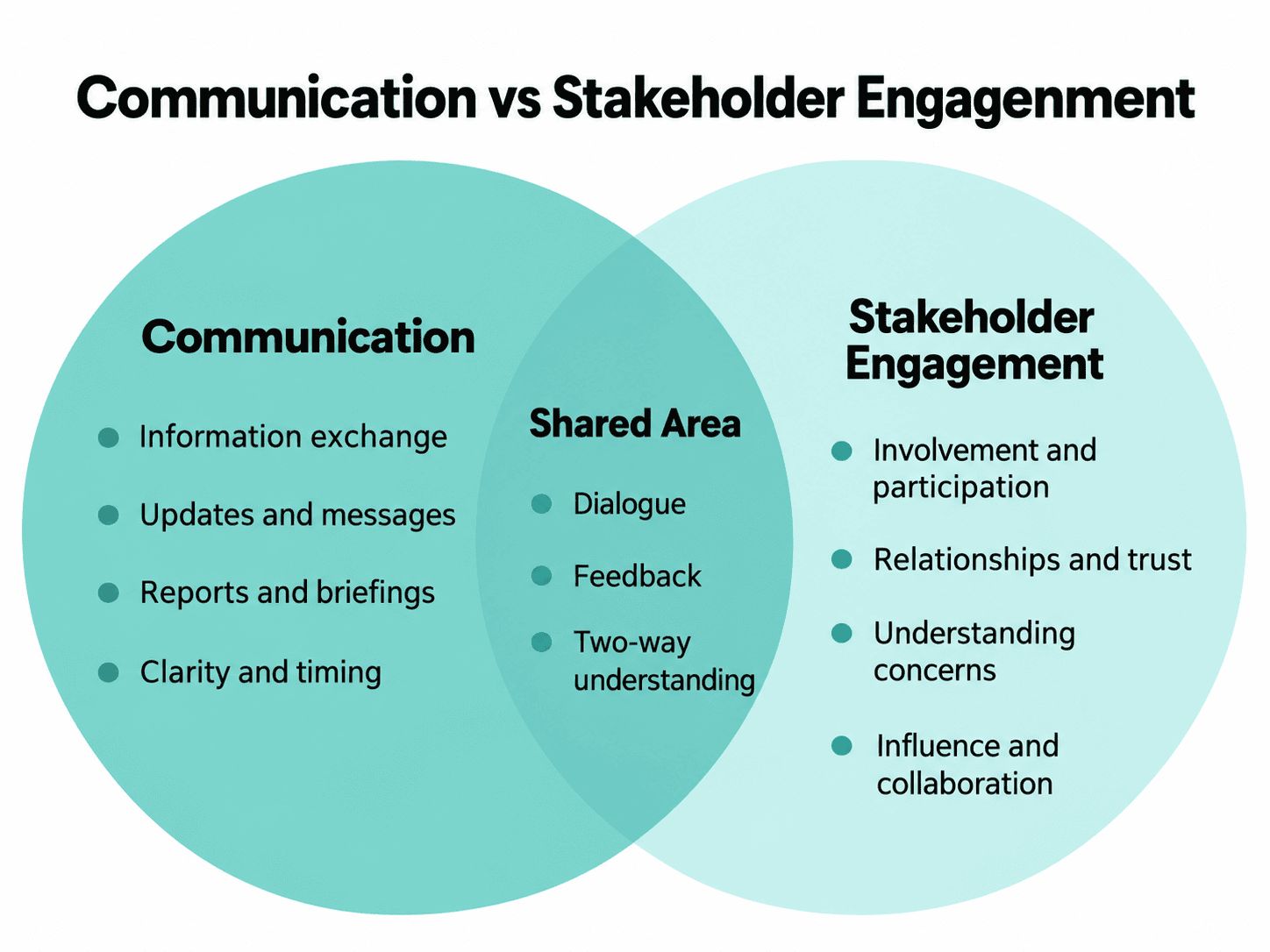
What Is the Difference Between Communication and Stakeholder Engagement?
Communication concerns the exchange of information. Stakeholder engagement involves understanding, involving, listening to, and building relationships with people who can affect or be affected by the project.
Communication is an important part of engagement, but exchanging information does not automatically mean stakeholders are meaningfully involved.
For example:
Communication: The Project Manager emails users about a planned system change.
Engagement: The Project Manager and relevant user representatives discuss the proposed change, identify concerns, and explore how the project could address them.
The second example still involves communication, but it also allows stakeholders to contribute their perspectives.
This distinction matters because a project may distribute regular updates while overlooking concerns that could affect the project’s success.
Good engagement requires attention to what people say in response, not simply evidence that information has been sent.
For a closer look at how PRINCE2 helps project teams identify, understand, and involve the right people, explore our guide to PRINCE2 Stakeholder Management.
What Is the PRINCE2 Communication Management Approach?
The Communication Management Approach is an official PRINCE2 management product that forms part of the Project Initiation Documentation.
It describes how communication and feedback will be managed across the project ecosystem.
Its purpose is to establish appropriate communication arrangements that support stakeholder engagement, shared understanding, and the development of the project.
In practical terms, the approach helps answer questions such as:
- Which stakeholders need to be considered?
- What information needs to be communicated?
- What communication activities and channels will be used?
- How frequently should communication take place?
- Who is responsible for communication activities?
- How can people provide feedback?
- What resources, tools, and standards apply?
The approach is concerned with listening as well as communicating messages.
This distinction is important because stakeholders may have concerns or information that the project team does not yet understand.
A project that only broadcasts updates could miss these perspectives.
The Communication Management Approach should also remain appropriate as the project evolves. New stakeholders may become important, relationships may change, and different types of information may be needed as delivery progresses.
The Project Manager is responsible for developing and maintaining the project’s communication arrangements, while the Project Board approves the management approaches as part of the Project Initiation Documentation and any subsequent proposed changes requiring its approval.
Does PRINCE2 Require a Communication Plan?
PRINCE2 7 identifies the Communication Management Approach as the relevant official management product.
It does not prescribe an additional, separately named mandatory management product called a Communication Plan.
However, that does not mean communication should be left unplanned.
The Communication Management Approach includes communication arrangements and schedules. Projects may use practical tools such as communication calendars, stakeholder matrices, or planning tables to support its implementation.
For example, a Project Manager could maintain a simple spreadsheet recording which stakeholder groups receive updates, how frequently communication takes place, and who is responsible.
This spreadsheet would be a useful working tool, but it should not be presented as an additional mandatory PRINCE2 management product.
The important distinction is between the official management information required by the method and the format chosen to maintain and use it.
What Should Project Communication Arrangements Cover?
Effective arrangements should establish how the project will exchange relevant information and obtain feedback.
The Communication Management Approach provides the formal framework. A practical planning tool can make those arrangements easier to implement.
Who Needs the Information?
Different audiences need different levels of detail.
The Project Board usually needs information that supports oversight and decisions. Delivery teams need enough detail to understand authorised work. Users may need information about how the project’s products will affect them.
Sending every stakeholder every report can create unnecessary information overload.
Instead, consider what each audience needs to know and why.
Why Are You Communicating?
Before choosing a communication method, establish its purpose.
Is the aim to provide an update, obtain feedback, request a decision, coordinate work, or escalate a concern?
The answer affects what information should be included and how quickly it needs to reach the recipient.
For example, a routine progress summary and a forecast tolerance breach have different purposes. They should not automatically follow the same communication timetable.
Which Communication Channels Should You Use?
Communication methods should be appropriate to the audience, purpose, and project context.
Depending on the situation, a project might use reports, meetings, workshops, demonstrations, electronic dashboards, emails, or collaboration platforms.
These formats are illustrative options rather than a mandatory PRINCE2 channel list.
A dashboard may support management oversight, while a discussion or demonstration may be more suitable for exploring user concerns.
The aim is not to select the most sophisticated tool. It’s to establish useful information exchange.
How Often Should Communication Happen?
PRINCE2 does not require every stakeholder to receive weekly updates.
The appropriate frequency depends on the information, management controls, audience, and project circumstances.
For example, Checkpoint Reports are produced according to arrangements defined in the relevant Work Package. Highlight Reports are produced at intervals determined for Project Board oversight.
Other communication may be event-driven.
A serious issue or forecast exception may require attention before the next scheduled report.
What Reports Does PRINCE2 Use for Communication and Control?
PRINCE2 uses management reports to communicate structured information about project progress, performance, decisions, and significant events.
These reports support the Progress Practice and help information reach the appropriate level of management.
Common PRINCE2 Reports and Who They Help Inform
| Report | Prepared by | Main recipient | Typical timing |
|---|---|---|---|
| Checkpoint Report | Team Manager | Project Manager | Agreed intervals within the Work Package |
| Highlight Report | Project Manager | Project Board | Agreed reporting intervals |
| End Stage Report | Project Manager | Project Board | Stage boundary |
| Exception Report | Project Manager | Project Board | When project or stage tolerances are forecast to be exceeded |
| End Project Report | Project Manager | Project Board | During project closure |
| Issue Report | Context-dependent | Relevant decision-makers | When formal issue review is needed |
The Lessons Report is another PRINCE2 management product. Its reporting arrangements depend on the circumstances and may be event-driven or time-driven.
These reports are not intended to replace all other forms of communication.
For more detail, see our guide to PRINCE2 management products.
What Is a Highlight Report?
A Highlight Report gives the Project Board a summary of stage progress and status at agreed intervals.
It is prepared by the Project Manager and helps the Project Board maintain oversight without becoming involved in every day-to-day decision.
For example, a Highlight Report might summarise completed work, upcoming activities, progress against the Stage Plan, and important risks or issues.
The Project Board determines the reporting intervals appropriate to its oversight needs.
What Is a Checkpoint Report?
A Checkpoint Report communicates the status of work being undertaken within a Work Package to the Project Manager.
It is normally prepared by the Team Manager, with reporting frequency defined in the Work Package.
It helps the Project Manager understand how delegated delivery work is progressing and whether corrective action may be required.
For example, a Team Manager might report completed products, forthcoming activities, and any concerns affecting the Work Package.
What Is an End Stage Report?
An End Stage Report helps the Project Board assess progress at a management stage boundary and determine what should happen next.
The Project Manager prepares the report to provide an overview of stage performance and the wider project situation.
It supports the decision about whether to authorise the next stage, subject to the project’s continued justification and other considerations.
Explore PRINCE2 project stages and the project lifecycle for more context.
What Is an Exception Report?
An Exception Report informs the Project Board that project or stage tolerances are forecast to be exceeded and presents options and recommendations for proceeding.
It is prepared by the Project Manager.
Unlike routine progress reporting, an Exception Report communicates a situation requiring higher-level consideration.
For example, a supplier delay might create a forecast breach of the Stage Plan’s time tolerance.
The Project Manager would need to escalate the situation rather than continue treating it as ordinary progress information.
What Is an End Project Report?
An End Project Report reviews how the project performed against the Project Initiation Documentation used to authorise it.
It is prepared by the Project Manager and presented to the Project Board as part of the project closure decision.
The report helps the Project Board assess delivery performance, consider relevant recommendations, and determine whether the project can be formally closed.
How Does Information Flow Through a PRINCE2 Project?
Information moves through multiple levels and relationships within a PRINCE2 project.
For governance purposes, the method distinguishes the business, directing, managing, and delivering layers.
These layers establish how authority is delegated and how information supports decisions.
For example:
- The business layer provides the wider organisational direction and governance context.
- The Project Board directs the project and authorises major decisions within its authority.
- The Project Manager manages the current stage and reports progress to the Project Board.
- Team Managers and delivery teams carry out authorised work and communicate relevant progress information.
However, communication does not only travel upwards.
It also moves downwards when decisions, instructions, and authorisations are communicated.
Information travels across teams when people coordinate dependencies, share knowledge, or resolve concerns.
Communication also extends beyond the formal project management structure to users, suppliers, and other stakeholders.
The most useful way to understand information flow is therefore as a combination of structured reporting and broader communication across the project ecosystem.
Who Is Responsible for Communication in PRINCE2?
Communication responsibility is distributed across the project management structure.
The Project Manager has an important coordinating and reporting role, but this does not mean every conversation, update, or relationship must be managed personally by the Project Manager.
Communication Responsibilities in PRINCE2
| Role | Communication-related responsibilities |
|---|---|
| Business layer | Provides wider business direction, requirements, and governance information |
| Project Board | Directs the project, communicates authorisations and decisions, and receives management reports |
| Executive | Leads the Project Board and represents the business interest |
| Senior User | Represents user interests and helps ensure user needs and perspectives are considered |
| Senior Supplier | Represents supplier interests and expertise |
| Project Manager | Coordinates stage management, provides reports, communicates decisions, and supports agreed stakeholder communication arrangements |
| Team Manager | Communicates Work Package status, progress, and relevant delivery concerns |
| Project Assurance | Supports independent assurance and communicates assurance findings through appropriate arrangements |
| Project Support | May assist with administration, information management, and communication-related activities where assigned |
The exact allocation of communication activities should be clear within the project’s agreed arrangements.
What Communication Is the Project Manager Responsible For?
The Project Manager manages the current stage on behalf of the Project Board, within delegated authority.
Communication forms part of this responsibility.
The Project Manager needs to maintain suitable information flows with delivery teams, report to the Project Board, and ensure relevant risks, issues, progress information, and decisions are communicated appropriately.
The Project Manager also has a role in establishing and maintaining the management approaches used by the project.
What Does the Team Manager Communicate?
The Team Manager helps ensure the Project Manager receives appropriate information about the status of authorised work.
This normally includes reporting progress through Checkpoint Reports and communicating matters requiring attention.
The agreed Work Package arrangements establish what reporting is required.
How Does the Project Board Communicate Direction?
The Project Board is not simply a recipient of reports.
It directs the project by making decisions, providing authorisations, and delegating authority to the Project Manager.
It also considers escalated exceptions and stage-boundary decisions.
Information therefore moves both towards and away from the Project Board.
For a fuller explanation, read PRINCE2 roles and responsibilities.
How Does Communication Support Management by Exception?
Management by Exception depends on clearly defined authority, agreed tolerances, and timely information.
In PRINCE2, tolerances establish how much variation from an agreed plan is permitted before escalation is required. For more detail on how these limits work across the seven performance targets, see our guide to tolerances in PRINCE2.
Routine reporting allows senior management to remain informed without continually directing day-to-day activities.
The Project Manager can make appropriate adjustments within delegated Stage Plan tolerances.
However, when a tolerance is forecast to be exceeded, the situation must be escalated to the next management level.
This is where communication becomes a critical project control.
What Happens When Tolerance Is Forecast to Be Exceeded?
Consider a project where a supplier delay is forecast to push the current stage beyond its permitted time tolerance.
The Project Manager should not simply wait until the planned completion date has passed.
Instead, the situation needs to be assessed and escalated through the relevant exception arrangements.
An Exception Report can explain the forecast deviation, its consequences, available options, and a recommendation.
The Project Board can then consider how the project should proceed.
This illustrates why PRINCE2 distinguishes routine reporting from communication that requires an immediate management response.
Learn more about Management by Exception in PRINCE2.
Why Are Formal Reports Not Enough?
Formal management reports are valuable, but they do not represent the entire communication system of a project.
A Highlight Report may provide accurate information about stage performance without revealing whether users understand an upcoming change or whether relationships between teams are deteriorating.
PRINCE2 recognises that important information may emerge through informal conversations, working relationships, and feedback.
For example, a delivery team member might mention a developing dependency during a routine discussion.
A user might express concerns about a proposed process during a demonstration.
A supplier might identify a practical problem that has not yet appeared in formal reporting.
These conversations can provide useful information before a problem becomes significant.
The aim is not to replace formal reporting with informal communication. Both contribute to effective project management.
An open project culture can also make it easier for people to raise concerns early.
How Does Communication Support Risk, Issue, and Change Management?
Communication supports several PRINCE2 Practices by helping information reach the people who need to assess it or take action.
Risk Management
Risks involve uncertainty about events that could affect project objectives.
Relevant information about identified risks, changing circumstances, responses, and ownership needs to reach appropriate people.
For example, if a supplier identifies a possible shortage of specialist resources, the project needs a way to communicate and assess that uncertainty.
A risk may require monitoring, action, or escalation depending on its significance.
Issue Management
Issues may include requests for change, off-specifications, problems, or concerns requiring management attention.
Communication helps ensure issues are raised, assessed, considered by the appropriate authority, and followed through.
Importantly, stakeholder feedback does not automatically authorise a change.
A user requesting an additional feature has provided information that may need formal consideration. The request must still be handled according to the project’s issue management arrangements.
Read our guide to the difference between risks and issues in PRINCE2.
Organisational Change
Projects may introduce changes to people’s responsibilities, processes, routines, and working relationships.
Communication helps the project understand how people may be affected and supports the activities needed to prepare for those changes.
The Communication Management Approach and Change Management Approach are related, but they serve different purposes.
The first focuses on information exchange, communication, and feedback. The second addresses the transition from the current organisational state towards the required future state.
How Should PRINCE2 Communication Be Tailored?
PRINCE2 communication arrangements should suit the project’s context.
A small internal project with a closely connected team may need relatively simple communication arrangements.
A complex project involving multiple suppliers, locations, and stakeholder groups may require more structured approaches.
Tailoring can affect:
- Communication formats and channels.
- Reporting frequency and detail.
- Stakeholder involvement.
- Formality of documentation and controls.
- How teams collaborate.
- How information is made accessible.
- How arrangements are reviewed as the project progresses.
For example, a small project might use short progress summaries and regular direct conversations.
A geographically distributed project may benefit from agreed reporting arrangements, shared collaboration tools, and deliberate opportunities for informal discussion.
Neither approach is automatically better.
The important question is whether the arrangements provide the information, feedback, and management control the project needs.
Tailoring communication does not mean removing important communication.
It means designing arrangements that remain proportionate, effective, and suitable.
See our guide to tailoring PRINCE2 to your project.
How Does PRINCE2 Communication Work in Agile or Hybrid Projects?
PRINCE2 can be applied alongside linear, iterative, and hybrid delivery methods.
This flexibility extends to communication.
An iterative delivery team may use regular working discussions, demonstrations, reviews, or other feedback activities to coordinate specialist work.
At the same time, PRINCE2 project management controls can provide information needed for governance, stage management, and higher-level decisions.
For example, a Scrum Team may use Daily Scrums to support delivery coordination while the Project Manager provides Highlight Reports to the Project Board at agreed intervals.
These activities serve different purposes and can coexist.
PRINCE2 does not require replacing the delivery team’s useful communication practices with additional meetings or documents purely for the sake of formality.
Instead, reporting and communication should be tailored so that the project retains appropriate control while supporting the chosen delivery method.
Read more in PRINCE2 vs Scrum.
PRINCE2 Communication Management Example
Consider a fictional project to introduce a new customer-service platform.
The project involves a Project Board, Project Manager, software development team, external supplier, Customer Service Manager, end users, and Information Security specialists.
Each group requires different information:
| Audience | Information needed | Example communication |
|---|---|---|
| Project Board | Stage progress, forecasts, significant risks, and decisions | Highlight Report |
| Project Manager | Delivery progress, dependencies, and issues | Checkpoint Reports and working discussions |
| Development team | Authorised work, requirements, priorities, and decisions | Work Package information and collaboration |
| Customer Service Manager | Operational impact and implementation preparation | Workshops and progress discussions |
| Supplier | Requirements, dependencies, and agreed decisions | Coordination meetings |
| End users | Proposed changes and opportunities for feedback | Demonstrations and user discussions |
| Information Security | Relevant security requirements and concerns | Specialist reviews |
Routine Project Communication
During normal delivery, the Project Manager receives agreed progress information from the development team and coordinates with relevant stakeholders.
The Project Board receives Highlight Reports at the agreed frequency.
Communicating a Growing Risk
The external supplier identifies a potential delay involving a required integration.
The concern is communicated so the Project Manager can assess its impact and ensure the risk is managed appropriately.
Escalating an Exception
Further assessment shows that the delay is forecast to exceed the current stage’s time tolerance.
The Project Manager prepares an Exception Report for the Project Board, providing the relevant information and recommendations.
This escalation should not wait for the next routine Highlight Report.
Managing Stakeholder Feedback
During user testing, employees request an additional reporting feature.
The Project Manager ensures the feedback is considered through the appropriate requirements and issue management arrangements.
The new feature is not automatically approved simply because users requested it.
This example demonstrates how formal reporting, day-to-day communication, feedback, and escalation work together rather than operating as separate activities.
A Practical PRINCE2 Communication Matrix
A communication matrix can help translate communication arrangements into an accessible working plan.
The following is an original practical communication-planning tool using PRINCE2 concepts. It is not a mandatory PRINCE2 management-product template.
| Audience | Purpose | Channel | Frequency or trigger | Owner |
|---|---|---|---|---|
| Project Board | Stage oversight | Highlight Report | Agreed intervals | Project Manager |
| Project Manager | Delivery oversight | Checkpoint Report | Work Package schedule | Team Manager |
| Users | Obtain feedback | Demonstration | Agreed review points | Assigned engagement owner |
| Supplier | Coordinate dependencies | Working discussion | As required | Assigned coordination owner |
| Project Board | Escalate forecast exception | Exception Report | When required | Project Manager |
The example can be extended with information needs, response requirements, access restrictions, and review dates where useful.
Use our editable planner to organise communication needs, responsibilities, channels, reporting arrangements, and feedback routes throughout your project.
Common Communication Mistakes in PRINCE2 Projects
Communication problems are not always caused by a lack of information. Sometimes the difficulty is how information is selected, exchanged, or used.
Common mistakes include:
- Treating reports as the whole communication approach. Formal reporting cannot replace meaningful conversations and feedback.
- Sending everyone the same information. Different stakeholders need different levels of detail.
- Failing to establish responsibilities. Unclear ownership may cause important updates or concerns to be overlooked.
- Waiting for routine reporting when escalation is required. Forecast exceptions need timely attention.
- Ignoring informal information flows. Significant concerns may emerge outside scheduled meetings.
- Failing to listen. Broadcasting information without considering responses can weaken engagement.
- Neglecting communication as the project evolves. Changes in stakeholders, delivery arrangements, or relationships may require a revised approach.
Avoiding these mistakes begins with treating communication as an ongoing management activity rather than a documentation exercise.
PRINCE2 Communication Management Checklist
Before finalising or reviewing communication arrangements, consider the following questions:
- Have the relevant stakeholder groups been identified?
- Does each group receive information suited to its needs?
- Is the purpose of each communication activity clear?
- Are responsibilities for communication agreed?
- Are the communication channels appropriate?
- Are reporting frequencies and event triggers established?
- Are feedback routes available and understood?
- Are formal reporting and escalation arrangements clear?
- Is important information accessible to the people who need it?
- Are communication arrangements suitable for remote, co-located, or hybrid teams?
- Have relationships or stakeholder needs changed?
- Does the Communication Management Approach still reflect the project?
Frequently Asked Questions
What is communication management in PRINCE2?
Communication management in PRINCE2 involves planning and managing how project information is exchanged, how feedback is received, and how communication supports stakeholder engagement and project delivery. It is addressed through the Communication Management Approach and the wider application of the method.
Does PRINCE2 have a Communication Management Approach?
Yes. The Communication Management Approach is an official PRINCE2 7 management product included in the Project Initiation Documentation. It establishes the means and frequency of communication and feedback across the project ecosystem.
Does PRINCE2 require a communication plan?
PRINCE2 7 identifies the Communication Management Approach as the official management product. A separate document called a Communication Plan is not prescribed as an additional mandatory management product, although schedules and planning tools can support the approach.
What is a Highlight Report in PRINCE2?
A Highlight Report is prepared by the Project Manager to provide the Project Board with a summary of stage progress and status at agreed intervals.
What is a Checkpoint Report in PRINCE2?
A Checkpoint Report communicates Work Package progress from the Team Manager to the Project Manager at the frequency agreed in the Work Package.
How often should PRINCE2 reports be produced?
Reporting frequencies depend on the project and its agreed controls. Checkpoint and Highlight Reports follow established reporting intervals, while reports such as Exception Reports are triggered by particular events.
Does all PRINCE2 communication need to be formal?
No. PRINCE2 recognises the importance of formal reporting and informal communication. Conversations, feedback, collaboration, and working relationships all contribute to effective information exchange.
How does communication support Management by Exception?
Communication supports Management by Exception by keeping the appropriate management levels informed and enabling prompt escalation when delegated tolerances are forecast to be exceeded.
How should communication be tailored?
Communication should reflect the project’s scale, complexity, stakeholders, delivery method, culture, and control requirements. The format, frequency, and level of detail should be appropriate to the project’s needs.
How does PRINCE2 communication work in Agile projects?
PRINCE2 communication and reporting can coexist with Agile team collaboration, demonstrations, and iterative feedback. Project-level controls and delivery-level communication serve complementary purposes.
What Should You Explore Next?
Understanding PRINCE2 communication management is particularly useful when learning how the method brings together People, governance, reporting, and project controls.
To build on this knowledge, explore our guides to PRINCE2 People, Management Products, Roles and Responsibilities, and Management by Exception.
If you’re preparing for a qualification or want to develop your ability to apply PRINCE2 in real projects, structured Foundation and Practitioner training can help you connect these concepts.
Want to understand how PRINCE2 turns project information into better control and decision-making?