How Do You Tailor PRINCE2 to Different Projects?
To tailor PRINCE2 to different projects, you adapt how the method is applied according to the project’s size, complexity, delivery method, risks, and organisational requirements. This can involve adjusting responsibilities, reporting arrangements, management products, controls, and stages. However, all seven PRINCE2 principles must still be applied to maintain the integrity of the method.
PRINCE2 Project Management (Version 7) is designed to work across different project environments. Rather than prescribing exactly how every project should be managed, it provides a structured approach that can be adapted to suit the circumstances.
The main contextual factors to consider are:
- Organisational context: How the organisation operates and governs projects.
- Commercial context: The relationships and agreements between customers and suppliers.
- Delivery method: How the project produces its deliverables.
- Sustainability requirements: The environmental, social, or other sustainability commitments that affect the project.
- Scale: The project’s relative complexity, importance, and risk.
The objective is to apply an appropriate level of project management without introducing unnecessary work or weakening essential controls.
What Does Tailoring Mean in PRINCE2?
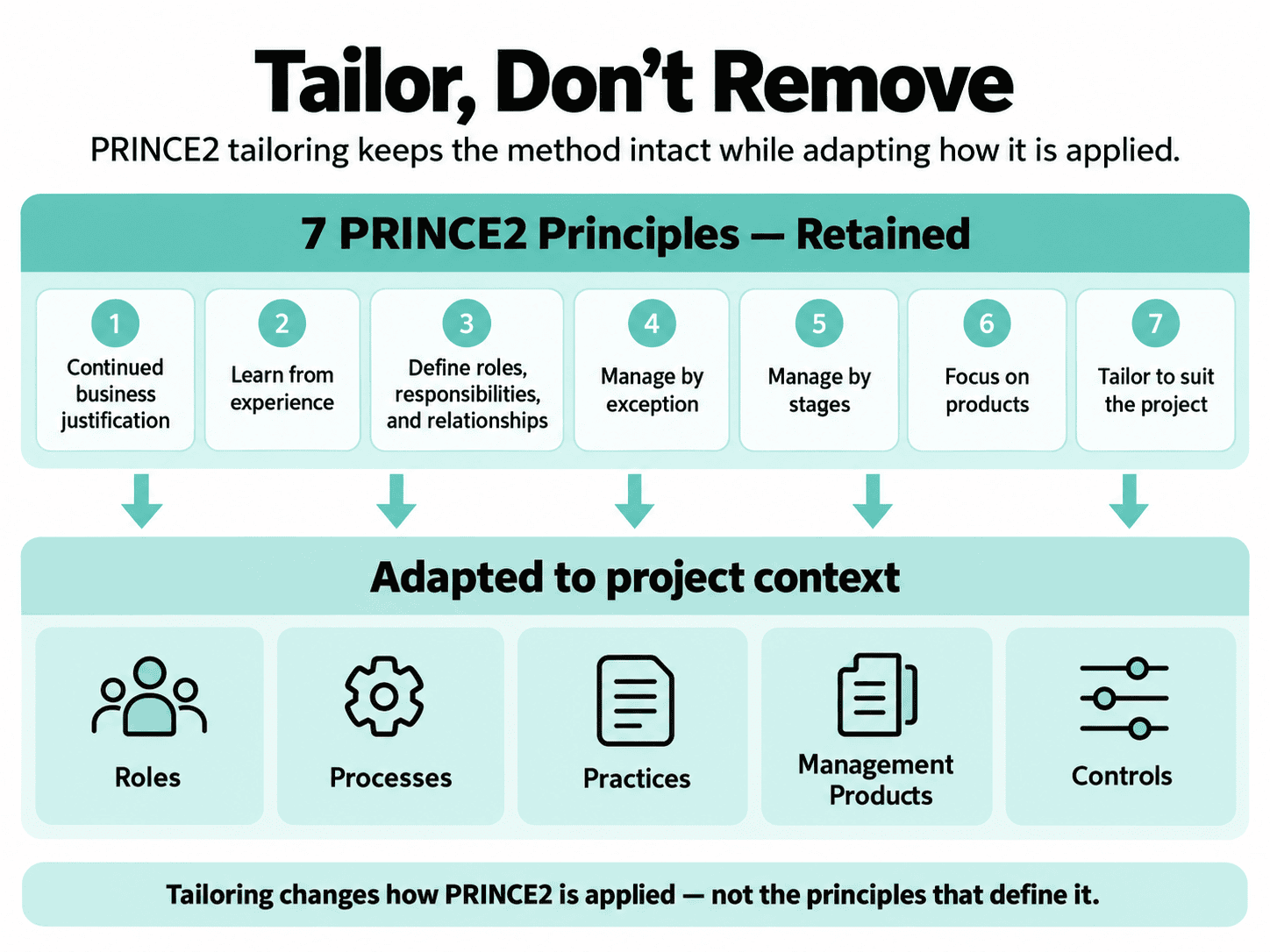
PRINCE2 tailoring is the deliberate adaptation of how the method is used to suit a project’s specific context while preserving its seven guiding principles.
One of the seven PRINCE2 principles is Tailor to suit the project. It recognises that projects differ in their objectives, complexity, risks, delivery methods, and the people involved.
For example, the management arrangements needed to introduce a new internal booking system will differ significantly from those required to deliver a major public infrastructure project.
Both can use PRINCE2, but they don’t need identical structures, reporting arrangements, or levels of formality.
Tailoring involves two connected decisions:
- How the method is configured: Choosing appropriate terminology, techniques, procedures, and management approaches.
- How the method is applied: Deciding how to allocate roles, organise management stages, set tolerances, and establish suitable controls.
The Project Manager recommends how the method should be tailored, while the Project Board is accountable for approving those recommendations.
Explore the seven PRINCE2 principles to understand how they guide decisions throughout a project.
Why Does PRINCE2 Need to Be Tailored?
PRINCE2 needs to be tailored because using identical management arrangements for every project would not provide an appropriate balance between control and effort.
Too much management activity can create unnecessary administrative work, slow decisions, and divert attention from delivery.
Too little can lead to unclear responsibilities, inadequate information, missed risks, or decisions being made without appropriate authority.
Consider two projects.
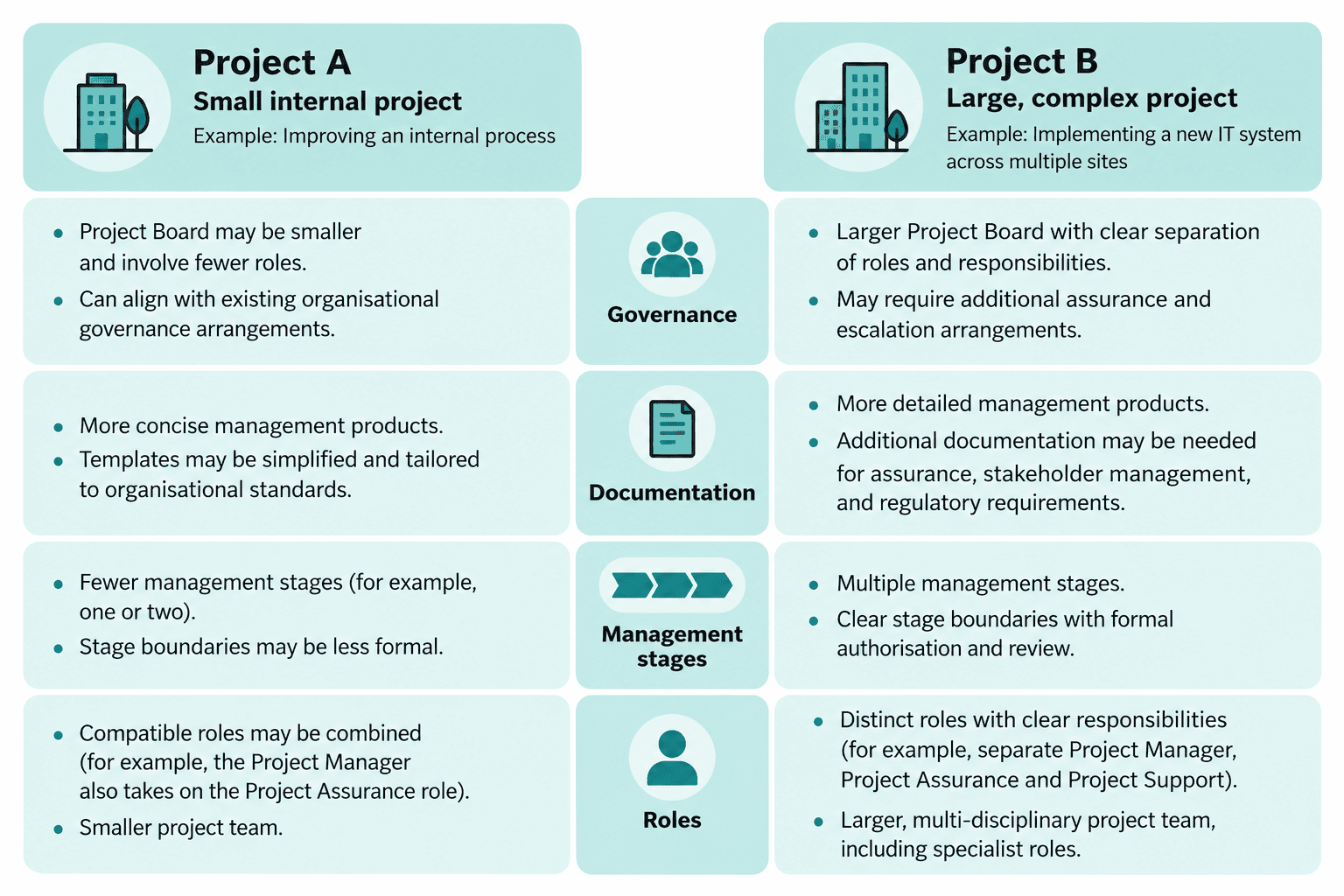
Project A: A marketing department is introducing a new scheduling tool for a small internal team.
Project B: A regional organisation is replacing a business-critical system across multiple locations, involving external suppliers and extensive operational change.
Both projects need clear objectives, agreed responsibilities, controlled progress, and appropriate oversight.
However, Project A may be managed through a smaller team, straightforward records, and relatively simple reporting arrangements.
Project B may need distinct specialist responsibilities, more detailed assurance arrangements, formal supplier coordination, and additional management stages.
The underlying principles remain the same. The way they’re applied is different.
This is what makes PRINCE2 suitable for more than one type of project.
What Can Be Tailored in PRINCE2?
PRINCE2 allows the application of its roles, processes, practices, management products, techniques, controls, and terminology to be adapted to the project context. The amount of management activity and information should reflect the project’s requirements while continuing to fulfil the method’s essential purposes.
| Area | What can change? | Practical example |
|---|---|---|
| Roles | How appropriate roles are allocated or combined | One person undertakes several compatible responsibilities |
| Processes | How process activities are organised and carried out | Activities are integrated with existing organisational procedures |
| Practices | The procedures and techniques used to address each practice | An existing organisational risk procedure is adopted |
| Management products | Format, detail, structure, and combination | Related information is held in one shared digital system |
| Controls | Reporting frequency and formality | A monthly report is used instead of a weekly report where appropriate |
| Terminology | Names used for management activities or information | Familiar internal terminology is mapped to PRINCE2 terminology |
| Stages | The number and boundaries of management stages | Additional stages are introduced around significant investment decisions |
| Delivery arrangements | How specialist work is organised | Iterative software development operates within PRINCE2 governance |
Tailoring should always serve a purpose. Changing a procedure simply because a team prefers something different is not necessarily good tailoring.
The question is whether the proposed arrangement supports effective project management while remaining consistent with PRINCE2 principles.
What Cannot Be Tailored Out of PRINCE2?
The seven PRINCE2 principles cannot be removed. All seven must be applied for a project to be considered a PRINCE2 project.
These principles are:
- Ensure continued business justification
- Learn from experience
- Define roles, responsibilities, and relationships
- Manage by exception
- Manage by stages
- Focus on products
- Tailor to suit the project
For example, a smaller project may use a simpler approach to reporting, but this does not remove the need to monitor progress or escalate forecast exceptions.
Similarly, a project with fewer people may combine compatible roles, but responsibilities and accountability must remain clear.
All seven PRINCE2 practices must also be addressed throughout the project, although the way they’re applied can vary.
Tailoring therefore means maintaining the intent of the method while adapting its implementation.
How Does Project Context Affect PRINCE2 Tailoring?
Project context affects PRINCE2 tailoring by determining what management arrangements are appropriate for the circumstances in which a project operates.
PRINCE2 identifies five important contextual areas: organisational context, commercial context, delivery method, sustainability requirements, and scale.
1. Organisational Context
Organisational context concerns the structures, policies, people, and working arrangements within which a project operates.
For example, a project operating within an established programme may already have governance arrangements, assurance resources, and reporting standards.
A standalone project in an organisation with limited project management experience may need to establish more of these arrangements for itself.
Tailoring should consider existing organisational standards, decision-making structures, team capabilities, and the way people communicate and collaborate.
2. Commercial Context
Commercial context concerns the customer-supplier relationships and contractual arrangements involved in delivering the project.
A project delivered entirely by internal departments may require different commercial management arrangements from one involving several external suppliers.
For example, an organisation commissioning a new customer management system may need to coordinate an external software supplier, an integration partner, and its own IT department.
The project’s roles, reporting arrangements, approval procedures, and management approaches should reflect these relationships.
Contractual obligations must still be respected.
3. Delivery Method
The delivery method describes how the specialist work needed to produce project deliverables is organised.
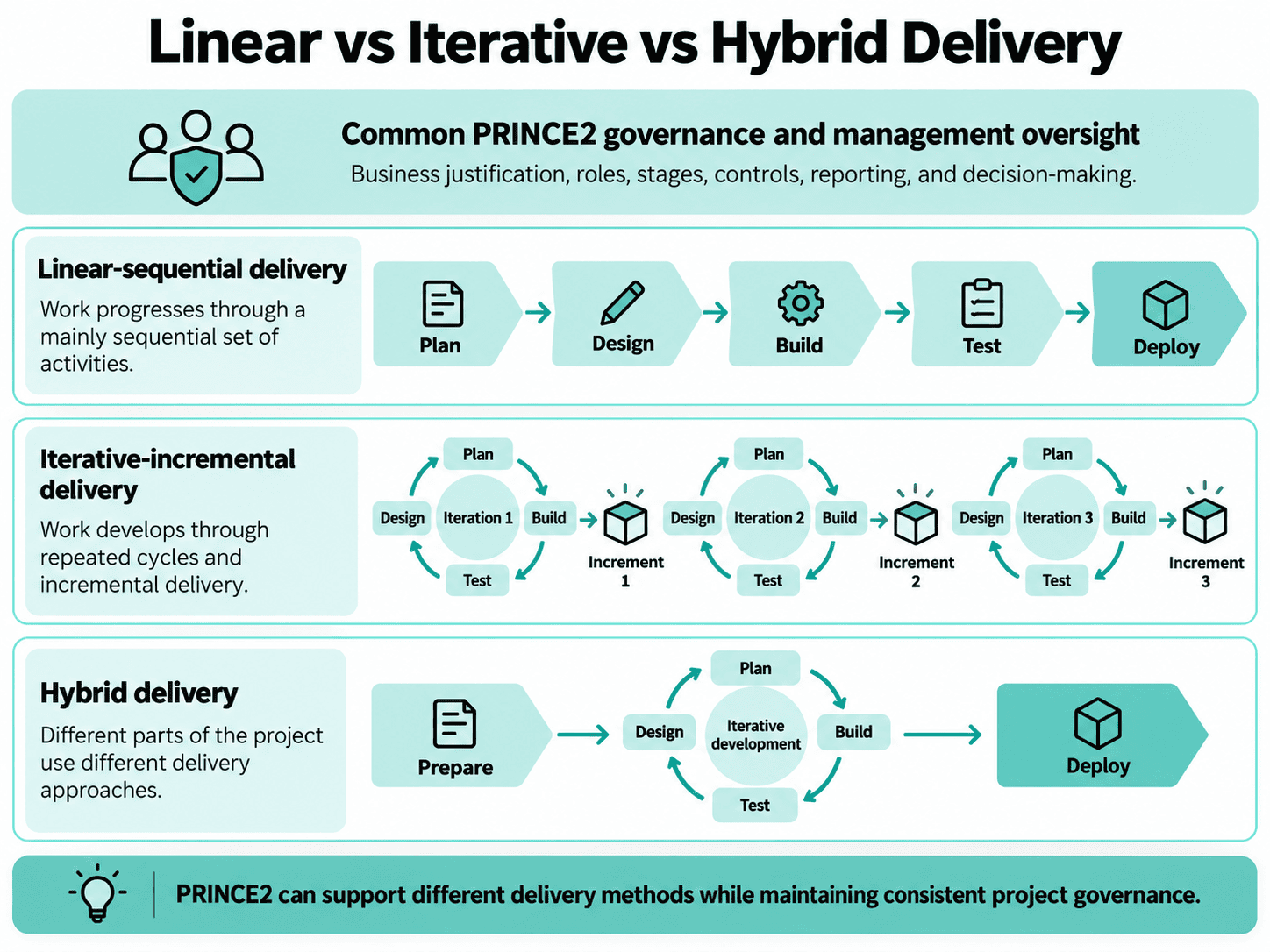
PRINCE2 accommodates different approaches, including:
- Linear-sequential delivery
- Iterative-incremental delivery
- Hybrid delivery
A construction project might use a predominantly linear-sequential approach, while a software project might develop features iteratively and incrementally.
PRINCE2 provides the project management framework around the work rather than requiring one particular method for producing the deliverables.
For examples of how different delivery approaches can operate within PRINCE2 governance, explore our guides to iterative and incremental delivery and hybrid project management.
4. Sustainability Requirements
Sustainability requirements can influence project objectives, responsibilities, reporting, decisions, and acceptance criteria.
For example, an organisation upgrading its facilities may need to consider energy efficiency, waste reduction, environmental commitments, or the longer-term operating costs of the completed facilities.
PRINCE2 Project Management (Version 7) includes sustainability as one of its seven project performance targets.
Tailoring should therefore reflect the sustainability requirements relevant to the project instead of treating them as an unrelated consideration.
5. Scale
Scale concerns the project’s relative size, complexity, importance, and risk.
A small project isn’t automatically simple, and a large project isn’t necessarily difficult to manage.
For example, a relatively small regulatory compliance project may require formal assurance and precise acceptance criteria because the consequences of failure are significant.
Conversely, a larger but predictable internal project may have relatively straightforward governance needs.
The appropriate level of control should reflect the project’s actual circumstances.
Explore the 5 PRINCE2 Project Contexts
Every project operates in different circumstances. Select a context below to explore what it means, how it influences PRINCE2 tailoring, and what this could look like in practice.
Organisational Context
What it means
The organisational structures, policies, culture, capabilities, and governance arrangements within which the project operates.
How it affects tailoring
PRINCE2 can be aligned with existing organisational standards, approval procedures, reporting arrangements, and the capabilities of the people involved.
A project operating within an established programme may use existing programme-level assurance and reporting arrangements. A standalone project may need to establish more of these arrangements itself.
Commercial Context
What it means
The commercial relationships, contracts, responsibilities, and agreements between the organisations involved in delivering the project.
How it affects tailoring
Management arrangements may need to reflect contractual obligations, supplier responsibilities, approval requirements, and agreed reporting or escalation procedures.
A company implementing a new customer management system works with an external software supplier and an integration partner. The project establishes clear supplier interfaces, responsibilities, and reporting arrangements that reflect the contracts.
Delivery Method
What it means
The approach used to produce the project’s deliverables. PRINCE2 can operate with linear-sequential, iterative-incremental, or hybrid delivery methods.
How it affects tailoring
Project management arrangements can accommodate the chosen delivery approach, including its planning techniques, terminology, work packages, progress information, and reporting.
An Agile software team delivers features through short sprints. Several sprints may take place within one PRINCE2 management stage, while the Project Board continues to authorise stages and oversee project performance.
Sustainability Requirements
What it means
The sustainability objectives, commitments, and performance requirements that the project needs to address. These may relate to environmental, social, or longer-term operational considerations.
How it affects tailoring
Project responsibilities, management products, performance targets, controls, and reporting arrangements can be adapted to reflect relevant sustainability requirements.
An organisation upgrading its offices includes agreed energy-efficiency targets in the project requirements. Progress reporting and acceptance arrangements reflect these targets alongside cost, time, quality, and other project performance considerations.
Scale
What it means
The relative size, complexity, importance, and risk of the project. A small project is not necessarily simple, and a large project is not necessarily complex.
How it affects tailoring
The project may require different role arrangements, management stages, documentation detail, controls, reporting frequency, and levels of governance.
A small internal process-improvement project may use concise reporting and combined compatible roles. A complex multi-supplier infrastructure project may need more detailed assurance, defined responsibilities, and additional management stages.
How Do You Tailor PRINCE2 for Small and Large Projects?
PRINCE2 can be simplified for smaller or less complex projects and expanded for larger or more complex projects. The goal is proportionality: management arrangements should provide sufficient control without imposing unnecessary effort.
PRINCE2 Tailoring for Small vs Large Projects
| Management area | Smaller or simpler project | Larger or more complex project |
|---|---|---|
| Roles | Compatible roles may be combined | Greater separation of responsibilities |
| Documentation | Concise, appropriately combined information | More detailed and specialised information |
| Reporting | Simpler arrangements where risk permits | More formal and frequent reporting where necessary |
| Stages | Fewer stages may be suitable | Additional stages may support decision-making |
| Governance | Straightforward but clearly defined | More extensive oversight and assurance |
| Team coordination | Direct communication may be sufficient | Structured communication across multiple teams |
| Controls | Proportionate to risk and importance | Reflect complex dependencies and higher exposure |
Example: Tailoring PRINCE2 for a Small Project
Imagine a local business is introducing a digital stock management system for one branch.
The project involves a small group of staff, an established software product, and relatively few external dependencies.
Suitable tailoring might include:
- Combining compatible project roles.
- Using concise management information.
- Reporting progress at intervals appropriate to the project’s risk.
- Keeping management stages aligned with meaningful decision points.
- Using existing organisational procedures where suitable.
The project still needs a valid business justification, clear authority, appropriate controls, and agreed acceptance criteria.
Example: Tailoring PRINCE2 for a Large Project
Now imagine a national organisation implementing a new stock management system across several distribution centres.
The project involves operational teams, IT specialists, external suppliers, data migration, training, and complex business dependencies.
Suitable tailoring might include:
- Establishing separate responsibilities for specialist areas.
- Defining supplier reporting and escalation arrangements.
- Using detailed management information to coordinate dependencies.
- Introducing management stages around major approvals and deployments.
- Strengthening assurance and stakeholder communication.
The difference is not that the second project uses more PRINCE2 principles. Both projects apply all seven.
The second project requires a more extensive application of the method.
If you’re interested in how this works in technology environments, our PRINCE2 Software Project Management guide explores governance across technical teams, suppliers, testing, and iterative delivery.
How Can PRINCE2 Roles and Responsibilities Be Tailored?
PRINCE2 roles can be allocated or combined to suit the project, subject to specific restrictions. The important requirement is that responsibilities remain clearly assigned and business, user, and supplier interests are represented.
A PRINCE2 role is not necessarily the same as someone’s normal job title. One individual may undertake more than one compatible project role.
However, not every combination is appropriate.
For example:
- The Project Executive may also undertake the Senior User or Senior Supplier role on a suitable smaller project.
- Combining the Senior User and Senior Supplier roles is not recommended because their interests can conflict.
- The Project Executive cannot also be the Project Manager.
- The Project Manager may undertake Team Manager or Project Support responsibilities where appropriate, but the Project Manager role should not otherwise be combined or shared.
The Project Board must still represent the required project interests.
These distinctions matter because tailoring is intended to make the project structure workable, not remove independent oversight or create conflicts in decision-making.
For a more detailed explanation, explore PRINCE2 roles and responsibilities.
How Can PRINCE2 Management Products Be Tailored?
PRINCE2 management products can be tailored by adapting how management information is organised, recorded, maintained, and presented.
Management products are the information needed to manage a project, such as plans, reports, logs, and the business case.
They don’t always need to be separate formal documents.
For example, a project might use:
- A spreadsheet to maintain relevant project information.
- A digital platform to record issues, risks, and decisions.
- A concise report containing information previously presented in several documents.
- A shared system that maintains related management records.
On a simpler project, management products serving related purposes may be combined. On a more complex project, information may need to be separated to make it easier to manage.
The key question is whether the necessary information remains available, accurate, controlled, and useful for decision-making.
Tailoring documentation does not mean removing information that the project needs.
How Can PRINCE2 Processes, Stages, and Controls Be Tailored?
PRINCE2 allows the application of processes, management stages, and controls to be adjusted according to project requirements while preserving the method’s principles.
Tailoring Processes
The seven PRINCE2 processes provide a structured approach to managing activity across the project lifecycle.
Their application can be adapted through existing organisational procedures, reporting arrangements, and supporting techniques.
However, adapting how an activity is performed is different from disregarding its purpose.
For example, an organisation might incorporate PRINCE2 initiation activities into an existing project approval process, provided the necessary decisions and management arrangements are properly addressed.
Learn more about the seven PRINCE2 processes.
Tailoring Management Stages
The number and duration of management stages should reflect the project’s needs.
Every PRINCE2 project requires at least two management stages: an initiation stage and at least one further stage.
Additional stages may be appropriate when a project involves significant risks, major investment decisions, important technical approvals, or changing circumstances.
For example, a complex digital transformation project might have separate management stages for design, implementation, and deployment.
An appropriately simple project might require fewer stages.
The Project Board continues to authorise stages individually, rather than giving unrestricted authority for the entire project.
Tailoring Controls and Reporting
PRINCE2 project controls can be tailored through the frequency, format, and formality of monitoring, reporting, reviewing, and decision-making.
For example, a low-risk internal project may not need the same reporting frequency as a high-risk infrastructure project.
However, the requirement to escalate forecast exceptions remains.
PRINCE2 uses tolerances to define how much a performance target may vary before the next management level needs to intervene.
Those tolerances relate to benefits, cost, time, quality, scope, sustainability, and risk.
Tailoring determines appropriate tolerances and reporting arrangements. It does not eliminate the need to manage by exception.
Can PRINCE2 Be Tailored for Agile or Hybrid Projects?
Yes. PRINCE2 can be tailored for Agile and hybrid projects because it does not require a single specialist delivery method.
PRINCE2 provides the management and governance arrangements surrounding the delivery work. The way that work is performed can vary.
PRINCE2 and Different Delivery Methods
| Delivery method | How delivery works | How PRINCE2 fits |
|---|---|---|
| Linear-sequential | Work progresses through a largely sequential set of delivery steps | Provides stage control, management responsibilities, and oversight |
| Iterative-incremental | Products are developed and refined through repeated cycles and increments | Provides governance around iterative work and decision-making |
| Hybrid | Different parts of the project use different delivery approaches | Coordinates project-level management across those approaches |
PRINCE2 with Agile Delivery
An Agile software team might work through short development cycles, regularly review progress, and adapt detailed requirements using feedback.
PRINCE2 can provide the wider business justification, project governance, defined responsibilities, and management-stage decisions.
The team may use Agile terminology and techniques, such as sprints, user stories, and visual progress boards, where these fulfil the required management purposes.
Importantly, an Agile sprint is not automatically a PRINCE2 management stage.
Several sprints may take place within one PRINCE2 management stage.
PRINCE2 with Hybrid Delivery
A hybrid project combines delivery approaches.
For example, a new customer service operation might involve:
- A sequential process for preparing physical infrastructure.
- Iterative software development for the customer-facing digital platform.
- Coordinated testing and deployment activities.
PRINCE2 can provide a common management structure for these different workstreams, with appropriate plans, responsibilities, controls, and decision points.
The project doesn’t need to force every workstream into the same delivery technique.
How to Tailor PRINCE2 to a Project: A Step-by-Step Guide
Tailoring PRINCE2 is a deliberate management decision rather than a one-off attempt to reduce documentation.
The following steps provide a practical approach.
Step 1: Understand the Project Context
Identify the project’s objectives, complexity, risks, importance, team capabilities, organisational arrangements, delivery method, and external obligations.
Consider which elements of the existing organisational project framework can be used.
Step 2: Identify the Management Requirements
Determine what information, responsibilities, decisions, approvals, and controls the project needs.
Think about who must make decisions, what evidence they’ll require, and which risks need regular attention.
Step 3: Decide How PRINCE2 Will Be Applied
Consider suitable tailoring of:
- Roles and responsibilities
- Practices and management approaches
- Process activities and supporting techniques
- Management products
- Management stages
- Reporting arrangements
- Tolerances and escalation procedures
- Terminology and working methods
Check that the proposed arrangements remain consistent with all seven principles.
Step 4: Document the Agreed Tailoring
The Project Manager should capture how PRINCE2 will be used in the Project Initiation Documentation.
This creates a shared reference for the Project Board, Project Manager, delivery teams, and other relevant participants.
Step 5: Obtain Project Board Approval
The Project Manager recommends tailoring arrangements, and the Project Board approves them as part of authorising the project following initiation.
This ensures that the proposed approach has appropriate oversight.
Step 6: Review the Tailoring as the Project Develops
Tailoring should be reconsidered when circumstances change.
For example, introducing a new supplier, identifying additional risks, or changing the delivery approach may require adjustments to management arrangements.
Proposed changes to management approaches require Project Board approval.
What Are Common PRINCE2 Tailoring Mistakes?
Poor tailoring usually occurs when management arrangements are either applied mechanically or weakened without considering the consequences.
Some common mistakes include:
- Treating the seven principles as optional: All seven remain necessary.
- Removing controls just to save time: Reduced administrative work should not mean losing oversight.
- Combining incompatible roles: Certain combinations can undermine accountability or introduce conflicts of interest.
- Using too much documentation: Requiring extensive reports that nobody uses can create unnecessary management effort.
- Assuming Agile removes the need for governance: Iterative delivery still requires appropriate project management and decision-making.
- Ignoring organisational procedures: Existing policies, standards, and contractual requirements may need to be incorporated.
- Failing to revisit the tailoring: Management arrangements may need to change as the project evolves.
Good tailoring is not measured by how much of the method has been simplified; it’s measured by how appropriately the method supports the project.
How Do You Know If PRINCE2 Has Been Over-Engineered?
A PRINCE2 project may be over-engineered when its management arrangements create more administrative effort than the project reasonably needs.
This can happen when the team uses detailed templates, frequent meetings, or extensive approval procedures without a clear management purpose.
However, reducing these activities should never prevent informed decisions, appropriate oversight, or effective escalation.
A useful test is to ask whether each management activity provides information, control, or assurance that the project genuinely needs.
Are We Over-Engineering This?
Effective PRINCE2 tailoring means finding the right level of management for your project. Tick each statement that accurately describes your current arrangements to identify areas worth reviewing.
Review Your Current Arrangements
Select the statements that apply to your project. Any remaining items can help identify management arrangements that may need further consideration.
Areas worth reviewing
How Does PRINCE2 Tailoring Fit into Training?
Understanding PRINCE2 tailoring is important because knowing the method’s terminology is different from knowing how to apply it to a real project.
PRINCE2® Project Management Foundation (Version 7) introduces the method’s principles, practices, processes, and other key elements.
PRINCE2® Project Management Practitioner (Version 7) places greater emphasis on applying and tailoring the method to project situations.
If you’re deciding which qualification is appropriate, our PRINCE2 Foundation vs Practitioner comparison explains the distinction in more detail.
Frequently Asked Questions About PRINCE2 Tailoring
What Does Tailoring Mean in PRINCE2?
Tailoring means adapting how PRINCE2 is applied to suit the needs and circumstances of a particular project. This can include adjusting the allocation of roles, management products, reporting arrangements, controls, procedures, and stages. The method’s seven principles must still be applied, and the resulting arrangements must provide appropriate project management.
Can PRINCE2 Be Used on Small Projects?
Yes. PRINCE2 can be used on small projects by simplifying its application to match the project’s complexity, risks, and importance. Appropriate tailoring may include combining compatible roles, using concise management information, and adopting straightforward reporting arrangements. However, a small project still needs clear responsibilities, continued business justification, management stages, and appropriate controls.
Can PRINCE2 Be Used on Large or Complex Projects?
Yes. PRINCE2 can be expanded to provide the management arrangements needed for large or complex projects. These may involve separate responsibilities, additional management stages, detailed reporting, multiple suppliers, and more extensive assurance. The level of governance should reflect actual project risks and requirements rather than size alone.
Can PRINCE2 Processes Be Tailored?
Yes. The application of PRINCE2 processes can be adapted to fit project and organisational circumstances. This may involve integrating process activities with existing procedures or selecting suitable supporting techniques. Tailoring should preserve the management purposes of the processes and remain consistent with the seven principles rather than simply omitting essential activities.
Can PRINCE2 Roles Be Combined?
Yes, some PRINCE2 roles can be combined, subject to restrictions. On a smaller project, the Project Executive may also undertake the Senior User or Senior Supplier role. However, the Project Executive cannot also be the Project Manager, and combining the Senior User and Senior Supplier roles is not recommended. Responsibilities must remain clearly allocated.
Can PRINCE2 Management Products Be Simplified?
Yes. PRINCE2 management products can be simplified, combined, or maintained in different formats when appropriate. For example, related records may be held in a shared digital system instead of several documents. However, the essential information required for project management and decision-making must remain available.
Can You Remove a PRINCE2 Principle?
No. All seven PRINCE2 principles must be applied for a project to be considered a PRINCE2 project. Tailoring changes how those principles are implemented, not whether they apply. For example, the controls used to manage by exception can vary, but the principle of establishing delegated authority and escalating forecast exceptions remains necessary.
Can PRINCE2 Work with Agile?
Yes. PRINCE2 can work alongside Agile delivery approaches because it does not prescribe a particular specialist delivery method. Agile teams may use iterative development, sprints, user stories, and frequent feedback, while PRINCE2 provides project-level management, governance, and decision-making. The arrangements should be integrated deliberately so responsibilities and control points remain clear.
Can PRINCE2 Work with Hybrid Delivery?
Yes. PRINCE2 can accommodate hybrid projects that combine linear-sequential and iterative-incremental delivery methods. Different workstreams can use different specialist approaches while operating within a shared project management structure. Tailoring should account for how these workstreams interact and how their progress, risks, and dependencies will be managed.
Who Is Responsible for Tailoring PRINCE2?
The Project Manager is responsible for recommending how PRINCE2 should be tailored, while the Project Board is accountable for approving the recommendations. The agreed arrangements are documented in the Project Initiation Documentation. Proposed changes to the management approaches must also be approved by the Project Board.
Does Tailoring PRINCE2 Reduce Bureaucracy?
Tailoring PRINCE2 can reduce unnecessary administrative work, but its purpose is broader than simply using fewer documents. It helps ensure that responsibilities, management information, reviews, and controls are appropriate to the project. Some projects may need simpler arrangements, while others require more extensive governance because of their complexity, importance, or risks.
What Should You Remember About Tailoring PRINCE2?
The most important point is that PRINCE2 is designed to be adapted, not applied identically to every project.
A small internal improvement project, a major infrastructure programme, and an Agile software initiative can have very different management requirements.
Tailoring allows each project to use suitable responsibilities, controls, stages, reporting arrangements, and management information while retaining the method’s seven principles.
If you’re new to the method, explore our complete guide to PRINCE2 Project Management to understand how the integrated elements work together.
If you’re considering PRINCE2 qualifications and would like help understanding which route suits your experience and goals, you can speak to one of our Course & Career Advisors.