How Does PRINCE2® Support Iterative and Incremental Delivery?
PRINCE2 supports iterative and incremental delivery by separating project management from specialist product development. Teams can repeatedly develop, test, and refine products while adding capability in increments. PRINCE2 provides management stages, plans, tolerances, quality controls, risk and issue management, and progress reporting around that work. The approach is tailored to the project’s context rather than requiring sequential delivery.
PRINCE2 iterative incremental delivery means a project can be managed through PRINCE2 controls while specialist teams develop the solution in repeated cycles. The team doesn’t have to design, build, and test the entire solution in one long sequence.
PRINCE2 does not require Waterfall delivery. It recognises linear-sequential, iterative-incremental, and hybrid delivery approaches.
The important distinction is between how the project is managed and how its products are developed. An iteration is a specialist delivery cycle, while a PRINCE2 management stage provides a period of project-management control. Those periods can be coordinated without having to match exactly.
What Is PRINCE2 Iterative and Incremental Delivery?
In PRINCE2 Project Management, an iterative-incremental approach is a recognised delivery method in which activities such as gathering requirements, design, development, and testing take place iteratively throughout the project lifecycle.
The method is frequently associated with Agile product development, although PRINCE2 doesn’t require a specific Agile framework.
In practical terms, the delivery team doesn’t have to complete all requirements gathering before starting all development, or finish all development before beginning testing.
Instead, work can be revisited and refined as the team learns more about the product.
At the same time, the product can become progressively more capable as additional functionality is developed.
PRINCE2 manages the wider project through its Principles, People, Practices, Processes, and Project Context.
Iterative vs Incremental Delivery: What’s the Difference?
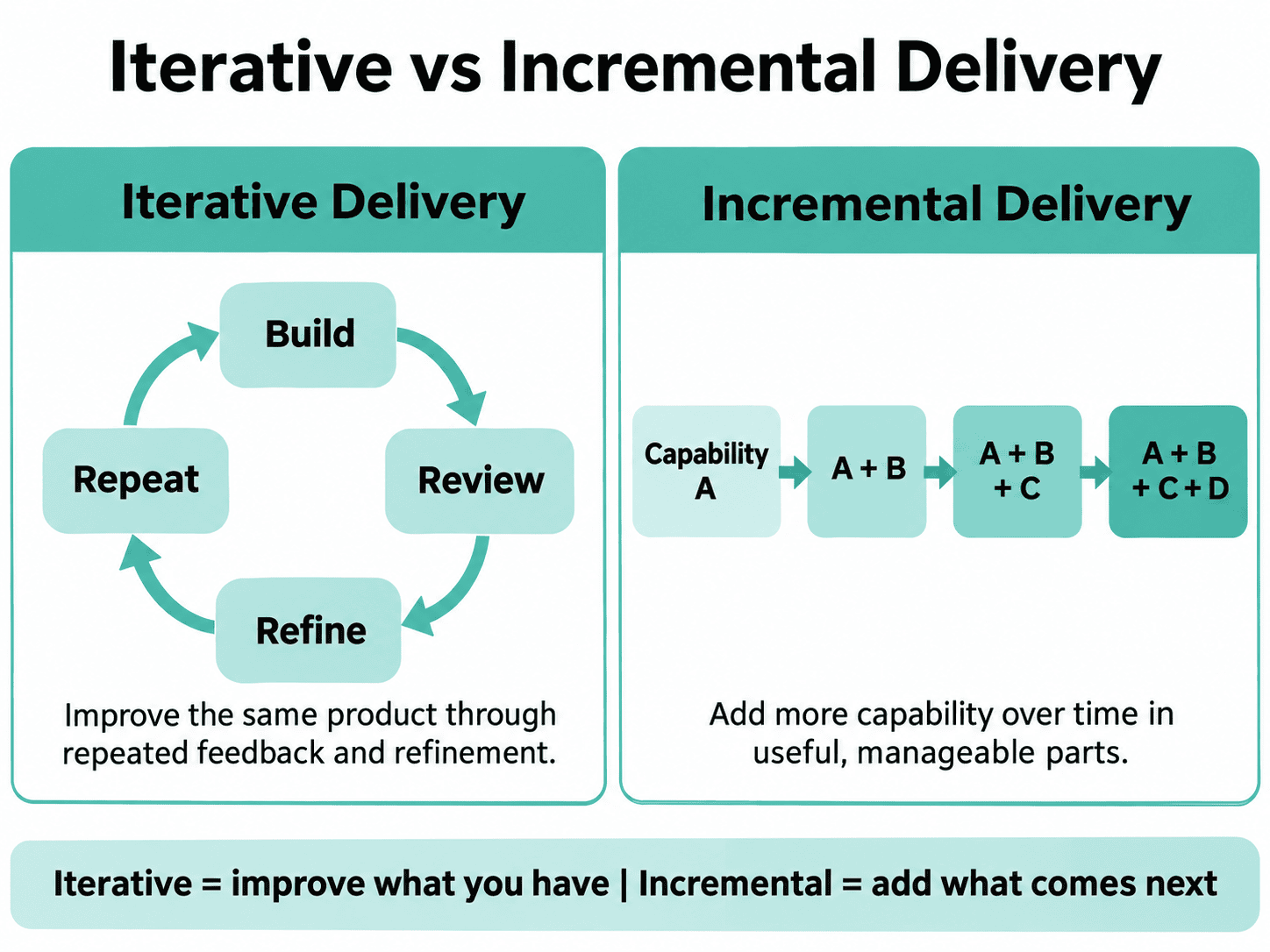
Iterative delivery involves repeatedly developing, reviewing, and refining work. Incremental delivery involves adding further product capability over time. Iterative-incremental delivery combines these approaches so that the solution becomes progressively more complete while individual elements are improved through feedback.
These are practical distinctions to help explain the combined delivery approach recognised in PRINCE2.
Imagine you’re creating a customer portal.
What Is Iterative Delivery?
The team develops an account dashboard and shows it to users.
Users find the navigation confusing, so the team changes it. A second review reveals that important information is difficult to locate. The team makes further improvements and tests the dashboard again.
The same product is being refined through repeated cycles.
Iterative means developing, reviewing, learning, and improving.
What Is Incremental Delivery?
The same customer portal starts with account viewing.
Later, the team adds profile editing, followed by support requests and notifications.
Each addition expands what the portal can do.
Incremental means progressively building or delivering additional capability.
How Do Iterative and Incremental Delivery Work Together?
A team might develop account viewing, test it with users, and refine it before introducing profile editing.
When profile editing is added, that capability is also tested and improved. The process continues as additional functionality becomes available.
The product grows in increments, while repeated cycles help improve its quality and suitability.
| Feature | Iterative | Incremental |
|---|---|---|
| Main idea | Improve through repeated cycles | Add capability progressively |
| What changes? | The quality, design, or suitability of work | The amount of functionality available |
| Portal example | Refine an existing dashboard | Add profile editing and support requests |
| Useful when | Feedback or uncertainty requires learning | Functionality can be developed in meaningful parts |
| Relationship to feedback | Feedback directly informs refinement | Feedback may influence later increments |
Does PRINCE2 Require Sequential or Waterfall Delivery?
No. PRINCE2 doesn’t require sequential or Waterfall delivery.
The current method recognises three broad delivery approaches: linear-sequential, iterative-incremental, and hybrid.
PRINCE2 manages the project without prescribing one specialist product-development lifecycle.
A construction project might have substantial sequential dependencies, while a digital service could be developed through repeated feedback and refinement.
Both can use PRINCE2.
For a more detailed explanation, read Is PRINCE2 Waterfall?.
What Delivery Methods Can PRINCE2 Support?
| Delivery approach | How it works | Illustrative example |
|---|---|---|
| Linear-sequential | Delivery activities generally follow a sequence | A construction project moving through design and construction |
| Iterative-incremental | Requirements, development, and testing can recur throughout delivery | A portal developed and refined in successive cycles |
| Hybrid | Different elements use different delivery approaches | Sequential infrastructure installation alongside iterative software development |
These are delivery methods that PRINCE2 can accommodate, not separate versions of PRINCE2.
A project might also use several specialist techniques within its chosen delivery approach.
How Does Project Context Determine the Delivery Method?
The most appropriate delivery method depends on the project rather than a preference for one framework.
PRINCE2 recognises that projects operate within different organisational and commercial arrangements, sustainability requirements, delivery environments, and levels of complexity.
Consider two projects.
A building project may need approved structural designs before substantial construction begins. A customer-facing digital service might benefit from testing early versions with users before finalising detailed functionality.
The nature of the products and dependencies influences which approach makes sense.
Other considerations include available skills, contractual commitments, uncertainty, risk, stakeholder involvement, and the organisation’s ability to support the chosen approach.
Iterative delivery isn’t automatically better than sequential delivery. The chosen method should help the project achieve its objectives within acceptable constraints.
How Should PRINCE2 Be Tailored for Iterative Delivery?
PRINCE2 is designed to be applied and tailored to the project’s circumstances.
For iterative-incremental delivery, this means deciding how the project’s management arrangements will work with the team’s development cycles.
Practical tailoring considerations include:
- Management stages: Choose stages around meaningful management and investment decisions.
- Planning: Establish the level of detail needed for the Project Plan, Stage Plans, and delivery-level planning.
- Reporting: Agree how frequently delivery information will be shared and in what form.
- Products: Decide how product requirements and descriptions will be represented and progressively elaborated.
- Roles: Clarify project-management responsibilities alongside the chosen delivery team’s responsibilities.
- Quality: Agree how testing, demonstrations, reviews, and acceptance requirements will be managed.
- Change: Define which decisions delivery teams can make and which require wider authorisation.
- Progress: Connect delivery information to current project and stage forecasts.
For example, a project might use user stories to describe specialist requirements and a collaborative planning board to track detailed development.
It still needs enough information for decisions about the project’s objectives, products, risks, and continued justification.
The Project Manager recommends suitable tailoring, while the Project Board remains accountable for approving the management approach.
Tailoring doesn’t mean abandoning PRINCE2’s Principles. It means making the method appropriate to the project.
Read How to Tailor PRINCE2 for more guidance.
How Do PRINCE2 Management Stages Work With Iterations?
A PRINCE2 management stage is a period of project-management control authorised by the Project Board.
An iteration is a cycle of specialist delivery work.
A management stage may contain several iterations, allowing the Project Manager to monitor delivery, forecast performance, and manage issues while the team develops and refines products.
For example, a portal project’s Build and Pilot management stage might contain four delivery iterations:
- Account access.
- Personal details.
- Leave requests.
- HR support requests.
The Project Manager monitors progress across the whole stage, rather than treating every small development cycle as a separate Project Board decision.
The manual also allows stage design to be tailored around timeboxes or releases where that creates appropriate management control.
The right structure depends on the project’s decision points, risks, and delivery arrangements.
Is a PRINCE2 Management Stage the Same as an Iteration?
No. They serve different purposes.
A management stage defines a project-management control period, including planning, delegated authority, reporting, and decisions about continued investment.
An iteration is a delivery cycle in which specialist work may be developed, reviewed, and refined.
The two periods may overlap, and a project can deliberately align their timing. However, they shouldn’t be treated as interchangeable concepts.
One management stage can contain several iterations. Alternatively, a project’s tailoring may align stages with selected timeboxes when that suits its governance needs.
Is a Management Stage the Same as a Scrum Sprint?
No. A Sprint is a defined event within Scrum, while a PRINCE2 management stage is a period of project-management control.
Scrum uses Sprints to create usable product Increments and provide opportunities for inspection and adaptation.
PRINCE2 stages give the Project Board controlled opportunities to authorise work and review continued justification.
A Sprint Review is not automatically a PRINCE2 stage-boundary decision.
For a more detailed comparison, read PRINCE2 vs Scrum.
How Do Stage Boundaries Work When Delivery Is Iterative?
A stage boundary allows the Project Board to review progress and decide whether the next management stage should be authorised.
For iterative projects, this decision can draw on evidence generated during delivery, including:
- Completed products and relevant quality results.
- Feedback and lessons from iterations.
- Current risks and issues.
- Actual and forecast performance against the Stage Plan.
- Updated project forecasts and Business Case.
- The proposed next Stage Plan.
The Project Manager prepares the relevant stage-boundary information, and the Project Board decides whether continued investment is justified.
Every iteration doesn’t need to end with a formal stage boundary.
A stage boundary should serve a useful management purpose, not simply duplicate the team’s delivery rhythm.
How Do Work Packages Support Iterative Delivery?
In PRINCE2, a Work Package is used to define and authorise work to create one or more products.
The Project Manager and Team Manager agree the work, relevant requirements, responsibilities, reporting arrangements, and tolerances.
Within that agreement, the specialist team can organise detailed development using an appropriate delivery method.
For instance, a Work Package could authorise a team to develop an agreed set of portal capabilities. The team might then organise its development through several iterations, providing progress information back to the Project Manager.
However, PRINCE2 can also be tailored to work with Sprints and user stories instead of conventional Work Packages and Product Descriptions.
The important requirement is that authority, accountability, product expectations, and progress information remain clear.
A Work Package isn’t automatically a Sprint or a Product Backlog. These concepts perform different functions, even when tailored arrangements bring them together.
Can Product-Based Planning Work With Iterative Delivery?
Yes. PRINCE2 Product-Based Planning can support iterative-incremental development because it focuses on what the project needs to deliver before deciding exactly how the delivery work will be organised.
Product-Based Planning helps identify the required products, clarify their descriptions, and understand dependencies.
For example, an employee portal project might identify account access, employee records, leave management, and support requests as required capabilities.
The project can agree these broad product expectations while allowing the delivery team to refine implementation details through iterations.
This doesn’t remove the need for planning. It allows the detail and timing of planning to match the chosen delivery approach.
Learn more in Product-Based Planning in PRINCE2 Explained.
Does a Product Breakdown Structure Freeze Every Detail Upfront?
No. A Product Breakdown Structure identifies how the project’s products are broken down into their constituent products.
It doesn’t automatically require every low-level feature to be fixed permanently before delivery begins.
The amount of detail should be sufficient for the project’s planning, control, and decision-making needs.
A Product Breakdown Structure is not the same as a Product Backlog. The first helps organise the project’s product structure, while the latter is associated with organising and refining work within particular delivery approaches.
How Do Product Descriptions Work When Products Evolve Iteratively?
PRINCE2 uses Product Descriptions to establish a shared understanding of the required products and their quality expectations.
These descriptions help the project estimate work, plan dependencies, allocate responsibilities, and establish how products will be assessed.
In an iterative project, the form and detail of product information can be tailored.
For instance, the overall requirement might establish that employees must be able to submit leave requests securely.
The delivery team could then test several interface designs and refine the interaction through feedback without necessarily changing that authorised requirement.
In iterative-incremental projects, PRINCE2 allows product requirements and descriptions to be represented through features, epics, and user stories. The project can tailor these arrangements to suit its chosen delivery method, provided product expectations, responsibilities, and appropriate controls remain clear.
What matters is that evolving detail remains consistent with authorised product expectations and appropriate controls.
Can Requirements Change During Iterative PRINCE2 Delivery?
Yes. Requirements can evolve during iterative delivery, but the nature and impact of a change determine how it should be handled.
It helps to distinguish between two situations:
Refinement within authority: A team improves the wording on a leave-request form, clarifies an error message, or adjusts the layout while continuing to meet agreed requirements.
Potential project-level change: A stakeholder requests a new payroll system that wasn’t included in the authorised project products.
The first situation may be managed within existing delivery authority.
The second may affect approved scope, plans, resources, risks, or the Business Case, and therefore needs assessment and appropriate authorisation.
Not every change in implementation detail has to become a formal project-level issue.
PRINCE2’s Issues Practice provides the wider controls for issues and changes that need project-management attention.
Read more about PRINCE2 Issue Management.
How Does PRINCE2 Keep Iterative Delivery From Becoming Scope Creep?
Iterative delivery doesn’t mean the team can keep adding functionality indefinitely.
PRINCE2 controls scope by defining the products required, establishing quality expectations, agreeing tolerances, and managing changes through appropriate decision-making authority.
Imagine users reviewing the employee portal.
They request clearer instructions for updating personal details. The team can potentially make that improvement within the agreed requirements.
They then suggest adding a company-wide performance-management system.
That second request could substantially change the approved project products and expected investment.
The fact that the idea emerged during an iteration doesn’t make it automatically authorised.
PRINCE2 helps the project assess the proposed change and understand its consequences before a decision is made.
Can Scope Be Flexible in Iterative Delivery?
Yes. PRINCE2 allows scope tolerance to be agreed alongside other performance tolerances.
For example, a project using timeboxed delivery may prioritise mandatory requirements and permit some flexibility around lower-priority features.
The manual notes that timeboxed iterative-incremental projects will typically use tighter time and cost tolerances with greater flexibility in scope.
That doesn’t mean every iterative project must fix its budget and deadline or allow unrestricted changes to scope.
The actual boundaries must be established for the project.
How Do Tolerances Support Iterative Delivery?
PRINCE2 tolerances define the permitted variation from an agreed performance target before a deviation must be escalated.
The method recognises seven performance aspects: benefits, cost, time, quality, scope, sustainability, and risk.
These boundaries allow the Project Board, Project Manager, and delivery teams to make decisions at the appropriate management level.
A team might adjust its development sequence or revise a design while remaining within the authority agreed for its work.
If its forecast indicates that a relevant tolerance will be exceeded, the issue must be escalated to the appropriate management level.
For example, suppose a stage has an eight-week target and a maximum permitted duration of nine weeks.
During week five, new information indicates that the stage will take ten weeks.
The Project Manager shouldn’t wait until week nine to raise the exception. The current forecast already exceeds the permitted tolerance.
Explore What Are Tolerances in PRINCE2?.
Why Does Management by Exception Work Well With Iterative Teams?
Management by Exception is a PRINCE2 Principle that allows decisions to be delegated within agreed tolerances.
This is useful when specialist teams need enough freedom to solve problems and refine products without seeking senior approval for every development decision.
The Project Board authorises a management stage and delegates day-to-day management to the Project Manager.
The Project Manager works with the delivery arrangements and delegates appropriate authority.
Higher management levels become involved when decisions fall outside delegated limits or otherwise require their authority.
This creates a distinction between delivery flexibility and uncontrolled decision-making.
Learn more about Management by Exception in PRINCE2.
How Does PRINCE2 Measure Progress During Iterative Delivery?
PRINCE2 measures progress by considering actual achievements, current forecasts, approved targets, and relevant tolerances.
In iterative delivery, the team may provide useful information through completed product increments, quality results, iteration reviews, and updated delivery forecasts.
The Project Manager uses appropriate information to understand the wider project’s position.
Completing four iterations doesn’t necessarily mean the project is on track.
For example, the team might have completed all four planned cycles but still have a significant security defect that prevents an agreed product from being accepted.
Conversely, a team might discover an integration problem during its second iteration. Even though less functionality has been completed than expected, identifying the problem can provide valuable information for forecasting and decision-making.
PRINCE2’s Progress Practice is concerned with what has actually been achieved, what remains achievable, and whether management action is required.
Does PRINCE2 Require Velocity or Burndown Charts?
No. PRINCE2 doesn’t mandate velocity or burndown charts as universal progress measures.
The manual recognises supporting techniques such as burn charts and Kanban boards.
These can provide useful delivery information where appropriate, but they don’t replace project-level assessment of products, forecasts, risks, issues, and tolerances.
How Does Quality Work When Products Are Refined Iteratively?
Quality expectations remain important when products are developed through repeated cycles.
PRINCE2’s Quality Practice establishes how product quality requirements will be defined, checked, and demonstrated.
Iterative teams may use prototypes, demonstrations, user reviews, automated testing, and other suitable techniques to examine and improve products.
These activities can reveal misunderstandings before the complete solution has been developed.
However, repeated testing doesn’t automatically establish that the final product meets its agreed requirements.
Quality criteria, responsibilities, and appropriate quality records still matter.
For more detail, see How Quality Management Works in PRINCE2.
Does Each Increment Need to Be Formally Accepted?
Not necessarily.
In iterative-incremental delivery, the project’s agreed quality and acceptance arrangements determine when formal acceptance is required.
A team may develop additional capability through successive cycles, but this doesn’t automatically mean each addition must be separately released or formally accepted as a project deliverable.
Where Scrum is used, its specific definition of an Increment also applies.
How Does Stakeholder Feedback Fit Into Iterative PRINCE2 Delivery?
Stakeholder feedback can help teams learn whether developing products are suitable for their intended users.
For example, a user demonstration may reveal that an employee understands how to submit a request but struggles to find its approval status.
That feedback can inform further refinement.
PRINCE2’s People element recognises the importance of relationships, collaboration, co-creation, and communication throughout the project.
Feedback can also reveal risks, constraints, conflicting expectations, and opportunities for improvement.
However, a stakeholder expressing a preference doesn’t automatically authorise a change to the project’s approved scope.
The response must remain consistent with the project’s agreed decision-making arrangements.
Explore PRINCE2 Stakeholder Management.
How Does the PRINCE2 People Element Support Iterative Working?
The People element helps establish the relationships and ways of working needed for successful project delivery.
This includes the people developing the products, the people using them, and the wider groups affected by the change.
Iterative delivery can create frequent opportunities for collaboration and feedback, but those opportunities only help when participants understand their responsibilities and share information effectively.
PRINCE2 encourages attention to communication, leadership, team capability, stakeholder relationships, and the adoption of project products.
These considerations support iterative working without making PRINCE2’s People element synonymous with any particular Agile framework.
How Does Issue Management Work During Iterative Delivery?
Iterative cycles can uncover issues early because products are repeatedly developed, checked, and reviewed.
A defect may be discovered, a requirement may need clarification, or users may request additional functionality.
PRINCE2’s Issues Practice helps projects decide how matters requiring management attention should be assessed and resolved.
In iterative-incremental environments, the issue management approach can be tailored to accommodate frequent changes and appropriate delegation.
For example, a development team may have authority to refine features within agreed boundaries, while a substantial change to the approved Project Product requires a higher-level decision.
The important distinction is between normal delivery refinement and matters requiring project-level management consideration.
How Does Iterative Delivery Affect Risk Management?
Iterative delivery can help reveal certain uncertainties earlier by testing assumptions and gaining feedback before the entire solution is complete.
For example, a portal team might discover that employees have difficulty using an authentication method during the first development cycle.
That information could allow the team to respond before additional capabilities depend on the same approach.
However, iterative delivery doesn’t eliminate risk.
Projects may still face supplier delays, integration problems, security concerns, unexpected costs, or difficulties introducing products into operational use.
PRINCE2’s Risk Practice continues to apply, with threats and opportunities identified, assessed, responded to, and monitored throughout the project.
Read our PRINCE2 Risk Management guide.
How Does the Business Case Work With Iterative Delivery?
The Business Case remains central to deciding whether the project is worth continuing.
Iterative delivery may provide new evidence about technical feasibility, user needs, operating costs, delivery timescales, and expected benefits.
For instance, early testing might show that an employee portal is more complicated to integrate with existing HR systems than anticipated.
The Project Manager can use that evidence to reassess delivery forecasts, risks, and the project’s continuing justification.
The Project Board can then use updated information when making decisions about future investment.
The fact that a team has successfully completed several iterations doesn’t, on its own, prove that the Business Case remains valid.
Can Incremental Delivery Realise Benefits Earlier?
Potentially, yes.
If a product increment becomes available for operational use, employees may be able to start using that capability before the entire project is completed.
For example, an organisation might deploy secure access and basic personal-details functionality while other portal services remain under development.
However, earlier availability doesn’t automatically mean earlier benefits.
Employees need to adopt the capability, relevant processes must support it, and the expected improvement needs to be measured.
The Benefits Management Approach should establish how benefits will be monitored and reviewed, including those expected after project closure.
Find out more in How Benefits Management Works in PRINCE2.
Are Increments the Same as Releases?
No. An increment represents additional product capability, while a release involves making product functionality available in a particular delivery or operational context.
The precise meaning of an increment depends on the specialist delivery approach.
A team might develop several increments before deploying them together in one release.
Alternatively, a usable increment might be released soon after completion if the project’s arrangements allow it.
Releases, increments, and formal product acceptance therefore shouldn’t automatically be treated as the same event.
Is a Release the Same as a PRINCE2 Management Stage?
No. A release concerns delivering or deploying capability, while a management stage is a period of project-management control.
A project may arrange for a release near a stage boundary when that creates a useful business decision point.
However, it can also release functionality during a stage without requiring a separate PRINCE2 stage-boundary decision for every deployment.
The relationship should be agreed through the project’s delivery and management arrangements.
How Does Iterative-Incremental Delivery Relate to Agile?
Iterative-incremental development is common in Agile approaches, but it isn’t synonymous with Agile.
PRINCE2 recognises iterative-incremental delivery as an approach that it can support without requiring one specific Agile framework.
A team might use Scrum, elements of another Agile approach, or organisation-specific iterative development techniques.
PRINCE2 provides the wider project-management arrangements, including roles, stages, Business Case management, progress controls, risks, and issues.
Learn more in How PRINCE2 Works With Agile Project Management.
How Can Scrum Iterations Sit Inside a PRINCE2 Project?
A PRINCE2 project can include a Scrum Team developing a product through Sprints.
In Scrum, each Sprint provides an opportunity to develop usable product capability and inspect the result.
At project level, the PRINCE2 Project Manager needs appropriate information about delivery performance, dependencies, risks, quality, and forecasts.
This information can inform the wider Stage Plan and project decisions without turning Scrum events into PRINCE2 governance meetings.
One management stage might contain several Sprints, although the project’s actual stage structure depends on its agreed tailoring.
This is an illustrative arrangement, not a mandatory PRINCE2-Scrum operating model.
How Does Iterative Delivery Fit Into a Hybrid PRINCE2 Project?
A hybrid project combines different delivery approaches.
For example, a company introducing a new customer service system might use sequential work to install infrastructure while developing the user-facing portal iteratively.
PRINCE2 can bring both streams into one coherent project-management structure.
The Project Manager needs to understand the dependencies between them, monitor risks and progress, and ensure that the combined work remains aligned with the project’s objectives.
Different teams don’t all have to work in identical cycles.
PRINCE2 Iterative and Incremental Delivery Example
Consider a fictional organisation introducing an Employee Self-Service Portal.
The overall Project Product is an employee portal ready for agreed organisational use.
One authorised management stage is called Build and Pilot.
The delivery team plans four iterative-incremental cycles within that stage.
Define the Stage Objective
The Stage Plan establishes the products to be developed, the agreed controls, dependencies, responsibilities, and tolerances.
The Project Manager needs to understand what the stage should achieve and what evidence will demonstrate progress.
Authorise the Delivery Work
The Project Manager and delivery team agree the work to be undertaken and the relevant authority.
This might be organised through Work Packages or an appropriately tailored iterative delivery arrangement.
The team has room to manage its detailed development activities within the agreed boundaries.
Deliver the First Increment – Account Access
The team creates basic secure sign-in functionality.
Users test it and find that password recovery is confusing.
The team improves the recovery process and checks the revised experience.
The first increment provides usable authentication capability.
Deliver the Second Increment – Personal Details
The team adds functionality allowing employees to view and update approved personal information.
Testing reveals that employees aren’t always sure whether an update has been saved.
The team refines the confirmation message.
The portal now has more capability than it did after the first iteration.
Deliver the Third Increment – Leave Requests
The team introduces leave submission and approval functionality.
Feedback shows that managers need a clearer view of pending requests.
The team revises the workflow and tests the improvement.
The portal gains another capability.
Deliver the Fourth Increment – HR Support Requests
The team adds a way for employees to submit and track routine HR enquiries.
Testing and feedback help refine the feature.
By the end of the fourth iteration, the portal contains the capabilities needed for the planned pilot, subject to the project’s agreed checks and acceptance arrangements.
| Iteration | Added capability | Example refinement |
|---|---|---|
| 1 | Account access | Improve password recovery |
| 2 | Personal details | Clarify confirmation messages |
| 3 | Leave requests | Improve manager approval workflow |
| 4 | HR support requests | Refine request tracking |
Update the Project Forecast
Throughout the stage, the Project Manager uses delivery information to monitor the overall position.
Suppose the third iteration reveals an unexpected integration problem with an existing HR system.
The team estimates that resolving the issue will extend the stage beyond its agreed time tolerance.
The Project Manager must act on the forecast exception when it becomes apparent, rather than waiting until the target date has passed.
Other information, including product status, quality results, risks, and the effect on the Business Case, also informs management decisions.
Review at the Stage Boundary
The Project Manager brings together the relevant stage results, current forecasts, lessons, risks, and updated planning information.
The Project Board reviews whether the project remains justified and decides whether to authorise the next management stage.
This decision is concerned with the project’s wider objectives and continued investment.
It isn’t simply a review of how many iterations the team completed.
This fictional example illustrates one possible arrangement. It isn’t an official PRINCE2 lifecycle or prescribed delivery model.
Common Mistakes When Using PRINCE2 With Iterative Delivery
Several misunderstandings can cause unnecessary confusion or weaken project controls.
- Assuming PRINCE2 requires Waterfall: The method supports different delivery approaches.
- Treating management stages as Sprints: They have different purposes, even when their timing is aligned.
- Assuming iterative delivery requires no planning: Planning is still necessary, but its detail can be tailored.
- Allowing every requested feature into scope: Feedback doesn’t automatically authorise new project products.
- Treating a Work Package as a Sprint: The concepts differ, although PRINCE2 permits suitable tailoring.
- Escalating every minor adjustment: Management by Exception allows decisions within delegated authority.
- Using iteration counts as the only progress measure: Completed products, forecasts, quality, and tolerances also matter.
- Treating every increment as a release: Capability development and deployment are separate considerations.
- Assuming iterative delivery removes risk: Uncertainty still requires active management.
- Forgetting the Business Case: Completing product-development cycles doesn’t prove that the investment remains worthwhile.
PRINCE2 Iterative Delivery Checklist
Use these questions before agreeing how iterative-incremental delivery will operate in a PRINCE2 project.
Delivery method
- Why is iterative-incremental delivery suitable for this project?
- What will each increment contribute?
- What uncertainty should be addressed through feedback?
Products and planning
- Is the overall Project Product sufficiently defined?
- Which product details may evolve?
- Are the relevant quality expectations clear?
Stages and delivery authority
- Does each management stage have a meaningful purpose?
- How will iterations relate to management-stage decisions?
- What authority has been delegated to delivery teams?
Scope, issues, and risk
- What changes can be managed within existing authority?
- Which changes require project-level decisions?
- How will emerging risks and issues be monitored?
Progress and governance
- What delivery information will inform project forecasts?
- Are relevant tolerances established?
- Will forecast tolerance breaches be escalated promptly?
- Does the Business Case remain credible?
Frequently Asked Questions
Does PRINCE2 Support Iterative Delivery?
Yes. PRINCE2 explicitly recognises iterative-incremental delivery as an approach that can operate within its project-management method. Specialist teams can develop, review, and refine products through repeated cycles while PRINCE2 provides appropriate project-level planning, governance, progress controls, and management responsibilities.
Does PRINCE2 Support Incremental Delivery?
Yes. Products can be developed or delivered through progressively more complete capability. PRINCE2 doesn’t require every specialist product to be created in one sequential development process. The agreed project controls establish how product delivery, scope, quality, progress, and relevant decisions will be managed.
What Is Iterative-Incremental Delivery?
Iterative-incremental delivery combines repeated product-development and refinement cycles with the progressive addition of product capability. PRINCE2 recognises this as a delivery approach involving iterative requirements gathering, design, development, and testing throughout the project lifecycle.
Is PRINCE2 Waterfall?
No. PRINCE2 isn’t a Waterfall-only method. It recognises linear-sequential, iterative-incremental, and hybrid delivery. The approach used should suit the project and its products, dependencies, risks, and wider organisational context.
Can Multiple Iterations Happen in One PRINCE2 Stage?
Yes. A management stage can include several iterations or timeboxes. PRINCE2 can also be tailored to align stage boundaries with selected delivery periods when this supports appropriate management decisions. The stage structure should be determined by project-control needs rather than assumed to follow one fixed pattern.
Is a Management Stage the Same as a Sprint?
No. A PRINCE2 management stage provides a period of project-management control. A Scrum Sprint is a delivery event within Scrum. They may occur within the same project, but they have different functions and shouldn’t automatically be treated as equivalent.
Can Requirements Change During a PRINCE2 Project?
Yes. Requirements can evolve, particularly in iterative-incremental delivery. Changes must remain within the project’s agreed authority and control arrangements. A clarification or refinement within authorised product requirements is different from a proposed change that affects approved scope or other project baselines.
How Does PRINCE2 Control Scope During Iterative Delivery?
PRINCE2 uses agreed products, quality expectations, tolerances, defined responsibilities, and issue management to control scope. Teams may have appropriate freedom to refine implementation details, but proposed additions beyond authorised boundaries must be assessed and approved by someone with the necessary authority.
How Are Work Packages Used With Iterative Teams?
Work Packages can authorise the products that iterative teams develop and establish relevant expectations and reporting arrangements. PRINCE2 can also be tailored to work with Sprints and user stories instead of conventional Work Packages and Product Descriptions, provided appropriate project-management control is maintained.
How Does PRINCE2 Measure Iterative Progress?
PRINCE2 uses information about actual achievements, approved targets, current forecasts, product status, and tolerances. Iteration outcomes and delivery-team measures can contribute useful evidence, but the completion of iterations alone doesn’t establish that the wider project remains on track.
Does Every Increment Need Formal Acceptance?
No universal rule requires every increment to be formally accepted as a separate project deliverable. The project’s agreed quality and acceptance arrangements determine the relevant requirements. An increment may be intermediate, usable, or ready for release without necessarily representing final acceptance of the overall Project Product.
Are Releases the Same as Management Stages?
No. A release concerns delivering or deploying capability, while a management stage provides a PRINCE2 control period. Their timing can be coordinated, but a release doesn’t automatically require a stage-boundary decision, and a stage doesn’t necessarily end with a release.
What Should You Explore Next?
PRINCE2 can provide management control without forcing specialist teams to create an entire solution in one pass.
The key is to tailor the method so that project objectives, responsibilities, quality expectations, forecasts, and decision-making authority remain clear while development teams refine and expand product capability.
For anyone working in Project Management, this is an important distinction. It demonstrates how structured governance and adaptable delivery can complement each other.
If you’re studying PRINCE2 Foundation or Practitioner, understanding these relationships can also help you connect the method’s Principles, Practices, Processes, and Project Context.
Want to understand how PRINCE2 can give iterative teams flexibility without losing project control?