How Is AI Changing Project Management?
AI in project management is changing how Project Managers plan work, analyse risks, monitor progress, prepare reports, and communicate with stakeholders. Artificial intelligence can help automate routine administration, identify patterns, and explore possible outcomes. However, Project Managers remain responsible for checking the evidence, exercising judgement, managing people, and ensuring decisions follow the project’s governance arrangements.
The biggest change isn’t simply that Project Managers can complete certain tasks faster. It’s that more of their working day can shift from collecting and preparing information towards interpreting it, questioning assumptions, and deciding what needs attention.
For example, AI might produce a draft status report in minutes. But someone still needs to establish whether its figures are correct, whether it has overlooked an important issue, and whether the report gives decision-makers an accurate picture.
This change is already visible across the UK profession. Research published by the Association for Project Management (APM) in March 2026 found that 27% of 1,000 surveyed UK project professionals considered AI fully embedded in their workflows.
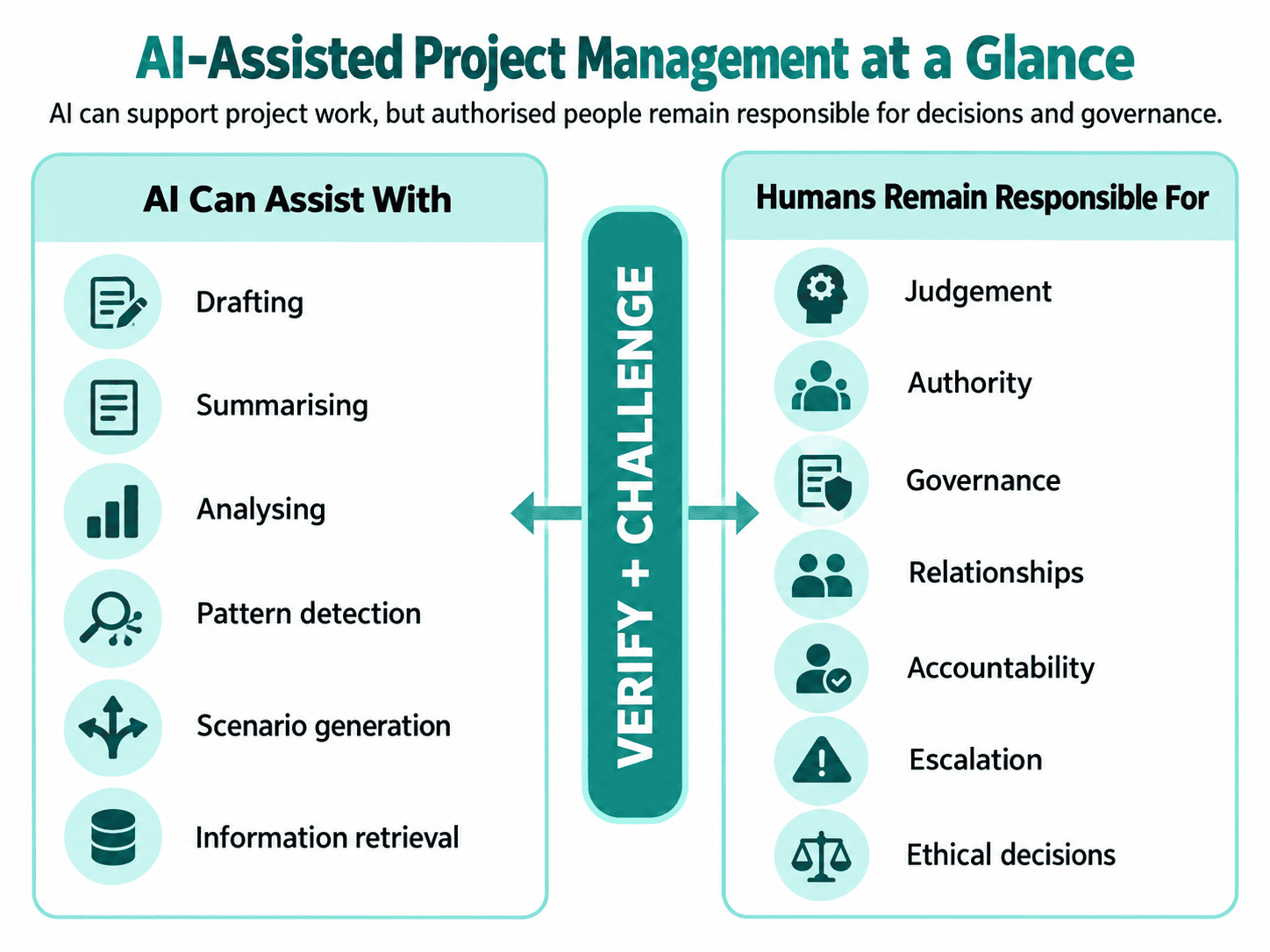
In practice, AI can help Project Managers:
- Turn meeting notes into draft actions and follow-ups.
- Prepare initial project plans, schedules, and risk descriptions.
- Summarise project documentation and historical lessons.
- Analyse progress information and highlight possible variances.
- Compare project options and prepare decision briefings.
- Draft reports for different stakeholder groups.
- Explore possible consequences of delays or resource changes.
None of these activities removes the need to understand the project or check the evidence behind the output.
What Does AI Mean in Project Management?
Artificial intelligence in project management refers to technologies that perform or assist with tasks involving language, information analysis, pattern recognition, prediction, and other capabilities associated with human cognitive work.
AI is broader than ChatGPT, and not every automated process uses artificial intelligence.
Three distinctions are particularly useful.
| Technology | What it does | Project management example |
|---|---|---|
| Generative AI | Produces new content based on instructions and available information | Drafts a risk description or project update |
| Predictive and analytical AI | Analyses patterns and may estimate possible outcomes | Identifies patterns associated with delays |
| Workflow automation | Executes defined actions, sometimes with AI assistance | Routes an approved report to stakeholders |
An AI assistant or copilot is a software feature that helps a person complete tasks. Depending on the product, it may combine generative AI, information retrieval, analytics, and automation.
How Is Generative AI Used in Project Management?
Generative AI is particularly useful for preparing and reviewing information.
A Project Manager might use an approved AI assistant to summarise a lengthy meeting, compare two versions of a Project Plan, prepare stakeholder questions, or create the first draft of a report.
Consider a meeting involving a supplier, technical specialists, and the Project Manager.
Instead of manually reviewing every note to identify follow-up actions, AI could produce a draft list of decisions, unresolved questions, and responsibilities.
The Project Manager would then check whether those decisions were actually made, whether the action owners were agreed, and whether the summary accurately represents the discussion.
This distinction matters because a polished summary isn’t necessarily a correct one.
How Is Predictive AI Used in Project Management?
Predictive AI uses statistical or machine-learning techniques to identify patterns in data and estimate possible outcomes.
In project management, appropriate systems may assist with:
- Forecasting schedule or cost outcomes.
- Identifying patterns associated with delivery delays.
- Analysing resource demand.
- Detecting unusual project performance.
- Exploring alternative delivery scenarios.
However, predictive capability depends on the system and available data. A general-purpose chatbot given a few project figures is not automatically a validated forecasting tool.
AI-generated predictions should be treated as estimates with assumptions and uncertainty, not guaranteed outcomes.
How Is AI Changing the Project Manager’s Role?
AI is changing the balance between preparing information and using it to manage projects.
Traditionally, Project Managers have spent considerable time gathering updates, compiling reports, reviewing documents, and preparing information for others.
AI can now assist with some of these activities, allowing greater attention to the work that follows.
| Traditional activity | With AI assistance | Project Manager’s responsibility |
|---|---|---|
| Compile project updates manually | Generate an initial summary | Verify status and identify exceptions |
| Draft documents from scratch | Prepare structured first drafts | Check content and ensure suitability |
| Review large amounts of information | Summarise and identify patterns | Investigate and challenge conclusions |
| Compare options | Organise evidence and trade-offs | Make or escalate decisions within authority |
| Prepare stakeholder messages | Draft audience-specific communications | Preserve meaning and manage relationships |
| Analyse project performance | Highlight trends and possible problems | Interpret evidence and act appropriately |
This is not a universal change. Some organisations have sophisticated AI-enabled project systems, while others are only experimenting with basic drafting and summarisation.
The direction, however, is becoming clearer.
In March 2026, APM research identified ethical judgement, data literacy, leadership, and stakeholder engagement among the skills professionals considered important for future project work.
The implication is that knowing how to use AI is increasingly valuable, but understanding project management remains essential.
How Is AI Changing Project Planning?
AI can help Project Managers prepare and analyse plans by turning requirements into draft activities, suggesting dependencies, comparing options, and identifying questions that need resolving.
Imagine you’re preparing a project to introduce an employee self-service portal.
You could provide an approved AI system with a project brief and ask it to identify potential deliverables, dependencies, planning assumptions, and missing requirements.
The AI might suggest work relating to access controls, employee training, integration testing, and operational handover.
These suggestions could help the team think more broadly about the project.
However, the AI might also invent requirements, underestimate activity durations, or assume resources are available when they aren’t.
A draft plan is not an approved plan.
The Project Manager and relevant specialists must confirm what products are required, what activities are necessary, how they depend on each other, and whether the proposed work is feasible.
This is particularly important when using product-based planning approaches, where the emphasis is on defining what the project must deliver before determining how it will be produced.
Can AI Create a Project Schedule?
Yes. AI can help create an initial project schedule, identify possible dependencies, and analyse alternative scheduling scenarios.
However, it cannot be assumed that the resulting schedule is accurate or achievable.
A reliable schedule depends on:
- Correct activity and product information.
- Validated dependencies.
- Realistic durations and estimates.
- Resource availability.
- Supplier and contractual constraints.
- Agreed milestones and tolerances.
- Current delivery conditions.
For example, AI might suggest that employee training and software testing could happen in parallel.
That may be reasonable, but the actual project might require an approved testing environment before training can begin.
The Project Manager must verify the relationship rather than accepting the suggestion automatically.
How Is AI Changing Project Risk Management?
AI can help Project Managers identify possible risks, analyse historical information, explore scenarios, and prepare draft risk responses.
One useful application is challenging the team’s assumptions.
For example, a Project Manager might ask an approved AI system to review a project plan and suggest risks associated with dependencies, supplier capacity, technical integration, or stakeholder readiness.
This can help the team identify possibilities it hasn’t yet considered.
However, AI-generated risks are hypotheses, not established project facts.
AI may overlook unusual circumstances, give too much weight to common patterns, or suggest problems that aren’t relevant to the project.
Each proposed risk therefore needs to be evaluated against the actual project context.
AI can assist with identification and analysis. Risk assessment, ownership, acceptance, and response decisions must remain within the project’s authorised management arrangements.
Read more about PRINCE2 Risk Management.
Can AI Help Write Better Risk Descriptions?
Yes. AI can help turn vague risk statements into clearer descriptions that explain the cause, uncertain event, and potential effect.
Consider this initial description:
‘Supplier delay.’
This doesn’t explain why the delay might occur or what it could mean for the project.
An AI-assisted draft might read:
‘Because the specialist supplier has limited capacity, there is a risk that integration work starts late, which could delay completion of the current stage.’
This follows a useful structure:
Cause → Uncertain event → Effect
However, the supplier-capacity assumption must be verified. The AI has not established that the supplier actually has limited capacity.
A responsible Project Manager would check the supplier information and amend the risk description before recording it.
How Can AI Help With Project Issues?
AI can help Project Managers investigate issues by summarising their history, identifying affected products, comparing response options, and preparing decision briefings.
The distinction between a risk and an issue remains important.
A risk concerns an uncertain event that could affect objectives. An issue concerns something that requires management attention, such as an actual problem, a change request, or an off-specification.
For example, a supplier that is already 10 days late represents a current problem. The possibility that this delay affects a later project milestone is a separate potential consequence requiring assessment.
AI can help examine the relationship, but it shouldn’t silently convert possibilities into confirmed outcomes.
It also shouldn’t approve changes, assign authority, or conclude that a tolerance has been breached without the required evidence.
Learn more about how issue management works in PRINCE2.
How Is AI Changing Project Reporting?
AI can help Project Managers prepare more consistent and timely reports by transforming verified project information into structured summaries.
An AI assistant might combine approved status updates, issue records, risk information, and progress data into a draft report for management review.
For projects using PRINCE2, this could include preparing initial content for a Highlight Report.
The important point is that the report must still reflect the actual project position.
For example, an AI-generated summary might state:
‘The project remains on track despite supplier delays.’
But if no reliable completion forecast exists, that conclusion may be unsupported.
A safer draft might state:
‘The supplier has reported a delay. Its effect on the stage completion forecast requires confirmation.’
What to Check in an AI-Generated Project Report
| Check | Why it matters |
|---|---|
| Actual versus planned work | Prevents future activities being reported as completed |
| Target versus forecast | Avoids presenting an intended date as an achievable prediction |
| Risk versus issue | Distinguishes uncertainty from existing problems |
| Approved versus proposed | Prevents recommendations being presented as decisions |
| Source and attribution | Preserves who provided the information |
| Missing information | Ensures gaps aren’t concealed by confident wording |
| Confidentiality | Keeps information appropriate to the report’s audience |
These checks also apply when AI is preparing different messages for senior leaders, employees, and delivery teams.
The wording and level of detail can change. The underlying facts shouldn’t.
Learn more about how communication management works in PRINCE2.
How Can AI Help Project Managers Monitor Progress?
AI can help analyse progress by comparing actual performance with agreed plans, highlighting variances, and identifying patterns across reporting periods.
This is potentially more useful than simply producing a summary of the latest figures.
Consider a fictional office relocation project.
Last week, the furniture supplier was seven days late. This week, the delay has increased to 18 days.
AI can identify that the delay has worsened by 11 days.
It may also suggest investigating whether the furniture delay affects workstation installation, ICT testing, or employee relocation.
However, it cannot reliably conclude that the final project deadline has moved without sufficient schedule information.
The Project Manager needs to examine dependencies, available float, recovery arrangements, and current forecasts.
In PRINCE2, this analysis supports progress management. It doesn’t replace the agreed monitoring, reporting, tolerance, and escalation arrangements.
Can AI Predict Project Delays?
AI can help predict possible project delays by identifying patterns associated with previous delays and analysing current project information.
Some specialised analytical systems can generate forecasts based on project history, scheduling information, and other relevant inputs.
However, prediction is not certainty.
For example, a predictive model might identify an increased likelihood of schedule pressure where several interdependent activities are running late.
Its usefulness will depend on factors including:
- Historical data quality.
- Comparability between past and current projects.
- The reliability of current reporting.
- Model suitability and validation.
- Changes in project circumstances.
- The assumptions behind the forecast.
A prediction should also be interpreted alongside the actual schedule.
A delayed activity doesn’t necessarily mean that the overall project completion date will be missed. There may be available float, alternative sequencing, or an approved recovery approach.
AI project forecasting is therefore best understood as decision support, not an automatic declaration of failure or success.
How Is AI Changing Project Meetings?
AI can reduce some of the administrative work involved in project meetings.
Depending on the software and organisational permissions, AI-enabled meeting tools may assist with transcription, summarisation, identifying follow-up actions, and preparing draft communications.
This can be particularly useful for meetings covering multiple workstreams or complex technical discussions.
However, an AI-generated meeting summary may incorrectly attribute a statement, omit a qualification, or present a proposal as an agreed decision.
Before circulating the summary, the responsible person should verify:
- Whether the actions were actually agreed.
- Who owns each action.
- Whether any decisions require formal approval.
- Whether deadlines are correct.
- Whether important concerns or disagreements have been preserved.
Meeting recordings and transcripts also raise privacy and confidentiality questions.
Project Managers should understand whether the tool is approved, what information it processes, how recordings are stored, who can access them, and what notices or other data-protection arrangements apply.
How Can AI Help With Stakeholder Communication?
AI can help Project Managers adapt information for different stakeholder groups without having to draft every message from scratch.
For example, the same verified project information might support:
- A concise governance update for the Project Board.
- A practical explanation for affected employees.
- A detailed technical summary for delivery specialists.
- A short decision briefing for senior leadership.
The challenge is preserving the facts while changing the presentation.
Suppose a supplier has advised that furniture may be delayed by seven days.
Changing that into ‘Furniture is delayed’ removes three important details: the source of the information, the uncertainty, and the possible duration.
An AI-generated message should not remove those details simply to make the wording shorter.
AI can help prepare communication, but stakeholder management involves more than writing.
Project Managers still need to understand relationships, competing priorities, concerns, trust, and the consequences of what they communicate.
Sensitive discussions, conflict resolution, and negotiation should remain human-led.
Read more about PRINCE2 Stakeholder Management.
How Is AI Changing Project Documentation and Knowledge Management?
AI can make project documentation easier to prepare, compare, and search.
An authorised system with appropriate access could help a Project Manager:
- Summarise previous Lessons Reports.
- Compare document versions.
- Locate relevant project policies.
- Extract actions from meeting records.
- Identify inconsistencies between project documents.
- Prepare structured first drafts.
- Search large collections of approved project information.
For example, a Project Manager preparing a new software implementation might ask an approved AI knowledge assistant to summarise lessons from comparable previous projects.
The resulting summary could highlight previous integration problems or stakeholder communication challenges.
But the Project Manager should check the actual Lessons Reports.
A retrieved summary may refer to outdated information or overlook material that the system couldn’t access.
Project documentation must still have appropriate ownership, version control, traceability, and approval arrangements.
AI should make evidence easier to use, not make its origins harder to establish.
Can AI Make Project Decisions?
AI can support project decisions by comparing options, organising evidence, modelling scenarios, and challenging assumptions. However, project decisions requiring formal authority should remain with the appropriate authorised people.
Imagine an AI tool compares three potential responses to a major supplier delay.
It might identify trade-offs involving cost, schedule, quality, and risk.
That analysis could be valuable.
But it doesn’t mean the AI has the authority to approve additional spending, accept a significant risk, or change the project’s approved scope.
In a PRINCE2-managed project, responsibilities and decision authority are defined through the project’s governance arrangements.
The Project Manager works within delegated authority and tolerances. Decisions beyond that authority require escalation to the appropriate level.
AI output can inform that process. It doesn’t become the Project Board, a Change Authority, a risk owner, or a product approver.
Read more on PRINCE2 Roles and Responsibilities.
How Can AI Support Business Cases, Benefits, Quality, and Scope?
AI can assist with several important project-control activities, provided its outputs are validated.
Supporting the Business Case
AI can help organise evidence, compare possible options, identify gaps, and test assumptions.
For example, it might help review whether a proposed office relocation Business Case adequately addresses alternative options, costs, risks, benefits, and delivery feasibility.
However, AI should not invent financial estimates, assume that unapproved funding has been authorised, or choose the preferred option without an evidenced basis.
Read more about what a PRINCE2 Business Case is.
Supporting Benefits Management
AI can analyse benefit measures, compare actual performance with targets, and highlight changes requiring investigation.
For an employee portal project, it might help compare the number of routine HR support requests before and after implementation.
However, a reduction in requests must be interpreted carefully. The change may be affected by other business activities or reporting differences.
AI can support analysis. The responsible business roles still need to assess whether the expected benefits have been realised.
Supporting Quality Management
AI can help prepare quality checklists, identify inconsistencies, and analyse defect information.
It can also review draft acceptance criteria for ambiguity.
However, AI-generated project documentation itself requires quality control. A well-formatted checklist may still contain incorrect requirements.
Quality responsibilities, approved criteria, testing, and acceptance arrangements remain in place.
Learn more about how quality management works in PRINCE2.
Supporting Scope Control
AI can compare a proposed change with approved requirements and identify potentially affected products, activities, or dependencies.
This can help prepare an impact assessment.
But a proposed change doesn’t become authorised because an AI tool considers it reasonable.
Normal issue management and change-control arrangements still apply.
How Is AI Changing Resource Management?
AI may help Project Managers identify resource conflicts, compare workload scenarios, and examine whether specialist skills are available when required.
For example, an approved project system might identify that the same technical specialist is allocated to two activities scheduled for the same period.
That could prompt the Project Manager to investigate the conflict.
However, resource recommendations may overlook information about individual skills, availability, working arrangements, or team relationships.
AI-supported analysis involving employee information also raises fairness and privacy considerations.
Project Managers should avoid relying on automated recommendations alone for decisions about people’s performance, suitability, or continued involvement in a project.
Resource planning can be assisted by AI, but people management requires appropriate judgement and organisational safeguards.
How Is AI Being Built Into Project Management Software?
AI capabilities are increasingly being incorporated into workplace and project-management platforms.
Depending on the particular product, subscription, configuration, and connected data, functionality may include:
- Generating task and project summaries.
- Drafting updates.
- Searching project documentation using natural language.
- Suggesting follow-up actions.
- Analysing project information.
- Supporting workflow automation.
However, features vary considerably between platforms.
A system that can summarise tasks does not necessarily provide reliable predictive scheduling or advanced risk analysis.
Before adopting AI-enabled project software, organisations should establish the problem they’re trying to solve, what data the system needs, how its outputs will be validated, and which governance controls apply.
The best tool isn’t necessarily the one with the greatest number of AI features. It’s the one that helps the project team perform a useful task reliably and appropriately.
What Are the Benefits of AI in Project Management?
The main potential benefits of AI in project management include reduced administrative work, faster preparation of information, improved access to project knowledge, and additional support for analysis.
| Potential benefit | What it means for a Project Manager |
|---|---|
| Less repetitive administration | More time available for management activities |
| Faster first drafts | Less time spent preparing initial documentation |
| Information synthesis | Easier review of large sets of project records |
| Pattern identification | Additional signals that may warrant investigation |
| Scenario exploration | More options to consider before making decisions |
| Consistent report structures | Easier comparison between reporting periods |
| Knowledge retrieval | Quicker access to relevant lessons and information |
However, these benefits should not be confused with proven improvements in project outcomes.
A report generated in two minutes instead of 30 minutes may represent an efficiency improvement.
But if it takes considerable time to correct or contains misleading conclusions, the actual value may be much smaller.
The relevant question is whether AI improves the quality, efficiency, or usefulness of the overall work, including verification.
What Are the Risks of Using AI in Project Management?
AI introduces risks that Project Managers need to understand and manage.
These include inaccurate information, confidential-data exposure, misleading analysis, bias, excessive reliance on automated recommendations, and confusion about accountability.
AI use also introduces an additional layer of governance. Organisations must manage not only the risks affecting the project, but also the risks associated with the AI systems used to support it.
What Project Information Should You Be Careful About Sharing With AI?
Project Managers should be cautious about entering personal, confidential, commercially sensitive, or security-related information into AI tools.
Examples include:
- Employee and customer personal data.
- Confidential client records.
- Supplier contracts and negotiations.
- Unreleased financial information.
- Security arrangements or credentials.
- Proprietary intellectual property.
- Sensitive organisational or project information.
This isn’t a universal prohibition on all such processing. Suitability depends on the approved tool, the data, applicable law, contractual obligations, and organisational controls.
In the UK, the Information Commissioner’s Office (ICO) provides guidance on data protection when developing and deploying AI systems.
Organisations processing personal data need to establish an appropriate lawful basis and meet other applicable data-protection requirements.
The UK Government’s AI Cyber Security Code of Practice also highlights risks associated with AI systems and the importance of appropriate security controls.
A useful practical rule is to check whether the information is permitted in the specific AI environment before uploading it.
Can AI Give Project Managers Incorrect Information?
Yes. Generative AI can produce incorrect information that appears credible.
This is sometimes called an AI hallucination.
An AI tool might invent a project milestone, produce an incorrect calculation, refer to a non-existent document, or present an assumption as an established fact.
The difficulty is that the output may be confidently written and professionally formatted.
Before relying on AI-generated project content, verify facts, dates, calculations, assumptions, references, and source information.
For high-impact decisions, the verification process should be proportionate to the consequences of an error.
How Can AI Bias Affect Project Decisions?
AI-supported analysis can be influenced by incomplete, unrepresentative, or biased data and system behaviour.
For example, a resource recommendation based on historical allocation patterns may reproduce previous inequalities or overlook people whose skills aren’t fully represented in the data.
Similarly, risk predictions based heavily on previous projects may fail to recognise unusual conditions in a new project.
Project Managers should challenge recommendations, consider whether relevant information is missing, and examine the possible effects on people and decisions.
What Is Automation Bias?
Automation bias is the tendency to place excessive trust in outputs or recommendations from automated systems.
In project management, this might involve accepting an AI-generated project forecast without checking the assumptions behind it.
A Project Manager could also give too much weight to an AI-generated recommendation because it appears detailed, numerical, or authoritative.
The solution isn’t to reject automated analysis. It’s to establish appropriate checks and maintain the ability to question it.
Verify This AI-Generated Project Update
AI can produce convincing project reports. But can you spot when a report makes claims that the evidence doesn’t support?
The scenario: You’re managing an employee self-service portal project. An AI assistant has prepared the following update.
“The employee self-service portal will launch on 15 December. Testing is complete, and the project remains on track for a successful launch.”
What the source records actually say:
- The approved project information does not contain a confirmed launch date.
- Testing is scheduled, but there is no evidence that it has been completed.
- No updated delivery forecast has been supplied.
This is a fictional learning example, not a report from a real project.
Find the three problems in the AI-generated update. Choose one answer for each question.
“The project launch date has not yet been confirmed. Testing is scheduled, but its completion status requires verification. An updated delivery forecast is required before the project’s overall schedule position can be confirmed.”
The key lesson: AI can draft and summarise project information, but it must not invent evidence, turn plans into completed activities, or present uncertain outcomes as confirmed facts.
AI suggests. Humans verify. Authorised roles decide.
Why Does Human Oversight Still Matter?
Human oversight remains important because project management involves contextual judgement, relationships, authority, and accountability.
AI can help process information, but the Project Manager still needs to determine whether that information is reliable and relevant.
This includes challenging assumptions, understanding competing priorities, and recognising when the available evidence is insufficient.
It also involves deciding when a conversation, escalation, or further investigation is more appropriate than another automated analysis.
A useful principle is:
AI suggests. Humans verify. Authorised roles decide.
This doesn’t mean every minor AI-assisted action needs formal approval. It means that the relevant governance, review, and decision controls should remain proportionate to the task and its risks.
Who Is Accountable When AI Is Used in Project Management?
Using an AI tool does not automatically transfer a Project Manager’s responsibilities or the project’s established decision authority to that tool.
Responsibilities remain governed by the organisation’s arrangements, the relevant roles, applicable law, and contractual obligations.
For example, if AI drafts an incorrect Highlight Report, the responsible project roles still need to ensure the report is checked and managed appropriately.
Similarly, an AI recommendation doesn’t independently authorise expenditure or a change in project direction.
Clear accountability requires organisations to understand who is responsible for the tool, its use, the validation of outputs, and any resulting decisions.
Will AI Replace Project Managers?
AI is more likely in the near term to change the tasks performed by Project Managers than eliminate the need for project management altogether.
However, no one can guarantee how every Project Manager role will evolve.
Some administrative and analytical tasks are becoming easier to automate or support with AI. This may affect how teams are structured and the amount of time spent on particular activities.
At the same time, projects still require people who can manage uncertainty, lead teams, negotiate, understand business priorities, and take responsibility for decisions.
A 2026 study published in Procedia Computer Science examined AI’s effects on project-management skills and concluded that AI’s contribution needs to be considered alongside human capabilities, including critical thinking and interpersonal skills.
This doesn’t establish that Project Managers are protected from employment changes.
It does suggest that professionals who can combine sound project-management knowledge with responsible AI use may be better positioned to adapt.
The more useful career question is not simply whether AI will replace Project Managers. It’s which skills will help Project Managers remain effective as technology changes.
What Skills Will Project Managers Need in an AI-Enabled Workplace?
Project Managers will increasingly benefit from combining established project-management skills with practical AI literacy and stronger data-evaluation capabilities.
Important skills include:
- AI literacy: Understanding appropriate uses, capabilities, and limitations.
- Critical thinking: Questioning outputs and identifying unsupported conclusions.
- Data literacy: Interpreting project information, forecasts, and uncertainty.
- Risk management: Recognising project risks and risks introduced by AI use.
- Governance: Understanding authority, escalation, approvals, and accountability.
- Stakeholder management: Building trust and communicating effectively.
- Leadership: Supporting teams through uncertainty and change.
- Professional judgement: Weighing evidence, consequences, and competing priorities.
These skills are complementary rather than competing.
A Project Manager who understands AI but lacks fundamental planning and governance skills may struggle to judge whether an AI-generated recommendation is sound.
Equally, someone with strong project-management experience can benefit from learning how modern tools support their work.
Do Project Managers Need to Learn AI Coding?
Not necessarily. Many Project Managers can use AI effectively without learning to develop AI models or write code.
For general project-management roles, understanding AI’s capabilities, limitations, information requirements, risks, and verification methods may be more immediately relevant.
Technical AI knowledge becomes more important when managing projects involving AI development, integration, or complex technical delivery.
The appropriate level of technical understanding depends on the role and project.
How Does PRINCE2 Fit Into AI-Enabled Project Management?
PRINCE2® Project Management provides a structured approach to managing projects, including principles, practices, processes, roles, and responsibilities.
AI may change how Project Managers prepare information, analyse evidence, or produce management documentation.
It doesn’t remove the need to establish why a project is justified, who is accountable, what must be delivered, and how progress and decisions are controlled.
PRINCE2 7 includes an emphasis on people, project context, and the appropriate use of data and digital technology.
| PRINCE2 element, principle, or practice | How AI might assist | What remains subject to human control |
|---|---|---|
| Business Case | Summarise evidence and compare scenarios | Justification, ownership, and approval |
| Plans | Suggest products, activities, and dependencies | Validation, baselines, and authorisation |
| Risk | Brainstorm and analyse possible risks | Risk assessment, ownership, and responses |
| Issues | Summarise impacts and available options | Change authority and decisions |
| Quality | Review criteria and identify inconsistencies | Approved criteria, assurance, and acceptance |
| Progress | Compare actuals, trends, and forecasts | Interpretation, tolerance assessment, and escalation |
| Communication | Draft audience-specific updates | Accuracy, relationships, and responsible issue |
The distinction becomes particularly important when a project involves developing or implementing an AI system.
Using AI to assist a Project Manager is different from managing a project whose deliverable is an AI-enabled product.
The latter requires project governance as well as appropriate controls over the AI product’s performance, security, data, and intended outcomes.
For more information, read What Is PRINCE2 Project Management? or explore How to Manage an AI Project Using PRINCE2.
A Practical Way for Project Managers to Use AI Safely
Project Managers don’t need to begin with sophisticated automation.
A sensible starting point is a small, useful task that can be checked against reliable information.
Practical AI-Assisted Project Management Workflow
- Define the task. Decide whether you need a draft, summary, analysis, or comparison.
- Check the tool. Confirm that the AI system is approved for the intended use.
- Review the information. Identify personal, confidential, or restricted content before sharing.
- Provide relevant context. Explain the task, intended audience, and available evidence.
- Request a structured output. Ask for facts, assumptions, and information gaps to be distinguished.
- Check the sources. Compare the response with approved project records.
- Challenge the analysis. Investigate unsupported assumptions, omissions, and contradictions.
- Correct the output. Resolve inaccuracies before using the information.
- Apply professional judgement. Determine the appropriate next action.
- Follow normal governance. Record, review, escalate, or approve through the authorised process.
This is an original practical workflow for AI-assisted project management, not an official PRINCE2 process.
One particularly useful instruction is to ask AI to identify information that is missing rather than filling every gap with an assumption.
For example:
‘Use only the supplied project information. Separate established facts from possible implications. Do not invent dates, costs, approvals, owners, or forecasts. Identify any information required before a reliable conclusion can be made.’
This won’t guarantee that the system makes no mistakes, but it creates a better basis for reviewing its output.
What Should Project Managers Never Delegate Blindly to AI?
Project Managers should not blindly delegate decisions or outputs where errors could materially affect the project, the organisation, or individuals.
Activities requiring particular caution include:
- Formal project and Business Case approvals.
- Acceptance of significant risks.
- Change authorisation and contractual commitments.
- Safety-critical decisions.
- Sensitive employee or stakeholder decisions.
- Regulatory and compliance conclusions.
- Final financial commitments.
- Material project reporting and escalation decisions.
AI may still help prepare information for these activities.
For example, it could compare the possible consequences of a scope change, but the appropriate authority must decide whether to approve it.
The boundary is between useful assistance and inappropriate delegation of responsibility.
AI in Project Management Example
Consider a fictional project introducing an employee self-service portal.
The aim is to give employees a way to complete routine HR tasks online.
Here’s how a Project Manager might use approved AI tools during a normal working week.
Monday — Meeting Follow-Up
AI summarises a project meeting and produces draft actions. The Project Manager checks the notes against the discussion and confirms which actions were agreed.
Tuesday — Scope Review
A stakeholder requests an additional portal feature. AI compares the request against the approved product requirements and highlights possible impacts. The Project Manager checks the analysis and follows the agreed change process.
Wednesday — Risk Identification
The Project Manager uses AI to brainstorm risks associated with a possible supplier delay. Suggested risks are checked against actual supplier information before being assessed or recorded.
Thursday — Reporting
AI produces a first draft of the Project Board update using verified project information. The Project Manager checks progress figures, issues, risks, forecasts, and decisions before the report is issued.
Friday — Progress Analysis
AI helps compare actual performance with the Stage Plan. It highlights a possible schedule concern. The Project Manager checks dependencies, available tolerances, and whether further investigation or escalation is required.
Throughout the week, AI helps organise and examine information.
The Project Manager remains responsible for verifying sources, challenging assumptions, communicating appropriately, and ensuring decisions follow the project’s governance arrangements.
This is the practical value of AI in project management: useful support without losing control of the project.
Common Mistakes When Using AI in Project Management
Several mistakes can undermine the value of AI-assisted project work.
Treating AI-generated information as verified fact. Always check important figures, claims, and sources.
Uploading sensitive information without checking permissions. Confirm the approved tool and applicable organisational rules.
Confusing targets with forecasts. A planned completion date isn’t evidence that the project will finish on time.
Accepting false precision. Detailed estimates are not necessarily reliable estimates.
Allowing AI to make decisions beyond its role. Keep authority with the appropriate people.
Automating an ineffective process. Faster execution doesn’t automatically improve the underlying work.
Ignoring missing information. A useful analysis should identify uncertainty rather than conceal it.
Replacing stakeholder conversations with automated messages. Some project situations require direct communication and negotiation.
Failing to measure value. Using AI more frequently isn’t an achievement unless it improves a relevant aspect of the work.
AI in Project Management Checklist
Before using AI for a project-management task, consider the following questions.
Task
- Is AI appropriate for the work I need to complete?
- Do I understand what I want the output to achieve?
Data
- Is the tool approved?
- Am I permitted to share the information?
- Have privacy, confidentiality, and security requirements been considered?
Output
- Can I verify the facts, dates, and calculations?
- Have sources and assumptions been identified?
- Could important information be missing?
Decision
- Is this analysis or an actual project decision?
- Who has authority to act?
- Am I giving the recommendation more confidence than the evidence supports?
Governance
- Does the output need to be reviewed or approved?
- Should the result be recorded in project documentation?
People
- Could the output unfairly affect someone?
- Would a direct conversation be more appropriate?
Value
- Has AI actually saved time or improved the work after review?
- Is the result useful enough to justify using the tool?
Frequently Asked Questions About AI in Project Management
How Is AI Changing Project Management?
AI is helping Project Managers prepare documentation, analyse information, monitor progress, identify possible risks, and explore project scenarios. Its growing use can reduce some administrative work and support more informed analysis. However, Project Managers must still verify important outputs, manage stakeholder relationships, exercise judgement, and follow appropriate governance arrangements.
How Can Project Managers Use AI?
Project Managers can use approved AI tools to draft plans, summarise meetings, prepare reports, analyse project records, brainstorm risks, and compare possible responses to project problems. The most appropriate applications are tasks where the information is suitable for processing and the output can be checked against reliable project evidence.
Can AI Create Project Plans?
Yes. AI can generate initial plans, activity lists, dependencies, and planning questions. However, these outputs may contain incorrect assumptions or unrealistic estimates. The Project Manager and relevant specialists need to validate requirements, resources, timescales, and constraints before adopting a plan.
Can AI Identify Project Risks?
AI can suggest possible risks by examining project information, patterns, and common sources of uncertainty. These suggestions are starting points rather than confirmed risks. Project teams must assess whether each risk is relevant, understand its possible effects, and establish suitable ownership and responses.
Can AI Write Project Status Reports?
Yes. AI can prepare draft status reports from verified project data and supporting records. However, it may misinterpret information or omit important qualifications. The responsible Project Manager should check actual progress, forecasts, risks, issues, and approvals before issuing the report.
Can AI Predict Project Delays?
Some AI systems can analyse historical and current data to estimate the likelihood of delays. Their reliability depends on data quality, model performance, and project context. A prediction should not be treated as certainty or as an automatic declaration that the project’s approved time tolerance has been exceeded.
Can AI Make Project Decisions?
AI can support project decisions through analysis, option comparisons, and scenario modelling. However, decisions requiring project authority should remain with authorised people. AI recommendations do not independently approve changes, accept risks, authorise expenditure, or replace formal project governance.
What Are the Risks of AI in Project Management?
Important risks include incorrect outputs, confidential-data exposure, bias, misleading forecasts, unsupported assumptions, and excessive reliance on automated recommendations. AI can also make it harder to understand where information originated if sources aren’t properly recorded. Project Managers should use approved systems, verify outputs, and follow organisational policies.
Will AI Replace Project Managers?
AI is expected to continue changing the work Project Managers perform, especially administrative and information-processing activities. However, the extent of future job displacement remains uncertain. Leadership, stakeholder management, governance, decision-making, and professional judgement remain important areas of project-management responsibility.
What AI Skills Do Project Managers Need?
Useful skills include AI literacy, data interpretation, critical thinking, information verification, governance, ethical judgement, and risk awareness. Project Managers also need to understand when AI assistance is appropriate and how to challenge its output. Traditional leadership, planning, and stakeholder-management skills remain valuable.
Do Project Managers Need to Know How to Code?
No, coding isn’t a general requirement for using AI in project management. Many roles can benefit from AI literacy, good analytical skills, and the ability to verify outputs. More advanced technical knowledge may be useful for Project Managers leading software development or AI implementation projects.
How Does PRINCE2 Work With AI?
PRINCE2 provides a project-management method with defined principles, practices, processes, and responsibilities. AI can help prepare plans, analyse risks, draft reports, and examine progress information within a PRINCE2-managed project. However, AI does not replace the method’s governance, roles, tolerances, or decision authority.
What Should You Explore Next?
AI is becoming part of project-management work, but knowing how to use a tool is only one part of managing a successful project.
Project Managers still need to understand how to plan work, evaluate risks, control changes, monitor progress, and make responsible decisions.
Learning a structured project-management method can help you build that foundation.
PRINCE2 Foundation and Practitioner provides a route to learning and applying established project-management principles, practices, and processes. It isn’t an AI qualification, but the knowledge remains relevant when AI is used to support project activities.
Want to build Project Management skills that remain valuable as AI changes how projects are run?
AI can make preparing and analysing project information easier. The real skill is knowing what to trust, what to challenge, and what to do next.